
宇信科技

Search documents
宇信科技:截至11月28日公司含信用账户股东总户数为70114户
Zheng Quan Ri Bao Wang· 2025-12-05 07:11
Core Viewpoint - Yuxin Technology (300674) reported that as of November 28, 2025, the total number of shareholders with credit accounts is 70,114 [1] Company Summary - Yuxin Technology has engaged with investors through an interactive platform, providing updates on shareholder statistics [1]

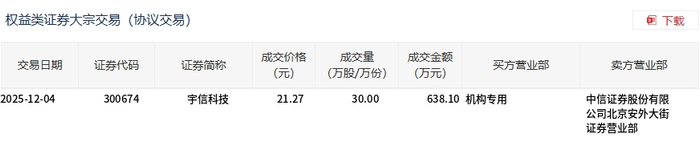
宇信科技今日大宗交易平价成交30万股,成交额638.1万元
Xin Lang Cai Jing· 2025-12-04 09:00
Group 1 - On December 4, Yuxin Technology executed a block trade of 300,000 shares, with a transaction amount of 6.381 million yuan, accounting for 3.95% of the total trading volume for the day [1][2] - The transaction price was 21.27 yuan per share, which remained stable compared to the market closing price of 21.27 yuan [1][2]

宇信科技:已关注到网上不实报道并采取措施
Mei Ri Jing Ji Xin Wen· 2025-12-04 08:39
Core Viewpoint - The company, Yuxin Technology (300674), has acknowledged the existence of false reports regarding online share reductions and has taken relevant measures in response [1] Group 1 - Investors inquired about the management's perspective on the online share reduction behavior [1] - The company has noted the false reports circulating online [1] - Relevant measures have been implemented by the company to address the situation [1]
宇信科技董事长洪卫东应邀出席2025“读懂中国”国际会议,共话金融赋能新质生产力
Xin Lang Cai Jing· 2025-12-03 12:36
Core Insights - The "Understanding China" International Conference was held from November 30 to December 2, 2025, focusing on "New Layout, New Development, New Choices - Chinese-style Modernization and the New Global Governance Pattern" [1][10] - The conference gathered global political leaders, scholars, and industry leaders to discuss the new opportunities presented by Chinese-style modernization [3][13] Company Focus - Yuxin Technology has been dedicated to providing information and digitalization products and services for the Chinese financial industry, particularly banking, for 26 years [6][13] - The company emphasizes the integration of hard technology breakthroughs with soft technology applications to maximize value, aligning with China's advancements in mobile banking and payment systems [6][13] Industry Leadership - Yuxin Technology has played a crucial role in the domestic replacement of core banking technology, assisting major banks in transitioning to fully localized solutions across hardware, software, and applications [6][16] - The company has developed a comprehensive "4+1" ecosystem in the financial technology sector, covering data centers, IaaS, PaaS, SaaS, and compliant financial cloud services [6][16] Future Outlook - Yuxin Technology plans to continue leveraging technological innovation as a core driver for new productivity, focusing on AI, digital operations, and the migration of domestic solutions [10][19] - The company aims to expand its international presence, particularly in Southeast Asia, by sharing its successful financial technology experiences and products [10][19]

本轮回撤超20%,东方财富阶段新低,金融科技ETF(159851)失守年线,“抄底”资金连续介入
Xin Lang Cai Jing· 2025-12-03 11:57
Core Viewpoint - The financial technology sector continues to decline, with the China Securities Financial Technology Theme Index dropping over 2% and breaking below the annual line, indicating a bearish trend in the market [1][6]. Market Performance - The financial technology sector saw a general decline, with most constituent stocks closing in the red, except for Chuangshi Technology and Tax Friend Co., which recorded gains [1][6]. - Dongfang Wealth fell over 1%, reaching a nearly five-month low, down more than 20% from its peak on August 29 [1][6]. - The largest financial technology ETF (159851) also dropped over 2%, hitting a new low in this round of adjustments, with a total trading volume of 474 million yuan [1][6]. Short-term Analysis - The recent poor performance of the financial technology sector is attributed to multiple factors: 1. Daily trading volume in the two markets has remained around 1.6 trillion yuan, which is a contraction from previous highs, leading to tighter market liquidity that suppresses high-volatility sectors [3][8]. 2. Year-end risk aversion has increased, impacting technology stocks that are sensitive to liquidity [3][8]. 3. The technical outlook shows a downward trend in the sector [3][8]. Long-term Investment Opportunities - Long-term investment opportunities in the financial technology sector are expected to arise from two main areas: the financial end and the technology end. - On the financial side, policy support is anticipated to promote high-quality development in the financial industry, with long-term interest rates expected to remain low and the equity market continuing a bullish trend driven by risk appetite [3][9]. - On the technology side, AI is expected to empower the sector, with financial software and computer-related industries likely to see synchronized upward performance in their earnings and technology cycles [3][9]. ETF Focus - It is recommended to pay close attention to the financial technology ETF (159851) and its linked funds (Class A 013477, Class C 013478), which cover a wide range of themes including internet brokerage, financial IT, cross-border payments, AI applications, and Huawei's HarmonyOS [4][10]. - As of December 2, the financial technology ETF (159851) has a scale exceeding 9 billion yuan, with an average daily trading volume of 800 million yuan over the past six months, leading in scale and liquidity among eight ETFs tracking the same index [4][10].


MLOps概念下跌3.32%,5股主力资金净流出超3000万元
Zheng Quan Shi Bao Wang· 2025-12-03 09:08
Group 1 - The MLOps concept has declined by 3.32%, ranking among the top declines in concept sectors, with companies like Transsion Holdings, New Juwang Network, and Oriental Guoxin experiencing significant drops [1][2] - The MLOps sector saw a net outflow of 839 million yuan in main funds today, with 17 stocks experiencing net outflows, and 5 stocks seeing outflows exceeding 30 million yuan [2] - Transsion Holdings led the outflow with a net outflow of 331 million yuan, followed by Runhe Software, Zhongke Chuangda, and Tuolisi with net outflows of 147 million yuan, 143 million yuan, and 47.83 million yuan respectively [2][3] Group 2 - The top gainers in concept sectors included Cultivated Diamonds with a gain of 2.72%, while the Kuaishou concept saw a decline of 3.56% [2] - Other sectors with notable declines included DRG/DIP at -3.21% and Web3.0 at -3.15% [2] - The trading volume for Transsion Holdings was 3.20%, while other companies like Runhe Software and Zhongke Chuangda had turnover rates of 2.81% and 4.70% respectively [2][3]


机器学习因子选股月报(2025年12月)-20251128
Southwest Securities· 2025-11-28 07:02
Quantitative Models and Construction Methods - **Model Name**: GAN_GRU **Model Construction Idea**: The GAN_GRU model combines Generative Adversarial Networks (GAN) for processing volume-price sequential features and Gated Recurrent Unit (GRU) for encoding sequential features to construct a stock selection factor [4][13] **Model Construction Process**: 1. **GRU Model**: - The GRU model is based on 18 volume-price features, including closing price, opening price, trading volume, turnover rate, etc. [14][17][19] - Training data includes the past 400 days of volume-price features for all stocks, with feature sampling every 5 trading days. The feature sampling shape is 40x18, using the past 40 days' features to predict the cumulative return over the next 20 trading days [18] - Data processing includes outlier removal and standardization for each feature in the time series and cross-sectional standardization at the stock level [18] - The model structure includes two GRU layers (GRU(128, 128)) followed by an MLP (256, 64, 64). The final output, predicted return (pRet), is used as the stock selection factor [22] - Training is conducted semi-annually, with training points on June 30 and December 31 each year. The training set and validation set are split in an 80:20 ratio [18] - Hyperparameters: batch_size equals the number of cross-sectional stocks, optimizer is Adam, learning rate is 1e-4, loss function is IC, early stopping rounds are 10, and maximum training rounds are 50 [18] 2. **GAN Model**: - The GAN model consists of a generator (G) and a discriminator (D). The generator learns the real data distribution and generates realistic samples, while the discriminator distinguishes between real and generated data [23][24] - Generator loss function: $$L_{G} = -\mathbb{E}_{z\sim P_{z}(z)}[\log(D(G(z)))]$$ where \(z\) represents random noise, \(G(z)\) is the generated data, and \(D(G(z))\) is the discriminator's output probability for the generated data [24][25] - Discriminator loss function: $$L_{D} = -\mathbb{E}_{x\sim P_{data}(x)}[\log D(x)] - \mathbb{E}_{z\sim P_{z}(z)}[\log(1-D(G(z)))]$$ where \(x\) is real data, \(D(x)\) is the discriminator's output probability for real data, and \(D(G(z))\) is the discriminator's output probability for generated data [27][29] - The generator uses an LSTM model to retain the sequential nature of input features, while the discriminator employs a CNN model to process the two-dimensional volume-price sequential features [33][37] **Model Evaluation**: The GAN_GRU model effectively captures volume-price sequential features and demonstrates strong predictive power for stock selection [4][13][22] Model Backtesting Results - **GAN_GRU Model**: - IC Mean: 0.1131*** - ICIR (non-annualized): 0.90 - Turnover Rate: 0.83 - Recent IC: 0.1241*** - One-Year IC Mean: 0.0867*** - Annualized Return: 37.52% - Annualized Volatility: 23.52% - IR: 1.59 - Maximum Drawdown: 27.29% - Annualized Excess Return: 23.14% [4][41][42] Quantitative Factors and Construction Methods - **Factor Name**: GAN_GRU Factor **Factor Construction Idea**: The GAN_GRU factor is derived from the GAN_GRU model, leveraging GAN for volume-price sequential feature processing and GRU for sequential feature encoding [4][13] **Factor Construction Process**: - The factor is constructed using the predicted return (pRet) output from the GAN_GRU model. The factor undergoes industry and market capitalization neutralization, as well as standardization [22] **Factor Evaluation**: The GAN_GRU factor demonstrates robust performance across various industries and time periods, with significant IC values and excess returns [4][13][41] Factor Backtesting Results - **GAN_GRU Factor**: - IC Mean: 0.1131*** - ICIR (non-annualized): 0.90 - Turnover Rate: 0.83 - Recent IC: 0.1241*** - One-Year IC Mean: 0.0867*** - Annualized Return: 37.52% - Annualized Volatility: 23.52% - IR: 1.59 - Maximum Drawdown: 27.29% - Annualized Excess Return: 23.14% [4][41][42] Industry-Specific Performance - **Recent IC Rankings (Top 5 Industries)**: - Social Services: 0.2198*** - Real Estate: 0.2027*** - Steel: 0.1774*** - Non-Bank Financials: 0.1754*** - Coal: 0.1537*** [4][41][42] - **One-Year IC Mean Rankings (Top 5 Industries)**: - Non-Bank Financials: 0.1401*** - Steel: 0.1367*** - Retail: 0.1152*** - Textiles & Apparel: 0.1124*** - Utilities: 0.1092*** [4][41][42] - **Recent Excess Return Rankings (Top 5 Industries)**: - Environmental Protection: 7.24% - Machinery: 4.37% - Real Estate: 4.03% - Textiles & Apparel: 3.89% - Building Materials: 2.91% [4][45][46] - **One-Year Average Excess Return Rankings (Top 5 Industries)**: - Building Materials: 2.15% - Real Estate: 1.97% - Social Services: 1.77% - Textiles & Apparel: 1.71% - Retail: 1.62% [4][45][46]
金融科技2026年投资策略 - 短期看市场活跃的持续性,中期关注金融IT
2025-11-26 14:15
Summary of Financial Technology Conference Call Industry Overview - The financial technology sector is experiencing positive policy guidance aimed at promoting high-quality development and technological investment across banking, insurance, and brokerage industries, providing long-term investment value assurance for related companies [1][18] Key Insights and Arguments - Financial IT investment continues to grow, although the growth rate is slowing down. The B-end of the securities IT sector is dominated by companies like Hang Seng, Vertex, and Jinzheng, while the C-end is led by Tonghuashun and Wealth Trend. Tonghuashun has begun to develop AI systems, but the revenue contribution is still small [1][4][5] - The financial technology index has outperformed the broader market, with Tonghuashun, Wealth Trend, and Oriental Fortune showing significant price increases. Stock prices are highly correlated with market trading activity, necessitating attention to new account openings and average daily transaction volume [1][8] - Short-term focus should be on changes in market share for Oriental Fortune's brokerage and margin financing businesses, while long-term attention should be on AI product development. The impact of fee policy adjustments on fund distribution business is limited, with overall adverse factors largely eliminated [1][9] Company-Specific Highlights - **Oriental Fortune**: Achieved significant results through a multi-license and multi-traffic ecosystem model. Short-term focus on market share changes in brokerage and margin financing, and long-term focus on AI product development [6][9] - **Tonghuashun**: Short-term performance elasticity is mainly reflected in C-end advertising and internet promotion, with significant year-on-year growth. The company assists financial institutions in generating revenue [6][10][12] - **Wealth Trend**: Relies on historical high-quality traffic and license acquisitions for monetization [6] - **Vertex and Ninefang**: Both depend on market activity for product sales growth, with a long-term focus on license monetization [12] Market Performance and Valuation - As of November 13, 2025, the financial technology index has increased by 74%, significantly outperforming the Wind All A Index (42%) and the CSI 300 Index (39%). Notable stock price increases were observed in Tonghuashun (27%), Wealth Trend (38%), and Oriental Fortune (approximately 5%) [8] - The financial technology sector's PE valuation is approximately 66 times, higher than the historical percentile of 14%. Leading companies like Oriental Fortune and Hang Seng have lower volatility in valuations, while others like Wealth Trend and Vertex show mixed valuation percentiles [16] Recommendations - Recommended companies for investment include Oriental Fortune, Wealth Trend, Hang Seng, Vertex, Changliang Technology, Yuxin Technology, and Jinzheng. These companies have strong fundamentals and configuration value, with steady growth opportunities from the ongoing promotion of Xinchuang [2][17] - Long-term investment opportunities in B-end IT companies include Hang Seng, Vertex, Changliang Technology, Yuxin Technology, and Jinzheng, all showing improving fundamentals and growth potential [21] Policy Impact - Financial technology policies from 2021 to 2025 cover multiple sectors, promoting high-quality development and encouraging investment in financial technology, which is expected to positively influence the industry's development [18] Development Directions for Financial IT Companies - Broker IT focuses on production system construction and AI system updates for new revenue. Internet finance should prioritize traffic acquisition and product license monetization, while bank IT needs to meet diverse customer service demands and focus on overseas orders [19]





专题研究:《再论股债同向:国债期货与权益市场关系进入新阶段》
GUOTAI HAITONG SECURITIES· 2025-11-26 12:25
Group 1: Fixed Income Research - The recent correlation between government bond futures and equity markets indicates a new phase, moving beyond the previous simple "see-saw" logic [3][4] - As of November 21, the 10-day correlation between TL contracts and the CSI 300 index has significantly increased to a historical high since July 2025, suggesting a complex relationship [3][4] - The future dynamics of government bond futures are expected to be influenced by equity market movements, indicating a potential for better resilience in bond futures if growth expectations change [4] Group 2: Computer Industry Research - The release of DeepSeek R1 in 2025 is anticipated to significantly enhance general model reasoning capabilities and reduce costs, marking a turning point for AI deployment in financial institutions [5][6] - AI applications are rapidly penetrating core business and back-office scenarios in various financial institutions, aiming to optimize internal operations and enhance external value [6][7] - Large financial institutions are focusing on private deployment of large models, while smaller institutions are pursuing cost-effective solutions for agile development [8] Group 3: Investment Recommendations - Recommended stocks in financial information services include Tonghuashun and Jiufang Zhitu Holdings, while third-party payment recommendations include Newland and New Guodu [6][7] - In the banking IT sector, recommended stocks include Yuxin Technology and Jingbeifang, with additional recommendations in securities IT and insurance IT sectors [7][8]
“AI+金融”系列专题研究(二):应用场景打开,AI助推金融机构内部效率与外部价值双升
Haitong Securities International· 2025-11-25 14:02
Investment Rating - The report suggests a positive investment outlook for the AI and financial services sector, highlighting the potential for significant advancements and cost reductions due to the release of DeepSeek R1 in 2025, which is expected to be a turning point for localized AI deployment in financial institutions [7]. Core Insights - AI applications are rapidly penetrating core business areas and back-office functions of various financial institutions, enhancing both internal efficiency and external value [1][7]. - The report identifies that most financial institutions are currently in the exploration and accumulation phase of AI application, with deep application being an inevitable trend [14]. - AI is expected to transform financial business processes and organizational structures, ushering in a new era of digital intelligence in finance [7]. Summary by Sections Investment Recommendations - The report recommends focusing on several sectors within the financial industry, including: 1. Financial information services with key stocks like Tonghuashun, Jiufang Zhitu Holdings, and Guiding Compass [8]. 2. Third-party payment services, recommending stocks such as Newland and Newguodu, with related stocks like Lakala [9]. 3. Banking IT, with recommended stocks including Yuxin Technology, Jingbeifang, and Guodian Yuntong [9]. 4. Securities IT, recommending stocks like Hengsheng Electronics and Jinzhen Shares [10]. 5. Insurance IT, with recommended stocks including Xinzhi Software and Zhongke Software [11]. Application Stages - Financial institutions' AI applications are categorized into three stages: 1. Initial exploration of large model applications. 2. Development of certain model application capabilities with data accumulation. 3. Achieving deep application of large models [14]. Application Value - AI applications provide value through: 1. Internal cost reduction and efficiency improvement, optimizing operational management and core business processes [21]. 2. External value extraction, enhancing marketing and customer service to improve sales conversion and customer value [21]. Application Pathways - Different types of financial institutions exhibit varied pathways for AI application deployment: 1. Large institutions leverage strong self-research capabilities for deep AI application penetration. 2. Smaller institutions focus on cost-effective solutions, utilizing lightweight models and integrated systems for agile development [26]. AI Empowerment in Banking - AI is enhancing front-office quality and efficiency, optimizing back-office processes across various banking functions [43]. - In credit risk management, AI models can analyze financial data to identify potential risks and improve decision-making processes [47]. AI Empowerment in Securities - The number of securities firms exploring large models is rapidly increasing, with applications extending across various business functions, including investment advisory and research [58][59].