SpaceX

Search documents
上市第二年业绩“开倒车”,拉普拉斯营收净利双降
Shen Zhen Shang Bao· 2026-02-27 04:04
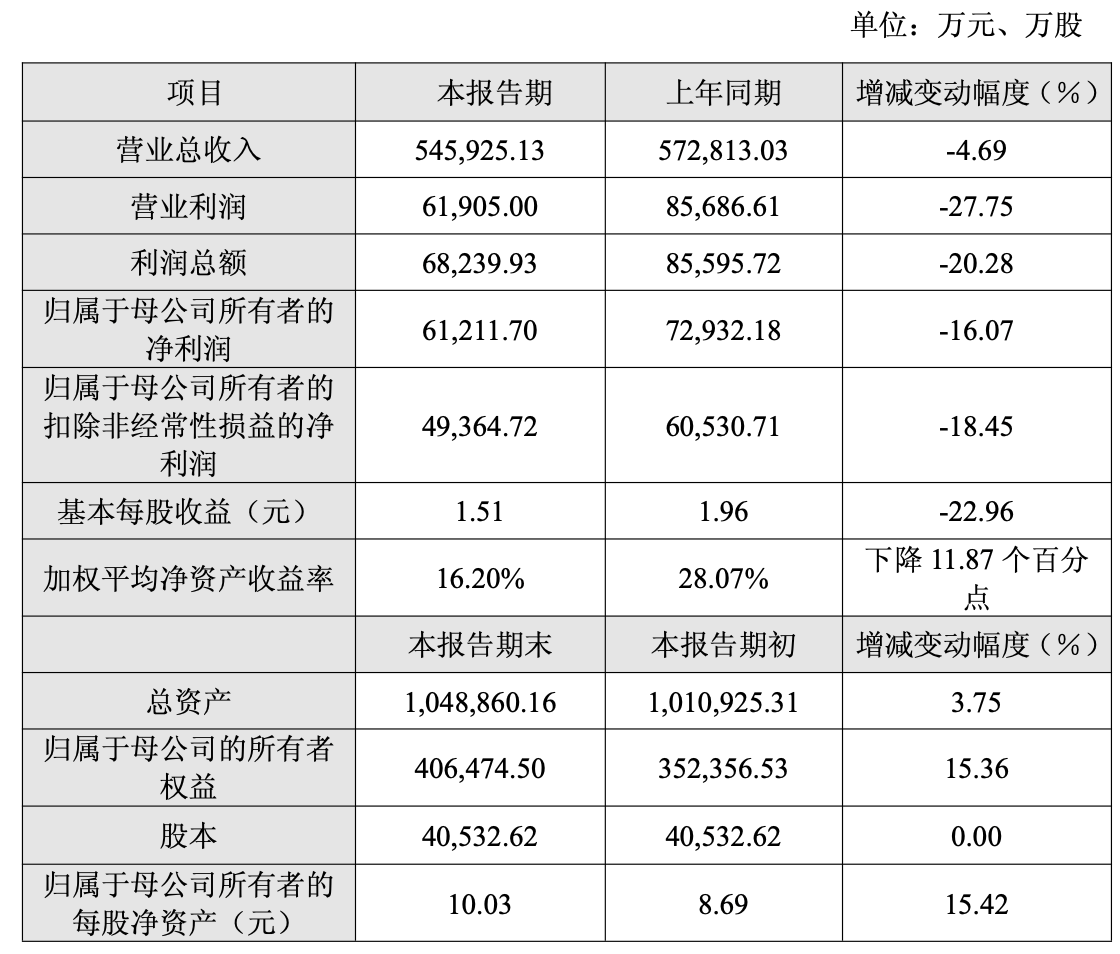
Core Viewpoint - The financial performance of Laplace in 2025 reflects a significant downturn in both revenue and profit, highlighting the challenges faced by the photovoltaic industry amid a phase of supply-demand imbalance [1][5]. Financial Performance Summary - The company reported total revenue of 5.46 billion yuan, a decrease of 4.69% compared to the previous year [3]. - Net profit attributable to shareholders was 612 million yuan, down 16.07% year-on-year [3]. - The net profit excluding non-recurring gains and losses was 494 million yuan, representing an 18.45% decline [3]. - Basic earnings per share were 1.51 yuan, reflecting a decrease of 22.96% [3]. - The weighted average return on equity (ROE) fell from 28.07% to 16.20%, a drop of 11.87 percentage points [6]. Operational Context - The company acknowledged that its revenue and profits were under pressure due to the supply-demand imbalance in the photovoltaic industry [6]. - Despite the challenges, the company is actively advancing its technology and product competitiveness in areas such as TOPCon, XBC, perovskite, and tandem solar cells [6]. - The company is also focusing on research and application in semiconductor equipment, aiming for breakthroughs in integrated circuit fields [6]. Market Position and Future Outlook - Laplace specializes in the research, production, and sales of high-performance thermal processing, coating, and automation equipment for photovoltaic cells [7]. - The company is monitoring trends in downstream applications and is committed to supporting innovation and market expansion for photovoltaic technology [7]. - The potential of "space photovoltaics" is still in the exploratory stage, with significant uncertainties affecting its industrialization process [8].

上市公司蹭太空光伏“贴金” 监管密集亮剑后“凉凉”
Xin Jing Bao· 2026-02-27 03:29
Core Viewpoint - The article discusses the recent surge in interest around the "space photovoltaic" concept, driven by Elon Musk's statements, and highlights the regulatory scrutiny faced by companies attempting to capitalize on this trend through misleading disclosures [1][2]. Group 1: Regulatory Actions - Several companies in the photovoltaic and lithium battery sectors have received regulatory warnings for improper disclosures since February, including Shuangliang Energy and Trina Solar, which were cautioned for misleading statements regarding partnerships with SpaceX [1][2]. - The Shanghai Stock Exchange emphasized the need for accurate and complete information disclosure, particularly when companies are attempting to associate themselves with high-profile projects like those of SpaceX [4]. Group 2: Market Reactions - Following Musk's endorsement of "space photovoltaics," the photovoltaic sector saw a significant market reaction, with a total market capitalization increase of 178.5 billion yuan for 98 companies on January 23 [2]. - However, after regulatory warnings, companies like Shuangliang Energy experienced sharp declines in stock prices, with a drop of approximately 0.11% in revenue impact from a reported order [3]. Group 3: Investor Guidance - Investors are advised to critically assess the credibility of claims made by companies regarding their involvement in high-profile projects, focusing on the availability of objective evidence to support such claims [7]. - The article suggests that investors should evaluate the alignment between a company's current capabilities and its ambitious narratives, particularly in light of the recent trend of companies leveraging popular concepts like commercial space travel and AI [7]. Group 4: Corporate Governance - The article stresses that effective market value management should prioritize compliance and value creation over mere stock price manipulation, urging companies to enhance governance and profitability before engaging in promotional activities [8].


太空光伏概念爆发!钧达股份、金开新能等涨停,光伏ETF汇添富(516290)拉升涨超1%,轻松反包昨日跌幅!太空光伏逐步走向产业化落地
Sou Hu Cai Jing· 2026-02-27 03:03
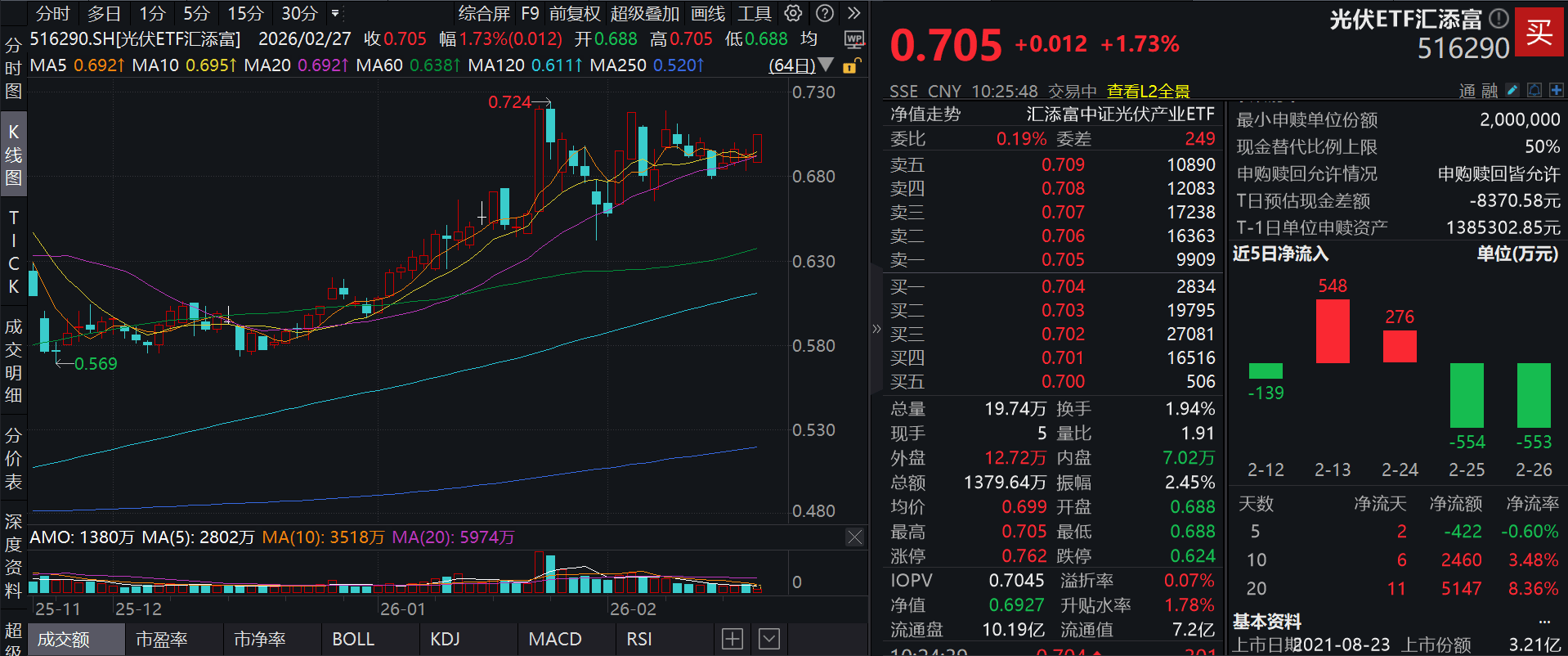
Group 1 - The core viewpoint of the news is that China's new generation solar cell research has made significant progress, achieving a power conversion efficiency of over 15% for copper zinc tin sulfur selenium-based solar cells, marking a leading position in the world [1] - The research team from the Chinese Academy of Sciences has proposed a new mechanism to control metal ion migration during the phase transition process, which aids in grain phase growth [1] - The global demand for computing power is increasing, and space computing is emerging as a new application scenario for satellites, with space photovoltaics expected to provide several times the power generation compared to ground systems [1] Group 2 - The market potential for solar photovoltaic equipment is projected to reach hundreds of billions, driven by the expansion plans of companies like SpaceX, which aims to establish 100GW of solar capacity in the U.S. within 3-4 years [2] - The competitive landscape is expected to remain concentrated, with leading manufacturers likely to benefit first from the growing market [2] - The sentiment in the photovoltaic sector is anticipated to improve due to the combination of new technologies and the emergence of space photovoltaics as a catalyst [5] Group 3 - The ETF Huatai-PineBridge (516290) has seen significant increases in its constituent stocks, with notable rises such as 12.39% for Juhua Materials and 10.00% for Junda Co [3] - The management fee for the Huatai-PineBridge ETF is 0.15%, which is significantly lower than the market average, making it an attractive option for investors [5]

四大利好驱动,商业航天概念活跃丨盘中线索
2 1 Shi Ji Jing Ji Bao Dao· 2026-02-27 02:40
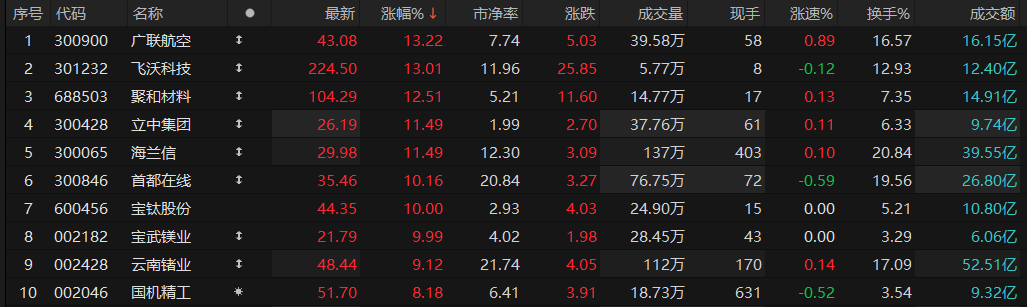
Group 1 - The commercial aerospace sector is experiencing a resurgence driven by four main advantages: policy support, capital influx, industry activity, and technological breakthroughs [1][2] - Policy support is evident as over 20 provinces in China have mentioned plans for commercial aerospace industries during local meetings, with expectations for further emphasis during the upcoming national meetings [1] - Capital influx is highlighted by significant financing events, including a record 5.037 billion yuan raised by Space Honor in its D++ round, indicating a growing recognition of the commercial aerospace sector [1] - The industry is witnessing increased activity with the completion of the main structure of the Hainan commercial aerospace launch site, which is expected to have a launch capacity of 60 per year by the end of the year [1][2] Group 2 - Technological advancements are leading to a peak in domestic commercial aerospace launches, with multiple reusable rockets scheduled for launch in March [2] - The market for commercial aerospace is expanding, prompting a "recommended" rating from Huolong Securities, which suggests focusing on specific companies in rocket launching, satellite manufacturing, and satellite applications [2] - On February 27, stocks related to commercial aerospace, such as Guanglian Aviation and Feiwo Technology, saw significant gains, indicating strong market interest [3]




未知机构:华泰电新特朗普召集科技巨头签署电力成本承诺重申燃气轮机推荐观点特朗普计-20260227
未知机构· 2026-02-27 02:25
Summary of Conference Call Records Industry Overview - The records focus on the **gas turbine industry** and its growth prospects, particularly in the **North American market** driven by increasing demand from data centers and power supply challenges [1][2]. Key Points and Arguments - **Trump's Initiative**: Trump plans to gather major tech companies like Amazon, Meta, Microsoft, and Google to sign a commitment to cover the electricity costs of their high-energy data centers, reinforcing the ongoing demand surge for data centers and the resulting power shortages in North America [1]. - **Gas Turbine Demand Growth**: The U.S. leads global gas turbine demand growth, with light gas and internal combustion engines emerging as diversified primary power solutions. According to McCoy, global gas turbine new orders reached **34 GW** in Q4 2025, reflecting a **134% year-on-year increase** and a **42% quarter-on-quarter increase**. The total for 2025 is projected at **100 GW**, a **75% increase** year-on-year, surpassing initial expectations of **60-80 GW** [1]. - **Market Performance**: The U.S. market is experiencing a **159% year-on-year growth**, accounting for **44%** of global orders. The contribution from data centers to Siemens Energy's gas turbine agreements has increased significantly, with data centers now contributing over **25%**, a rise of **9.5 percentage points** from Q3 2025 [2]. - **Future Projections**: The global gas turbine new orders are expected to maintain double-digit year-on-year growth in 2026. Siemens Energy anticipates a **38% increase** in new orders to **36 GW**, while GEV has **43 GW** in booked agreements, which could translate to a **44% increase** in new orders for 2026 if fully converted [2]. Investment Themes - **Main Investment Lines**: - **Overseas Gas Turbine Volume and Price Increase**: Overseas manufacturers are fully booked until the end of 2029, with expected order growth as capacity is released. Key companies include ENR and GEV [2]. - **Domestic Supply Chain Expansion**: There is a growing tension in supply chain bottlenecks, particularly in hot-end blades. Companies like Yingliu and Wanze are highlighted as relevant players in this space [2]. - **Demand Overflow**: The demand overflow trend is expected to strengthen in the short term due to a **30%+ supply-demand gap**. Domestic light gas turbines have achieved self-sufficiency in intellectual property and hot component supply, indicating a positive outlook for domestic gas turbines entering overseas markets. Companies such as Dongfang Electric, Hailianxun, Weichai Power, and others are noted as key players [3]. Additional Important Insights - The records emphasize the critical role of gas turbines in addressing power shortages and the potential for domestic manufacturers to expand internationally, particularly in light of the increasing reliance on gas turbines for power generation [3].
今日起更名生效!火箭密集发射季,资金大举流入卫星ETF招商(159218)
Sou Hu Cai Jing· 2026-02-27 02:17
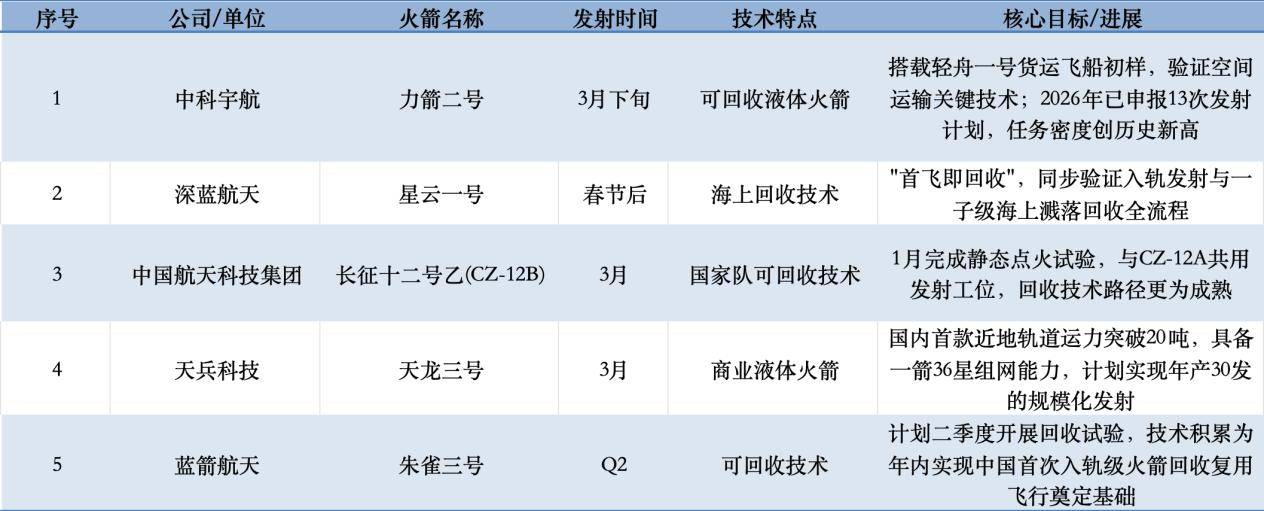
Core Viewpoint - The Chinese commercial space market is experiencing significant growth, with multiple companies preparing for IPOs and advancements in reusable rocket technology, indicating a shift from concept validation to large-scale implementation [1] Group 1: Market Dynamics - The first satellite industry ETF in the market has been renamed to "Satellite ETF Zhaoshang (159218)" and has seen over 200 million yuan net inflow in the past five days, reflecting increasing market interest [1] - A rare "rocket launch season" is expected in March, with at least six new rockets scheduled for launch globally, marking a critical transition in the space industry from experimental validation to large-scale application [1][2] Group 2: Reusable Rocket Technology - Reusable rockets are entering a critical phase in China, with a dual-drive model involving both state-owned and private enterprises expected to launch five rockets around March [2] - The economic value of reusable technology is highlighted by the cost reduction of SpaceX's Falcon 9 rocket, where the launch cost drops from $50 million to $20 million through booster reuse, achieving a 60% reduction [4] - The cost per kilogram to orbit can decrease by over 70% with multiple reuses of boosters, making reusable rockets essential for competitive positioning in the global low Earth orbit market [5] Group 3: Satellite Industry Evolution - The global satellite industry is undergoing a transformation, with accelerated network deployment and expanded application scenarios, transitioning from a focus on communication to becoming a "distributed space cloud server" [6] - By 2026, China is expected to enter a high-frequency satellite internet deployment phase, with significant projects like the Thousand Sails and GW constellations [6] - The satellite internet industry in China is projected to grow from approximately 28 billion yuan in 2023 to over 51.6 billion yuan by 2028, indicating a shift in the value chain towards operational services and data applications [6] Group 4: Investment Perspective - The successful commercialization of reusable rockets is anticipated to create a positive feedback loop in the satellite industry, with launch costs dropping below $20 million enabling the economic viability of low Earth orbit satellite constellations [7] - The Satellite ETF Zhaoshang (159218) covers the entire satellite industry chain, including manufacturing, launch, ground equipment, and operational services, aligning with the current development phase of the industry [8]
港股异动 | 钧达股份(02865)一度涨超14% 机构看好太空光伏打造新增长空间
智通财经网· 2026-02-27 01:57
Group 1 - The core viewpoint of the article highlights the significant rise in the stock price of JunDa Co., which increased by over 14% and is currently trading at 35.86 HKD, with a transaction volume of 329 million HKD [1] - SpaceX is reportedly building a 100GW-level photovoltaic capacity in the United States, expected to be completed in 3-4 years, with major players like Blue Origin, Google, and companies from China, Japan, and Europe also entering the market [1] - GF Securities indicates that the consensus on "computing power in space" is driving the space photovoltaic sector, which is expected to benefit significantly, potentially creating a market space worth hundreds of billions for photovoltaic equipment [1] Group 2 - Shenwan Hongyuan believes that the global construction of low-orbit satellite constellations and the space computing power industry are in an explosive growth phase, leading to a pressing demand for low-cost, high-efficiency, and lightweight energy solutions [1] - The company has previously collaborated with Shanghai Institute of Optics and Fine Mechanics, now known as Xingyi Chip Energy, to develop core technologies such as silicon/calcium titanate stacked batteries and CPI films, which are expected to replace the current mainstream gallium arsenide solutions and break through cost barriers [1] - This sector has high technical barriers and clear market space, independent of the terrestrial photovoltaic industry cycle, which is expected to open new high-margin growth opportunities for the company [1]

马斯克最新发言惊吓所有家长:你们孩子未来可能要没工作了!
Sou Hu Cai Jing· 2026-02-27 00:23
Group 1 - Elon Musk made a rare appearance at the Davos Forum, discussing the potential explosive growth of the global economy due to nearly free AI and ubiquitous robots [2][4] - Musk predicts that AI will surpass human intelligence by the end of 2026, and Tesla's humanoid robot, Optimus, is expected to be available for public sale by the end of 2027 [4][6] - The Optimus robot is currently performing simple tasks in Tesla factories and is expected to handle more complex industrial tasks by the end of this year, with a public launch planned for next year [6][7] Group 2 - Musk emphasized that the commercial path for Optimus includes high reliability, safety, and a wide range of functions, with future applications extending to childcare and elder care [6][8] - Tesla's Full Self-Driving (FSD) technology is described as a solved problem, with plans to widely promote the Robotaxi service in the U.S. by the end of this year [7] - Musk stated that a solar panel area of 100 square miles could power the entire U.S., and both SpaceX and Tesla are working on significant solar manufacturing capacity [8]