
舜宇光学科技

Search documents
嘉实基金旗下嘉实前沿科技沪港深股票C一季度末规模2.65亿元,环比增加2478.21%
Jin Rong Jie· 2025-04-24 09:32
截至2025年3月31日,嘉实基金旗下嘉实前沿科技沪港深股票C(020315)期末净资产2.65亿元,比上期 增加2478.21%,该基金经理为王贵重。 简历显示,王贵重先生:博士研究生,曾任上海重阳投资管理股份有限公司TMT行业研究员。2015年7月 加入嘉实基金管理有限公司,历任TMT行业研究员、科技组组长,现任大科技研究总监。2019年5月7日至 今任嘉实科技创新混合型证券投资基金基金经理,2020年8月21日至今任嘉实文体娱乐股票型证券投资基 金基金经理,2021年2月10日至今担任嘉实创业板两年定期开放混合型证券投资基金基金经理。2022年1 月22日担任嘉实前沿科技沪港深股票型证券投资基金、嘉实前沿创新混合型证券投资基金基金经理。 2023年11月16日担任嘉实创新先锋混合型证券投资基金基金经理。 近期份额规模变动情况: 日期期间申购(亿份)期间赎回(亿份)期末总份额(亿份)期末净资产(亿元)净资产变动率2025- 03-310.000.000.020.02-2.54%2024-12-310.000.020.020.02-47.96%2024-09-300.000.020.040.04-27.77 ...
告别英伟达依赖,车企换“芯”潮来了
投中网· 2025-04-24 06:29
以下文章来源于豹变 ,作者朱晓宇 豹变 . 直抵核心。做最具穿透力、洞察力的商业观察,深度影响未来。 将投中网设为"星标⭐",第一时间收获最新推送 国产芯片打响"抢位赛"。 作者丨 朱晓宇 编辑丨 邢昀 来源丨 豹变 时隔三个月,英伟达创始人 黄仁勋紧急访华。与今年 1 月春节期间的常规行程有所不同,在对等关税的进一步升级下,英伟达针对中国大陆市场推出 的 H 20 芯片也被进一步限制出口, 股价暴跌, 黄仁勋急需找到中国市场的突破口。 重要性之高,连黄仁勋最爱的皮衣都换成了西装。 黄仁勋在会谈中表示,中国是英伟达非常重要的市场,希望继续与中国合作。 英伟达作为全球 AI 算力芯片的龙头,在 美国禁令 发布后遭受重创,黄仁勋的紧急访华行程背后,折射出全球芯片产业被改写的格局。 其中, 中国加速国产 芯片 替代 成为趋势。尤其是车规级芯片方面,曾经依赖美国进口芯片的上下游产业链,正在紧急寻找更稳妥的替代方案,甩掉美 国标签,更高比例的国产化芯片成为整车厂的核心诉求。也正是在这轮操作的刺激下, 国产车规级芯片正在迎来询价需求的大爆发。 国内一家生产高低边驱动控制器芯片的公司向《豹变》透露,美国的芯片出口管制给中国 ...
亚太市场,开盘普涨
Zheng Quan Shi Bao· 2025-04-23 02:01
Market Performance - The Hang Seng Index opened with a gain of 2.4%, while the Hang Seng Tech Index rose by 3.5% [1] - Notable stocks such as BYD Electronics and BYD Company saw increases of over 6%, while Alibaba and Xiaomi Group rose by more than 5% [1] - Other stocks like Pop Mart, Xpeng Motors, and Bilibili also experienced gains exceeding 4% [1] Stock Details - BYD Electronics reached a price of 35.000 with a rise of 6.22% [2] - BYD Company was priced at 399.000, increasing by 6.17% [2] - Alibaba's stock price was 116.400, up by 5.82%, and Xiaomi Group was at 46.750, up by 5.29% [2] - Other notable stocks included Sunny Optical Technology at 65,800 (+4.61%) and Pop Mart at 184.000 (+4.60%) [2] A-share Market - The A-share market also opened positively, with the Shanghai Composite Index up by 0.25%, the Shenzhen Component Index up by 0.87%, and the ChiNext Index up by 1.14% [3] - Approximately 3,500 stocks in the market were in the green at the opening [3] Analyst Insights - Goldman Sachs issued a report rating A-shares and H-shares as "outperform," citing favorable policy stimuli for A-shares [5] - The firm anticipates a 12% upside for the MSCI China Index and a 15% upside for the CSI 300 Index over the next 12 months [5] - The report highlighted that the current P/E ratio for Hong Kong stocks is around 10 times, significantly lower than that of U.S. stocks, making them attractive [5] Sector Recommendations - According to a report by China Merchants Securities, key sectors to focus on include those with low exposure to U.S. export risks, such as PCB, rare earths, and home appliances [5] - The report also emphasizes areas of domestic substitution, including semiconductor equipment and high-end medical devices [5] - Consumer sectors with growth potential, such as gaming, animation, and pet food, are also recommended [5]




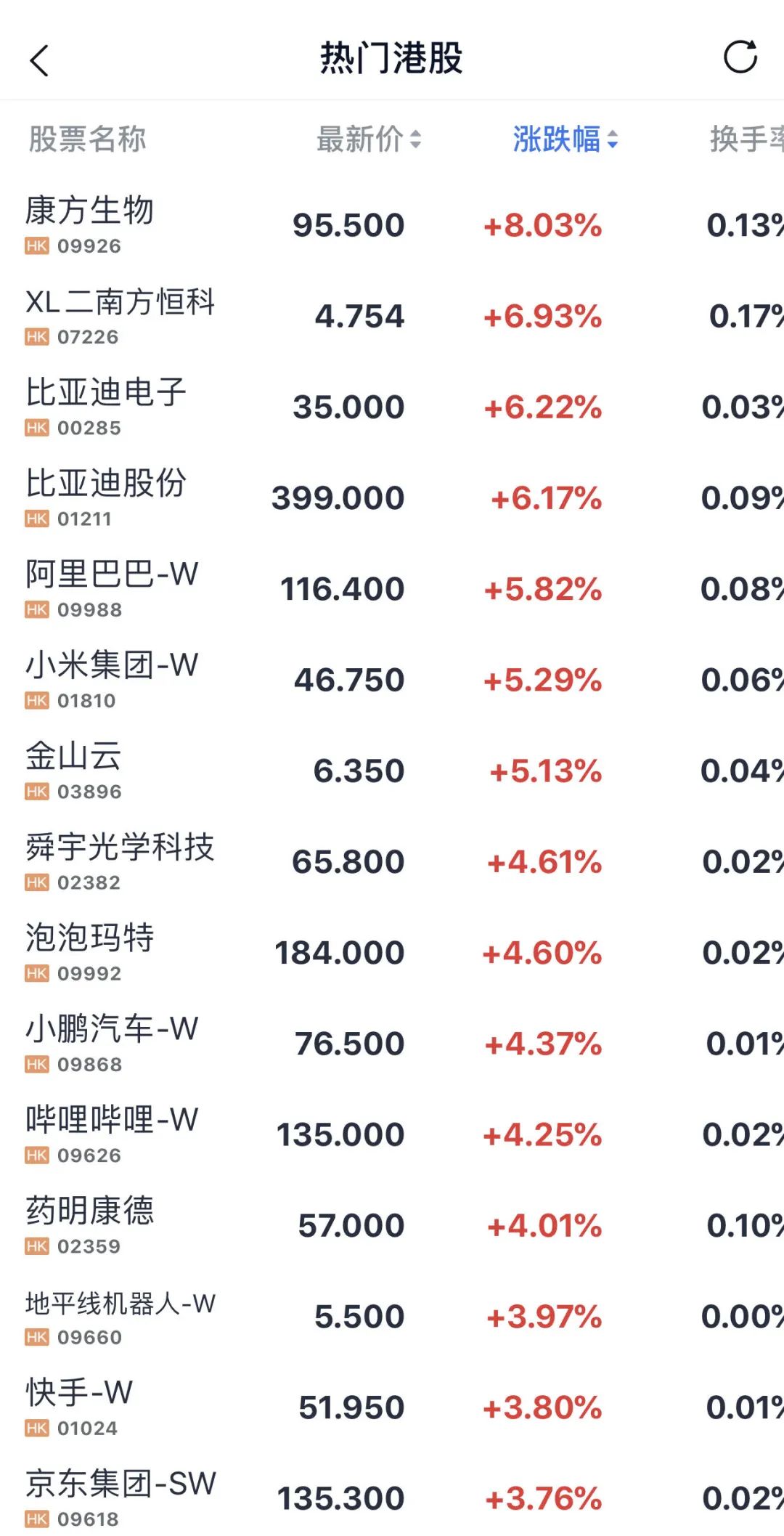
亚太市场,开盘普涨!
证券时报· 2025-04-23 01:55
开盘普涨。 4月23日,香港恒生指数开盘涨2.4%,恒生科技指数涨3.5%。 热门港股方面,比亚迪电子、比亚迪股份涨超6%,阿里巴巴、小米集团涨超5%,泡泡玛特、小鹏汽 车、哔哩哔哩等涨超4%。 | < | 热门港股 | | C | | --- | --- | --- | --- | | 股票名称 | 最新价 : : 涨跌幅 : | | 换手臂 | | 康方生物 | 95.500 +8.03% | | 0.13% | | HK 09926 | | | | | XL二南方恒科 | 4.754 +6.93% | | 0.179 | | HK 07226 | | | | | 比亚迪电子 | 35.000 +6.22% | | 0.03% | | HK 00285 | | | | | 比亚迪股份 | 399.000 +6.17% | | 0.09% | | HK 01211 | | | | | 阿里巴巴-W | 116.400 +5.82% === | | 0.08% | | HK 09988 | | | | | 小米集团-W | 46.750 | +5.29% | 0.069 | | HK 01810 | | | ...

这三个国家,正在缓解中国外贸的“焦虑”
吴晓波频道· 2025-04-22 16:04
点击图片▲立即试听 上周,最高领导人连续走访越南、马来西亚、柬埔寨三个东南亚国家。 财经评论员刘晓博撰文指出:当前, 重点实施"周边战略",跟欧洲形成关税联盟,再加上非洲战略、南美战略,中国就可以稳住外贸基本盘,还 可以有所增长。 对中国企业家而言,这也是一次企业转向"生而全球"的好契机。 以上述东南亚三国为例,走访期间,双方总共签署超过105份双边合作文件,在当前国际秩序和经济全球化遭受冲击的背景下,此次的"商业订单 大礼包"可以说是给中国企业出海找了三个"铁杆队友"。 武汉阳逻港通往越南凯莱港的航线 其中,越南45份,涵盖互联互通、人工智能、海关检验检疫、农产品贸易、文化和体育、民生、人力资源开发等领域。 " 这既是一场 ' 用空间换时间 ' 的战略布局,更是一次 ' 以合作破壁垒 ' 的全球突围。 " 文 / 巴九灵(微信公众号:吴晓波频道) 关税战下,"元首外交"成了关注焦点。 马来西亚和柬埔寨,均为30多份,前者涵盖数字经济、服务贸易、"两国双园"升级发展、联合实验室、铁路、知识产权、农产品输华、大熊猫保 护等领域;后者涉及产供链合作、人工智能、发展援助、海关检验检疫、卫生、新闻等领域。 为什么优先 ...
智立方:一季度营业收入同比增长近一倍,加速布局新赛道
Zheng Quan Shi Bao Wang· 2025-04-21 07:49
Group 1 - The company reported a revenue of 161 million yuan for Q1 2025, representing a year-on-year growth of 98.78%, and achieved a net profit of 249.05 million yuan, marking a turnaround from losses [1] - The core business focuses on two main sectors: semiconductors and electronic products, with successful launches of various intelligent manufacturing equipment in the semiconductor field [1] - The company has established relationships with several leading clients in the semiconductor and optical communication equipment sectors, including major global electronics manufacturers [1] Group 2 - The chairman stated that 2025 will be a year of deep transformation for the company, aiming to enhance competitiveness in existing sectors while exploring new ones, particularly leveraging AI-driven opportunities [2] - The company plans to expand its product offerings in the display semiconductor and optical communication sectors, moving from key equipment for Mini LED chips to packaging processes for Mini/Micro LED [2] - The company aims to build a vertically integrated development model by extending its core technologies in sorting and die bonding to various applications across different industries [2]
指数基金投资+:被动外资增持港股,推荐关注通信ETF
Huaxin Securities· 2025-04-21 07:32
- The "XinXuan ETF Absolute Return Strategy" aims to achieve both absolute returns and long-term relative returns compared to A-share equities by selecting ETFs from the XinXuan ETF pool. The strategy uses a "drawer method" to test equity ETFs in the market. Over the past three years, the strategy achieved an annualized return of 14.23%, a maximum drawdown of 8.6%, and a Sharpe ratio of 1.44. From the beginning of 2024 to the present, the total return of the XinXuan ETF portfolio is 29.91%, with an excess return of 19.67% compared to equal-weighted ETFs. The Sharpe ratio is 1.18, the maximum drawdown is 6.3%, the volatility is 18.14%, and the Calmar ratio is 3.71. The best-performing ETF in the portfolio during this period is the ChiNext ETF, with a holding period return of 40.69%[11][12] - The "All-Weather Multi-Asset Multi-Strategy ETF Risk Parity Strategy" combines industry rotation, style rotation, and size rotation strategies to enhance the precision of ETF usage and maximize returns. It employs a risk parity approach to reduce overall portfolio volatility by effectively diversifying assets across different asset classes and strategies. The portfolio includes commodities (e.g., gold ETFs), U.S. equities (e.g., S&P 500 ETFs), domestic equities (e.g., industry/style/size rotation), and domestic bonds (e.g., 10-year and 30-year government bond ETFs). From the beginning of 2024 to the present, the strategy achieved a return of 17.51%, a maximum drawdown of 3.62%, a volatility of 4.5%, and a Sharpe ratio of 2.45[14][16][17] - The "China-U.S. Core Asset Portfolio" integrates four strong-trend assets: Baijiu, dividend, gold, and Nasdaq ETFs. It combines the RSRS timing strategy for trend-following markets and technical reversal strategies to form a portfolio. From 2015 to the present, the annualized return of the portfolio is 33.77%, with an excess return of 14.19% compared to equal-weighted indices. The Sharpe ratio is 1.63, the maximum drawdown is 18.23%, and the volatility is 17.91%. The latest holding includes gold ETFs[20] - The "High Prosperity/Dividend Rotation Strategy" alternates between high-growth and dividend strategies based on signals. When the signal indicates high growth, the portfolio includes 50% ChiNext ETFs and 50% STAR 50 ETFs. When the signal indicates dividends, the portfolio includes 50% low-volatility dividend ETFs and 50% central enterprise dividend 50 ETFs. From the beginning of 2021 to the present, the annualized return of the strategy is 19.01%, with an excess return of 22.13% compared to equal-weighted indices. The Sharpe ratio is 0.85, the maximum drawdown is 22.91%, and the volatility is 24.43%. The latest holdings include low-volatility dividend ETFs and central enterprise dividend 50 ETFs (60% combined), as well as ChiNext ETFs and STAR 50 ETFs (40% combined)[23] - The "Dual Bond LOF Enhanced Strategy" adjusts the weights of bond-heavy portfolios and other products to ensure a higher proportion of bonds. The strategy uses the volatility of weekly returns to normalize weights, with bonds typically having lower volatility, thus increasing their weight. From 2019 to the present, the annualized return of the strategy is 6.81%, the Sharpe ratio is 2.55, the maximum drawdown is 2.42%, and the volatility is 2.58%, all outperforming the dual bond LOF benchmark[26] - The "Structured Risk Parity Strategy (QDII)" replaces the XinXuan ETF pool with a strategy pool that includes QDII products, domestic long-term bond ETFs, gold, and domestic dividend ETFs. From the beginning of 2024 to the present, the strategy achieved a return of 22.27%, a maximum drawdown of 2.38%, a volatility of 4.85, and a Sharpe ratio of 2.93[27][29] - **Backtest Results for Strategies** - XinXuan Technical Quantitative Strategy: Total return 29.91%, annualized return 23.33%, maximum drawdown -6.30%, volatility 18.11%, Sharpe ratio 1.13[32] - High Prosperity/Dividend Rotation Strategy: Total return 45.11%, annualized return 34.76%, maximum drawdown -22.04%, volatility 35.90%, Sharpe ratio 0.94[32] - China-U.S. Core Asset Portfolio: Total return 53.79%, annualized return 41.19%, maximum drawdown -10.86%, volatility 17.52%, Sharpe ratio 1.94[32] - Dual Bond Enhanced Strategy: Total return 8.64%, annualized return 6.86%, maximum drawdown -2.26%, volatility 3.51%, Sharpe ratio 1.34[32] - Structured Risk Parity Strategy (QDII): Total return 22.27%, annualized return 17.48%, maximum drawdown -2.38%, volatility 4.85, Sharpe ratio 2.93[32] - All-Weather Multi-Asset Risk Parity Strategy: Total return 17.51%, annualized return 13.80%, maximum drawdown -3.62%, volatility 4.50, Sharpe ratio 2.45[32]
港股收盘(04.16) | 恒指收跌1.91%止步六连涨 科技、汽车股承压显著 黄金股逆市走强
智通财经网· 2025-04-16 08:42
Market Overview - The ongoing tariff war continues to impact the capital markets, with the Hang Seng Index dropping 1.91% to close at 21,056.98 points, marking the end of a six-day rally [1] - The Hang Seng Technology Index fell nearly 5%, while the Hang Seng China Enterprises Index decreased by 2.55% [1] - Despite the short-term risks, the market has structural support due to domestic demand orientation, continuous southbound capital support, and relatively stable RMB exchange rates [1] Blue Chip Performance - China Resources Mixc Lifestyle (01209) led blue-chip gains, rising 3.01% to HKD 37.7, contributing 1.23 points to the Hang Seng Index [2] - Longfor Group (00960) and China Resources Land (01109) both increased by 1.9%, contributing 0.65 points and 2.65 points respectively [2] - Xinyi Solar (00968) and Sunny Optical Technology (02382) faced declines of 6.62% and 4.76%, dragging the index down by 1.42 points and 3.57 points respectively [2] Sector Highlights - Large tech stocks experienced significant declines, with Alibaba dropping over 4% and Tencent down 1.75% [3] - Gold stocks surged as international gold prices surpassed USD 3,300 per ounce, with notable gains in companies like Chifeng Jilong Gold Mining (06693) up 21.17% [3][4] - Real estate stocks saw some upward movement, with Sunac China (01918) rising 5.63% and Longfor Group (00960) increasing by 1.9% [4][5] Apple Concept Stocks - Apple-related stocks faced significant declines, with companies like Cowell e Holdings (01415) and Sunny Optical (02382) dropping 7.97% and 4.76% respectively [5] - The U.S. Customs and Border Protection updated import tariffs, which may affect the pricing of consumer electronics, although some products were temporarily exempted [5][6] Automotive Sector - The automotive sector collectively declined, with XPeng Motors (09868) down 6.92% and Li Auto (02015) down 3.93% [6] - The U.S. announced a 25% tariff on imported cars starting April 3, 2024, but the impact on Chinese exports to the U.S. is expected to be minimal [6] Notable Stock Movements - Man Kwan Group (03390) saw a dramatic drop of 90.26% before being suspended, following a significant decline in revenue and profit [7] - Lion Group (02562) surged by 27.36%, attributed to increased consumer interest in Chinese shopping apps in the U.S. [8]
港股苹果概念股多数走低,高伟电子(01415.HK)跌超5%,比亚迪电子(00285.HK)跌近4%,瑞声科技(02018.HK)、舜宇光学科技(02382.HK)等跟跌。
news flash· 2025-04-16 01:56
港股苹果概念股多数走低,高伟电子(01415.HK)跌超5%,比亚迪电子(00285.HK)跌近4%,瑞声科技 (02018.HK)、舜宇光学科技(02382.HK)等跟跌。 ...

中证港美上市全球智能驾驶主题指数报5531.79点,前十大权重包含理想汽车-W等
Jin Rong Jie· 2025-04-14 09:57
Core Points - The China Securities Index for Global Intelligent Driving, which includes companies listed in Hong Kong and the US, has seen a decline of 10.79% in the past month, 18.03% over the last three months, and 18.28% year-to-date [1] - The index comprises 50 companies involved in intelligent driving sectors such as perception, positioning, decision-making, control execution, and vehicle networking, reflecting the overall performance of these companies [1] Group 1: Index Performance - The index is currently at 5531.79 points, with a base date of December 30, 2016, set at 1000.0 points [1] - The index has experienced significant declines, indicating potential challenges in the intelligent driving sector [1] Group 2: Index Holdings - The top ten holdings in the index include NVIDIA Corp (9.98%), XPeng Motors-W (9.95%), Li Auto-W (9.21%), and Tesla Motors Inc (8.08%) [2] - The index's market distribution shows that 60.74% of the holdings are from the Nasdaq Global Select Market, 30.10% from the Hong Kong Stock Exchange, and smaller percentages from other exchanges [2] - In terms of industry representation, passenger vehicles account for 23.62% of the index, while optical electronics and digital media represent 3.46% and 3.41%, respectively [2] Group 3: Index Adjustment - The index samples are adjusted biannually, with adjustments occurring on the next trading day after the second Friday of June and December [3] - Weight factors are generally fixed until the next scheduled adjustment, with provisions for temporary adjustments in special circumstances [3]


