
迈瑞医疗

Search documents
Enhertu联合疗法获FDA优先审评,有望重塑HER2阳性乳腺癌一线治疗
Xinda Securities· 2025-09-29 05:04
Investment Rating - The report maintains an investment rating of "Positive" for the pharmaceutical and biotechnology sector [2]. Core Insights - The recent FDA priority review of Enhertu in combination with pertuzumab is expected to reshape first-line treatment for HER2-positive breast cancer, with a decision anticipated in Q1 2026 [16][31]. - The pharmaceutical sector has experienced a recent overall pullback, primarily due to a lack of significant business development and catalysts in the innovative drug space during August and September [14]. - The report suggests focusing on stocks with potential high growth or exceeding expectations for Q3 earnings as the third-quarter reports approach [14]. Summary by Sections 1. Industry Overview - The pharmaceutical and biotechnology sector's return was -2.20% last week, underperforming the CSI 300 by 3.27%, ranking 24th among 31 primary sub-indices [13]. - Over the past month, the sector's return was -4.73%, with a relative performance of -6.92% against the CSI 300, ranking 21st [13]. 2. Market Performance - The recent one-month performance of the pharmaceutical sector was -4.73%, with a relative performance of -6.92% against the CSI 300 [38]. - The sector's current PE (TTM) stands at 30.72, which is above the historical average of 29.33 [39]. 3. Focus Areas for Investment - The report highlights several focus areas for investment: 1. Demand recovery in the innovative drug supply chain, particularly in CXO and life sciences [15]. 2. High-end medical device import substitution and accelerated overseas expansion [15]. 3. AI in healthcare, emphasizing the performance of AI-driven pharmaceutical e-commerce and marketing [15]. 4. Innovative drugs with significant breakthroughs in product pipelines, recommending companies like Innovent Biologics and Hengrui Medicine [15]. 4. Enhertu's Clinical Data - Enhertu in combination with pertuzumab demonstrated a significant improvement in median progression-free survival (mPFS) from 26.9 months to 40.7 months, reducing the risk of disease progression or death by 44% [18][31]. - The safety profile of the Enhertu + pertuzumab combination aligns with known safety characteristics of both drugs, showing a lower rate of treatment discontinuation due to adverse events compared to the THP regimen [28][31].
AI与国产化双轮驱动成长主线 创业板50ETF(159949)近10个交易日“吸金”超15亿
Xin Lang Ji Jin· 2025-09-29 04:36
Group 1: Market Trends - The ETF has shown a significant trend of "outflow to inflow," with a cumulative net outflow of 7.683 billion yuan over the past 60 trading days, but a recent shift to a net inflow of 1.548 billion yuan in the last 10 trading days, indicating a renewed interest in the technology growth sector [1] - The three major stock indices strengthened in early trading on September 29, with the ChiNext Index rising nearly 2%, leading to a 1.94% increase in the ChiNext 50 ETF (159949), which reported a trading volume of 1.657 billion yuan [2][3] Group 2: ETF Performance - The ChiNext 50 ETF (159949) saw a half-day trading volume of 1.657 billion yuan and a turnover rate of 5.85%, ranking first among similar ETFs [2][3] - The top ten holdings of the ChiNext 50 ETF showed a mixed performance, with 9 out of 10 stocks rising, led by EVE Energy with a 7.57% increase, followed by Sungrow Power with a 3.97% rise [4] Group 3: Industry Insights - The domestic semiconductor equipment market is accelerating, with a market localization rate reaching 21% in the first half of 2025, an increase of 5 percentage points year-on-year [5] - The industry is experiencing a virtuous cycle driven by policy support, technological breakthroughs, and demand pull, with expectations for domestic equipment manufacturers' market share to increase by 6 percentage points to 29% in 2026 [6] - The ChiNext 50 ETF (159949) is highlighted as a convenient and efficient investment tool for investors looking to capitalize on the long-term growth of the Chinese technology sector [6]


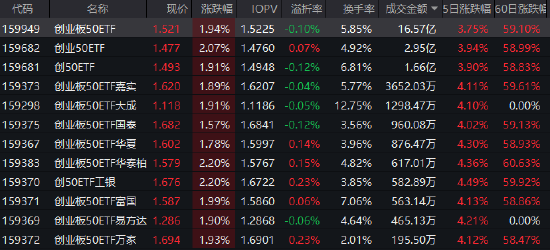
创业50ETF(159682)涨2.07%,半日成交额2.95亿元
Xin Lang Cai Jing· 2025-09-29 03:40
Core Viewpoint - The article highlights the performance of the Chuangye 50 ETF (159682) as of September 29, noting a 2.07% increase in its value and a trading volume of 295 million yuan, indicating strong market interest and positive investor sentiment [1] Group 1: ETF Performance - The Chuangye 50 ETF (159682) closed at 1.477 yuan, with a trading volume of 2.95 billion yuan [1] - The ETF's performance benchmark is the return of the ChiNext 50 Index, managed by Invesco Great Wall Fund Management Co., with fund managers Wang Yang and Zhang Xiaonan [1] - Since its inception on December 23, 2022, the ETF has achieved a return of 44.75%, with a one-month return of 18.61% [1] Group 2: Top Holdings Performance - Key holdings in the ETF include: - Ningde Times up 3.05% - Dongfang Wealth up 2.92% - Huichuan Technology up 0.44% - Zhongji Xuchuang up 2.00% - Mai Rui Medical down 1.39% - Xinyi Sheng up 2.86% - Sunshine Power up 3.97% - Shenghong Technology up 2.29% - Yiwei Lithium Energy up 7.57% - Tonghuashun up 1.84% [1]





电新和通信领涨,大湾区ETF(512970)的投资机会受关注
Xin Lang Cai Jing· 2025-09-29 02:37
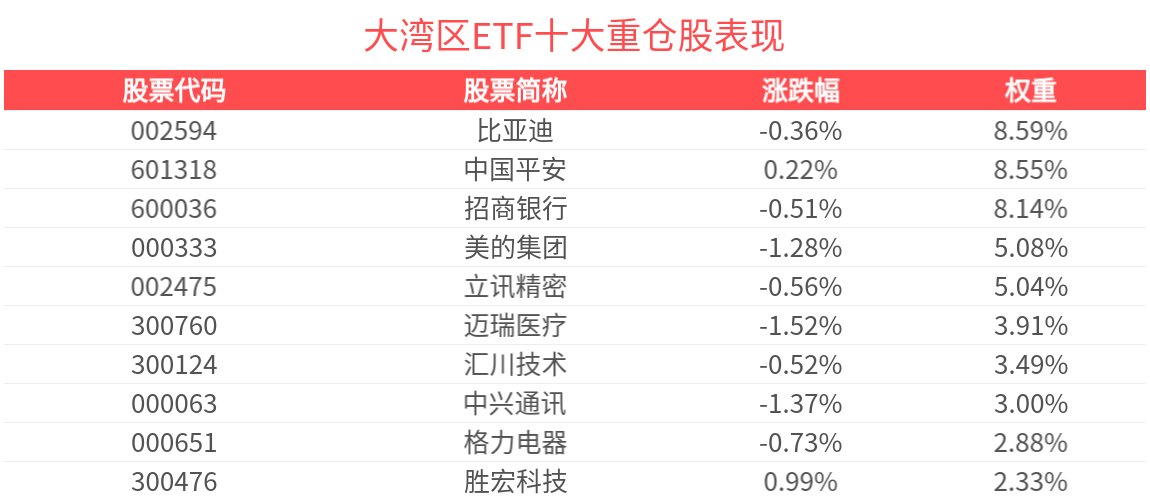
Core Insights - The China Securities Index for the Guangdong-Hong Kong-Macao Greater Bay Area Development (931000) has shown a 0.24% increase as of September 29, 2025, with notable stock performances from Tianqi Lithium (8.17%), Yiwei Lithium Energy (7.74%), and Xinjubang (6.96%) [1] Performance Summary - The Greater Bay Area ETF (512970) has experienced a recent price of 1.51 yuan, with a weekly increase of 1.21% as of September 26, 2025 [1] - Over the past year, the Greater Bay Area ETF has achieved a net value increase of 42.09% [1] - The ETF's highest single-month return since inception was 21.99%, with the longest consecutive monthly gains being 4 months and a maximum increase of 26.18% [1] - The average monthly return during the rising months was 5.38% [1] - The annualized excess return over the benchmark for the past three months was 6.80% [1] - The Sharpe ratio for the past year stands at 1.84 [1] Drawdown and Recovery - The Greater Bay Area ETF has recorded a relative drawdown of 0.17% against the benchmark over the past six months, with a recovery period of 92 days [2] Fee Structure - The management fee for the Greater Bay Area ETF is 0.15%, while the custody fee is 0.05% [2] Tracking Accuracy - The tracking error for the Greater Bay Area ETF over the past two months is 0.027% [3] - The index closely tracks the performance of companies benefiting from the Greater Bay Area development, including a selection of up to 50 Hong Kong stocks, 300 companies from the Shanghai-Hong Kong-Shenzhen markets, and 100 mainland companies [3] Top Holdings - As of August 29, 2025, the top ten weighted stocks in the index include Ping An Insurance (8.55%), BYD (8.59%), and China Merchants Bank (8.14%), collectively accounting for 49.06% of the index [4]
迈瑞医疗(300760):上半年承压,2025Q3有望迎来业绩拐点
Huaan Securities· 2025-09-29 01:19
Investment Rating - The investment rating for the company is "Buy" (maintained) [1] Core Views - The company reported a significant decline in revenue and net profit for the first half of 2025, with revenue at 167.43 billion yuan, down 18.45% year-on-year, and net profit at 50.69 billion yuan, down 32.96% year-on-year [4][5] - Domestic market revenue fell sharply due to intensified competition and a prolonged revenue recognition cycle, but a recovery is expected in the third quarter of 2025 as bidding activities improve [5] - The overseas market showed resilience with revenue of 83.32 billion yuan, up 5.39% year-on-year, driven by double-digit growth in certain regions and an increase in high-end customer penetration [6] - The in-vitro diagnostics (IVD) segment has become the company's largest business, with international IVD revenue experiencing notable growth despite a decline in domestic sales [7][8] Financial Performance Summary - For the first half of 2025, the company achieved revenue of 167.43 billion yuan and a net profit of 50.69 billion yuan, with significant declines in both metrics compared to the previous year [4] - The company expects revenue growth to recover in the coming years, projecting revenues of 385.88 billion yuan, 454.89 billion yuan, and 537.19 billion yuan for 2025, 2026, and 2027 respectively, with corresponding net profits of 122.26 billion yuan, 145.36 billion yuan, and 172.75 billion yuan [9] - The projected earnings per share (EPS) for 2025, 2026, and 2027 are approximately 10.08 yuan, 11.99 yuan, and 14.25 yuan, with price-to-earnings (P/E) ratios of 24, 20, and 17 respectively [9][11]

全球第25,国内第一!迈瑞医疗国际收入占比达50%
Sou Hu Cai Jing· 2025-09-28 15:21
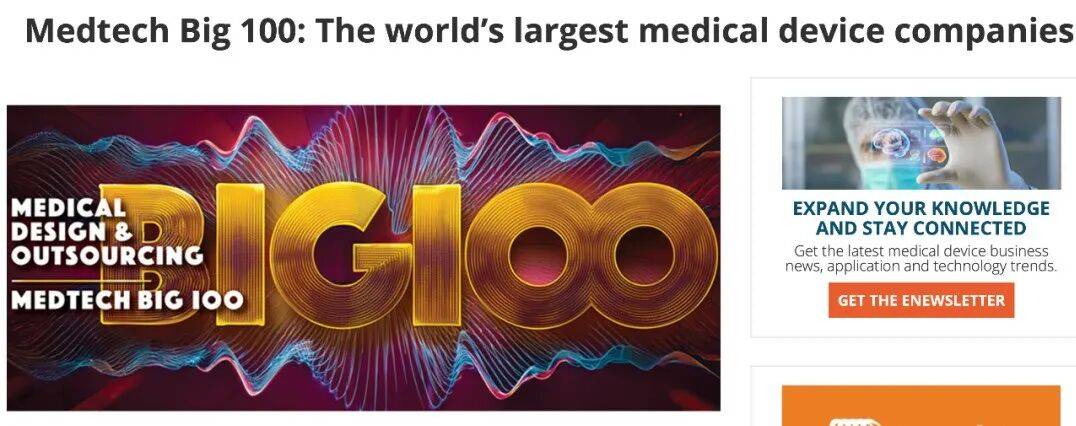
Core Insights - China's leading medical device company, Mindray Medical, ranked 25th in the 2025 Global Top 100 Medical Device Companies list, improving from 27th in 2024, maintaining its position as the top domestic medical device enterprise [1][5] Company Overview - Mindray Medical was founded in Shenzhen in 1991, focusing on core technology breakthroughs and successfully launching domestic monitoring devices and portable ultrasound equipment in the late 1990s, breaking the monopoly of imported brands in the mid-to-low-end medical device market [5] - The company went public on the New York Stock Exchange in 2006, expanded into overseas markets, and returned to the Shenzhen Stock Exchange in 2018 after privatization, establishing itself as a benchmark in the domestic medical device sector [5] Financial Performance - In the first half of 2025, Mindray Medical reported its first revenue and net profit decline since its A-share listing in 2018, with revenue of 16.743 billion yuan, down 18.45% year-on-year, and net profit of 5.069 billion yuan, down 32.96% year-on-year [5] - All three main business segments experienced declines: Life Information and Support business down 31.59%, In Vitro Diagnostics down 16.11%, and Medical Imaging down 22.51% [5] Global Market Position - Mindray Medical's international business revenue grew by 5.39% year-on-year in the first half of 2025, accounting for approximately 50% of total revenue, indicating a new stage in its internationalization process [9] - The company has successfully added over 160 new high-end clients in the In Vitro Diagnostics field and penetrated existing high-end clients' product lines [9] Strategic Initiatives - Mindray Medical's core strategy for international market expansion includes localization and acquisitions, having acquired several companies to enhance its global footprint [9] - The company invested 4.008 billion yuan in R&D in the 2024 fiscal year, maintaining a rhythm of launching new products every few years and achieving breakthroughs in high-end products [10] Market Valuation - As of September 26, 2025, Mindray Medical's stock price was 240.10 yuan per share, with a total market capitalization of 291.107 billion yuan, reflecting a 46.96% decline from its historical high of 461.94 yuan per share in 2021 [8]
医疗器械深度:行业拐点已至,创新并购出海造就全球性龙头
2025-09-28 14:57
Summary of Key Points from the Conference Call on the Medical Device Industry Industry Overview - The Chinese medical device industry has significant potential for domestic substitution, with certain segments still having room for improvement in localization rates [1][3][10] - Chinese companies are positioned to become global leaders in the context of globalization, leveraging strong innovation capabilities and manufacturing advantages [1][4][10] Core Insights and Arguments - The high-value consumables sector is expected to see a notable recovery by 2025, with investment opportunities in orthopedics, neurointervention, ophthalmology, and electrophysiology [1][5] - Companies such as Huatai Medical, MicroPort, Lepu Medical, Mindray, and United Imaging are highlighted for their growth potential [1][5] - The upstream medical device sector is experiencing a turning point, with companies like Meihua Medical and Yirui Technology poised for significant revenue growth due to innovative products [1][6] - The in vitro diagnostics (IVD) sector has faced challenges due to policy impacts, but a recovery is anticipated next year, with New Industry expected to see positive revenue growth in Q4 [1][7] - Strategic adjustments by Chinese medical device companies include cost reduction, technological innovation, transformation to consumer-oriented businesses, and overseas market expansion [1][9] Additional Important Insights - The global medical device market is approximately 4 to 5 times larger than China's market, which is projected to grow significantly [2][12] - Chinese companies are diversifying their overseas expansion strategies, which include R&D innovation, clinical registration, and patent layout to mitigate geopolitical risks [2][11][14] - The importance of innovation is emphasized as a key driver for growth, with a focus on new product development and emerging technologies such as AI and brain-computer interfaces [26][31] - The medical device industry is witnessing a trend towards mergers and acquisitions as a means for companies to enhance their product lines and market positions [33][36] Notable Companies and Their Strategies - Mindray Medical is leading in internationalization, with overseas revenue expected to reach 45% in 2024 [19] - United Imaging and BGI are also making significant strides in their respective markets, with notable growth in overseas business [19][24] - High-value consumables companies like Nanwei Medical and MicroPort are employing various strategies, including direct sales and ODM, to expand their international presence [21][22] Future Outlook - The medical device industry is expected to continue evolving, with significant opportunities in areas such as AI healthcare applications, home respiratory devices, and surgical robots [28][30] - The brain-computer interface technology is emerging as a key investment area, with China positioned as a global leader [31] - The overall sentiment is optimistic regarding the recovery and growth potential of the Chinese medical device market, particularly as companies adapt to changing market conditions and consumer demands [36]

迈瑞医疗20250926
2025-09-28 14:57
Summary of the Conference Call for Mindray Medical Company Overview - **Company**: Mindray Medical - **Date**: September 26, 2025 Key Industry Insights - **Market Recovery**: The domestic medical device tendering has shown signs of recovery, but the revenue recognition cycle has lengthened, and the uneven distribution of last year's base has led to limited improvement in the third quarter [2][4] - **Strategic Focus**: Mindray Medical is accelerating import substitution and increasing industry concentration to enhance market share [2][4] Core Strategic Directions - **Digitalization**: Emphasis on AI-enabled devices to enhance customer stickiness and solve clinical problems [2][5] - **Streamlined Operations**: Focus on consumables business growth, including in vitro diagnostic reagents, minimally invasive surgical consumables, and cardiovascular consumables [2][5] - **Internationalization**: Replicating successful experiences and advancing localization to expand sales teams and channels [2][6][8] High-Potential Business Areas - **Minimally Invasive Surgery**: Achieved over 10% market share in the domestic market, with products covering 4K, 3D, and fluorescence technology [2][7] - **Animal Healthcare**: Equipped with necessary products for three major production lines, with international revenue exceeding 80% in the first half of the year [2][7][8] - **Cardiovascular Sector**: Acquisition of Huatai has injected vitality into the business, with the establishment of the electrophysiology division and clinical progress of products like DBA and RFA [2][7][9] Market Performance and Factors - **Third Quarter Performance**: Significant improvement noted, attributed to the gradual easing of multiple factors affecting domestic market growth, including healthcare reform and industry regulation [4] - **Revenue Recognition Delays**: The transition from public tendering to revenue recognition has been significantly prolonged, impacting the timing of revenue realization [4] Additional Insights - **Huatai's Contribution**: The independent operation of Huatai has enhanced the performance of Mindray's cardiovascular business, with successful clinical entry of products and improved operational efficiency [3][9] - **International Market Growth**: Strong performance in international markets, particularly in the high-end pet hospital sector, with a focus on expanding product offerings [8]
AI医疗行业深度解析
2025-09-28 14:57
Summary of AI in Healthcare Industry Conference Call Industry Overview - The AI healthcare industry is experiencing rapid growth, driven by advancements in AI systems and increasing training data, which enhance language and reasoning capabilities [2][8] - The integration of AI in healthcare aims to reduce medical service costs, which are rising due to increasing labor costs [2][4] Key Insights and Arguments - AI can operate 24/7, breaking time and space limitations, thus lowering healthcare service costs [1][4] - The National Health Commission has developed guidelines for AI applications in healthcare, covering 84 scenarios across four major areas, providing a regulatory framework for AI integration [1][6][7] - Over 100 AI products are currently available in the healthcare sector, focusing on drug development, specialized care, patient consultations, traditional medicine, and medical imaging [1][9] - The classification of AI medical software by the National Medical Products Administration (NMPA) includes third-class management for clinical diagnostic suggestions and second-class for data processing [1][10] Market Potential - The AI healthcare market is projected to grow significantly, particularly in medical imaging and drug development sectors [8] - As AI models become more integrated with healthcare applications, the market outlook remains promising [8] Specific Applications of AI - AI is utilized in creating fluid dynamics models from CT images, allowing for non-invasive measurement of coronary flow reserve (FFR), enhancing diagnostic accuracy [3][14] - In drug development, AI can reduce the time to market from 13 years to 8 years and cut costs from $2.4 billion to $600 million [3][24] - AI-assisted decision support systems (CDSS) enhance diagnostic capabilities in primary healthcare settings by providing treatment recommendations based on patient data [5] Regulatory Impact - Regulatory frameworks established by health authorities are crucial for the development of AI in healthcare, ensuring safety and efficacy [6][7] Technological Advancements - AI's application in medical imaging includes personalized scanning protocols, rapid image reconstruction, and diagnostic analysis, achieving detection rates as high as 98% for certain conditions [11][12] - The trend towards multi-disease detection capabilities in imaging software is increasing efficiency in disease diagnosis [12] Company Developments - Companies like RunDa and Xunfei Medical Technology are leading in AI-assisted diagnostics, with RunDa's intelligent assistant achieving an accuracy of 87.74% in disease report interpretation [22][23] - RunDa's collaboration with Huawei aims to develop specialized AI models for various medical applications [21] Conclusion - The AI healthcare industry is poised for significant advancements, driven by technological innovations, regulatory support, and a growing market demand for efficient healthcare solutions [8][26]
2025Q3医药业绩前瞻
2025-09-28 14:57
Summary of the Conference Call on the Pharmaceutical Industry Industry Overview - The pharmaceutical industry is currently experiencing a period of adjustment, particularly in the innovative drug sector, with leading companies like Innovent Biologics and China National Pharmaceutical Group showing stable fundamentals and product progress meeting expectations [1][4] - The overall sentiment in the pharmaceutical sector remains optimistic despite recent market fluctuations, with no signs of a bubble [2] Key Points and Arguments Innovative Drug Sector - The innovative drug sector is undergoing a rational adjustment, with a focus on companies that can deliver strong performance [3] - The 11th round of national drug procurement is expected to yield positive results, with local alliance procurement rules becoming more reasonable, potentially leading to a reversal in the generics sector [3][20] - Companies such as Kanglong Chemical, Baidu Pharmaceutical, Tianyu Co., and Betta Pharmaceuticals are projected to see significant revenue growth [3][24] Medical Device Sector - The medical device sector is benefiting from a reduction in competitive pressures, particularly in high-value consumables like Nanwei Medical and Xinmai Medical, which have not yet faced centralized procurement [5] - The orthopedic industry is recovering from previous procurement pressures, with companies like Chunli Aikang showing strong performance [5] - Companies focused on domestic bidding markets, such as Mindray and Kaili Medical, are expected to benefit from this trend [5] Customized Consumables - The customized consumables sector is performing well, with Yingke Medical exceeding profit expectations in Q2 and extending order schedules into Q3, indicating a recovery in end-user demand [6] IVD Sector - The IVD sector is under pressure due to policy changes and tax rate adjustments, but the bottom has been solidified, with companies like Mindray and New Industries showing strong overseas export performance [7] Traditional Chinese Medicine - Recommended companies in the traditional Chinese medicine sector include Jiuzhitang, Kangyuan Pharmaceutical, and China Resources Sanjiu, with Jiuzhitang showing significant potential in its stem cell pipeline [8] API Sector - The API sector is expected to benefit from anti-involution policies, leading to a new round of supply-side reforms [1][15] - Companies like Tianyu Co. are experiencing rapid capacity utilization increases, with projected profits exceeding 300 million yuan [15][18] Additional Insights - The blood products sector is facing pressure but is nearing a stabilization point, with new developments in high-purity products expected to create investment opportunities [22] - The raw material industry is anticipated to see long-term improvements due to government policies aimed at reducing chaotic price competition [15][18] - New delivery systems and commercialization scenarios in the pharmaceutical industry, such as Minophagen's GLP-1 delivery system, are gaining attention and providing more investment opportunities [17] Conclusion - The pharmaceutical industry, particularly the innovative drug and medical device sectors, presents a range of investment opportunities despite current market challenges. Companies with strong fundamentals and innovative pipelines are likely to perform well in the coming quarters [1][2][3][4][5][6][7][8][15][18][22]