碧桂园

Search documents
淄博区县房企进军中心城区
Qi Lu Wan Bao· 2025-08-21 23:29
Core Insights - The domestic real estate market is undergoing a significant transformation, with local developers becoming the main players as top-tier companies retreat from second and third-tier cities [1][3][5] - In Zibo, the real estate market is experiencing a reshuffle, with local firms taking the lead in land acquisition and project development [1][3][6] Group 1: Market Dynamics - Local developers, such as Shandong Jinxiangshu Real Estate Co., are increasingly dominating land acquisition in Zibo, evidenced by the competitive bidding for key plots [2][3] - The sales performance of local firms has improved, with companies like Fangzheng Real Estate and Jinyicheng Real Estate showing significant sales figures, indicating a shift in market dynamics [2][6] - The absence of major national developers like Vanke and Country Garden in Zibo's central urban area highlights the diminishing presence of top-tier firms in smaller cities [3][5] Group 2: Competitive Landscape - The competitive landscape has shifted, with local firms leveraging their regional knowledge and reputation to capture market share previously held by larger companies [3][8] - The introduction of innovative building concepts, such as passive housing by Fangzheng Real Estate, reflects a growing trend among local developers to enhance product quality and sustainability [8][9] - The ongoing competition between local and county-level developers is seen as a structural reform in the supply side of the real estate market, leading to increased diversity and options for consumers [9][10] Group 3: Future Outlook - The focus on high-quality residential projects is expected to continue, with local firms aiming to set new standards in design and construction [9][10] - As the market evolves, companies that prioritize understanding consumer needs and refining their products are likely to emerge as leaders in the changing landscape [10]
20家房企债务重组,化债规模已超12000亿元
第一财经· 2025-08-21 15:09
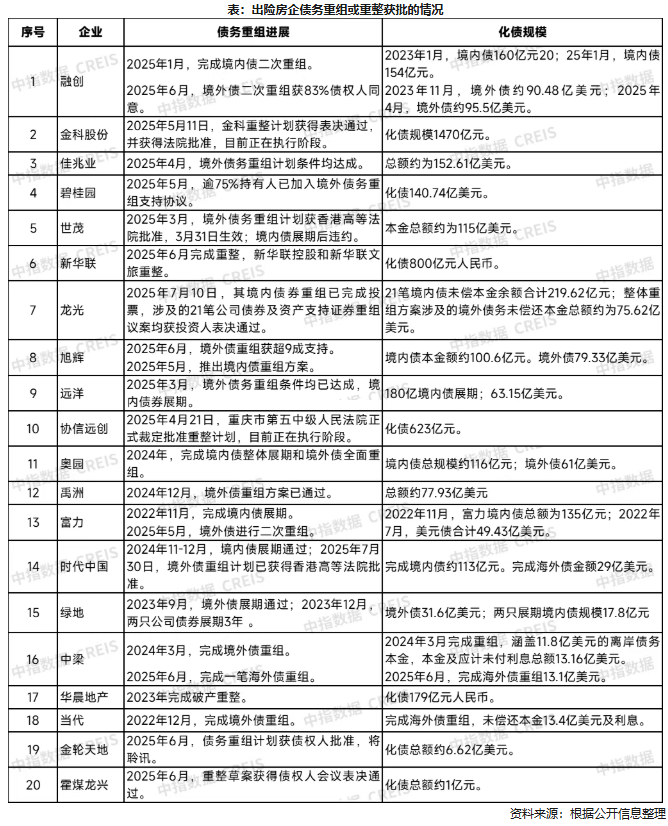
Core Viewpoint - The article discusses the progress of debt restructuring among real estate companies in China, highlighting a smoother process in 2025 compared to previous years, with significant amounts of debt being restructured and approved by creditors [3][6]. Group 1: Debt Restructuring Progress - As of August 20, 2025, "21 Xuhui 03" approved its restructuring plan, bringing Xuhui's domestic debt restructuring close to completion, with a total of 96 billion yuan in six domestic bonds approved [3]. - Sunac has completed various terms of its domestic debt restructuring, with stock option registration completed for an amount of 5.59 billion yuan, and its domestic bonds resumed trading on August 11 [3]. - Country Garden's offshore debt restructuring has gained more support from creditors, while Times China successfully obtained approval from the Hong Kong High Court for its offshore debt restructuring plan [3]. Group 2: Debt Restructuring Scale - Approximately 60 distressed real estate companies have announced debt restructuring or corporate reorganization progress, with 20 companies having their debt restructuring or reorganization plans approved, totaling over 12 trillion yuan in debt [6]. - Companies that have completed both domestic and offshore debt restructuring include Sunac, Aoyuan, Yuanyang, Times China, and Longguang, while companies with approved offshore debt restructuring include Xuhui, Kaisa, Yuzhou Properties, Shimao, Greenland, and Country Garden [7]. Group 3: Restructuring Strategies - Many companies that completed debt restructuring earlier have faced new crises due to misjudgments about the industry, leading to a new round of self-rescue efforts [7]. - The main strategies for recent restructuring plans include cash buybacks, debt extensions, and debt-to-equity swaps, with many companies aiming for a debt reduction ratio of around 70% [8]. - Sunac's second offshore debt restructuring plan involves converting all its dollar bonds into equity, making it the first large developer to adopt this approach [7].


20家房企债务重组,化债规模已超12000亿元
Di Yi Cai Jing· 2025-08-21 13:55
Group 1 - The debt restructuring process for real estate companies has become smoother in 2023, with significant progress reported in both domestic and overseas debt restructuring [1][5] - As of early August 2025, approximately 60 distressed real estate companies have announced debt restructuring or corporate reorganization progress, with 20 companies having their debt restructuring or reorganization approved, totaling over 12,000 billion RMB in debt reduction [5][6] - Major companies that have completed domestic and overseas debt restructuring include Sunac, Aoyuan, Yuanyang, Times China, and Longguang, while companies like CIFI, Kaisa, Yuzhou Properties, Shimao, Greenland, and Country Garden have received approval for overseas debt restructuring [5][6] Group 2 - The mainstream options for debt restructuring among real estate companies include cash buybacks, debt extensions, and debt-to-equity swaps, with many companies opting for debt-to-equity swaps to preserve capital [6] - Sunac has become the first major developer to convert all its dollar bonds into equity in its overseas debt restructuring plan, which involves approximately 95.5 billion USD [6] - The average debt reduction ratio for most distressed companies is around 70%, as many are facing tight cash flows and reduced asset values [6]
中指研究:截至2025年8月20家出险房企债务重组、重整获批 化债超1.2万亿元
智通财经网· 2025-08-21 08:14
Group 1 - As of August 2025, 20 distressed real estate companies have received approval for debt restructuring and reorganization, with a total debt resolution scale exceeding 1.2 trillion RMB [1][2] - The companies that completed domestic and overseas debt restructuring include Sunac, R&F, Aoyuan, and others, with significant amounts of debt involved [2][4] - The restructuring efforts are a response to the deep market impact and operational challenges faced by real estate companies since 2022, leading to 27 listed companies being passively delisted [6] Group 2 - From 2020 to 2025, over 70 real estate companies experienced debt defaults, with 44 defaults occurring in 2022 alone, indicating a severe industry crisis [6] - The majority of listed real estate companies are facing significant financial difficulties, with 63.4% of 71 companies reporting losses in the first half of 2025, an increase from the previous year [9] - Many companies are divesting from real estate development to transition to lighter asset models, driven by both proactive transformation and the need to protect their market positions [6]
LPR连续三个月维持不变,不敢降息背后的原因
Sou Hu Cai Jing· 2025-08-21 03:32
Core Viewpoint - The People's Bank of China (PBOC) has maintained the Loan Prime Rate (LPR) at 3.0% for one year and 3.5% for five years, reflecting a cautious approach amid calls for market stimulus, influenced by global capital flows and the Federal Reserve's policies [1][2]. Group 1: Reasons for Not Lowering Interest Rates - The current net interest margin for commercial banks has compressed to a historical low of 1.42%, indicating that banks earn only 1.42 yuan for every 100 yuan loaned, which poses systemic risks if LPR is lowered [3]. - The Federal Reserve's hawkish stance is a significant constraint, with a 93% probability of a 25 basis point rate cut in September, yet the Fed has maintained its rate at 4.25%-4.5%, leading to a 274 basis point inversion in the 10-year treasury yield between China and the U.S. [5][6]. - Economic fundamentals provide implicit support, with a GDP growth of 5.4% in the first half of the year and a weighted average loan interest rate dropping to a historical low of 3.2%, suggesting that further rate cuts may not be necessary [7]. Group 2: Impact of Global Capital Flows - The inverted interest rate differential of 274 basis points incentivizes foreign capital to withdraw from Chinese bonds, resulting in a net sell-off of 68 billion yuan in July, which increases financing costs for real estate companies [11]. - Currency fluctuations linked to LPR adjustments can indirectly raise mortgage costs for consumers, as a depreciation of the yuan can increase the hidden costs of purchasing property [13]. - The dynamics of LPR stability and expectations of Federal Reserve rate cuts illustrate the complex interplay of global interest rates, requiring the industry to navigate external pressures while stimulating domestic demand [10].
买房的“分水岭”到了:这代人或真成了“最后一代买房人”!
Sou Hu Cai Jing· 2025-08-20 20:05
Group 1 - The traditional view of home buying as a primary goal is shifting, with younger generations feeling less motivated to purchase homes due to financial burdens and lifestyle preferences [1][3] - The birth rate in 2024 is projected to be the lowest since 1949, with a significant increase in the aging population, leading to a decline in the primary home-buying demographic [1] - The housing market is seeing a shift from viewing homes as investment assets to considering them as living spaces, with speculation losing its appeal [3][5] Group 2 - The housing price-to-income ratio in major cities is alarmingly high, reaching 12.3 times nationally and nearly 25 times in first-tier cities, making home ownership increasingly unattainable for young professionals [3] - The introduction of "rent and purchase rights" in 2025 allows renters to access benefits previously reserved for homeowners, changing perceptions of renting as a temporary solution [3] - Urban renewal initiatives and the rise of long-term rental apartments are transforming the housing landscape, with developers pivoting towards community services and affordable housing options [5][7] Group 3 - The current mindset among potential homebuyers reflects a fear of market volatility and a shift towards rational decision-making regarding home purchases, emphasizing the importance of individual circumstances [5][7] - The future of housing may not necessitate ownership, as alternative living arrangements become more viable and appealing, suggesting a potential evolution in residential choices [7]
楼市牛市强势来袭,买房者迎来最佳时机,投资回报潜力巨大
Sou Hu Cai Jing· 2025-08-20 10:42
2025年的夏天,本应泾渭分明的楼市与股市,却意外地交汇碰撞,激荡起令人不安的复杂情绪。压抑、 沸腾、四散,空气中弥漫着刺鼻的焦灼,预示着一场风暴的来临,没有人敢言全身而退。 彼时,韩国股市年内涨幅已超30%,日经225指数更是突破了1989年的历史高点。全球资金流动加速, 贸易局势的缓和与美联储降息的预期,更助长了资金的冒险精神。外资7月净流入韩国股市超过30亿美 元,将中国市场视为第二大海外投资标的。国内方面,7月非银存款同比多增1.39万亿,居民存款开 始"搬家"。种种迹象表明,牛市的氛围日渐浓厚。 沪深两市在8月气势如虹,成交量连续突破2万亿大关。权重股一路高歌猛进,媒体和朋友圈充斥着"牛 市归来"的欢呼。然而,狂欢的背后,并非人人都能分享盛宴。不少投资者手中的股票纹丝不动,甚至 不涨反跌,委屈、焦虑、无奈写在他们的脸上。 数据显示,过去一年,6256只权益类基金(包括股票型、混合型)平均收益率高达34.06%,近乎99%的 产品实现盈利,一片欣欣向荣。然而,深入审视却发现,2021年买入的新基金中,仍有158只累计跌幅 超过30%。有人收益翻倍,有人却仍在原地挣扎。市场热情高涨,躁动不安的情绪也在暗 ...

碧桂园:境外债务重组力争年底前完成
Jin Rong Jie· 2025-08-19 13:59
本文源自:金融界AI电报 碧桂园发布公告,公司就境外债务重组建议已与银行协调委员会协定主要条款,协调委员会占现有银团 贷款本金总额的49%,其成员已加入重组支持协议,或正履行内部程序以取得加入批准。碧桂园同时表 示,已获得持有大量现有债务的债权人大力支持,公司正与项目小组及协调委员会就正式文件紧密合 作,力争在2025年年底前完成建议重组。 ...
碧桂园(02007.HK)拟8月29日举行董事会会议批准中期业绩
Ge Long Hui· 2025-08-19 09:00
格隆汇8月19日丨碧桂园(02007.HK)公布,本公司将于2025年8月29日(星期五)举行董事会会议,藉以 (其中包括)考虑及批准本公司及其附属公司截至2025年6月30日止六个月的中期业绩及其发布。 ...
断供14年!广州番薯岛,甩出5宗Tod王炸地
Sou Hu Cai Jing· 2025-08-19 08:53
Core Viewpoint - The article discusses the significant development plans for Nanpu Island, which has not seen land sales for 14 years, indicating a potential transformation of the area into a more developed and accessible region [1]. Group 1: Development Plans - Guangzhou's planning authority has announced a detailed control plan for the eastern reserve land of Nanpu Island, which includes the addition of 5 residential plots and a new school [3][6]. - The new planning area covers approximately 92.5 hectares, equivalent to 130 standard football fields, and will include residential, commercial, and public facilities [5]. Group 2: Infrastructure Improvements - The new regulations will increase the residential land by about 23.6 hectares, roughly the size of two Flower City Squares [6]. - The plan includes the addition of 71 public service facilities, a significant increase of 32 facilities compared to previous plans, including a 42-class nine-year school [9]. - Road density will be improved to 8.1 kilometers per square kilometer, addressing long-standing traffic issues faced by the 165,000 residents of Nanpu Island [10][13]. Group 3: Green Spaces and Environmental Enhancements - The area will see an increase of over 1 hectare in park green space, bringing the total green area to 7.1 hectares, along with improvements to the water system [14]. Group 4: Real Estate Market Insights - Despite a low presence in the market, Nanpu Island is considered a value area in Panyu, with nearly 70% of properties being over 15 years old [16][17]. - Current property prices in Nanpu are significantly lower than in nearby areas, with average prices around 25,000 to 38,000 yuan per square meter, compared to 40,000 to 60,000 yuan in adjacent districts [19][21]. Group 5: Future Development Potential - There are over 1,000 acres of vacant land in the area, indicating substantial development potential, especially with several important planning initiatives already in place [24][25]. - The area has been included in multiple development plans, suggesting that it is not overlooked and has the potential for significant economic growth [25].