快手

Search documents
智通ADR统计 | 1月9日




智通财经网· 2026-01-08 22:22
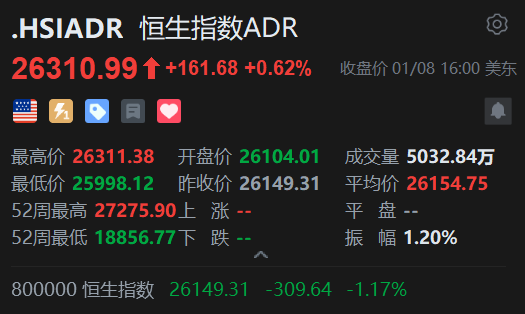
Market Overview - The Hang Seng Index (HSI) closed at 26,310.99, up by 161.68 points or 0.62% as of January 8, 16:00 Eastern Time [1] - The index reached a high of 26,311.38 and a low of 25,998.12 during the trading session, with a trading volume of 50.328 million shares [1] Major Blue-Chip Stocks Performance - HSBC Holdings closed at HKD 125.439, up by 0.92% compared to the Hong Kong close [2] - Tencent Holdings closed at HKD 615.197, down by 0.13% compared to the Hong Kong close [2] Stock Price Movements - Tencent Holdings: Latest price HKD 616.000, down by HKD 8.500 or 1.36%, with an ADR price of 615.197, reflecting a decrease of 0.13% [3] - Alibaba Group: Latest price HKD 142.600, down by HKD 3.300 or 2.26%, with an ADR price of 150.458, reflecting an increase of 5.51% [3] - HSBC Holdings: Latest price HKD 124.300, down by HKD 2.900 or 2.28%, with an ADR price of 125.439, reflecting an increase of 0.92% [3] - Other notable movements include Meituan-W down by 3.35% and JD.com down by 2.02% [3]

恒生科技大幅回撤,互联网、银行等紧随其后;恒生医疗逆势大涨
Ge Long Hui· 2026-01-08 21:06
Group 1 - The Hang Seng Index closed down 0.94%, with the technology sector experiencing the largest decline [1] - The Hang Seng Technology Index fell by 1.81%, with notable drops from BYD Co. Ltd. (-3.93%), Alibaba (-3.25%), and NetEase (-2.88%) [3] - The Hang Seng Bank Index also saw a decline of 1.1%, with Standard Chartered down 2.43% and China Construction Bank down 1.42% [3] Group 2 - The Hang Seng Healthcare Index rose by 2.47%, driven by significant gains from companies like CanSino Biologics (+7.31%) and 3SBio (+7.16%) [3] - Other healthcare stocks such as WuXi Biologics and Innovent Biologics also saw increases of 5.92% and 5.38% respectively [3] - More than ten healthcare stocks recorded gains exceeding 3% [3]
多平台公布涉“AI魔改”违规视频处置结果
Jing Ji Guan Cha Wang· 2026-01-08 15:24
Core Viewpoint - The National Radio and Television Administration will launch a month-long "AI Modification" video governance action nationwide starting January 1, 2026, targeting the regulation of AI-modified content across various online platforms [1] Group 1: Regulatory Actions - WeChat has processed a total of 1,078 pieces of non-compliant short video content since the start of the initiative [1] - Douyin has removed 1,075 videos related to "AI Modification" violations [1] - Kuaishou has conducted a special governance action against "AI Modification" videos, processing 1,057 pieces of non-compliant content [1] Group 2: Platform-Specific Results - Bilibili has intercepted and dealt with over 700 problematic submissions related to "AI Modification" [1] - Xiaohongshu has cleaned up 487 pieces of non-compliant "AI Modification" video content and has dealt with 21 non-compliant accounts [1] - Baidu has inspected and cleared 284 non-compliant videos related to classic IPs and sensitive political and military scenarios, closing 2 accounts [1] - Weibo has intercepted and cleared over 190 non-compliant videos and has imposed temporary to permanent bans on 7 non-compliant accounts based on severity [1]
1月8日港股通净卖出49.01亿港元



Zheng Quan Shi Bao Wang· 2026-01-08 15:16
Market Overview - On January 8, the Hang Seng Index fell by 1.17%, closing at 26,149.31 points, with a total net sell of HKD 4.901 billion through the southbound trading channel [1][3] - The total trading volume for the southbound trading was HKD 117.906 billion, with a net sell of HKD 4.901 billion [1] Trading Activity - In the Shanghai-Hong Kong Stock Connect, the trading volume was HKD 70.891 billion, with a net sell of HKD 3.968 billion; in the Shenzhen-Hong Kong Stock Connect, the trading volume was HKD 47.015 billion, with a net sell of HKD 0.933 billion [1] - The most actively traded stock in the Shanghai-Hong Kong Stock Connect was Alibaba-W, with a trading volume of HKD 57.22 billion, followed by the Tracker Fund of Hong Kong and SMIC, with trading volumes of HKD 48.64 billion and HKD 33.52 billion, respectively [1] Net Buy/Sell Analysis - Tencent Holdings had the highest net buy amount of HKD 0.585 billion, despite a closing price drop of 1.36% [1] - The Tracker Fund of Hong Kong recorded the highest net sell amount of HKD 4.631 billion, closing down by 1.28% [1] - In the Shenzhen-Hong Kong Stock Connect, Alibaba-W also led in trading volume with HKD 37.64 billion, while Xiaomi Group-W had the highest net buy of HKD 0.494 billion, closing down by 0.37% [2]
港股通1月8日成交活跃股名单
Zheng Quan Shi Bao Wang· 2026-01-08 15:07
Market Overview - On January 8, the Hang Seng Index fell by 1.17%, with southbound capital totaling HKD 117.906 billion, comprising HKD 56.503 billion in buying and HKD 61.403 billion in selling, resulting in a net sell of HKD 4.901 billion [1] Southbound Trading Activity - The southbound trading through Stock Connect (Shenzhen) had a total turnover of HKD 47.015 billion, with buying at HKD 23.041 billion and selling at HKD 23.974 billion, leading to a net sell of HKD 0.933 billion [1] - The southbound trading through Stock Connect (Shanghai) recorded a total turnover of HKD 70.891 billion, with buying at HKD 33.461 billion and selling at HKD 37.429 billion, resulting in a net sell of HKD 3.968 billion [1] Active Stocks - Alibaba-W had the highest trading volume among southbound stocks, with a total turnover of HKD 94.86 billion, followed by the Tracker Fund of Hong Kong and SMIC, with turnovers of HKD 65.30 billion and HKD 55.70 billion respectively [1] - The top net buying stocks included Xiaomi Group-W with a net buy of HKD 10.72 billion, Tencent Holdings with HKD 8.64 billion, and SMIC with HKD 5.63 billion [1] - The stock with the highest net sell was the Tracker Fund of Hong Kong, with a net sell of HKD 62.84 billion, followed by Hang Seng China Enterprises and Southern Hang Seng Technology with net sells of HKD 28.78 billion and HKD 12.88 billion respectively [1] Continuous Net Buying and Selling - Xiaomi Group-W, Tencent Holdings, and SMIC were among the eight stocks that appeared on both the Shenzhen and Shanghai Stock Connect active lists, with Xiaomi Group-W having a total turnover of HKD 41.07 billion and a net buy of HKD 10.72 billion, while Tencent Holdings had a turnover of HKD 45.90 billion and a net buy of HKD 8.64 billion [2] - Over a continuous period, Xiaomi Group-W, Alibaba-W, and Goldwind Technology saw net buying for more than three days, with Xiaomi Group-W leading with a total net buy of HKD 46.84 billion [2] - Conversely, China Mobile and Hua Hong Semiconductor experienced continuous net selling, with net sells of HKD 31.39 billion and HKD 6.88 billion respectively [2]
AI正在进公司,谁成了职场人的默认工具丨AI产品榜·网站榜2025年12月
36氪· 2026-01-08 13:35
Core Insights - The article presents the December 2025 AI Product Rankings, highlighting the stability and growth of various AI products across different categories, including chatbots, search engines, and image generators [5][6]. Global Rankings - ChatGPT remains the top AI product with 5.7 billion web visits, despite a slight decrease of 5.59% from the previous month. Gemini follows in second place with 1.79 billion visits, showing a significant growth of 28.38% [7][16]. - The rankings indicate a trend where the leading products are becoming the "default entry points" for users in the AI space [7]. Domestic Rankings - In the domestic market, DeepSeek leads with 451.1 million visits, marking a 30.40% increase. The trend shows that users are increasingly accessing AI products directly for specific tasks rather than through recommendations [9][10]. - Kimi, however, is noted for a significant drop in traffic, with an 11.86% decrease, indicating potential challenges in user engagement [9][10]. Outbound Rankings - The outbound rankings feature products like SeaArt and Manus, which, while not having the largest traffic, are noted for their clear product positioning. Manus reportedly has an annual recurring revenue (ARR) of $100 million and was acquired by Meta for several billion [11][12]. Growth Rankings - The standout in the global growth rankings is Qianwen, which achieved 28.43 million visits with a remarkable growth of 323.13%. Other notable products include CF Studio and wisprflow, with growth rates of 137% and 116%, respectively [14][32]. - The data suggests that AI is deeply integrated into the content production chain, covering various aspects from information retrieval to collaborative delivery [14]. Application Rankings - The application rankings reveal a diverse array of AI tools, with significant traffic and growth across categories such as image generation, writing assistance, and coding support [27][28]. Decline Rankings - The decline rankings highlight products like Getresponse and CheggMate, which experienced substantial drops in traffic, indicating potential market challenges or shifts in user preferences [30][31]. Chatbot Rankings - The chatbot category is led by ChatGPT and Gemini, with DeepSeek also showing strong performance. The rankings reflect a competitive landscape where user engagement is critical [35].



AI视频赛道热度升温 Kling AI、万兴科技万兴天幕AI等受关注
Zhong Zheng Wang· 2026-01-08 13:20
Group 1 - Kling AI's paid performance in overseas markets is increasing, driven by its "one-click generation" feature that significantly lowers the creation barrier [1] - Wanxing Technology's AI product, Wanxing Tianmu AI, is gaining attention as a representative of full-chain audio and video creation, efficiently adapting to high-quality computing power and supporting the generation of coherent videos over 60 seconds [1] - According to Frost & Sullivan, the average cost for users to generate a 5-second 1080P video segment using Wanxing Technology's model is among the lowest in the industry [1] Group 2 - Kling AI leverages the Kuaishou content platform and traffic marketing ecosystem to quickly meet consumer demands through continuous iteration of gameplay and experience [2] - Wanxing Tianmu AI serves both C-end individual creators, represented by short video creators, and B-end enterprise users, and can synergize with other products from Wanxing Technology [2] - The rise of AIGC audio and video creation applications, exemplified by Kling AI and Wanxing Tianmu AI, is becoming a new generation of creative productivity platforms accepted by global creators, showcasing the immense potential of AI in empowering creative production [2]
资讯日报:美国职位空缺和ADP报告显示就业持续降温-20260108
Guoxin Securities Hongkong· 2026-01-08 12:54
Market Overview - The U.S. job openings fell to the lowest level in over a year, indicating a cooling labor market[11] - The ADP report showed moderate growth in private sector employment for December, with labor demand remaining weak[11] - The S&P 500 index's expected price-to-earnings ratio is currently around 22 times, down from 23 times in November but still above the five-year average of 19 times[12] U.S. Stock Market Performance - On Wednesday, the S&P 500 index closed down, primarily due to weakness in financial stocks like JPMorgan and Blackstone[2] - The Nasdaq index saw a slight increase, driven by gains in Nvidia and Alphabet[2] - Major tech stocks mostly rose, with Google A up 2.43% and Microsoft up 1.04%, while Tesla and Apple saw declines of 0.36% and 0.77%, respectively[11] Hong Kong Stock Market Performance - The Hang Seng Index closed at 26,459, down 0.94% for the day, but up 3.23% year-to-date[3] - Technology stocks faced significant declines, with Alibaba down over 3% and Kuaishou down over 2%[9] - The automotive sector also struggled, with NIO dropping over 3% and several other manufacturers down more than 2% due to tightening subsidies and a forecasted 7% decline in China's auto market sales for 2026[9] Sector-Specific Insights - Oil stocks collectively fell, with Kunlun Energy and CNOOC down over 3% amid concerns over increased supply from Venezuela[9] - Pharmaceutical stocks performed well, particularly CRO and CDMO-related companies, with notable gains for clients like Kelaiying and Tigermed, rising 8.92% and 8.88% respectively[9] - The paper industry saw gains, with Nine Dragons Paper up 8.97% due to supply cuts and price increases announced by major companies[9]
快手的金融野心藏不住了,推自营现金贷后,又巨额增资小贷
3 6 Ke· 2026-01-08 12:15
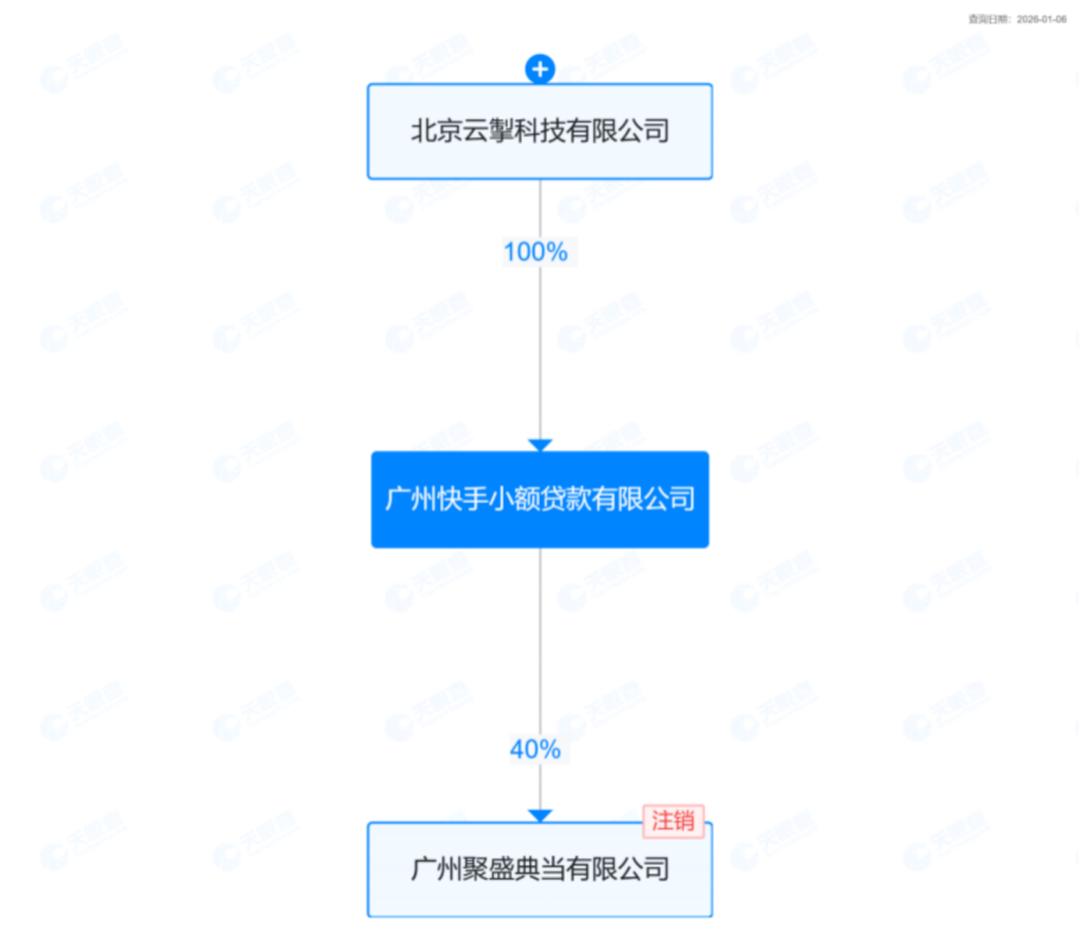
Core Viewpoint - Kuaishou is aggressively expanding its lending ambitions, as evidenced by the increase in registered capital for its lending subsidiary, Kuaishou Microloan, and its parent company, Beijing Yuncheng Technology [1][3] Group 1: Financial Expansion - Kuaishou Microloan's registered capital increased from 500 million to 1 billion yuan, allowing it to potentially leverage up to 5 billion yuan in lending capacity, effectively doubling its lending pool [1][3] - The company has been building its financial ecosystem since 2020, starting with the acquisition of a majority stake in Yilian Payment, which provided it with a crucial financial license [4] - As of the end of 2024, Kuaishou's lending business balance is estimated to be around 5 billion yuan, indicating significant growth in its financial services [4] Group 2: Product Offerings - Kuaishou launched its self-operated cash loan service "Kuaishou Shengxin Borrow" in August 2025, offering lower interest rates compared to third-party platforms, with annual rates adjusted to a range of 6.1% to 24% [5] - The company introduced "Kuaishou Monthly Payment" in June 2025, a credit payment service aimed at facilitating installment payments within its e-commerce platform, potentially generating over 2 billion yuan in annual revenue if it captures a 10% penetration rate [7] Group 3: Regulatory Challenges - Kuaishou faces significant compliance challenges, particularly regarding high-interest rates and aggressive collection practices, which have led to numerous user complaints [9][10] - The introduction of new regulations in October 2025 mandates comprehensive cost transparency in lending, which could pose a challenge for Kuaishou's existing financial practices [12][14] - The new regulations aim to protect consumers by eliminating hidden fees and capping annual interest rates at 24%, directly impacting Kuaishou's lending operations [13][14]
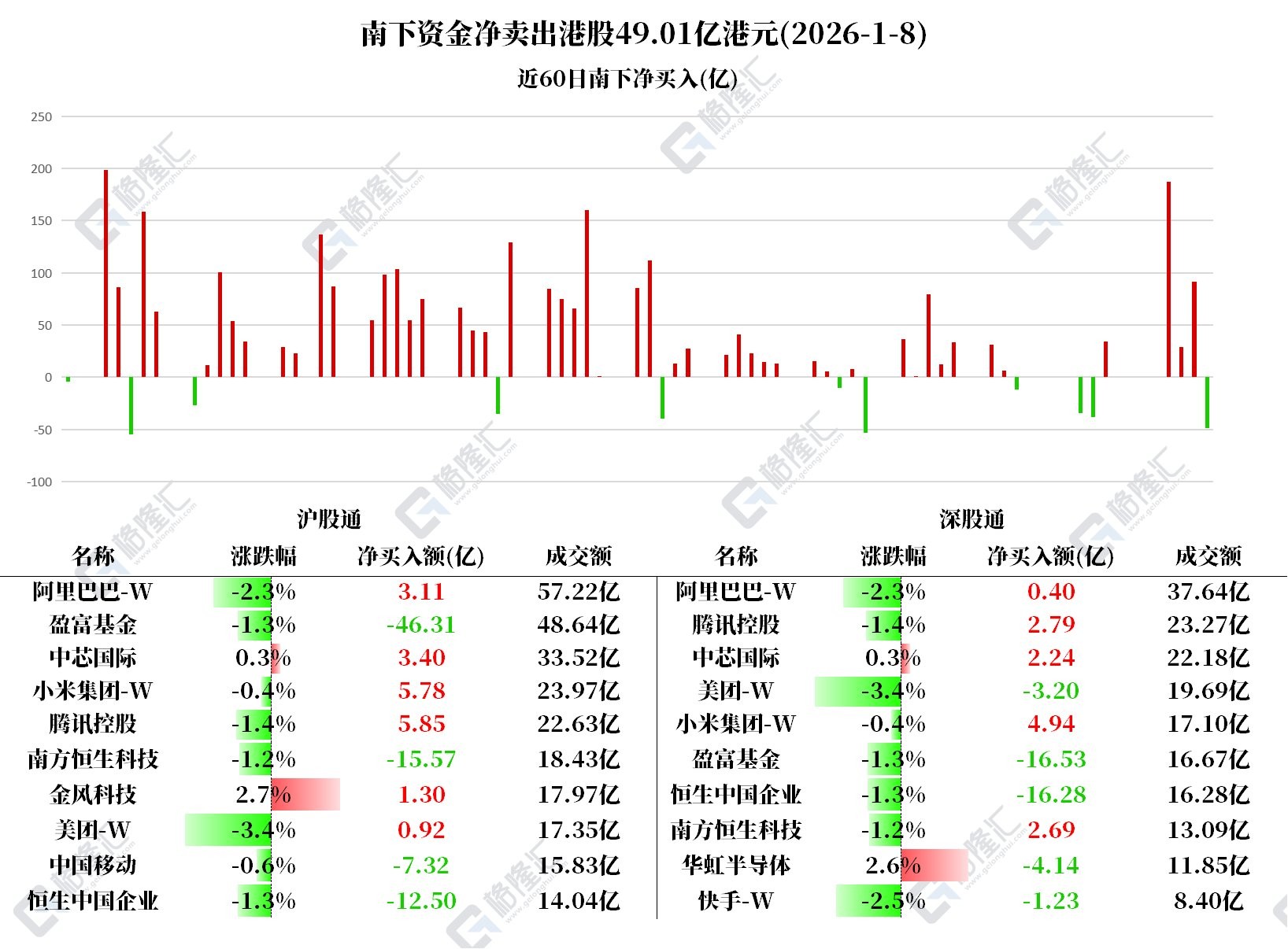
图解丨南下资金逆势净买入小米、腾讯和中芯国际
Ge Long Hui· 2026-01-08 11:56
Group 1 - The net outflow of southbound funds from Hong Kong stocks today amounted to HKD 4.9 billion, with notable net purchases in Xiaomi Group (HKD 1.072 billion), Tencent Holdings (HKD 0.863 billion), SMIC (HKD 0.563 billion), Alibaba (HKD 0.35 billion), and Goldwind Technology (HKD 0.13 billion) [1] - The net sales included significant amounts in the Tracker Fund of Hong Kong (HKD 6.284 billion), Hang Seng China Enterprises (HKD 2.878 billion), Southern Hang Seng Technology (HKD 1.288 billion), China Mobile (HKD 0.732 billion), Hua Hong Semiconductor (HKD 0.413 billion), Meituan (HKD 0.227 billion), and Kuaishou (HKD 0.122 billion) [1] - Southbound funds have recorded six consecutive days of net purchases in Xiaomi, totaling HKD 4.6844 billion, and five consecutive days of net purchases in Alibaba, totaling HKD 2.46627 billion; conversely, there have been four consecutive days of net sales in China Mobile, totaling HKD 3.13893 billion [1] Group 2 - In the Shanghai Stock Connect, Alibaba saw a decline of 2.3% with a net purchase of HKD 0.311 billion, while Tencent experienced a drop of 1.3% with a net outflow of HKD 4.631 billion [4] - SMIC had a slight increase of 0.3% with a net purchase of HKD 0.34 billion, and Xiaomi Group saw a decrease of 0.4% with a net purchase of HKD 0.578 billion [4] - Goldwind Technology increased by 2.7% with a net purchase of HKD 0.13 billion, while China Mobile decreased by 0.6% with a net outflow of HKD 0.732 billion [4]