
康诺亚

Search documents
2025年中国过敏性疾病药物行业系列报告(二):哮喘生物制剂治疗现状与联合疗法探索
Tou Bao Yan Jiu Yuan· 2025-10-13 14:00
Investment Rating - The report indicates a positive investment outlook for the allergic asthma drug industry in China, with a projected compound annual growth rate (CAGR) of 15.6% from 2024 to 2030, leading to a market size of 467 billion yuan by 2030 [5][9][11]. Core Insights - The current treatment landscape for allergic asthma includes a variety of therapies such as inhaled corticosteroids (ICS), allergen immunotherapy (AIT), and biologics targeting type 2 inflammation, suitable for moderate to severe cases [5][6]. - The market for allergic asthma drugs in China is expanding, driven by an increasing patient population exceeding 40 million and a growing demand for innovative treatments that focus on long-term control rather than just symptom relief [9][11]. - The report highlights the rapid development of biologics, with several monoclonal antibodies targeting IL-5, IL-4Rα, and TSLP showing promise in clinical trials, thus diversifying treatment options for severe asthma patients [12][22]. Summary by Sections Treatment Patterns - The treatment modalities for allergic asthma primarily consist of chemical drugs, allergen immunotherapy, and biologics. Biologics are particularly effective for patients with specific biomarkers [5][6]. Market Size and Growth - The Chinese allergic asthma drug market grew from 11.2 billion yuan in 2018 to an estimated 19.6 billion yuan in 2024, with a CAGR of 9.8%. It is expected to reach 46.7 billion yuan by 2030, reflecting a significant increase in demand due to a rising patient base and improved treatment awareness [9][11]. Drug Development - The report notes a diverse pipeline for new drug development in the allergic asthma sector, with multiple candidates in various clinical trial phases targeting different pathways, including IL-5 and TSLP [12][22]. Biologics Overview - Four classes of monoclonal antibodies have been approved for asthma treatment: anti-IgE, anti-IL-5, anti-IL-5R, and anti-TSLP. These biologics are recommended as add-on therapies for patients who remain uncontrolled on standard treatments [12][22]. Future Trends - The report anticipates a "demand upgrade-technology breakthrough-policy empowerment" phase for the allergic asthma drug market in China, aiming to create a comprehensive ecosystem for innovative treatments that cater to all patient demographics [11][12].
破局“双十定律” 诺诚健华走出创新药企可持续路径
Xin Jing Bao· 2025-10-13 04:23
Core Insights - The "Double Ten Law" highlights the high threshold of "ten years of R&D and one billion USD" that every innovative pharmaceutical company must face, including Nocare Pharma [1][6] - Nocare Pharma's sustainable development is supported by significant R&D investments, which accounted for over 90% of its revenue in the past three years, totaling over 2.2 billion RMB [1][7] - The company has successfully transitioned from relying on external funding to achieving self-sustaining revenue through its core product, Oubatinib, which has surpassed 1 billion RMB in annual sales [1][8] Company Development - Nocare Pharma was established in 2015, focusing on innovative drug development for malignant tumors and autoimmune diseases, with several indications successfully approved for market [3] - Oubatinib, the company's first commercial product, is the first BTK inhibitor in the autoimmune disease field in China, with three indications approved and included in the national medical insurance directory by the end of 2024 [3][4] Financial Performance - In the first quarter of 2025, Nocare Pharma achieved a significant milestone by recording its first quarterly profit, with revenue of 381 million RMB, a year-on-year increase of 129.92% [8] - The company reported a net profit of 18 million RMB, a substantial improvement from a loss of 142 million RMB in the same period last year [8] Business Development - Nocare Pharma has engaged in strategic business development (BD) partnerships to enhance its profitability, including a collaboration with Prolium that could yield up to 5.025 billion RMB in milestone payments [8][9] - A recent licensing agreement with Zenas BioPharma for Oubatinib and two preclinical assets could generate over 2 billion USD in total, marking a record for small molecule licensing in China's autoimmune field [9]

总金额超20亿美元,诺诚健华核心产品再出海
Xin Jing Bao· 2025-10-10 10:13
Core Viewpoint - InnoCare Pharma Inc., a wholly-owned subsidiary of Innovent Biologics, has signed a licensing agreement with Zenas BioPharma, granting Zenas rights to develop, produce, and commercialize the drug Orelabrutinib and two preclinical assets, with total payments exceeding $2 billion [1][2][4]. Group 1: Licensing Agreement Details - The agreement includes global exclusive rights for Orelabrutinib in multiple sclerosis (MS) and other non-MS indications outside Greater China and Southeast Asia, as well as exclusive rights for a preclinical IL-17 inhibitor and a preclinical oral TYK2 inhibitor [2][3]. - Zenas will pay an upfront fee of $100 million, milestone payments, and grant 7 million common shares to Innovent, with total potential payments exceeding $2 billion [2][4]. Group 2: Strategic Importance - This licensing deal marks the second business development (BD) initiative for Innovent in 2023, emphasizing the company's focus on international expansion and product commercialization over the next three years [1][7]. - The management has indicated that BD will be a priority, aiming to accelerate the global development and commercialization of Orelabrutinib and other pipeline products [4][7]. Group 3: Market Reaction - Following the announcement, Innovent's stock price fell by 6.24% on October 9 and continued to decline by 9.16% on October 10, indicating market skepticism regarding the licensing of non-core indications for Orelabrutinib [3][4]. Group 4: Previous Collaborations - Innovent has a history of international collaborations, including a previous agreement with BeiGene for Orelabrutinib, which was terminated in June 2023, but the company remains committed to exploring the drug's potential in various B-cell lymphomas [5][6][7].
诺诚健华放弃巨头背书,奥布替尼二次出海换2.8亿美元“首付+股权绑定”
Tai Mei Ti A P P· 2025-10-09 15:15
Core Viewpoint - The recent licensing agreement between Nuo Cheng Jian Hua and Zenas has led to a significant market reaction, with Nuo Cheng Jian Hua's stock dropping while Zenas's stock surged, indicating a divergence in market sentiment regarding the deal's value and potential [1][2]. Summary by Sections Licensing Agreement Details - Nuo Cheng Jian Hua has licensed its BTK inhibitor, Oubutini, for multiple sclerosis and other autoimmune diseases to Zenas, receiving an upfront payment of $100 million, milestone payments, and 7 million shares of Zenas stock, with a total potential deal value exceeding $2 billion [1][2]. - The upfront payment and stock value combined amount to $280 million, which is considered reasonable compared to industry standards, where the average upfront payment ratio is around 8% [3]. Market Reaction and Sentiment - The market's cautious sentiment towards the deal stems from two main concerns: the upfront payment not meeting expectations and the perceived lack of recognition of Zenas as a partner [2][5]. - Nuo Cheng Jian Hua's stock fell by 6.24% in A-shares and 11.64% in Hong Kong shares, while Zenas's stock rose by 24.22% following the announcement [1]. Strategic Considerations - Nuo Cheng Jian Hua had previously engaged with multinational corporations (MNCs) but ultimately chose Zenas due to smoother communication and Zenas's strong clinical development capabilities, particularly in the field of multiple sclerosis [5][10]. - Zenas, founded in 2019 and listed on NASDAQ in 2024, currently has no commercial products but has a promising pipeline, including a dual-function monoclonal antibody that complements Oubutini [7][8]. Industry Context - The collaboration reflects a shift in the global innovation drug landscape from one-time licensing deals to deeper collaborative models, where local pharmaceutical companies can retain equity in new ventures [12]. - Nuo Cheng Jian Hua's previous partnership with Biogen ended after about 18 months, highlighting the challenges in securing long-term collaborations in the industry [11]. Future Outlook - The partnership aims to advance the development of Oubutini in treating primary and secondary progressive multiple sclerosis, with significant market opportunities projected in the U.S. alone [8]. - The success of this collaboration will depend on Zenas's ability to progress its pipeline and the overall market performance of its shares [12].

诺诚健华超20亿美元BD出海,股价反跌近7%
Jing Ji Guan Cha Wang· 2025-10-09 06:40
Core Insights - The company, Nuo Cheng Jian Hua, announced a record-breaking over $2 billion external licensing collaboration in the field of autoimmune diseases, marking a significant milestone in China's small molecule licensing history [1][2] Group 1: Licensing Agreement Details - The agreement involves core product Aobutini and two other preclinical small molecules, with Zenas, a US pharmaceutical company, as the partner [1] - Nuo Cheng Jian Hua will receive an upfront payment of $100 million and milestone payments, including those expected to be achieved by 2026, totaling over $2 billion [1] - Zenas will issue 7 million shares of common stock to Nuo Cheng Jian Hua, valued at approximately $181 million based on Zenas' closing price of $25.9 per share on October 8 [1] Group 2: Product Rights and Clinical Trials - Nuo Cheng Jian Hua retains exclusive global rights for Aobutini in oncology while granting Zenas exclusive rights for the development, production, and commercialization of Aobutini in multiple sclerosis and non-oncology areas outside Greater China and Southeast Asia [2] - The company has initiated a Phase III clinical trial for Aobutini targeting primary progressive multiple sclerosis in Q3 2025, with plans to start a trial for secondary progressive multiple sclerosis in Q1 2026 [2] Group 3: Strategic Importance and Market Reaction - This collaboration is the second international deal for Nuo Cheng Jian Hua in 2025, following a $500 million agreement with Kangnuo Ya in January [3] - The company views this licensing deal as a crucial step in its internationalization strategy, aiming to achieve the internationalization of three to four products in the next three to five years [3] - Despite the record transaction amount, the market reacted negatively, with Nuo Cheng Jian Hua's stock price dropping nearly 7% in A-shares and over 11% in Hong Kong shares on October 9 [3]
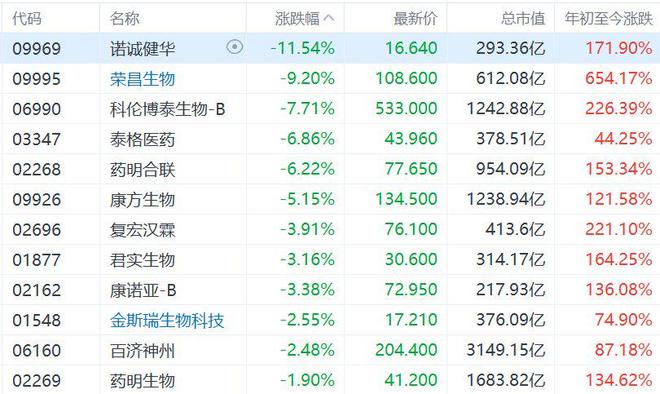
港股生物医药股普跌,荣昌生物跌超9%
Xin Lang Cai Jing· 2025-10-09 03:20
Core Viewpoint - The Hong Kong biopharmaceutical sector experienced a significant decline, with major companies reporting substantial drops in stock prices, indicating a bearish trend in the market [1]. Group 1: Stock Performance - Innovent Biologics (099660) saw a decline of 11.54%, with a latest price of 16.640 and a market capitalization of 293.36 billion, despite a year-to-date increase of 171.90% [2]. - Rongchang Biologics (09995) dropped by 9.20%, priced at 108.600, with a total market value of 612.08 billion, and a remarkable year-to-date increase of 654.17% [2]. - Kelun-Biotech (06990) fell by 7.71%, with a latest price of 533.000 and a market cap of 1,242.88 billion, while still showing a year-to-date increase of 226.39% [2]. - Tigermed (03347) decreased by 6.86%, priced at 43.960, with a market capitalization of 378.51 billion and a year-to-date increase of 44.25% [2]. - WuXi AppTec (02268) experienced a decline of 6.22%, with a latest price of 77.650 and a market cap of 954.09 billion, maintaining a year-to-date increase of 153.34% [2]. - CanSino Biologics (09926) dropped by 5.15%, priced at 134.500, with a market capitalization of 1,238.94 billion, and a year-to-date increase of 121.58% [2]. - Other companies like Junshi Biosciences (01877) and BeiGene (06160) also reported declines, with respective decreases of 3.16% and 2.48% [2].

2025年诺贝尔奖揭晓 创新药新风向标来了
Jing Ji Guan Cha Wang· 2025-10-07 02:35
据央视新闻客户端,当地时间10月6日,瑞典卡罗琳医学院宣布,将2025年诺贝尔生理学或医学奖授予 科学家玛丽·E·布伦科(Mary E.Brunkow)、弗雷德·拉姆斯德尔(Fred Ramsdell)和坂口志文(Shimon Sakaguchi),表彰他们在外周免疫耐受方面的研究贡献,获奖者将平分1100万瑞典克朗(约合832万元 人民币)奖金。 三名获奖者"合力"解码人体免疫系统 诺奖官网公报介绍,人体强大的免疫系统必须得到调节,否则可能会攻击自身器官。三名获奖者在外周 免疫耐受方面取得了突破性发现,坂口志文发现了调节性T细胞,它可以有效阻止免疫系统攻击人体自 身,布伦科和拉姆斯德尔则找到了与之相关的基因,这些成果加深了科学界对免疫系统如何运作的理 解,推动了自身免疫性疾病等方面的研究。 据介绍,人体免疫系统的作用,是保护人体免受数千种不同微生物的入侵,微生物有不同的外观,并且 许多伪装成与人类细胞相似的形式,免疫系统如何决定它应该攻击什么,和它应该防御什么成为免疫机 制的关键。 玛丽·E·布伦科、弗雷德·拉姆斯德尔和坂口志文三位科学家确定了免疫系统的防御机制,即"调节性T细 胞",它可以防止免疫细胞攻击 ...

年内涌现53只“翻倍基”,2025年前三季度基金业绩放榜
Zheng Quan Shi Bao· 2025-10-02 11:11
Core Insights - The public fund industry has experienced a fruitful year in the structural bull market leading up to Q3 2025, with active equity funds making a significant comeback [1] - A total of 53 funds have achieved over 100% returns year-to-date, with active equity funds accounting for 42 of these, highlighting the effective strategies of fund managers in high-growth sectors like technology and innovation [2][4] - Gold ETFs have emerged as the standout performers in the commodity fund sector, with all 14 gold ETFs showing gains exceeding 40% year-to-date [5] Fund Performance - The top-performing fund, managed by Ren Jie, is the Yongying Technology Smart Selection A, with a return of 194.49%, heavily invested in the overseas computing power industry [2] - The second-best performer is the Huatai-PineBridge Hong Kong Advantage Selection A, achieving a return of 155.09%, focusing on Hong Kong's innovative pharmaceutical stocks [2] - Other notable funds include the China Europe Digital Economy A with a return of 140.86%, and two additional funds with returns of over 128% [3] Gold ETF Highlights - Gold ETFs have shown remarkable performance, with the top two funds achieving returns of 41.48% and 41.47% respectively [5] - Over the past three years, these gold ETFs have accumulated returns exceeding 110%, indicating strong long-term investment potential [6] - The recent surge in international gold prices, reaching a high of $3922.7 per ounce, is expected to further enhance the investment value of gold [6] Asset Allocation Outlook - Looking ahead to Q4, market sentiment remains high, with structural opportunities continuing to emerge, although some signs of overvaluation are noted [7] - Investment strategies may shift from growth to cyclical and consumer sectors, with a focus on underperforming cyclical stocks that may benefit from policy changes [8] - The ongoing AI technology revolution is expected to provide a premium for related assets, despite current high valuations [8][9] - The bull market trend is anticipated to continue, with a focus on emerging technologies and cyclical financials, particularly in the Hong Kong market [9]
年内涌现53只“翻倍基”!2025年前三季度基金业绩放榜
证券时报· 2025-10-02 10:55
Core Viewpoint - The public fund industry has experienced a fruitful year in the structural bull market, with active equity funds achieving remarkable performance, particularly in the AI computing and innovative pharmaceutical sectors, leading to a significant number of funds doubling their returns [1][3]. Group 1: Performance of Active Equity Funds - A total of 53 funds have seen their returns exceed 100% year-to-date as of September 30, with 42 of these being active equity funds, highlighting the fund managers' effective strategies in popular sectors like technology growth [3][4]. - The top-performing fund, managed by Ren Jie, achieved a return of 194.49%, heavily investing in the overseas computing industry chain, with significant contributions from stocks like Shenghong Technology, which surged 581% this year [3]. - Other notable funds include Zhang Wei's fund with a 155.09% return, focusing on Hong Kong innovative pharmaceuticals, and Feng Ludan's fund with a 140.86% return, both demonstrating strong performance in their respective sectors [3]. Group 2: Gold ETFs Performance - Gold ETFs have emerged as the standout performers in the commodity fund sector, with all 14 gold ETFs showing year-to-date gains exceeding 40% as of September 30 [6]. - The top gold ETFs, managed by Zhao Xu and Rong Ying, reported returns of 41.48% and 41.47%, respectively, reflecting the strong investment value of gold amid rising international gold prices [6][7]. - Over the past three years, these gold ETFs have accumulated returns exceeding 110%, indicating their robust long-term investment potential [7]. Group 3: Asset Allocation Outlook for Q4 - Looking ahead to Q4, several fund companies have provided asset allocation recommendations, suggesting a focus on growth sectors initially, followed by cyclical and consumer stocks, and finally stable dividend-paying stocks [9][10]. - The ongoing structural opportunities in the market are expected to continue, with a particular emphasis on technology, innovative pharmaceuticals, and sectors benefiting from supply-side improvements, such as new energy and chemicals [10][12]. - Companies like Guotai Fund maintain a bullish outlook on the market, emphasizing the continued importance of emerging technologies and the potential for recovery in sectors like renewable energy due to policy changes [11][12].

康诺亚(02162) - 截至二零二五年九月三十日止月份之股份发行人的证券变动月报表
2025-10-02 08:57
股份發行人及根據《上市規則》第十九B章上市的香港預託證券發行人的證券變動月報表 截至月份: 2025年9月30日 狀態: 新提交 致:香港交易及結算所有限公司 公司名稱: 康諾亞生物醫藥科技有限公司(於開曼群島註冊成立的有限公司) 呈交日期: 2025年10月2日 I. 法定/註冊股本變動 | 1. 股份分類 | 普通股 | 股份類別 | 不適用 | | 於香港聯交所上市 (註1) | | 是 | | | --- | --- | --- | --- | --- | --- | --- | --- | --- | | 證券代號 (如上市) | 02162 | 說明 | | | | | | | | | | 法定/註冊股份數目 | | | 面值 | | 法定/註冊股本 | | | 上月底結存 | | | 500,000,000 | USD | | 0.0001 USD | | 50,000 | | 增加 / 減少 (-) | | | 0 | | | USD | | 0 | | 本月底結存 | | | 500,000,000 | USD | | 0.0001 USD | | 50,000 | 本月底法定/註冊股本總額 ...