
锦江酒店

Search documents
从世界体系聊到科幻想象,观察者网2026答案秀·思想者春晚火爆全网
Guan Cha Zhe Wang· 2026-01-22 09:54
Group 1 - The event "2026 Answers Show" aims to address critical global issues and explore new narratives in a changing world [1][2] - The first segment focuses on the reconstruction of the world system, featuring discussions on US-China relations and the role of emerging countries in shaping a new international order [2][21] - Key speakers include Wang Fan, who discusses the evolution of US-China relations, and Indian diplomat Saran Singh, who emphasizes the importance of viewing the world beyond a binary perspective [2][21] Group 2 - The second segment centers on AI and politics, with experts discussing the reconfiguration of power in the AI era and China's position in global AI competition [7][8] - Notable contributions include Jin Canrong's insights on the intersection of technological advancements and international relations, and suggestions for maintaining China's competitive edge in AI [7][8] - The dialogue also addresses the ethical implications of AI and the need for governance frameworks in a rapidly evolving technological landscape [8] Group 3 - The third segment, "Industrial Fantasia," analyzes China's manufacturing transformation and technological innovation during the 14th Five-Year Plan period [11][12] - Eric Solheim highlights the significance of China's rise in the renewable energy sector for global green transitions, criticizing the previously established international order [11][12] - Discussions include the shift from "Made in China" to "Empowered Globally," showcasing various industry leaders' perspectives on China's role in global markets [11][12] Group 4 - The fourth segment, "Narrative Wars," explores how cultural narratives shape perceptions and the importance of reclaiming narrative control in the film and media industries [17][18] - Notable speakers discuss the challenges faced by Chinese filmmakers and the need for a global expression of Eastern narratives [17][18] - The segment concludes with reflections on the historical context of international relations and the potential for a new era of peace led by China [18] Group 5 - The final segment features discussions among scholars from China, the US, and Russia on the evolving dynamics of international relations and the potential for a multipolar world order [21][22] - Key insights include the recognition of the diminishing effectiveness of traditional international order rules and the emergence of a "jungle law" in global affairs [21][22] - The dialogue emphasizes the need for reform in the international system, with a consensus on the necessity for a new, multipolar approach to global governance [21][22]


酒店餐饮板块1月22日涨0.74%,*ST云网领涨,主力资金净流出895.69万元
Zheng Xing Xing Ye Ri Bao· 2026-01-22 09:01
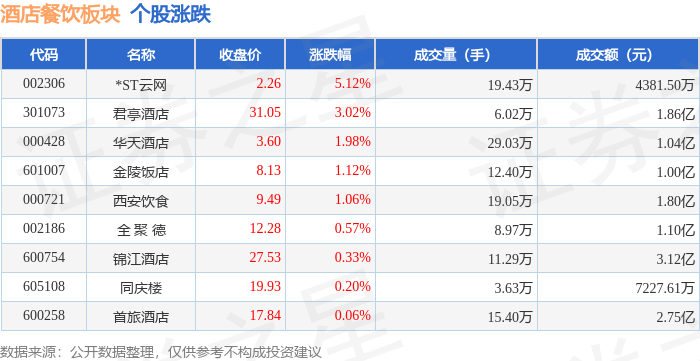
Core Viewpoint - The hotel and catering sector experienced a rise of 0.74% on January 22, with *ST Yunwang leading the gains, while the overall market indices showed modest increases [1] Group 1: Market Performance - The Shanghai Composite Index closed at 4122.58, up 0.14% [1] - The Shenzhen Component Index closed at 14327.05, up 0.5% [1] - The hotel and catering sector stocks showed varied performance, with *ST Yunwang closing at 2.26, up 5.12% [1] Group 2: Stock Performance - *ST Yunwang led the sector with a closing price of 2.26 and a trading volume of 194,300 shares, amounting to a transaction value of 43.81 million yuan [1] - Junting Hotel closed at 31.05, up 3.02%, with a transaction value of 186 million yuan [1] - Huaten Hotel closed at 3.60, up 1.98%, with a transaction value of 104 million yuan [1] - Jinling Hotel closed at 8.13, up 1.12%, with a transaction value of 100 million yuan [1] - Xian Catering closed at 9.49, up 1.06%, with a transaction value of 180 million yuan [1] - Quanjude closed at 12.28, up 0.57%, with a transaction value of 110 million yuan [1] - Jinjiang Hotel closed at 27.53, up 0.33%, with a transaction value of 312 million yuan [1] - Tongqinglou closed at 19.93, up 0.20%, with a transaction value of 72.28 million yuan [1] - Shoulu Hotel closed at 17.84, up 0.06%, with a transaction value of 27.5 million yuan [1] Group 3: Capital Flow - The hotel and catering sector saw a net outflow of 8.96 million yuan from main funds, while retail investors contributed a net inflow of 64.28 million yuan [1] - Junting Hotel had a main fund net inflow of 10.78 million yuan, while retail investors had a net outflow of 5.07 million yuan [2] - *ST Yunwang experienced a main fund net inflow of 8.96 million yuan, with retail investors showing a net outflow of 5.06 million yuan [2] - Huaten Hotel had a net outflow of 1.25 million yuan from main funds, but a net inflow of 8.47 million yuan from retail investors [2] - Jinling Hotel and Quanjude both experienced significant net outflows from main funds, while retail investors showed positive net inflows [2]




2026酒店业新变局:寒冬中探寻突破的持久之道
Sou Hu Cai Jing· 2026-01-21 16:47
Core Viewpoint - The hotel industry is experiencing a dichotomy, with some players struggling while others thrive through innovation in operations and business models, emphasizing efficiency and cash flow health over mere expansion [1][3]. Group 1: Industry Trends - The economic hotel segment is shrinking, with brands like Pudding Hotel and Wan Feng exiting the market, while leading players like Huazhu and Atour are leveraging "stay + retail" and AI technology to enhance their operations [1][3]. - The focus has shifted from opening new locations to improving operational efficiency and innovating business models, as the era of aggressive expansion is over [1][3]. Group 2: Financial Challenges - The hotel industry is capital-intensive, with long payback periods, particularly for mid-range hotels, which now have a return cycle extending to 5-6 years, compounded by tightening financing conditions [3][4]. - Many innovative ideas are hindered by a lack of funding, as hotels face significant financial pressure [3][4]. Group 3: Digital Hotel Solutions - A new digital hotel solution has emerged, aiming to tokenize future revenue rights of hotels into digital equity, allowing public investors to purchase these rights [4][6]. - For example, a hotel with 300 rooms can issue 20,000 digital rights at 2,000 yuan each, generating 40 million yuan in cash without incurring debt, effectively "securitizing" future room revenues [6][7]. Group 4: Benefits of Digital Solutions - This approach provides quick capital for hotels, allowing them to bypass traditional financing routes and directly attract market investment [7][9]. - Tokenizing assets enhances liquidity, enabling holders to transfer rights in a compliant secondary market, thus unlocking the value of previously illiquid assets [7][9]. - The model fosters a win-win ecosystem where equity holders are also long-term customers, enhancing customer loyalty and trust through transparent digital technology [7][10]. Group 5: Future Outlook - With the influx of funds from digital equity sales, hotels can further develop their "stay + retail" offerings, creating more sophisticated environments and products [9][10]. - The integration of AI with clear user profiles and blockchain data can lead to more precise service delivery and automated management of rights [9][10]. - The hotel industry is likely to evolve into a multifaceted value platform that combines investment, consumption, and brand experience, moving beyond traditional accommodation services [10].


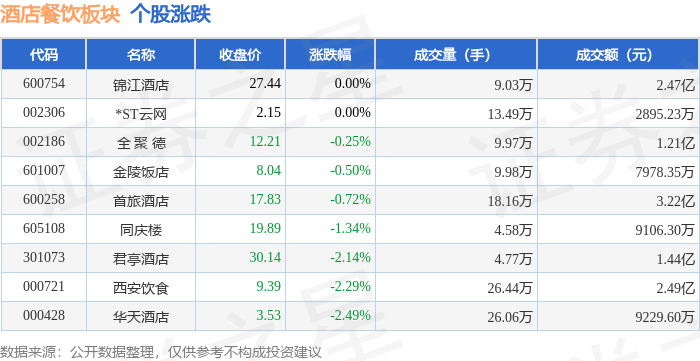
酒店餐饮板块1月21日跌0.77%,华天酒店领跌,主力资金净流出672.61万元
Zheng Xing Xing Ye Ri Bao· 2026-01-21 08:54
| 代码 | 名称 | 主力净流入(元) | 主力净占比 游资净流入 (元) | | 游资净占比 散户净流入 (元) | | 散户净占比 | | --- | --- | --- | --- | --- | --- | --- | --- | | 600258 首旅酒店 | | 3157.27万 | 9.82% | 175.45万 | 0.55% | -3332.72万 | -10.36% | | 000428 华天酒店 | | 664.48万 | 7.20% | -391.40万 | -4.24% | -273.08万 | -2.96% | | 601007 | 金陵饭店 | -43.46万 | -0.54% | 137.69万 | 1.73% | -94.23万 | -1.18% | | 301073 君享酒店 | | -391.39万 | -2.71% | -580.47万 | -4.03% | 971.86万 | 6.74% | | 002306 *ST云网 | | -431.57万 | -14.91% | 401.02万 | 13.85% | 30.55万 | 1.06% | | 002186 | 全 ...
140亿融资,8家上岸,2025文旅IPO回暖了?
Sou Hu Cai Jing· 2026-01-21 04:25
Core Insights - In 2025, various segments of the cultural tourism industry successfully accessed capital markets, with 8 companies raising over 14 billion RMB, while 4 others are awaiting listings in Hong Kong [1] - The A-share market saw a breakthrough with Shaanxi Tourism becoming the only tourism company listed in the A-share market in the past five years [5] - The Hong Kong market remains a primary channel for companies to go public, with a trend towards multi-market listings becoming the norm [1] Group 1: Company Listings - Shaanxi Tourism's successful listing was supported by its core assets, including the performance of the "Chang Hen Ge" show and the Huashan West Peak cableway, contributing over 90% of its revenue [6] - Impression Dahongpao listed in Hong Kong, raising approximately 1.48 billion HKD, but faced a significant drop in share price on its first day, closing down 35.28% [7][8] - Meiya Technology became the first tourism company to pass the review at the Beijing Stock Exchange, aiming to raise 200 million RMB [11] Group 2: Market Trends and Challenges - Despite the influx of companies into the Hong Kong market, many smaller tourism stocks face liquidity issues and low valuations, with most trading in a "仙股化" state [2] - The listing of Impression Dahongpao and others highlights the challenges of maintaining value recognition and liquidity in the market, especially for companies pursuing H-share listings [2] - The automatic driving sector saw significant activity with companies like WeRide and Pony.ai listing in Hong Kong, although they also face substantial losses [19][20] Group 3: Financial Performance - Shaanxi Tourism reported revenues of 1.244 billion RMB and a net profit of 503 million RMB in 2024, with a significant portion of income derived from tourism performances and cableway operations [6] - Impression Dahongpao's revenue from its main performance exceeded 91% of total income from 2022 to 2024, indicating a strong reliance on its core product [7] - Meiya Technology's revenue fluctuated from 457 million RMB in 2022 to 401 million RMB in 2024, with a net profit of 78 million RMB in 2024, reflecting a stabilization in its business model [12]

星级酒店经营数据已经断更一年了
36氪· 2026-01-20 13:38
Core Viewpoint - The hotel industry in China has experienced a significant downturn, with a year-long gap in the reporting of star-rated hotel operating data, raising concerns about the industry's current state and future prospects [4][10][12]. Group 1: Industry Performance - The star-rated hotel operating data has not been updated since December 26, 2024, marking a rare one-year hiatus in reporting [6][7]. - In 2024, the accommodation industry with annual revenue exceeding 2 million yuan reported losses totaling 32.02 billion yuan, with tourism hotels accounting for 23.18 billion yuan of this loss [15][16]. - Only Beijing and Shanghai reported profits in the accommodation sector for 2024, with total profits of 2.13 billion yuan and 240 million yuan, respectively [17]. - The average room rate for five-star hotels decreased to 599.72 yuan, a year-on-year decline of 4.78%, with an average occupancy rate of only 60.73% [22]. Group 2: Market Dynamics - The hotel industry is facing intense competition, leading to a significant increase in supply without a corresponding rise in consumer demand [23]. - The number of hotels in China grew from 252,400 in 2021 to 348,700 in 2024, with room numbers increasing from 13.47 million to 17.64 million [25][26]. - Price competition has led to a detrimental cycle of "low price - low quality - even lower prices," severely impacting profit margins [28][30]. Group 3: Structural Challenges - The star-rated hotel evaluation system is becoming increasingly irrelevant, with the number of star-rated hotels declining from 9,861 in 2016 to 7,245 in early 2024 [34][38]. - The star-rated hotel system's complexity and disconnect from current consumer preferences have led many hotels to lose interest in the rating process [40][42]. - The market is shifting towards brand recognition and service quality rather than traditional star ratings, with many hotel groups developing their own rating systems [44][52]. Group 4: Future of Star Ratings - The star rating system is under review, with new standards implemented in 2024 that reduce requirements for less utilized facilities while emphasizing smart technology and cultural promotion [55]. - The evolving market dynamics suggest that the value of star ratings will increasingly depend on market participants rather than official standards [59][60].

酒店餐饮板块1月20日涨0.01%,首旅酒店领涨,主力资金净流出3395.42万元
Zheng Xing Xing Ye Ri Bao· 2026-01-20 08:57
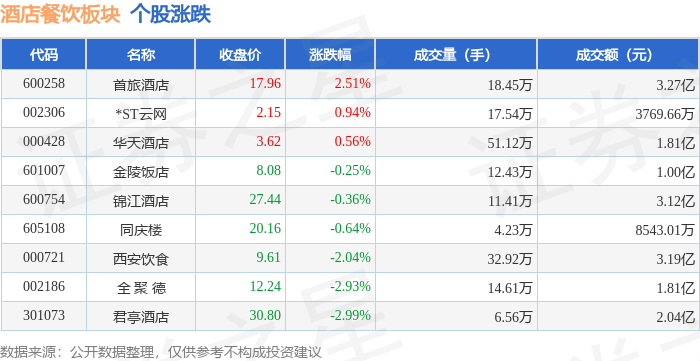
Core Viewpoint - The hotel and catering sector experienced a slight increase of 0.01% on January 20, with Shoulu Hotel leading the gains, while the overall market indices showed a decline [1]. Market Performance - The Shanghai Composite Index closed at 4113.65, down 0.01% - The Shenzhen Component Index closed at 14155.63, down 0.97% [1]. Individual Stock Performance - Shoulu Hotel (600258) closed at 17.96, up 2.51% with a trading volume of 184,500 shares and a turnover of 327 million yuan - ST Yunwang (002306) closed at 2.15, up 0.94% with a trading volume of 175,400 shares and a turnover of 37.7 million yuan - Huatian Hotel (000428) closed at 3.62, up 0.56% with a trading volume of 511,200 shares and a turnover of 181 million yuan - Jinling Hotel (601007) closed at 8.08, down 0.25% with a trading volume of 124,300 shares and a turnover of 100 million yuan - Jinjiang Hotel (600754) closed at 27.44, down 0.36% with a trading volume of 114,100 shares and a turnover of 312 million yuan - Tongqinglou (605108) closed at 20.16, down 0.64% with a trading volume of 42,300 shares and a turnover of 85.4 million yuan - Xianyinshi (000721) closed at 9.61, down 2.04% with a trading volume of 329,200 shares and a turnover of 319 million yuan - Quanjude (002186) closed at 12.24, down 2.93% with a trading volume of 146,100 shares and a turnover of 181 million yuan - Junxi Hotel (301073) closed at 30.80, down 2.99% with a trading volume of 65,600 shares and a turnover of 204 million yuan [1]. Capital Flow Analysis - The hotel and catering sector saw a net outflow of 33.95 million yuan from main funds, while retail investors contributed a net inflow of 31.30 million yuan - The main funds showed a significant outflow from Jinling Hotel (1,482.85 million yuan) and Xianyinshi (2,194.96 million yuan) [1][2]. - Shoulu Hotel had a net inflow of 23.62 million yuan from main funds, while Huatian Hotel saw a net inflow of 14.05 million yuan [2].


酒店-供需驱动-结构优化-酒店行业景气度上行
2026-01-20 01:50
Summary of Hotel Industry Conference Call Industry Overview - The hotel industry is experiencing an upward trend driven by supply-demand dynamics and structural optimization, with a significant mismatch in supply and demand in 2023 due to a post-pandemic demand surge while supply lagged behind, leading to increased Average Daily Rates (ADR) [1][2] - The chain hotel rate in China is approximately 40%, lower than over 70% in the U.S., indicating potential for growth in the chain hotel segment, particularly in the economy sector [1][10] Key Insights - **Supply and Demand Dynamics**: The pandemic caused a significant reduction in hotel supply, with recovery to pre-pandemic levels only occurring in 2023 and 2024. The mismatch in supply and demand has led to a notable increase in ADR, attracting single hotels back into the market, which disrupts the chain rate [2][4] - **Challenges Facing the Industry**: The hotel industry faces challenges such as oversupply, deteriorating operations, and intense competition. Single hotels are heavily reliant on Online Travel Agencies (OTAs) for customer acquisition, facing high commission rates, while large chain hotels are reducing dependence on OTAs through proprietary channels [5][6][8] - **Investor Sentiment**: Despite low returns, investors are attracted to the hotel industry due to stable cash flows, reasonable payback periods (5-6 years, with some regions achieving 4 years), and opportunities for property transformation [5][9] Performance of Major Brands - **Huazhu Group**: The group operates approximately 11,000 to 12,000 stores, with improvements in RevPAR for its economy brands (Hanting, Haiyou) and mid-to-high-end brand (Quanjing) in Q4 2026. However, most other brands have not shown recovery, indicating that the recovery is not widespread across the industry [12][14] - **Investment Returns**: There are significant differences in returns when investing in different hotel brands. For instance, Quanjing has shown higher premiums compared to Jinjiang's Vienna brand, which has performed poorly [13] Future Trends and Recommendations - **Chain Rate Trends**: The chain rate is expected to continue growing, particularly in the luxury and mid-to-high-end segments, while the economy segment may see a decline due to the influx of single hotels [4][9] - **Impact of Policy Changes**: Upcoming policy changes, such as the potential expansion of holiday systems, are expected to positively impact travel and hotel demand, creating more opportunities for the industry [17] - **Recommendations for Investors**: Focus on large chain brands like Huazhu, which have shown strong growth potential. However, due to Huazhu not being available on the Hong Kong Stock Connect, investors are recommended to consider Shoulv, which is showing positive trends [18][19] Conclusion - The hotel industry is in a stabilization phase, with signs of recovery in select brands. However, the overall recovery is not expected to be uniform across the industry, and competition is likely to intensify as single hotels engage in price wars. Investors should prioritize large chain brands with strong growth momentum for future investments [20]
春运“抢票”助推旅游市场升温
Mei Ri Shang Bao· 2026-01-19 23:12
Group 1 - The tourism market is experiencing a surge as the winter and Spring Festival holidays approach, with high-speed train tickets for popular routes becoming difficult to obtain [1][4] - The secondary market for tourism concept stocks has seen significant increases, with companies like Jiuhua Tourism and Dalian Shengya reaching their daily price limits [1][2] - Recent data indicates that travel bookings for the winter and Spring Festival holidays have surpassed last year's figures, with hotel bookings for popular cities during the Spring Festival increasing by 70% year-on-year [1][4] Group 2 - The tourism sector is showing strong performance, with 33 out of 35 tourism concept stocks rising, including notable gains from Jiuhua Tourism and Dalian Shengya [2][3] - Dalian Shengya's stock saw a rapid rebound, reaching a price limit with a trading volume of 9.12 billion yuan and a market capitalization of 6.33 billion yuan [2][3] - Jiuhua Tourism's stock also reached its price limit, driven by factors such as revenue growth and strong cash flow, with a market capitalization of 4.79 billion yuan [3] Group 3 - The upcoming 2026 Spring Festival holiday, lasting from February 15 to February 23, is expected to further stimulate the tourism market, with predictions of record-breaking travel demand [3][4] - The spring transportation season has begun, with reports of sold-out tickets for various destinations, indicating a robust travel demand [4] - Recent policies from the government aim to support the tourism industry through various measures, including enhancing service quality and expanding tourism infrastructure [4][5][6]


春运首日火车票开售 出行需求燃情释放
Zheng Quan Ri Bao· 2026-01-19 16:08
Group 1: Railway Travel Market Trends - The railway travel market is heating up as train tickets for the Spring Festival travel period officially went on sale on January 19, leading to a surge in A-share tourism-related stocks, with companies like Dalian Shengya and Jiuhua Tourism hitting the daily limit [1] - Data from Tongcheng Travel indicates that by January 19, multiple train routes from Beijing to cities like Changchun and Shenyang were sold out, with popular departure cities including Guangzhou, Chongqing, Chengdu, Beijing, and Shenzhen, primarily catering to students returning home and business travelers [1] - The Spring Festival holiday this year is notably long, lasting 9 days, which is the longest in history, with flight booking volumes for travel services during this period increasing by over 30% year-on-year, and the peak travel day expected to be February 19, with bookings up over 40% compared to last year [1] Group 2: Reverse Spring Festival Travel Trend - The trend of "reverse Spring Festival" is becoming more pronounced, with many families shifting from the traditional model of children returning home to parents traveling to their children's workplaces for the holiday, resulting in a 35% year-on-year increase in bookings for reverse Spring Festival flights [2] - Popular departure cities for reverse travel include Zhengzhou, Wuhan, Xi'an, Changsha, Chengdu, Harbin, and Changchun, while destinations are concentrated in major cities like Beijing, Shanghai, Guangzhou, Shenzhen, and Hangzhou, indicating a flow from central and western cities to first-tier and new first-tier cities [2] - The longer holiday period allows for more flexible travel arrangements, which is expected to alleviate the pressure of concentrated passenger flow during traditional Spring Festival travel, leading to a more balanced distribution of travelers [2] Group 3: Service Optimization Measures - To meet the travel demand during the Spring Festival, the railway department has introduced service optimization measures, including a new feature on the 12306 platform allowing passengers to self-process refunds for mistakenly purchased tickets without fees if done within 30 minutes of payment and more than 4 hours before departure [3] - The active travel market is closely linked to the overall recovery of service consumption, with the National Bureau of Statistics reporting a 5.5% year-on-year growth in service retail sales in 2025, particularly in sectors like cultural and recreational services, communication services, and travel consulting [3] - The upcoming Spring Festival travel period is expected to be the first concentrated release of demand for the year, with diverse travel needs driving the continued positive development of the tourism market and service consumption [3]