平安银行

Search documents
年内企业ABS发行规模破万亿元,公募基金两年内首次环比增持
Xin Lang Cai Jing· 2025-09-30 08:08
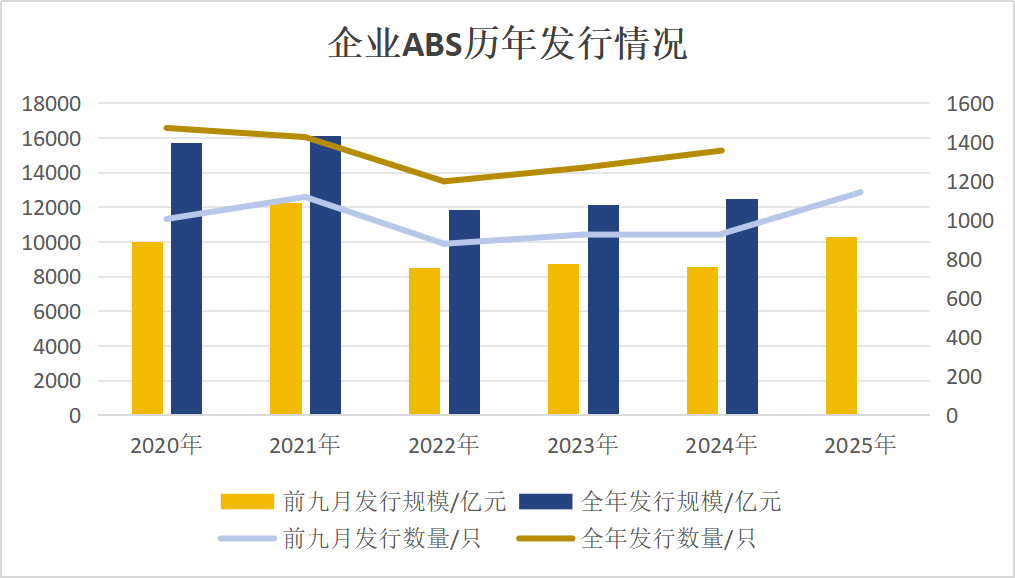
Core Insights - The issuance scale of corporate Asset-Backed Securities (ABS) has exceeded 1 trillion yuan in 2023, reaching 10,321 billion yuan by the end of September, marking a year-on-year increase of over 20% [1][8] - This level is approaching the total issuance scale for the entire year of 2024, which is projected to be 12,483 billion yuan, and represents the first time since 2022 that the number of corporate ABS issued has surpassed 1,000 in September [1][8] Issuance Trends - A total of 1,142 corporate ABS have been issued as of September 2023, with significant growth in large-scale issuances, particularly those exceeding 2 billion yuan, which have seen a year-on-year increase of 17.65% [1][5] - The largest single issuance this year is the "CITIC Financial Asset Yunfan Phase 1" plan, with a scale of 10.01 billion yuan, achieving the lowest cost and narrowest spread among similar products [6][8] Types of ABS - Corporate ABS is primarily issued by non-financial enterprises and is regulated by the China Securities Regulatory Commission, while credit ABS is issued by financial institutions and circulates mainly in the interbank market [5][8] - Traditional underlying assets for ABS include accounts receivable, lease rentals, trust loan rights, small loans, and consumer loans, with over 800 products issued in these categories, accounting for more than 70% of total corporate ABS issuance [6][8] Innovation in ABS - New types of ABS based on data assets, intellectual property, and low-altitude economy have emerged, with the recent issuance of the "Huaxin-Xinxin Data Asset Phase 1" plan marking a significant development in data asset securitization [7][8] - Data asset ABS allows companies to convert dormant data resources into financing, particularly benefiting technology firms with insufficient collateral [7][8] Market Dynamics - The ABS market is experiencing a surge in both issuance and secondary market activity, driven by strong demand from small and medium-sized enterprises seeking to optimize their financing structures [8][9] - Regulatory support and the introduction of new fundraising mechanisms are expected to further expand the ABS market [8][10] Investor Participation - Institutional investors, including trust institutions and banks, are the primary participants in the ABS market, with trust institutions increasing their holdings significantly [10][11] - Public funds have also begun to increase their ABS holdings, with a notable rise in the number of funds participating [11][12] Yield and Risk - ABS products typically offer higher yields compared to standard bonds, with the average coupon rates for different tiers of ABS varying significantly, reflecting the risk-return profile of the underlying assets [14][16] - The current low-interest-rate environment has made ABS an attractive investment option for institutional investors, providing a unique opportunity for yield enhancement [14][16]

企业资产支持证券产品报告(2025年8月):发行规模有所收缩,融资成本下行态势趋缓,二级市场活跃度走低但同比仍呈提升趋势
Zhong Cheng Xin Guo Ji· 2025-09-30 07:31
Group 1: Report Overview - The report is titled "Enterprise Asset - Backed Securities Product Report (August 2025)" and is a regular report from CCXI [5]. Group 2: Industry Investment Rating - No industry investment rating is provided in the report. Group 3: Core Viewpoints - In August 2025, the issuance scale of enterprise asset - backed securities shrank, with a 8.81% decline compared to the previous month and a 20.69% decline compared to the same period last year. The trading activity in the secondary market decreased month - on - month but still increased year - on - year. The downward trend of financing costs slowed down [5][23]. Group 4: Issuance Situation - In August 2025, 125 single enterprise asset - backed securities were issued, with a total issuance scale of 117.181 billion yuan. Compared with the previous month, the number of issuances increased by 3, but the scale decreased by 8.81%. Compared with the same period last year, the number decreased by 10, and the scale decreased by 20.69% [5][6]. - In terms of issuance venues, the Shanghai Stock Exchange issued 81 products with an amount of 80.279 billion yuan (68.51% of the total), and the Shenzhen Stock Exchange issued 44 products with an amount of 36.902 billion yuan (31.49% of the total) [6]. - The top five original equity holders in terms of issuance scale were China Railway Capital Co., Ltd. (7.465 billion yuan, 6.37%), China Great Wall Asset Management Co., Ltd. (7.32 billion yuan, 6.25%), China Railway Trust Co., Ltd. (6.611 billion yuan, 5.64%), Huaxin International Trust Co., Ltd. (5.4 billion yuan, 4.61%), and China National Foreign Trade Trust Co., Ltd. (5.165 billion yuan, 4.41%). The total issuance scale of the top five was 31.961 billion yuan, accounting for 27.27% [7]. - The top five managers in terms of new management scale were Shanghai Guotai Haitong Securities Asset Management Co., Ltd. (17.66%), Ping An Securities Co., Ltd. (10.61%), CITIC Securities Co., Ltd. (10.33%), China International Capital Corporation Limited (8.23%), and Shenwan Hongyuan Securities Asset Management Co., Ltd. (6.98%). The total new management scale of the top five was 63.05 billion yuan, accounting for 53.81% [9][10]. - The underlying asset types mainly included personal consumer finance, accounts receivable, enterprise financial leasing, CMBS, and micro - loans. Personal consumer finance accounted for 22.74% of the scale, accounts receivable accounted for 19.13%, and enterprise financial leasing accounted for 14.13% [12]. - The highest single - product issuance scale was 5.1 billion yuan, and the lowest was 0.51 billion yuan. The products with a single - issuance scale in the range of (5, 10] billion yuan had the largest number and scale, with 53 products and an amount accounting for 36.84% [15]. - The shortest term was 0.71 years, and the longest was 39.02 years. The products with a term in the range of (1, 3] years had the largest number and scale, with 67 products and an amount accounting for 44.37% [16][17]. - In terms of grade distribution, AAAsf - rated securities accounted for 90.95% [17]. - The lowest issuance interest rate of one - year - around AAAsf - rated securities was 1.71%, and the highest was 2.48%. The interest rate center was approximately between 1.70% and 1.90%, with the median decreasing by about 2BP month - on - month and about 28BP year - on - year [20]. Group 5: Filing Situation - In August 2025, 99 single enterprise asset - backed securities were filed with the Asset Management Association of China, with a total scale of 87.592 billion yuan [5][24]. Group 6: Secondary Market Trading Situation - In August 2025, enterprise asset - backed securities traded 3,566 times on the exchange market, with a total transaction amount of 77.112 billion yuan. The number of transactions decreased by 743 month - on - month and increased by 1,076 year - on - year. The transaction amount decreased by 24.39% month - on - month and increased by 47.56% year - on - year. The Shanghai Stock Exchange accounted for 79.09% of the amount, and the Shenzhen Stock Exchange accounted for 20.91% [5][25]. - The more active underlying asset types in the secondary market were class REITs (27.38%), CMBS (12.44%), supply chain (11.89%), accounts receivable (11.83%), and personal consumer finance (9.53%) [25]. Group 7: Maturity Situation in September 2025 - In September 2025, 172 outstanding enterprise asset - backed securities were due for repayment, with a total scale of 49.737 billion yuan. The main underlying assets were accounts receivable (46.63%), supply chain (16.31%), policy loan (11.26%), and personal consumer finance (8.35%) [27]. - In terms of original equity holders, China Railway Capital Co., Ltd. had 7 due securities with a repayment scale of 6.583 billion yuan (13.24%), China Railway Trust Co., Ltd. had 4 due securities with a repayment scale of 6.012 billion yuan (12.09%), and China Pacific Life Insurance Co., Ltd. had 6 due securities with a repayment scale of 5.602 billion yuan (11.26%) [27].
多方协同筑屏障 30余家机构为高校学子撑起金融消费“安全伞”
Sou Hu Cai Jing· 2025-09-30 02:01
Core Points - The event "Safeguarding Youth, Worry-Free Consumption" aims to enhance financial education and create a healthy consumption environment on campus, initiated by the Shenzhen Consumer Council and other organizations [1][3] - The activity focuses on protecting the financial rights of young students and ensuring consumption safety through various interactive formats, including skits and anti-fraud lectures [3][5] - The event gathered nearly a thousand students, highlighting the importance of financial literacy among youth who are often vulnerable to financial scams [3][6] Group 1 - The event integrates resources from government, industry associations, universities, and market institutions to build a collaborative financial education model [3][12] - The Shenzhen Consumer Council emphasizes that financial education in schools is crucial for protecting youth consumption rights and promoting a healthy market [5][12] - The event featured real-life case studies of financial fraud, educating students on common scams and prevention strategies [6][10] Group 2 - Interactive experiences, such as skits depicting financial risks, helped students better understand their financial rights [8][10] - Financial institutions provided one-on-one consultations to address practical financial questions, enhancing student engagement [8][12] - The event serves as a replicable model for financial education in other universities, aiming to equip students with essential financial skills for their future [12]

21社论丨推动货币政策措施落实落细,充分释放政策效应
2 1 Shi Ji Jing Ji Bao Dao· 2025-09-29 22:37
Core Viewpoint - The recent meetings of the Central Political Bureau and the People's Bank of China indicate a shift in monetary policy focus towards execution, reflecting confidence in the current economic stability and a reduced necessity for aggressive easing measures [1][2]. Group 1: Economic Performance - The industrial added value for large-scale enterprises grew by 6.2% year-on-year in the first eight months of the year, slightly lower than the 6.4% growth in the first half [1]. - The service production index maintained a year-on-year growth of 5.9%, consistent with the first half of the year [1]. - The economy is expected to achieve the annual growth target of 5.0%, indicating that there is no immediate need for policy intensification [1]. Group 2: Monetary Policy Adjustments - The People's Bank of China has shifted its language from "implementing a moderately loose monetary policy" to "ensuring detailed implementation," emphasizing the importance of execution [1][2]. - The net interest margin for commercial banks narrowed to a historical low of 1.42% in the second quarter, raising concerns about the impact of monetary easing on bank profitability [2]. - The central bank's focus is on balancing financial support for the real economy while maintaining the health of financial institutions [2]. Group 3: Policy Tools and Coordination - The central bank is committed to maintaining ample liquidity through various tools such as reverse repos and medium-term lending facilities [3]. - Structural monetary policy tools will be utilized to support sectors like technology innovation, consumption, small and micro enterprises, and foreign trade [3]. - There is an emphasis on the coordination between fiscal and monetary policies, with discussions on government bond issuance and offshore RMB bond mechanisms [3][4].
银行股回调背后: 谁在抛售 谁在加仓
Zhong Guo Zheng Quan Bao· 2025-09-29 22:18
9月29日,银行板块(申万一级行业)指数盘中冲高回落,收盘跌0.46%。若将时间拉长,自7月11日以 来,银行板块指数呈阶段性下行趋势,8月上旬经小幅反弹后,持续波动回调至今,整体跌幅超14%。 多位业内人士告诉中国证券报记者,短期套利资金撤出与市场风险偏好抬升是导致近期银行股持续震荡 的主要因素,本轮调整与银行基本面关系不大。展望后市,阶段性调整不改银行股估值修复的长期逻 辑。四季度银行板块本就容易出现行情,尤其是经历了三季度的回调,银行股迎来估值修复的机会更 大。随着政策加码,险资、主动基金、被动基金等都有望为银行板块带来增量资金。 银行股持续回调 "7月以来,我们发现A股市场风险偏好有所提升,活跃资金倾向于配置科技类、成长类等弹性更高的板 块。同时,存款搬家趋势显现,部分高净值客户愿意去投资一些较高风险的资产。"某股份行董事会办 公室相关负责人告诉记者。 虽然银行股近段时间缺乏亮眼表现,但业内人士认为,银行股对资金的吸引力依然较强,它们是险资、 社保基金等中长期资金的心头好。随着政策持续加码,今年以来,多项利好政策鼓励险资入市,接下 来,银行股或仍为受益标的。 数据显示,截至二季度末,险资共出现在超70 ...
平安银行将派发中期分红每10股2.36元,股权登记日10月14日
Bei Jing Shang Bao· 2025-09-29 13:57
Core Viewpoint - Ping An Bank announced a cash dividend distribution plan for 2025, reflecting its commitment to returning value to shareholders [1] Summary by Sections Dividend Distribution - The bank will distribute a cash dividend of RMB 2.36 per 10 shares, amounting to a total cash dividend of RMB 4.58 billion, based on a total share capital of 19.406 billion shares as of June 30, 2025 [1] - The dividend distribution will not include stock dividends or capital reserve transfers [1] Key Dates - The record date for the dividend distribution is set for October 14, 2025, while the ex-dividend date is October 15, 2025 [1]

平安银行:2025年半年度权益分派实施公告
Zheng Quan Ri Bao Zhi Sheng· 2025-09-29 13:40
证券日报网讯 9月29日晚间,平安银行发布2025年半年度权益分派实施公告称,公司2025年半年度权益 分派方案为每10股派2.3600元人民币现金(含税),股权登记日为2025年10月14日,除权除息日为2025 年10月15日。 (编辑 任世碧) ...
平安银行(000001) - 2025年半年度权益分派实施公告
2025-09-29 12:45
证券代码:000001 证券简称:平安银行 公告编号:2025-043 优先股代码:140002 优先股简称:平银优 01 平安银行股份有限公司 2025 年半年度权益分派实施公告 本公司及董事会全体成员保证信息披露的内容真实、准确、完整,没有虚假记载、误导 性陈述或重大遗漏。 平安银行股份有限公司 2025 年半年度权益分派方案已获 2025 年 8 月 22 日 召开的本公司第十二届董事会第四十二次会议审议通过,现将权益分派事宜公告 如下: 一、董事会审议通过利润分配方案等情况 1、根据本公司 2023 年年度股东大会的授权,2025 年 8 月 22 日,本公司第 十二届董事会第四十二次会议审议通过了《平安银行股份有限公司 2025 年中期 利润分配方案》:以本公司 2025 年 6 月 30 日的总股本 19,405,918,198 股为基数, 每 10 股派发现金股利人民币 2.36 元(含税),合计派发现金股利人民币 45.80 亿元,不送红股,不以公积金转增股本。 2、在实施本次利润分配方案的股权登记日前,若本公司总股本发生变动, 按照分配总额不变的原则,相应调整分配比例。 本公司 2025 年 ...
双节消费季,银行信用卡营销激战
Bei Jing Shang Bao· 2025-09-29 12:38
Core Viewpoint - The article highlights the surge in consumer spending during the extended holiday period, prompting banks to launch various credit card promotions to capture market share, while emphasizing the need for a long-term strategy beyond short-term marketing tactics [1][5][7]. Group 1: Consumer Trends - During the holiday season, domestic travel intentions increased by 30% year-on-year, and outbound travel demand grew by over 40% [1]. - Banks are responding to this consumer enthusiasm by offering targeted credit card promotions that include discounts, cashback, and exclusive offers across various spending categories [1][3]. Group 2: Bank Strategies - Major banks such as Bank of China, Agricultural Bank of China, and China Merchants Bank have introduced special credit card offers for the holiday season, focusing on travel, shopping, and dining [3][4]. - For instance, Bank of China launched a "Double Festival Global Travel" campaign, providing significant discounts and cashback for cardholders traveling to popular destinations [3]. Group 3: Marketing Effectiveness - Analysts note that promotional strategies like cashback and discounts effectively meet immediate consumer needs and can significantly boost credit card usage during holiday periods [5][9]. - However, there is a call for banks to integrate these short-term promotions with a sustainable long-term benefits system to enhance customer loyalty and usage frequency [5][9]. Group 4: Industry Challenges - Despite the promotional activities, the credit card industry faces growth challenges, with many banks reporting a decline in transaction volumes compared to previous years [7][8]. - For example, while China Merchants Bank led the industry with a transaction volume of 2.02 trillion yuan, it still experienced an 8.54% decrease year-on-year [7]. Group 5: Future Directions - Banks are focusing on transforming their credit card business by optimizing customer acquisition strategies and enhancing service offerings to adapt to changing market conditions [8][10]. - There is an emphasis on deepening the integration of credit cards into everyday consumer scenarios and improving risk management through advanced data analytics [9][10].

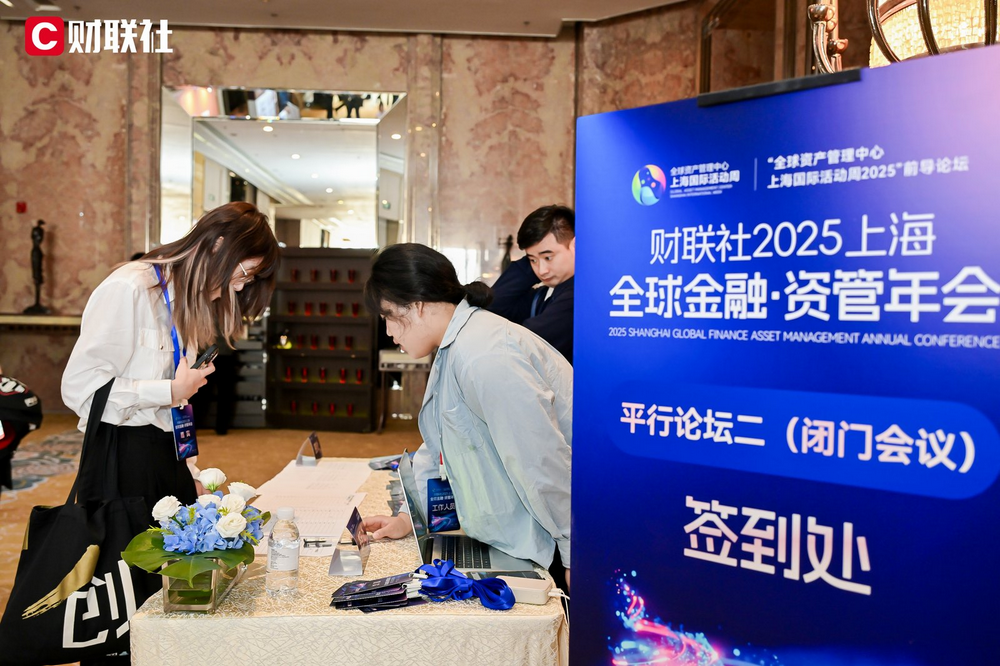
共话国家战略下的金融新使命!2025财联社“金融五篇大文章”主题论坛成功举办
Xin Lang Cai Jing· 2025-09-29 12:21
Core Insights - The conference focused on five key areas of finance: technology finance, green finance, inclusive finance, pension finance, and digital finance, emphasizing the financial industry's role in supporting national strategies and empowering the real economy [1] Group 1: AI in Banking - The Chief Technology Officer of Industrial and Commercial Bank of China (ICBC) discussed the application prospects and practical paths of large model technology in the banking sector, highlighting the bank's goal of creating a comprehensive financial model technology system [3][5] - ICBC aims to be a pioneer in the development and application of artificial intelligence, while facing challenges such as insufficient data quality, increased computing power demands, and difficulties in algorithm adaptation [5] Group 2: Opportunities for Foreign Banks - HSBC China emphasized the investment opportunities in China due to its large market size, complete industrial chain, and active innovation ecosystem, which continue to attract multinational companies [5][7] - The acceleration of China's capital market internationalization, development of panda bonds, and the promotion of RMB internationalization are seen as significant opportunities for foreign institutions [7] Group 3: Life Insurance Industry Transformation - The CEO of Cigna & Evergrande Life Insurance acknowledged the challenges faced by the life insurance industry in a low-interest-rate environment, indicating a need for collective action to address risks [7][9] - Cigna & Evergrande is focusing on reducing liability costs, increasing the proportion of participating insurance products, and enhancing health management ecosystems as part of its "big health" strategy [9] Group 4: Green Finance Challenges - A roundtable discussion highlighted the significant potential of the green finance market, but noted challenges such as the lack of unified standards and the need for improved data infrastructure [11] - Experts pointed out that while there are innovative green finance products, they often lack a standardized product system, making them difficult to replicate and promote [11] Group 5: Technology Finance Collaboration - A second roundtable focused on the collaborative mechanisms in technology finance, noting a shift from traditional single debt models to a "debt + equity" cooperation model between banks and investment institutions [13] - The discussion emphasized the importance of banks in supporting technology enterprises through customized asset allocation and family trust services, creating a service loop from enterprises to individuals [13][14]