北方稀土

Search documents
中国稀土集团:严格落实出口管制政策
Zheng Quan Shi Bao Wang· 2025-10-23 12:01
Core Viewpoint - The China Rare Earth Group held an economic operation analysis meeting for Q3 2025, outlining key tasks for Q4, emphasizing strict adherence to export control policies and enhancing production stability [1] Group 1: Key Tasks for Q4 - The company will focus on strict implementation of export control policies and conducting operations in compliance with laws [1] - There will be an emphasis on stabilizing production and supply to ensure operational continuity [1] - The company aims to enhance governance levels through state-owned enterprise reform initiatives [1] Group 2: Innovation and Development - The company plans to strengthen technological innovation to boost development momentum [1] - Project advancement will be prioritized to accelerate the pace of development [1] Group 3: Risk Management - The company will focus on risk prevention to establish a solid foundation for development [1]


掘金三季报!146家上市公司披露业绩预告,哪些板块跑出多匹“黑马”?
Hua Xia Shi Bao· 2025-10-23 10:57
Core Insights - The A-share market is experiencing a peak in the disclosure of Q3 reports and forecasts, with 146 companies having released their forecasts by October 22, 2025, of which 121 companies reported positive earnings expectations, indicating a strong operational signal for the market [2][3] Company Performance - Among the 121 companies with positive earnings forecasts, 60 companies expect their net profits to double, and 5 companies anticipate profit increases exceeding 10 times, including XianDa Co., ChuJiang New Materials, YingLian Co., ShuoBeiDe, and Guangdong Ming [3][4] - XianDa Co. expects a net profit of 180 million to 205 million yuan, representing a year-on-year increase of 2807.87% to 3211.74%, driven by significant price increases of its main product, and operational reforms [4] - ChuJiang New Materials forecasts a net profit of 350 million to 380 million yuan, with a year-on-year increase of 2057.62% to 2242.56%, attributed to product upgrades and capacity release [4] Turnaround Companies - Nine companies successfully transitioned from losses to profits, including BingChuan Network, Shandong Steel, and GuangSheng Nonferrous, with BingChuan Network reporting a net profit of 435 million to 565 million yuan [5][6] - Shandong Steel's profit is around 140 million yuan, while GuangSheng Nonferrous expects a profit of 100 million to 130 million yuan, with improvements in efficiency and cost reductions driving their performance [5] Industry Highlights - The non-ferrous metals and chemical industries are leading the positive earnings forecasts, with companies benefiting from price increases and demand recovery [7][8] - Notable performers in the non-ferrous metals sector include YaHua Group, which expects a net profit of 320 million to 360 million yuan, and BeiFang Rare Earth, with a forecast of 1.51 billion to 1.57 billion yuan, reflecting significant year-on-year growth [7] - In the chemical sector, LiMin Co. anticipates a net profit of 384 million to 394 million yuan, while BaTian Co. expects 676 million to 736 million yuan, both showing substantial year-on-year increases [8]


解密主力资金出逃股 连续5日净流出653股
Zheng Quan Shi Bao Wang· 2025-10-23 09:52
Core Insights - As of October 23, a total of 653 stocks in the Shanghai and Shenzhen markets have experienced a net outflow of main funds for five consecutive days or more, indicating a significant trend of capital withdrawal from these stocks [1] Group 1: Stocks with Longest Net Outflow - Tianma Technology has the longest streak of net outflow, with 27 consecutive days [1] - Enwei Pharmaceutical follows with 19 consecutive days of net outflow [1] Group 2: Stocks with Highest Total Net Outflow - Northern Rare Earth has the highest total net outflow amounting to 6.479 billion yuan over 8 days [1] - BYD ranks second with a total net outflow of 4.138 billion yuan over 5 days [1] Group 3: Stocks with Highest Net Outflow Proportion - BYD also leads in terms of the proportion of net outflow relative to trading volume, with a 19.67% outflow ratio over the past 5 days [1] - Other notable stocks with significant outflow proportions include Shanghai Electric at 7.39% and Shanzi Gaoke at 9.91% [1] Group 4: Performance of Affected Stocks - Northern Rare Earth has seen a cumulative decline of 13.82% during the net outflow period [1] - BYD has experienced a 3.06% drop over the last 5 days [1] - Other stocks like Shanghai Electric and Shanzi Gaoke have also reported declines of 11.56% and 18.14% respectively [1]

10月23日沪投资品(000102)指数涨0.5%,成份股德业股份(605117)领涨
Sou Hu Cai Jing· 2025-10-23 09:05
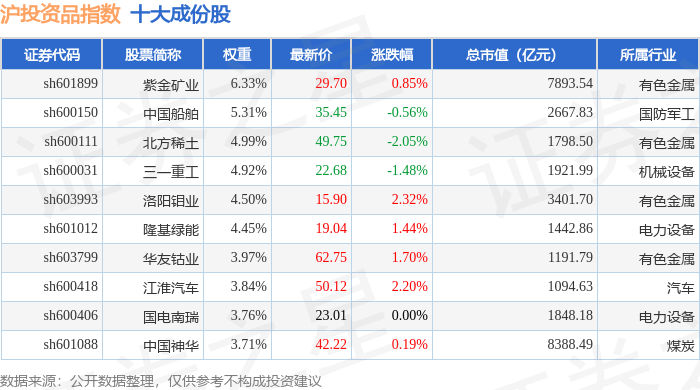
Core Points - The Shanghai Investment Products Index (000102) closed at 7184.98 points, up 0.5%, with a trading volume of 649.17 billion yuan and a turnover rate of 1.29% [1] - Among the index constituents, 32 stocks rose while 15 fell, with DeYe Co., Ltd. leading the gainers at 4.61% and Hengli Hydraulic leading the decliners at 2.9% [1] Index Constituents Summary - The top ten constituents of the Shanghai Investment Products Index include: - Zijin Mining (6.33% weight, latest price 29.70, market cap 789.35 billion yuan) in the non-ferrous metals sector [1] - China Shipbuilding (5.31% weight, latest price 35.45, market cap 266.78 billion yuan) in the defense industry [1] - Northern Rare Earth (4.99% weight, latest price 49.75, market cap 179.85 billion yuan) in the non-ferrous metals sector [1] - SANY Heavy Industry (4.92% weight, latest price 22.68, market cap 192.20 billion yuan) in the machinery sector [1] - Luoyang Molybdenum (4.50% weight, latest price 15.90, market cap 340.17 billion yuan) in the non-ferrous metals sector [1] - Longi Green Energy (4.45% weight, latest price 19.04, market cap 144.29 billion yuan) in the power equipment sector [1] - Huayou Cobalt (3.97% weight, latest price 62.75, market cap 119.18 billion yuan) in the non-ferrous metals sector [1] - JAC Motors (3.84% weight, latest price 50.12, market cap 109.46 billion yuan) in the automotive sector [1] - Guodian NARI Technology (3.76% weight, latest price 23.01, market cap 184.82 billion yuan) in the power equipment sector [1] - China Shenhua Energy (3.71% weight, latest price 42.22, market cap 838.85 billion yuan) in the coal sector [1] Capital Flow Summary - The net outflow of main funds from the index constituents totaled 627 million yuan, while retail investors saw a net inflow of 527 million yuan [3] - Key stocks with significant capital flow include: - China Aluminum (net inflow of 43.41 million yuan from main funds) [3] - Luoyang Molybdenum (net inflow of 33.70 million yuan from main funds) [3] - Jianghuai Automobile (net inflow of 19.50 million yuan from main funds) [3] - Longi Green Energy (net inflow of 16.40 million yuan from main funds) [3] - Huayou Cobalt (net inflow of 158 million yuan from main funds) [3]





大国博弈的新战场:美澳矿产协议引爆检测仪器技术较量
仪器信息网· 2025-10-23 08:06
Core Viewpoint - The strategic partnership between the US and Australia aims to establish a "de-China" rare earth supply chain, significantly impacting the strategic mineral industry [2][3]. Agreement Core: Building a Strategic Mineral Supply Chain - The US and Australia signed an $8.5 billion critical minerals agreement, planning to invest over $1 billion each in mining and processing projects within six months [3]. - The agreement covers the entire industry chain from exploration to final product manufacturing, focusing on critical minerals like gallium, rare earth elements, lithium, and cobalt, which are essential for high-tech industries [5]. - The Pentagon will invest in a high-end gallium refining plant in Western Australia with an annual capacity of 100 tons, addressing the US's complete reliance on imports for gallium [5]. Full Industry Chain Driving Instrument and Testing Market - The agreement will boost the demand for analytical testing instruments in three main areas: - Exploration phase demand surge due to the need for geological exploration instruments for accurate mineral assessments [6]. - Quality control during production, where online monitoring and laboratory analysis instruments are crucial for ensuring product quality and efficiency [6]. - Export regulatory compliance, increasing the need for authoritative testing services and supporting instruments due to stricter export controls [7]. Market Response and Price Trends - The implementation of the US-Australia critical minerals agreement is expected to expand the market for critical mineral testing instruments [8]. - Global rare earth prices are rising, with dysprosium prices doubling to $850 per kilogram and terbium prices increasing from $965 to $3,000 per kilogram, a cumulative increase of over 210% [8]. - The combination of rising prices and increased production will lead mining companies to invest more in quality control and composition analysis, driving up testing instrument procurement budgets [8]. Chinese Market: Short-term Pain and Long-term Opportunities - The US-Australia minerals agreement and China's new export controls will have profound effects on China's analytical instrument market: - Short-term export pressure on Chinese rare earth and superhard materials due to new export controls [9]. - Acceleration of domestic substitution as the US-China tech decoupling trend necessitates upgrades in domestic scientific instruments [9]. - Opportunities for technological upgrades as Chinese rare earth companies shift towards high-end manufacturing, increasing demand for high-end analytical instruments [9]. Instrument Technology Evolution: Addressing New Industry Demands - Detection technology is evolving in two main directions to meet new demands from the critical minerals industry: - On-site rapid screening technology, exemplified by portable X-ray fluorescence spectrometers (XRF), allows for quick qualitative and semi-quantitative analysis of critical minerals [10]. - Laboratory precision analysis technology, including large analytical instruments like ICP-MS and XRD, provides accurate quantitative analysis and phase identification to meet high standards for product quality control and compliance [10]. Strategic Background: Reshaping Global Supply Chain Dynamics - The agreement is rooted in a strategic context where China controls approximately 70% of global rare earth mining and 90% of separation and processing [12]. - The current supply chain structure, where over 70% of rare earth minerals mined in the US are exported to China for processing, gives China significant pricing power in the global rare earth value chain [12]. - The US-Australia critical minerals agreement not only signifies immediate equipment procurement needs but also represents long-term opportunities for technological upgrades and market expansion in the testing instrument sector [12].

有色ETF基金(159880)涨超1.1%,锂电带动有色金属走强
Xin Lang Cai Jing· 2025-10-23 07:15
Core Viewpoint - The non-ferrous metal industry index has shown strong performance, with significant gains in lithium-related stocks, driven by advancements in solid-state battery technology and expanding applications in various sectors [1][2]. Group 1: Industry Performance - As of October 23, 2025, the non-ferrous metal industry index (399395) increased by 1.23%, with notable stock performances from companies like Zhongfu Industrial (600595) up 5.82% and Ganfeng Lithium (002460) up 5.20% [1]. - The non-ferrous ETF fund (159880) rose by 1.13%, with the latest price at 1.71 yuan [1]. Group 2: Technological Advancements - At the 2025 New Energy Battery Industry Development Conference, Xinwanda introduced a new generation of polymer all-solid-state batteries with an energy density of 400 Wh/kg and a cycle life of 1200 weeks under ultra-low pressure [1]. - Xinwanda plans to establish a 0.2 GWh polymer solid-state battery pilot line by the end of this year and has successfully developed laboratory samples of lithium metal super batteries with an energy density of 520 Wh/kg [1]. Group 3: Market Trends - The application of lithium batteries is rapidly expanding into diverse fields such as electric two-wheelers, low-altitude economy, robotics, and RVs [2]. - In the first half of 2025, domestic sales of lithium batteries for electric two-wheelers surged by over 40% year-on-year, with industrial and consumer-grade drone batteries expected to grow at a CAGR of 18.08% from 2025 to 2030 [2]. - Global robot shipments are projected to increase by over 39% in 2024, while RV lithium battery sales are expected to grow at a CAGR of 8.55% from 2025 to 2031 [2]. Group 4: Index Composition - As of September 30, 2025, the top ten weighted stocks in the non-ferrous metal industry index include Zijin Mining (601899), Northern Rare Earth (600111), and Ganfeng Lithium (002460), collectively accounting for 53.12% of the index [3].


最新资金净流入1.36亿元,稀有金属ETF(562800)份额创成立以来新高!
Xin Lang Cai Jing· 2025-10-23 02:50
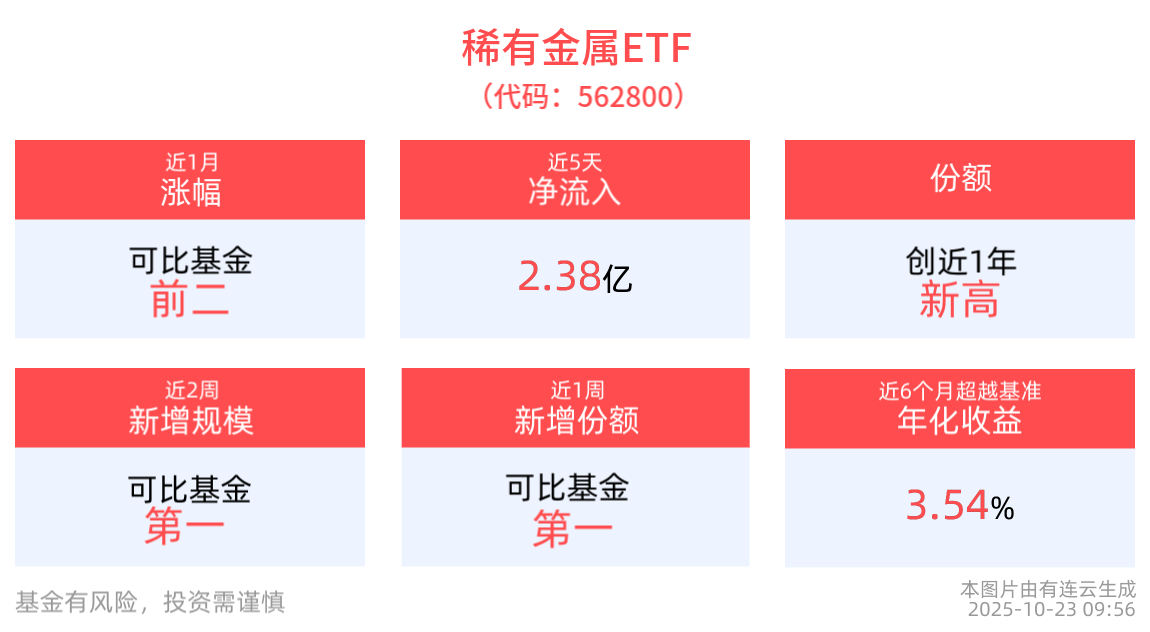
Group 1: ETF Performance - The rare metals ETF recorded an intraday transaction of 32.1891 million yuan, with a significant scale increase of 707 million yuan over the past two weeks, ranking first among comparable funds [3] - The latest share count for the rare metals ETF reached 4.626 billion, marking a new high since its inception and also ranking first among comparable funds [3] - The ETF saw a net inflow of 136 million yuan recently, accumulating a total of 238 million yuan over the last five trading days [3] Group 2: Historical Returns - As of October 22, 2025, the net value of the rare metals ETF has increased by 10.66% over the past three years [3] - The highest monthly return since inception was 24.02%, with the longest streak of consecutive monthly gains being five months and a maximum cumulative gain of 66.25%, averaging a monthly return of 8.60% during rising months [3] Group 3: Industry Supply and Demand - On the supply side, global electrolytic aluminum supply growth is below 3% due to constraints from energy and infrastructure, while small metals like molybdenum, antimony, and gallium face resource depletion and insufficient investment [4] - On the demand side, sectors such as data center construction, power infrastructure upgrades, new energy vehicles, energy storage, photovoltaics, 5G, and aerospace are driving rigid demand for copper, aluminum, lithium, and rare earths [4] Group 4: Market Outlook - Industry experts believe that the global manufacturing investment cycle is on the rise, coupled with a growing need for strategic metal resource reserves amid de-globalization, which will continue to boost demand for non-ferrous metals [4] - The current macroeconomic recovery logic in China is strengthening, suggesting that non-ferrous metals may become core assets in the upcoming slow bull market, with a focus on industrial non-ferrous metals, small metals, and gold over the next one to two years [4] Group 5: Top Weighted Stocks - The top ten weighted stocks in the CSI Rare Metals Theme Index account for a total of 59.91%, including Northern Rare Earth, Luoyang Molybdenum, Huayou Cobalt, and others [3]
稀土行业供需格局有望迎来拐点,稀土ETF嘉实(516150)近2周规模增长超26亿元同类居首!
Sou Hu Cai Jing· 2025-10-23 02:10
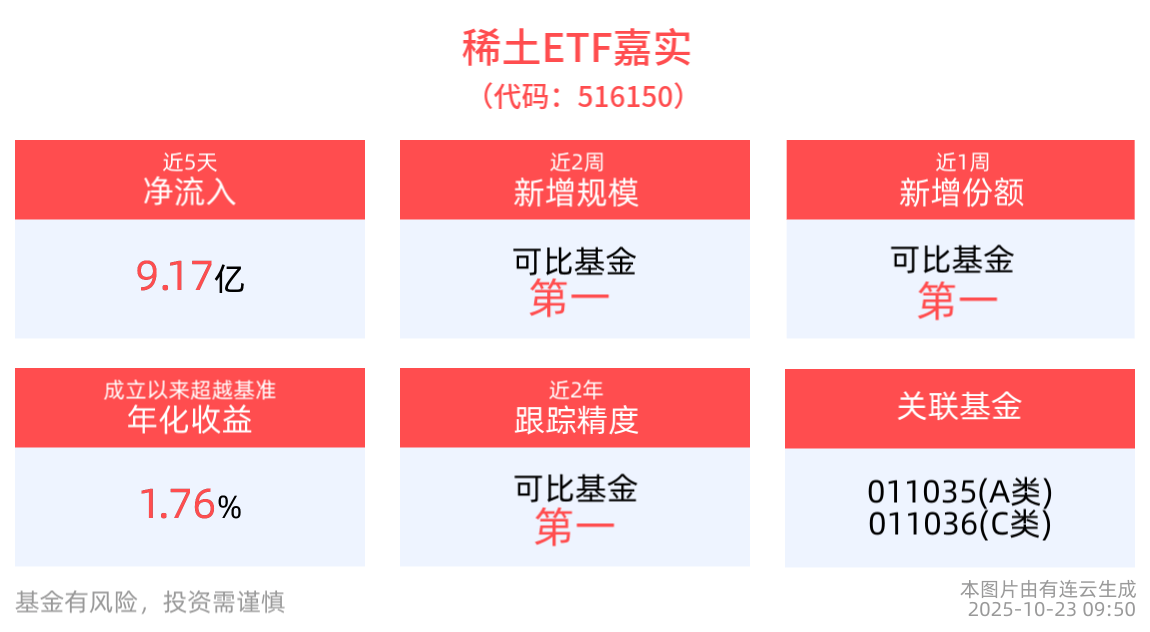
Group 1: Liquidity and Performance of Rare Earth ETF - The liquidity of the Rare Earth ETF managed by Jiashi reached a trading volume of 97.241 million yuan [3] - Over the past two weeks, the scale of the Rare Earth ETF increased by 2.632 billion yuan, marking significant growth and ranking first among comparable funds [3] - In terms of shares, the ETF saw an increase of 10.7 million shares in the past week, also ranking first among comparable funds [3] - In the last five trading days, there were net inflows on three days, totaling 917 million yuan [3] - As of October 22, the net value of the Rare Earth ETF has risen by 88.51% over the past two years, ranking 88th out of 2358 index equity funds, placing it in the top 3.73% [3] - The highest monthly return since inception was 41.25%, with the longest consecutive monthly increase being four months and a maximum increase of 83.89% [3] Group 2: Market Dynamics and Policy Impact - The Ministry of Commerce, in conjunction with the General Administration of Customs and other departments, has issued multiple export control policies, highlighting the strategic nature of rare earth resources [4] - The combination of regulatory constraints and declining imports has strengthened the rigidity of rare earth supply [4] - Demand from sectors such as new energy vehicles, consumer electronics, variable frequency air conditioners, and wind power is expected to continue rising, providing strong support for rare earth prices [4] - Emerging fields like robotics, low-altitude economy, and industrial motors are anticipated to open up long-term demand growth opportunities [4] - The supply-demand dynamics in the rare earth industry are expected to reach a turning point, with a continued recommendation for strategic allocation in the rare earth industry chain [4] Group 3: Top Weighting Stocks in Rare Earth Industry - The top ten weighted stocks in the China Rare Earth Industry Index account for 61.96% of the index, including Northern Rare Earth, Wolong Electric Drive, Lingyi Technology, China Rare Earth, Shenghe Resources, Gree Environmental, Goldwind Technology, Baotou Steel, Xiamen Tungsten, and China Aluminum [3]



冲中国稀土地位?美澳85亿稀土协议落地,特朗普:量多到用不完
Sou Hu Cai Jing· 2025-10-22 15:51
Core Viewpoint - The article discusses the strategic importance of rare earth elements in technology and military applications, highlighting the U.S. efforts to reduce dependence on China for these critical materials through a new agreement with Australia [2][3]. Group 1: U.S.-Australia Rare Earth Agreement - The U.S. and Australia have established an $8.5 billion rare earth supply framework agreement, with plans for both governments to invest over $1 billion each in the next six months, totaling over $3 billion for Australian mining projects [2][3]. - The agreement includes a $2.2 billion financing commitment from the U.S. Export-Import Bank to seven Australian companies, focusing on key projects like a gallium metal refinery in Western Australia [3]. - The collaboration aims to create a supply chain independent of China, with potential joint projects involving Japan [3]. Group 2: China's Dominance in Rare Earths - China holds approximately 37% of global rare earth reserves, with a production share exceeding 69%, making it the dominant player in the industry [5][6]. - The country has a complete supply chain for rare earths, from mining to refining, and controls 85% of domestic mining quotas and 90% of refining capacity [5]. - China's technological advancements in rare earth processing, including a high purity separation technology, give it a significant competitive edge [5]. Group 3: Challenges for U.S.-Australia Cooperation - Despite the agreement, experts suggest that it will be challenging for the U.S. and Australia to significantly reduce China's dominance in the short term due to the latter's extensive resources and established supply chain [6]. - Australia’s processing capabilities still rely heavily on China, and building independent processing facilities will take years and face environmental and technical hurdles [6]. - The initial market reaction to the agreement has been positive, with Australian rare earth stocks seeing a rise, but long-term production increases will take years to materialize [6]. Group 4: Geopolitical Context - The agreement is part of a broader strategy by the U.S. to counter China's influence amid escalating geopolitical competition, with the U.S. also increasing tariffs on Chinese imports [8]. - Australia’s strategic position as an ally is enhanced by its involvement in the AUKUS nuclear submarine agreement, which further solidifies its role in U.S. supply chain strategies [8]. Group 5: Future Implications - The agreement may encourage other countries to develop their rare earth resources, with nations like Pakistan, Kazakhstan, and Uzbekistan exploring new mining opportunities [10]. - The rising global demand for rare earths, driven by electric vehicles and green energy, is expected to increase the importance of these materials in the coming years [10].
A股市场交投趋冷,后市投资主线在哪?
Guo Ji Jin Rong Bao· 2025-10-22 15:12
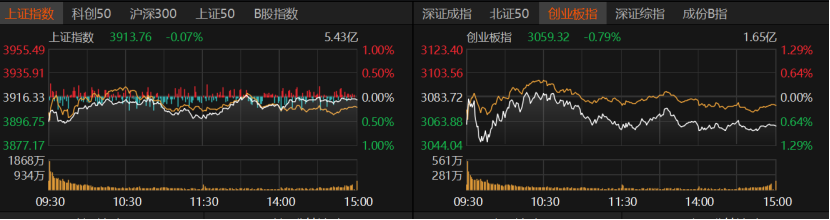
Market Overview - The A-share market experienced fluctuations on October 22, with the Shanghai Composite Index slightly down by 0.07%, the Shenzhen Component down by 0.62%, and the ChiNext Index down by 0.79% [1][3] - The total market turnover was 1.69 trillion yuan, a decrease of 200 billion yuan compared to the previous trading day [2][3] - Market sentiment is cautious, with trading volumes consistently below 2 trillion yuan since October 16 [3] Investment Sentiment - Current market conditions suggest that favorable factors slightly outweigh the suppressive ones, leading to a likely horizontal consolidation and slow upward trend [1][7] - Investors are advised to increase liquidity safety margins and wait for clearer directional signals before increasing positions [11] Sector Performance - There has been a recent shift from technology growth stocks to value dividend stocks, although the medium-term outlook remains positive for growth stocks [1][9] - The technology sector, particularly AI, new energy, and domestic substitution, continues to present structural opportunities despite recent adjustments [7][10] Individual Stock Highlights - Notable individual stock movements include Cambrian Technologies (688256) rising by 4.42% to 1429.50 yuan per share, approaching the price of Kweichow Moutai [5] - The trading volume for individual stocks was mixed, with 2,280 stocks rising and 2,965 stocks falling [5] Market Dynamics - The market is currently characterized by a rotation between sectors, with traditional cyclical stocks providing support amid the adjustment in technology stocks [9][10] - Analysts suggest that the recent adjustments are primarily due to profit-taking and the cautious approach of investors during the earnings reporting period [9] Future Outlook - The market is expected to maintain a high-level consolidation, with technology growth remaining the main investment theme [10] - Key macro variables to watch include the clarity of U.S.-China trade policies and the focus of China's 14th Five-Year Plan, which could provide sustained investment themes [11]