
抖音

Search documents
2025抖音美食内容创作年度报告:「吃商」爆炸元年,年轻人用好好吃饭诠释“爱你老己”:抖音x新榜
新经销· 2026-02-06 14:11
Investment Rating - The report does not explicitly provide an investment rating for the industry [4]. Core Insights - The concept of "eating commerce" has emerged as the annual core concept, reflecting young people's understanding, pairing, and recreation of food, marking a shift from physiological satisfaction to emotional expression and self-pleasure [6]. - Three main keywords define the creative trends: "rebellious cooking," "eating commerce evolution," and "de-mystifying delicacy," which highlight a shift towards creativity and authenticity in food content [7][8][9]. - The content creation style reflects collective emotions, categorized into four evolutionary directions: rebellion, buffering, evolution, and rebirth, each resonating deeply with user sentiments [10][11][12][13]. - Trend activities, such as various challenge competitions, have stimulated co-creation enthusiasm, transforming individual creation into community activities [14]. Summary by Sections Research Background Assessment - The report is a collaboration between Douyin and Xinbang, leveraging extensive user-generated data and third-party industry insights to ensure reliability and depth [4]. - The research focuses on food content creation on the Douyin platform, primarily targeting the domestic Chinese market and overseas students [5]. Key Data Capture and Presentation - Significant data points include: - The topic "rebellious food" has a view count of 1.73 billion [16]. - The topic "home-cooked dishes" has a view count of 211.02 billion [16]. - The number of challenge competitions in the food circle that exceeded 100 million views in 2025 is 13, with a total of 1.03 million submissions [18].
国家数据局局长刘烈宏主持召开系列专家企业代表座谈会听取对“十五五”时期数字中国规划和建设的意见建议
Mei Ri Jing Ji Xin Wen· 2026-02-06 14:08
Group 1 - The National Bureau of Statistics held four symposiums to gather opinions from industry experts and company representatives on advancing the construction of Digital China [1] - Experts and representatives from major companies such as Huawei, Tencent, Alibaba, and Baidu participated, discussing the challenges and trends in the industry during the 14th Five-Year Plan period [1] - There was a consensus among participants that the planning is systematic and leading, effectively addressing social concerns and enhancing development confidence [1]

抖音2025冰雪消费报告:冰雪团购订单量同比涨98% 亲子家庭成消费主力军
Zhong Guo Jing Ji Wang· 2026-02-06 08:15
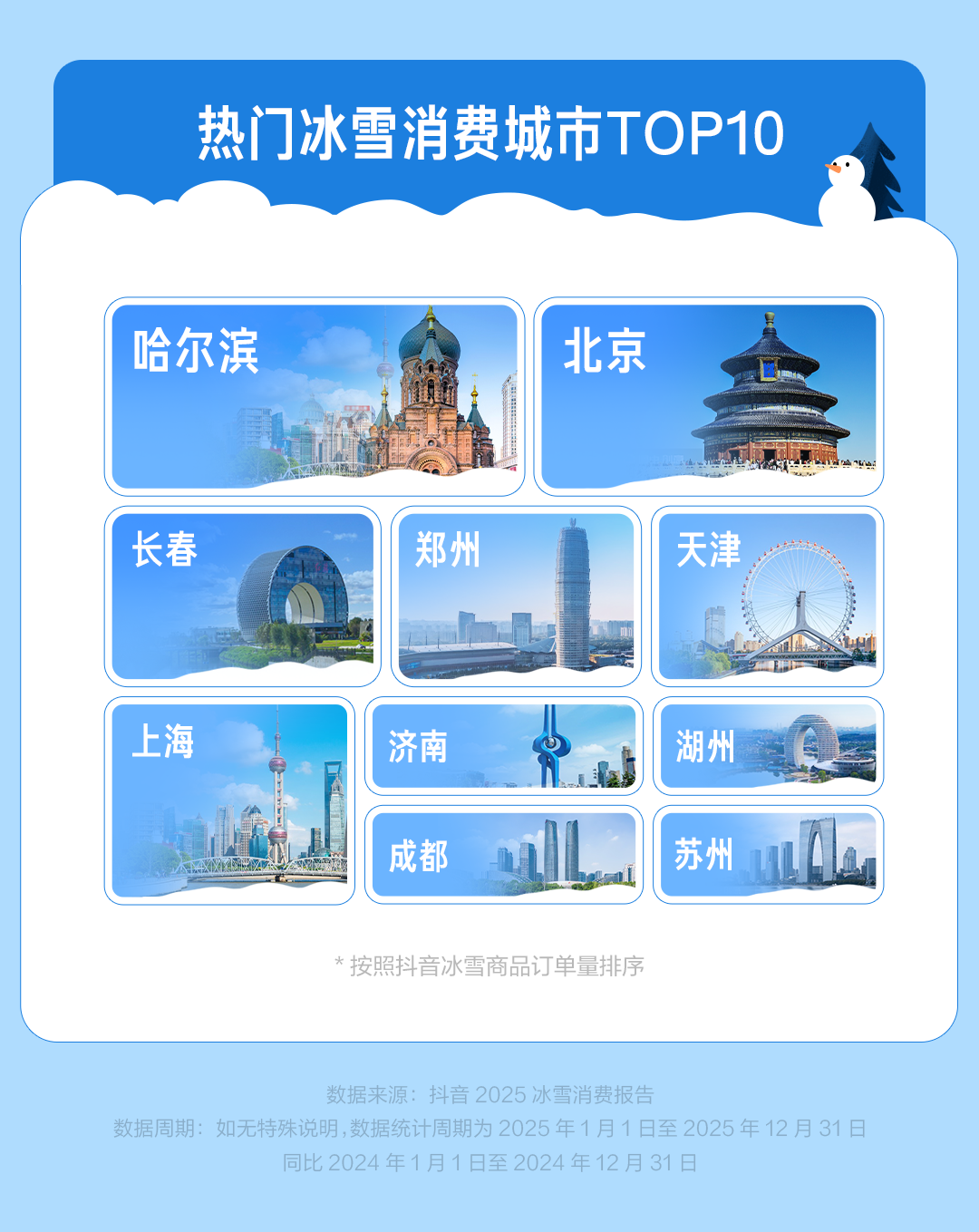
Core Insights - Douyin's "2025 Ice and Snow Consumption Report" indicates a significant growth in ice and snow-related content and consumption, with over 12.69 million related posts in the past year, marking a year-on-year increase of over 128% [1] - The report highlights a surge in group buying orders for ice and snow activities, with a 98% year-on-year increase, and 15.66 million users showing interest in ice and snow group purchases, up 79% [1] Group 1: Consumption Trends - The report identifies indoor skiing as a rising trend, with cities like Shanghai, Wuhan, and Huzhou leading in indoor skiing consumption, showing year-on-year growth in group buying orders of 77%, 1852%, and 116% respectively [4] - The "South to North" trend in ice and snow consumption is gaining momentum, with the northern ice and snow industry belt seeing a 108% increase in group buying orders [4] - Family-oriented consumers and the "new generation" are the main drivers of ice and snow consumption, with family orders accounting for over 55% and the new generation contributing over 17% [7] Group 2: Popular Activities and Locations - The report lists five popular ice and snow activities: skiing, hot springs, winter swimming, ice fishing, and ice sculpture [3] - Major cities for ice and snow consumption include Harbin, Beijing, Changchun, Zhengzhou, Tianjin, Shanghai, Jinan, Huzhou, Chengdu, and Suzhou [3] - Top attractions for ice and snow activities include Harbin Ice and Snow World, Zhengzhou Yinji Ice and Snow World, and others [3] Group 3: Future Initiatives - Douyin plans to launch an "Ice and Snow Season" event starting November 2025, collaborating with 19 types of merchants to offer over 50,000 ice and snow products [7] - The initiative aims to stimulate local ice and snow consumption through promotions and exclusive consumer subsidies [7] - Douyin will leverage content marketing, influencer partnerships, and unique IP collaborations to enhance offline ice and snow consumption [7]

屈田:复盘极兔出海全球的“三次突围”
混沌学园· 2026-02-06 07:07
Core Viewpoint - The notion that "not going overseas means being out of the game" is a fallacy, and blindly expanding internationally can be more dangerous [1] Group 1: Strategic Insights - True champions understand the strategy of "winning before fighting," summarized in the formula: Time and Space Selection × Deep Localization = Overseas Champions [2][9] - The success of companies like J&T Express is attributed to their ability to navigate crises and achieve critical breakthroughs, demonstrating the importance of strategic planning in international expansion [6][15] Group 2: Market Dynamics - The recent partnership between J&T Express and SF Express represents a significant alliance between the largest express companies in China and emerging markets, with a combined market value of $40 billion [5] - J&T Express has become the largest express company in Southeast Asia, holding a 33% market share and processing 27 million packages daily, indicating its strong market position [20] Group 3: Expansion Phases - J&T Express's first breakthrough was establishing a foothold in Southeast Asia, particularly Indonesia, which has the fastest e-commerce penetration growth outside of China and the U.S. [19] - The second breakthrough involved returning to China to leverage the changing market dynamics, where the share of major players was declining, allowing new entrants to gain a foothold [23][25] - The third breakthrough was global expansion into Latin America, the Middle East, and Africa, capitalizing on the global growth of Chinese e-commerce platforms [27] Group 4: Localization Importance - Deep localization is crucial for success in international markets, requiring teams to be physically present in the target country to understand the market effectively [8][30] - Companies must adopt a startup mentality when entering new markets, ensuring that local teams are empowered and not managed remotely [30] Group 5: Recommendations for Companies - Companies should assess whether they should go overseas, as not all are suited for international expansion; the idea that "not going overseas means being out of the game" is misleading [32] - It is advisable for companies to align with major trends and platforms when expanding internationally, as J&T Express did by following the global e-commerce trend [33] - Careful consideration is needed when choosing the first market for expansion, whether it be developed markets or emerging ones [34]

千问红包,被微信封禁
Sou Hu Cai Jing· 2026-02-06 06:59
Group 1 - The "Spring Festival 3 Billion Free Order" campaign by Qianwen App launched on February 6, allowing users to order milk tea for free using AI-generated phrases, resulting in over 1 million orders within 3 hours [1] - Qianwen adjusted the default sharing method for red envelopes on WeChat to "password red envelopes" in response to platform restrictions [2] - WeChat has previously banned red envelopes during the Spring Festival marketing period, including those from its subsidiary Yuanbao, indicating a crackdown on excessive marketing and misleading sharing practices [4] Group 2 - On February 5, Baidu's Wenxin Assistant faced a similar ban on its red envelope sharing link by WeChat, which cited misleading content as the reason for the block [6] - Following the ban, Baidu also switched to a "password red envelope" format, requiring users to manually copy the password to participate in the activity, a common method to bypass platform restrictions [6]



小餐馆“假装营收少”的日子结束了
第一财经· 2026-02-06 02:49
Core Viewpoint - The article discusses the impact of new tax regulations on the restaurant industry, particularly focusing on small and medium-sized restaurants that are now facing increased scrutiny and compliance requirements due to the "Internet Platform Enterprises Tax Information Reporting Regulations" implemented in 2025 [8][9][10]. Group 1: Tax Regulations and Compliance - The new tax regulation requires platforms to report merchants' real transaction data to tax authorities, affecting not only large companies but also small restaurants that previously operated in a gray area regarding tax compliance [8][9]. - The regulation has created a "survival line" of 5 million yuan in annual revenue, where exceeding this threshold forces restaurants to transition from small-scale to general taxpayers, significantly increasing their tax burden [10][11]. - The tax rate for small-scale taxpayers is 3%, while general taxpayers face a rate of 6%, with additional implications for cash flow and profit margins [10][11]. Group 2: Impact on Small Restaurants - Small restaurants, often run by individuals with limited financial literacy, have historically underreported income and avoided tax compliance, but the new regulations are forcing them to adapt [9][10]. - Many small restaurants are now scrambling to obtain business licenses and adjust their reporting practices to avoid being classified as general taxpayers, which would increase their tax liabilities [12][13]. - The article highlights the anxiety among restaurant owners as they navigate the new tax landscape, with some resorting to strategies like underreporting income to stay below the revenue threshold [11][12]. Group 3: Industry Adaptation and Future Outlook - The article suggests that the new regulations may ultimately lead to a healthier restaurant industry by eliminating unfair competition driven by tax evasion and underreporting [25][26]. - As restaurants become more compliant, the reliance on platforms like Meituan and Douyin for sales data will increase, making it harder for businesses to manipulate their reported income [16][18]. - The shift towards compliance is expected to phase out practices like "brushing orders" and low-priced meal packages that have contributed to unhealthy competition in the industry [25][26].
2025抖音美食内容创作年度报告:「吃商」爆炸元年,年轻人用好好吃饭诠释“爱你老己”-抖音x新榜
抖音x新榜· 2026-02-06 01:35
Investment Rating - The report does not explicitly provide an investment rating for the industry [4]. Core Insights - The concept of "eating commerce" has emerged as the annual core concept, reflecting young people's understanding, pairing, and recreation of food, marking a shift from physiological satisfaction to emotional expression and self-pleasure [6]. - Three main keywords define the creative trends: "rebellious cooking," "eating commerce evolution," and "deconstruction of delicacy" [7][8][9]. - The creative styles reflect collective emotions, categorized into four evolutionary directions: rebellion, buffering, evolution, and rebirth [10][11][12][13]. - Trends such as challenge events (e.g., ShortVideoStirringCompetition) have stimulated co-creation enthusiasm, transforming individual creation into community activities [14]. Summary by Sections Research Background Assessment - The report is a collaboration between Douyin and Xinbang, leveraging extensive user-generated content data and third-party industry analysis for reliable insights [4]. - The research focuses on food content creation on Douyin, primarily within mainland China, while also considering overseas student content [5]. Key Data Capture and Presentation - Significant topic playback volumes include: - HomeCooking: 2110.2 million - CreativeFood: 118.0 million - RebelliousFood: 17.3 million - ThickSkinOrange: 60.8 million - EverythingCanBeCosfood: 6.1 million - In 2025, there were 13 food-related challenge events with a total of 1.03 million submissions [16][18].
围剿“仅退款”,电商告别草莽时代
Shen Zhen Shang Bao· 2026-02-05 23:01
Core Viewpoint - The recent implementation of the "Network Transaction Platform Rules Supervision Management Measures" marks a significant shift in the e-commerce landscape, aiming to combat the malicious "only refund" practices that have plagued the industry, thus signaling the end of a chaotic era in e-commerce [1][8]. Group 1: Background and Evolution of "Only Refund" Mechanism - The "only refund" mechanism was introduced in 2021 to address the high logistics costs associated with returning perishable goods, allowing consumers to receive refunds without returning items, which initially reduced costs for both consumers and merchants [2][3]. - As the e-commerce industry shifted towards a focus on user retention, platforms began to excessively promote the "only refund" policy across all categories, leading to widespread misuse and a competitive race to offer the most lenient return policies [2][3]. Group 2: Impact on Merchants - Merchants have faced significant challenges due to the lack of oversight in the "only refund" process, with some consumers exploiting the system to obtain refunds without returning products, leading to substantial financial losses for businesses [3][4]. - The misuse of the "only refund" policy has created a detrimental ecosystem where dishonest consumers profit at the expense of honest merchants, forcing the latter to either cut costs or raise prices to compensate for losses [4][6]. Group 3: Regulatory Response and Platform Adjustments - In response to the escalating issues, major e-commerce platforms began to refine their "only refund" policies in late 2024, with initiatives aimed at enhancing merchant autonomy and reducing the incidence of malicious refund requests [6][8]. - The introduction of the "Network Transaction Platform Rules Supervision Management Measures" on February 1, 2026, explicitly prohibits platforms from forcing merchants to accept "only refund" requests, marking a pivotal regulatory intervention [8]. Group 4: Future Outlook - The ongoing regulatory efforts and platform reforms are expected to restore balance in the e-commerce ecosystem, fostering a healthier environment for both consumers and merchants, as evidenced by improved merchant sentiments regarding platform policies [8]. - The application of AI technology to detect fraudulent refund claims is also being implemented, further supporting merchants in combating abuse of the refund system [7][8].

围剿“仅退款” 电商告别草莽时代
Shen Zhen Shang Bao· 2026-02-05 21:21
Core Viewpoint - The recent implementation of the "Network Transaction Platform Rules Supervision Management Measures" marks a significant shift in the e-commerce landscape, aiming to combat malicious "only refund" practices that have plagued the industry for years [1][8]. Group 1: Background and Evolution of "Only Refund" Mechanism - The "only refund" mechanism was introduced in 2021 to address the high logistics costs associated with returning perishable goods, allowing consumers to receive refunds without returning items [2]. - Initially intended as a consumer-friendly solution, the mechanism was misused as e-commerce platforms prioritized user retention and customer satisfaction, leading to its expansion across all product categories [2][3]. - The misuse of the "only refund" policy resulted in a surge of fraudulent claims, with consumers exploiting the system to obtain refunds without legitimate reasons [3][4]. Group 2: Impact on Merchants and Industry - The proliferation of malicious refund claims created a detrimental environment for honest merchants, forcing them to either cut costs, lower product quality, or raise prices, ultimately harming the overall market ecosystem [4]. - Reports indicate significant financial losses for merchants due to fraudulent activities, with some individuals exploiting the system to generate substantial profits through repeated "only refund" claims [4][7]. - The situation escalated to the point where the "only refund" mechanism became synonymous with legal exploitation, leading to a crisis in merchant trust and operational viability [4][5]. Group 3: Regulatory Response and Industry Adjustments - In response to the growing chaos, e-commerce platforms began to refine their "only refund" policies starting in late 2024, with measures aimed at protecting merchants and curbing fraudulent activities [6]. - The introduction of the "Network Transaction Platform Rules Supervision Management Measures" in February 2026 explicitly prohibits platforms from forcing merchants to accept malicious refunds, signaling a regulatory shift towards fairer practices [8]. - E-commerce platforms are now implementing new technologies, such as AI for detecting fraudulent claims, and enhancing merchant support systems to restore balance in the marketplace [7][8].
上海家电数码购新补贴:新增“线下即时摇号”
Guo Ji Jin Rong Bao· 2026-02-05 14:07
2月4日晚,上海市商务委发布《上海市2026年落实国家家电以旧换新、数码和智能产品购新补贴政 策实施细则》,在原有线上摇号基础上,新增"线下即时摇号"参与方式,通过即摇、即中、即用的模 式,进一步满足消费者线下门店选购补贴商品的需求,该模式于2月5日起正式落地。 据悉,2026年上海家电以旧换新、数码和智能产品购新补贴整体仍以报名摇号、中签发券的形式开 展,此前已完成三轮线上报名摇号。 需要提醒的是,已参与线上摇号报名的消费者,在开始报名至完成发券期间(5天内)资格被锁 定,无法参与"线下即时摇号"活动,之后可以参与活动。 本次补贴覆盖品类与线上保持一致,包括6类家电产品和4类数码智能产品。其中,家电产品为1级 能效或水效标准的冰箱(含冰柜)、洗衣机、电视、空调(含中央空调)、热水器(含壁挂炉)、电脑 (含台式和便携式计算机);数码和智能产品为单件售价不超6000元的手机、平板、智能手表(手 环)、智能眼镜。补贴标准为产品扣除各环节优惠后最终售价的15%,每人每类限补贴1件,家电产品 单件补贴最高不超1500元,数码和智能产品单件补贴最高不超500元。 以云闪付APP为例,进入"政府以旧换新补贴"应用服务并选 ...