
江苏银行

Search documents
付文生再次出任宁波银行副行长,兼任公司党委副书记
Nan Fang Du Shi Bao· 2026-02-04 04:35
Core Viewpoint - Ningbo Bank has officially appointed Fu Wensheng as the vice president, marking his return to the executive team after over ten years in a similar role, which is expected to enhance the bank's governance and operational capabilities [2][4][6]. Group 1: Management Changes - Fu Wensheng's appointment as vice president is effective immediately following approval from the Ningbo Financial Regulatory Bureau, solidifying his role within the bank's leadership [2][4]. - Fu Wensheng has a strong background, having served in various key positions within Ningbo Bank and other financial institutions, which positions him as a core executive with both management and party responsibilities [6][7]. Group 2: Governance Structure - The current management structure of Ningbo Bank consists of a "one president and six vice presidents" model, which includes a diverse team with significant experience and a focus on internal cultivation [7]. - The stability of the management team is highlighted by the long tenure of Chairman Lu Huayu and the recent promotion of President Zhuang Lingjun, indicating a strategic approach to leadership development [7]. Group 3: Financial Performance - As of the end of 2025, Ningbo Bank's total assets reached 3.63 trillion yuan, reflecting a 16.11% increase from the beginning of the year [8]. - The bank reported total revenue of 71.968 billion yuan for the year, an 8.01% year-on-year growth, with net profit attributable to shareholders increasing by 8.13% to 29.333 billion yuan [8]. - Notably, interest income grew by 10.77% to 53.161 billion yuan, and net commission income surged by 30.72% to 6.085 billion yuan, showcasing the bank's strong performance in wealth management and other light capital businesses [8].



银行股集体上扬,渝农商行涨超2%成“领头羊,渝农商行涨超2%领跑,多股跟涨超1%
Ge Long Hui· 2026-02-04 02:02
此次银行(核心股)股的集体上扬,也吸引了众多投资者的目光。市场分析人士认为,银行股作为大盘 蓝筹股的重要组成部分,其稳定的表现和较高的股息率,对于追求稳健收益的投资者具有较强的吸引 力。未来,随着银行业基本面的不断改善和市场信心的逐步恢复,银行股有望继续保持良好的上涨态 势。 股票频道更多独家策划、专家专栏,免费查阅>> 责任编辑:栎树 2月4日,A股市场银行(核心股)板块表现亮眼,呈现出集体上涨的态势,为市场注入了一股强劲动 力。在众多银行股中,渝农商行表现尤为突出,涨幅超过2%,成为银行板块中的领涨先锋。与此同 时,宁波银行、上海银行、齐鲁银行、沪农商行、江苏银行、杭州银行、南京银行等也纷纷跟涨,涨幅 均超过1%。 | 代码 | 名称 | | 涨幅% ↓ | 总市值 | 年初至今涨幅%。 | | --- | --- | --- | --- | --- | --- | | 601077 | 渝农商行 | | 2.24 | 727亿 | 2.34 | | 002142 | 宁波银行 | 1 | 1.76 | 2063亿 | 11.21 | | 601229 | 上海银行 | 1 | 1.29 | 1334 乙 ...

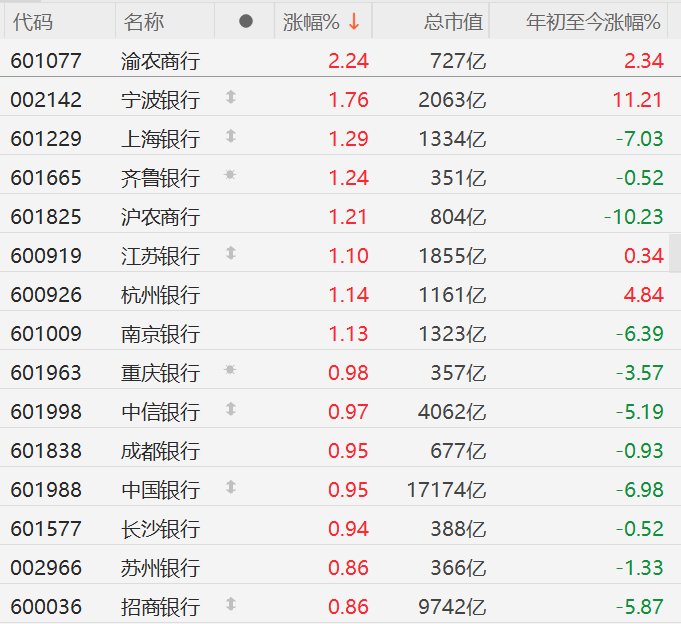
A股银行股集体上涨,渝农商行涨超2%
Ge Long Hui A P P· 2026-02-04 01:57
Group 1 - A-shares of bank stocks collectively rose, with notable increases in stocks such as Chongqing Rural Commercial Bank, which rose over 2%, and several others including Ningbo Bank, Shanghai Bank, and Qilu Bank, which rose over 1% [1] - Specific stock performance includes Chongqing Rural Commercial Bank increasing by 2.24% with a total market value of 72.7 billion, and Ningbo Bank rising by 1.76% with a market value of 206.3 billion [2] - The year-to-date performance shows significant variations, with Ningbo Bank up 11.21%, while Shanghai Bank down 7.03%, and Hu'nong Commercial Bank down 10.23% [2] Group 2 - The MACD golden cross signal has formed, indicating a positive trend for these bank stocks [2]


银行周报(0126-0201):美联储维持利率不变,消费类贷款催化剂工作指引出台
Tai Ping Yang Zheng Quan· 2026-02-04 00:25
Investment Rating - The industry investment rating is "Positive," indicating an expected overall return exceeding 5% above the CSI 300 index within the next six months [3][40]. Core Insights - The report highlights that the banking sector's performance is entering a recovery phase, with a focus on the stability of interest margins and the potential for improved asset quality as the economy recovers [7]. - The report emphasizes the importance of strong capital positions and reliable dividend payouts for investment selection, recommending specific banks based on their financial health and market position [7]. Summary by Sections Market Review - The Shanghai Composite Index and CSI 300 Index experienced changes of -0.44% and +0.08% respectively, while the banking sector index rose by 0.86%, outperforming the CSI 300 by 0.78 percentage points [10][11]. - Notable performances within the banking sector included increases in share prices for major state-owned banks such as Bank of China (+1.90%) and Agricultural Bank of China (+0.81%) [13][14]. Data Tracking - As of January 30, 2026, the banking sector's price-to-book (PB) ratio stands at 0.65, indicating a valuation at the 70.10 percentile over the past five years [6][19]. - The median dividend yield for individual stocks in the sector is 4.54%, which is 2.73 percentage points higher than the yield on 10-year government bonds [6][19]. Industry Dynamics - The Federal Reserve has decided to maintain interest rates between 3.5% and 3.75%, reflecting a balanced approach to managing inflation and employment concerns [33][35]. - The China Banking Association has introduced guidelines for the collection of personal consumption loans, aiming to standardize practices and promote healthy industry development [37][39].




险资火力全开 近10亿扫货港股基石 密集调研310家A股公司
2 1 Shi Ji Jing Ji Bao Dao· 2026-02-03 23:43
Group 1 - The insurance capital is increasingly active in equity market allocation due to a low interest rate environment and asset scarcity, participating in cornerstone investments in Hong Kong stocks and conducting research on A-share companies [1][5] - Since the beginning of 2026, insurance capital has participated in cornerstone placements for 7 Hong Kong stocks, with a total subscription amount nearing 1 billion yuan, covering sectors from technology to consumer [1][2] Group 2 - Insurance capital is becoming a core player in Hong Kong's IPO market, utilizing cornerstone investments as a strategy to achieve significant investment returns while establishing a clear long-term asset allocation path [2][9] - A notable example is the IPO of Hunan Mingming Henmang Commercial Chain Co., which raised 3.336 billion HKD, attracting major institutions like Tencent and Temasek, with a total subscription amount of 195 million USD [2][10] Group 3 - Taikang Life is leading the charge in this wave of insurance capital moving south, participating in multiple IPOs across various sectors, with individual subscription amounts ranging from 78 million HKD to 233 million HKD [3][11] - The synchronized investment strategy among insurance companies indicates a focus on optimizing asset allocation and value recovery, particularly as the Hong Kong market is at a historical valuation low [11][12] Group 4 - Since 2025, insurance capital has significantly increased its participation in Hong Kong IPO cornerstone investments, with 20 cases and a total subscription amount of 4.679 billion HKD, reflecting a favorable market return [12] - Future trends suggest that as global liquidity improves, insurance capital will continue to accelerate its investments in the Hong Kong market, capitalizing on the valuation discrepancies and enhancing overall portfolio returns [12] Group 5 - In addition to Hong Kong, insurance capital is actively investing in A-shares, with 713 A-share companies appearing in the top ten shareholders list, and a notable increase in research activity on 310 A-share companies [6][13] - The focus on consumer sectors, particularly in the pre-made food industry, is evident, with companies like Qianwei Yangchu achieving a revenue increase of 1% year-on-year [13][14]
江苏银行以苏味破局民生金融
Jiang Nan Shi Bao· 2026-02-03 14:30
人间烟火气,最抚凡人心,而餐饮消费正是民生烟火最直接的体现。1月31日,由江苏银行独家冠名, 江苏省商务厅联合省广电总台主办的"我是厨神"江苏味道冬季美食推广活动在南京国展中心圆满收官。 这场从泰州启幕、席卷江苏十三城的美食盛宴,自2025年12月6日启动以来,以市集、争霸赛、线上互 动等多元形式点燃全省消费热情,而作为活动总冠名商的江苏银行,不仅以美食赛道为切口,将金融服 务深度融入民生消费场景,更是用一场"金融+美食"的跨界联动,激活江苏"舌尖上的经济"。 十三城烟火遍地 金融服务嵌入民生消费现场 美食是融入百姓生活的最佳载体,也是金融服务贴近民生的最佳窗口。此次"我是厨神"活动,将十三场 美食集市与厨神争霸赛直接落地全省各地街巷。泰州早茶、徐州地锅、苏州糕团等地道苏味齐聚,让市 民在家门口就能打卡全省美食。而江苏银行则将金融服务台搬到了活动现场,化身市集里的"贴心服务 站",在现场派发近百万元消费券,并邀请20余家本地企业设立主题展位,实现"苏味+苏品苏货"的消费 联动,让市民在逛吃之余享受到实打实的优惠。 打破传统金融服务的生硬植入模式,江苏银行在现场设置的"金融驿站"主打"自然融入":工作人员化身 ...
丈量地方性银行(2):浙江163家区域性银行全梳理-20260203
GF SECURITIES· 2026-02-03 13:31
Investment Rating - The industry investment rating is "Buy" [2] Core Insights - The report provides a comprehensive analysis of 163 regional banks in Zhejiang Province, highlighting their asset and liability structures, profitability, and asset quality [6][20] - The asset growth rate for major city commercial banks in Zhejiang is 9.4%, which is lower than the 14.2% growth rate of listed city commercial banks, while major rural commercial banks show an asset growth rate of 8.0%, exceeding the 6.7% growth rate of listed rural commercial banks [6][25] - The report indicates that the loan-to-asset ratio for city commercial banks is projected to reach 55.5% in 2024, an increase of 95 basis points year-on-year, while rural commercial banks will see a decrease to 59.3%, down 19 basis points [31] - Profitability metrics show that the average Return on Assets (ROA) for city commercial banks in Zhejiang is 0.78%, slightly above the average of listed city commercial banks, while rural commercial banks have an average ROA of 0.82%, which is below the average of listed rural commercial banks [6][31] - The asset quality of regional banks in Zhejiang is reported to be better than that of listed banks, with non-performing loan ratios lower by 16 basis points for city commercial banks and 9 basis points for rural commercial banks compared to their listed counterparts [6][31] Summary by Sections Section 1: Economic Structure of Zhejiang Province - Zhejiang Province is focused on high-quality development and aims to become a model for common prosperity [13] - The province's GDP is heavily concentrated in cities like Hangzhou, Ningbo, and Wenzhou, with Hangzhou accounting for 24.3% of the total GDP in 2025 [15] Section 2: Overview of 163 Regional Banks - The report categorizes the banks into city commercial banks, rural banks, and others, with a total of 163 banks in the region [20] - The distribution of registered capital among these banks is relatively balanced, with 63 banks having over 500 million yuan in registered capital [22] Section 3: Asset and Liability Structure - The asset growth of major city and rural commercial banks has been declining since 2019, with city banks showing a growth rate of 9.4% in the first half of 2025 [25] - The liability structure indicates that customer deposits account for 77.5% of liabilities for city commercial banks, which is higher than the 66.2% for listed city banks [44] Section 4: Profitability and Asset Quality - The average ROE for city commercial banks in Zhejiang is 11.98%, slightly lower than the average of listed city banks [6][31] - The report highlights that the non-performing loan ratio for city commercial banks is lower than that of listed banks, indicating better asset quality [6][31]



电话会议纪要(20260201)
CMS· 2026-02-03 10:35
Macro Insights - The Federal Reserve paused interest rate cuts during the January meeting, with Powell indicating a higher threshold for future cuts due to reduced inflation and employment risks[2] - The upcoming change in tariff base mid-year is expected to facilitate monetary easing under the new chairmanship, reflecting the Fed's policy independence[2] Market Strategy - A-shares are expected to experience volatility in February, with a lack of catalysts before the Spring Festival leading to decreased market activity[4] - Post-Spring Festival, policy catalysts are anticipated to accelerate, potentially improving index performance[4] Investment Recommendations - Focus on cyclical and technology sectors, with particular attention to semiconductor and AI-related stocks, as well as sectors benefiting from the 14th Five-Year Plan[5] - Recommended index combinations include large-cap indices like CSI 1000 and ChiNext 50, with a preference for growth styles over value[5] Liquidity and Fund Flows - February is projected to see continued net inflows of incremental funds, with foreign capital expected to flow in before the Spring Festival[7] - The stock market experienced net outflows in January, but financing is becoming a primary source of incremental capital[7] Sector Performance - Industrial profits turned positive in December, with high growth areas identified in resource products and AI-driven sectors[8] - The insurance sector is expected to perform strongly in 2026, with significant growth in new policy premiums driven by favorable market conditions[15]
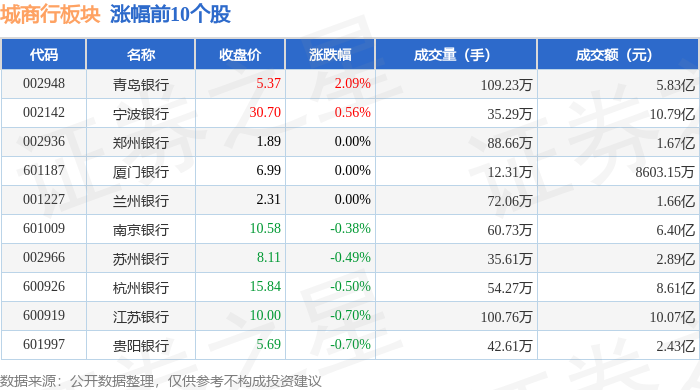
城商行板块2月3日跌0.59%,重庆银行领跌,主力资金净流入1.74亿元
Zheng Xing Xing Ye Ri Bao· 2026-02-03 09:03
Market Overview - The city commercial bank sector experienced a decline of 0.59% on February 3, with Chongqing Bank leading the drop [1] - The Shanghai Composite Index closed at 4067.74, up by 1.29%, while the Shenzhen Component Index closed at 14127.1, up by 2.19% [1] Individual Bank Performance - Qingdao Bank closed at 5.37, with an increase of 2.09% and a trading volume of 1.09 million shares, totaling a transaction value of 583 million yuan [1] - Ningbo Bank closed at 30.70, up by 0.56%, with a trading volume of 352,900 shares and a transaction value of 1.079 billion yuan [1] - Chongqing Bank closed at 10.18, down by 1.83%, with a trading volume of 122,900 shares and a transaction value of 125 million yuan [2] - Chengdu Bank closed at 15.82, down by 1.62%, with a trading volume of 447,000 shares and a transaction value of 710 million yuan [2] Capital Flow Analysis - The city commercial bank sector saw a net inflow of 174 million yuan from institutional investors, while retail investors experienced a net outflow of 322 million yuan [2] - The main capital inflow and outflow for individual banks showed that Hangzhou Bank had a net inflow of 104.1 million yuan from institutional investors, while retail investors had a net outflow of 63.65 million yuan [3] - Chengdu Bank had a net inflow of 75.59 million yuan from institutional investors, with a net outflow of 66.56 million yuan from retail investors [3]
险资火力全开!近10亿扫货港股基石,密集调研310家A股公司
2 1 Shi Ji Jing Ji Bao Dao· 2026-02-03 07:39
Group 1 - The core viewpoint of the articles highlights the increasing activity of insurance capital in equity markets, particularly in Hong Kong stocks, driven by a low interest rate environment and asset scarcity [1][4] - Insurance capital has participated in cornerstone investments for seven Hong Kong IPOs in 2026, with a total subscription amount nearing 1 billion yuan, covering sectors from technology to consumer goods [1][2] - The cornerstone investment mechanism in Hong Kong serves as a market value indicator, with insurance capital becoming a key player in this space, particularly in new consumption and hard technology sectors [2][3] Group 2 - Notable examples of cornerstone investments include the IPO of Hunan Mingming Henmang Commercial Chain Co., which raised 3.336 billion HKD, attracting major institutions like Tencent and Temasek [2][3] - Insurance companies like Taikang Life have led the charge in Hong Kong IPOs, participating in multiple cornerstone investments across various sectors, including AI and biomedicine [3][4] - The trend of insurance capital's involvement in Hong Kong IPOs has significantly increased since 2025, with a total of 20 IPOs and a subscription amount of 4.679 billion HKD, reflecting the value of quality assets in the Hong Kong market [4] Group 3 - In addition to Hong Kong, insurance capital is actively researching A-share companies, having surveyed 310 firms in early 2026, focusing on sectors like technology and consumer goods [5][6] - The insurance sector's investment strategy includes a notable stake in Shanghai Airport, marking the first major acquisition of 2026, indicating a proactive approach in the A-share market [6] - The pre-made food sector, particularly companies like Qianwei Yangchu, has attracted attention from insurance capital, with significant revenue growth reported [6][7] Group 4 - The insurance capital's strategy is influenced by the need for asset allocation optimization and value recovery, as the Hong Kong market is currently at a historical valuation low, providing a safety margin [3][4] - Analysts suggest that the low interest rate environment necessitates increased investment in equity assets, particularly high-dividend and stable cash flow companies, to enhance investment returns [7][8] - The ongoing trend of insurance capital entering equity markets is expected to continue, driven by improved global liquidity and policy guidance encouraging long-term investments [4][7]