腾讯

Search documents
春节AI混战,千问杀出重围,DAU逼平第一
3 6 Ke· 2026-02-12 12:33
Core Insights - The article highlights the significant impact of AI in consumer interactions during the 2026 Spring Festival, with a record of 1.2 billion orders processed by AI, marking a milestone in AI's real-world application and commercialization [3][4][9] Group 1: AI Performance and User Engagement - The AI system "Qianwen" achieved 1.2 billion completed orders in just six days, demonstrating a successful execution of AI in real-world tasks [2][3] - Daily active users of Qianwen surged to 73.52 million, nearly matching the industry leader, indicating a strong user engagement [2] - Nearly half of the orders came from county-level cities, and 1.56 million users aged 60 and above experienced ordering through AI for the first time, showcasing a broadening user base [6][8] Group 2: Technological Advancements and Ecosystem Integration - Qianwen successfully integrated the entire process from AI model to ecosystem, payment, and fulfillment, creating a positive feedback loop [5][6] - The underlying technology includes the "Zhenwu 810E" chip and a robust cloud computing infrastructure, enabling efficient handling of high order volumes [8] - Alibaba's extensive experience in e-commerce and logistics supports Qianwen's backend capabilities, enhancing its service offerings in various sectors [8] Group 3: Competitive Landscape and Future Implications - The current AI competition has shifted focus from model parameters to building executable and scalable task-oriented ecosystems, with Qianwen leading this transition [5][9] - The successful implementation of Qianwen during a high-traffic consumer period may redefine user interaction with AI, potentially establishing new habits in AI-assisted shopping and daily life [7][9] - As global competitors like Google test new features, Alibaba's Qianwen has already demonstrated a practical application of AI in consumer markets, positioning China at the forefront of AI model validation [9]



字节大模型的收敛之年
3 6 Ke· 2026-02-12 09:58
Core Insights - The article discusses ByteDance's strategic shift in AI development, highlighting its transition from a "follower" to a "leader" in the AI cloud partnership space within a year [1][22] - The focus is on the organizational restructuring and technological advancements that have positioned ByteDance for significant growth in the AI sector [22][30] Group 1: Organizational Changes - Wu Yonghui's appointment led to the cancellation of quarterly OKRs for the Seed team, emphasizing a shift in focus from short-term goals to long-term strategic development [2][5] - The integration of various teams under a unified command structure aimed to eliminate internal competition and streamline efforts in AI development [5][6] - The restructuring was a rare move towards consolidation rather than expansion, aimed at strengthening the core capabilities of the organization [7] Group 2: Technological Advancements - ByteDance's AI model team experienced a doubling in the number of papers published at top international conferences in the first half of 2025, indicating a renewed focus on foundational research [8][9] - The introduction of features like multi-dialect voice recognition and enhanced task execution capabilities in the Doubao product reflects a commitment to improving user experience and accessibility [10][11][12] - The company adopted a "zone pricing" strategy to optimize costs associated with AI model usage, significantly reducing expenses for users [18][19] Group 3: Market Positioning - By the end of 2025, Doubao's daily token usage surged to over 50 trillion, marking a tenfold increase compared to the previous year, and establishing ByteDance's significant market share in the AI cloud service sector [21] - The decision to phase out older model versions in favor of the latest Seed series was a strategic move to unify technology and reduce operational costs [14][15][16] - ByteDance's approach to AI development is characterized by a commitment to continuous improvement and a focus on long-term sustainability in a competitive landscape [30] Group 4: Future Challenges - The company faces challenges in maintaining its closed-source model amidst a growing trend of open-source initiatives from competitors like Alibaba and Baidu [25][26] - The reliance on a single annual product release cycle tied to the Spring Festival could pose risks if future releases do not meet expectations [27] - Competitors like Tencent and Alibaba are also making significant advancements, which could impact ByteDance's market position if not addressed [29][30]
美团、百度、腾讯、京东、阿里,集体下跌
Di Yi Cai Jing Zi Xun· 2026-02-12 08:39
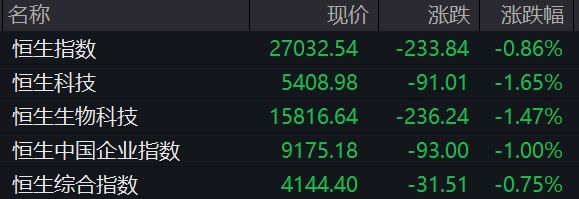
Market Overview - The Hang Seng Index fell by 0.86% to close at 27,032.54, while the Hang Seng Tech Index dropped by 1.65% to 5,408.98 [2][3] - The Hang Seng Biotech Index decreased by 1.47% to 15,816.64, and the Hang Seng China Enterprises Index declined by 1.00% to 9,175.18 [2] Technology Sector Performance - Major tech stocks experienced significant declines, with NetEase, Lenovo Group, and Meituan each dropping over 4%, and Ctrip Group falling nearly 4% [2] - Baidu saw a decline of nearly 3%, while Bilibili and Tencent Holdings fell over 2% [2] - JD Group and Xiaomi Group dropped over 1%, and Alibaba decreased by nearly 1% [2] - SenseTime was an exception, rising over 6% [2] Semiconductor Sector Performance - Semiconductor stocks saw substantial gains, with Zhaoyi Innovation rising over 20%, and Tianyu Semiconductor increasing over 10% [3][4] - Wall Street Technology and Lianqi Technology also experienced notable increases, with gains of nearly 10% and over 5%, respectively [3][4] GEO Concept Stocks - GEO concept stocks performed well, with Zhipu rising over 28% and MINIMAX increasing over 14% [5]



美团、百度、腾讯、京东、阿里,集体下跌
第一财经· 2026-02-12 08:31
2月12日,香港恒生指数跌0.86%,恒生科技指数跌1.65%。 | 名称 | 现价 | | --- | --- | | 恒生指数 | 27032.54 -233.84 -0.86% | | 恒生科技 | 5408.98 -91.01 -1.65% | | 恒生生物科技 | 15816.64 -236.24 -1.47% | | 恒生中国企业指数 | 9175.18 - 93.00 -1.00% | | 恒生综合指数 | 4144.40 -31.51 -0.75% | 科网股大幅下跌,网易、联想集团、美团跌逾4%,携程集团跌近4%,百度集体跌近3%,哔哩哔哩、 腾讯控股跌超2%,京东集团、小米集团跌超1%,阿里巴巴跌近1%;商汤逆势上涨逾6%。 | 名称 | 涨跌幅 ▼ | 现价 | | --- | --- | --- | | 天数智芯 | 21.45% 234.400c | | | 兆易创新 | 20.95% 358.000c | | | 天域半导体 | 10.54% | 54.650c | | 壁仞科技 | 9.70% | 36.860 c | | 澜起科技 | 5.56% | 182.300c | | ...

港股收评:恒指跌0.86%止步3连升,科技金融低迷,半导体午后拉升明显
Ge Long Hui· 2026-02-12 08:28
具体盘面上,作为市场风向标的大型科技股全线下跌拖累市场情绪低迷,其中,美团跌4.5%,百度跌 近3%,腾讯、小米、京东、阿里巴巴皆有跌幅;内银股、中资券商股、保险股等大金融多数下跌令大 市进一步承压;临近年关本该到旺季的餐饮股、影视股却跌幅十分明显,其中九毛九跌超5%,权重股 海底捞跌超3%,同样啤酒板块跌幅较大,千亿龙头百威亚太跌超5%。 另一方面,AI应用概念股继续活跃,港股大模型"双雄"(智谱、MINIMAX-WP)暴涨均创新高!智谱涨 价助推算力基建投入,半导体芯片股午后拉升上扬,兆易创新飙涨20%,澜起科技创历史新高,内外需 驱动!港股电力设备股集体拉升,三桶油普涨,中国石油化工创历史新高。(格隆汇) 港股三大指数全天表现低迷,大市止步3连升行情。恒生科技指数一度跌至2%,最终收跌1.65%,恒生 指数跌0.86%险守27000点,国企指数跌1%。连续三个交易日的上涨势头戛然而止。 ...
A股三大指数收涨,算力产业集体爆发,有新股狂飙244%触发临停
2 1 Shi Ji Jing Ji Bao Dao· 2026-02-12 07:37
Group 1 - The three major indices collectively rose, with the ChiNext Index and the Sci-Tech 50 Index both increasing by over 1%. The total trading volume in the Shanghai and Shenzhen markets reached 2.16 trillion yuan, an increase of 159.7 billion yuan compared to the previous trading day [1] - The computing power industry chain experienced a collective surge, with significant gains in computing power leasing concepts. Major companies like Dazhi Technology and Capital Online saw their stocks hit the daily limit [1] - The Ministry of Industry and Information Technology announced plans to develop national computing power interconnection nodes, aiming to enhance the efficiency and service level of public computing resources and promote high-quality development in the computing power sector [1] Group 2 - The CPO concept saw rapid gains, with leading company Tianfu Communication's stock rising by 11.61% to a historical high of 322 yuan per share, bringing its market capitalization to 250.33 billion yuan [2] - The computing power chip concept also rose in the afternoon, with companies like Chipone Technology experiencing over a 10% increase in stock price [2] - The electric grid equipment sector showed strong performance, with companies like Siyuan Electric and Sifang Co. reaching new highs, while other companies in the sector also saw significant stock price increases [2]
A股三大指数收涨,算力产业集体爆发,有新股狂飙244%触发临停
21世纪经济报道· 2026-02-12 07:29
Market Overview - On February 12, the three major indices collectively rose, with the ChiNext Index and the Sci-Tech Innovation 50 Index both increasing by over 1% [1] - The total trading volume in the Shanghai and Shenzhen markets reached 2.16 trillion yuan, an increase of 159.7 billion yuan compared to the previous trading day [1] Index Performance - Shanghai Composite Index: 4134.02 (+2.03, +0.05%) [2] - Shenzhen Component Index: 14283.00 (+122.06, +0.86%) [2] - ChiNext Index: 1816.15 (+27.93, +1.56%) [2] - CSI 300: 4719.58 (+5.76, +0.12%) [2] - CSI 500: 8423.57 (+97.76, +1.17%) [2] Industry Developments - The Ministry of Industry and Information Technology announced plans to develop national computing power interconnection nodes, aiming to enhance the efficiency and service level of public computing resources [3] - Major domestic internet companies, including Tencent, Alibaba, and Baidu, are increasing efforts to attract users to AI applications, which is expected to significantly boost active user numbers in AI applications [3] - The demand for AI applications is driving growth in the domestic computing power industry chain, presenting key development opportunities [3] Stock Highlights - Tianfu Communication, a leader in the CPO concept, saw its stock rise by 11.61% to 322 yuan per share, reaching a market capitalization of 250.33 billion yuan [3] - Chip companies related to computing power also experienced gains, with Chipone Technology rising over 10% [3] - The liquid cooling server concept showed strong performance, with Chuanrun Co. achieving two consecutive trading limits in four days [3] - The electric grid equipment sector saw collective strength, with companies like Siyuan Electric and Sifang Co. reaching new highs [3] Individual Stock Movements - Double Good Energy, a solar energy company, saw its stock price hit the limit up within 10 minutes, with a total market value of 20.1 billion yuan, following the announcement of three overseas orders for high-efficiency heat exchangers [4] - Newly listed company N Haisheng experienced a maximum increase of 244.94%, triggering a trading halt, with over 300 million yuan in transactions [4]

大模型接连上新!AI竞赛加速,存储芯片延续暴涨!芯原股份涨近13%,科创芯片ETF汇添富(588750)涨超2%,大厂抢占春节AI流量,算力需求爆发
Sou Hu Cai Jing· 2026-02-12 07:22
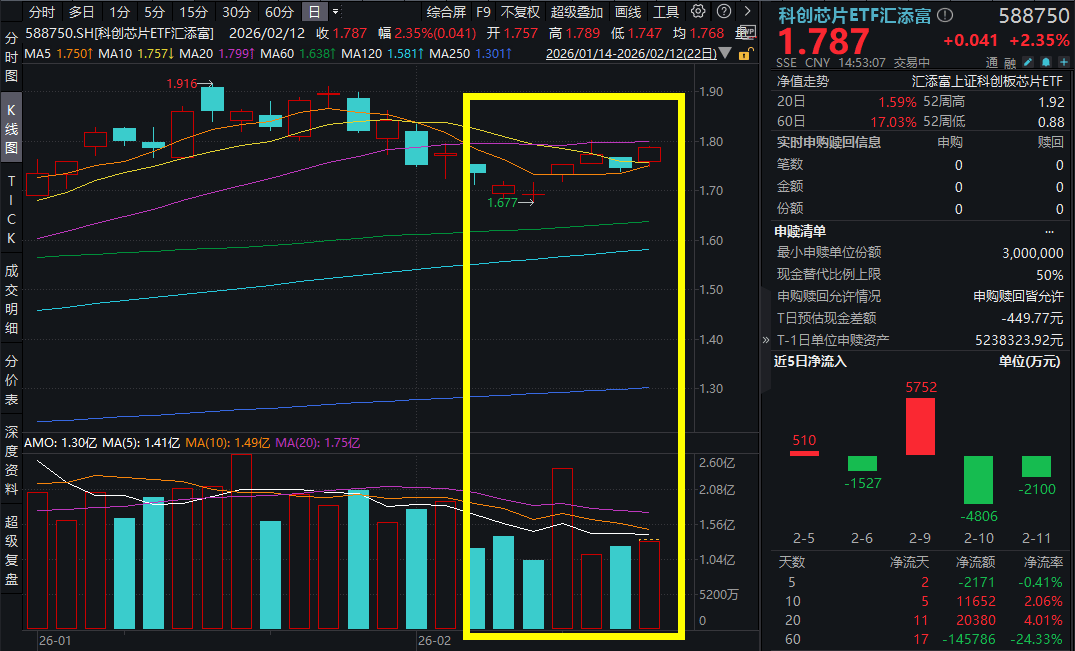
Core Viewpoint - The A-share market is experiencing an upward trend, particularly in the sci-tech chip sector, with significant gains in the ETF Huatai-PineBridge (588750) and its constituent stocks [1][3]. Group 1: Market Performance - As of 14:53, the sci-tech chip ETF Huatai-PineBridge (588750) rose over 2%, with a slight increase in trading volume [1]. - Key constituent stocks such as Chip Origin (涨近13%), Baiwei Storage (涨超7%), and Cambricon (涨超3%) showed notable gains [3]. Group 2: Stock Performance Details - The following stocks were highlighted for their performance: - Haiguang Information: 2.89% increase [4] - Chip Origin: 12.92% increase [4] - Baiwei Storage: 7.21% increase [4] - The performance of these stocks indicates a strong interest in the electronic sector, particularly in chip-related companies [4]. Group 3: Policy and Investment Trends - Recent policy initiatives emphasize the need for state-owned enterprises to enhance investment in computing power and promote the synergy between computing and electricity [5]. - Major tech companies are significantly increasing their capital expenditures, with Alibaba planning to raise its investment in AI infrastructure from 380 billion to 480 billion RMB over the next three years [6]. Group 4: AI and Cloud Services - The demand for AI applications is surging, with major companies like Tencent, Alibaba, ByteDance, and Baidu investing over 4.5 billion RMB to capture the AI market [5]. - International cloud service providers are also ramping up their capital expenditures, with Meta, Alphabet, Amazon, and Microsoft projecting substantial increases in their investments for AI infrastructure [7]. Group 5: Index and Investment Strategy - The sci-tech chip 50 ETF (588750) focuses on high-tech segments of the chip industry, with a high concentration of core segments at 95%, indicating strong growth potential [8][11]. - The index has shown a remarkable profit growth rate of 94% in the first three quarters of 2025, significantly outperforming peers [11]. - The ETF is characterized by high elasticity and rapid rebound potential, making it an attractive option for investors looking to capitalize on the chip sector's growth [12].




年末 AI 回顾:从模型到应用,从技术到商战,拽住洪流中的意义之线
晚点LatePost· 2026-02-12 07:15
Group 1: Core Insights - The article summarizes key developments in the AI sector over the past year, focusing on major events and trends in AI technology and applications [4][5]. - It emphasizes the importance of understanding the evolving landscape of AI, particularly through the lens of various models, applications, and the competitive dynamics among major players [4][5]. Group 2: Models - The article discusses the emergence of the Agentic Model, which supports advanced capabilities such as reasoning, coding, multi-modal understanding, and memory [6][7]. - The rise of reasoning models, particularly highlighted by the success of DeepSeek-R1, marks a significant milestone in AI development, showcasing the potential for complex problem-solving [8][10]. - DeepSeek's open-source approach and low training costs have garnered attention and respect within the AI research community, influencing the broader landscape [9][18]. Group 3: Applications - The year 2025 is identified as a pivotal moment for the widespread adoption of Agent applications, driven by advancements in reasoning, coding, and multi-modal capabilities [27][30]. - General Agents, which leverage coding as a means to execute various tasks, are becoming increasingly prevalent, with products like Claude Code leading the way [28][31]. - The article highlights the emergence of specialized Agents in vertical markets, such as legal and educational sectors, which are transforming traditional business models from service-based to outcome-based [38][39]. Group 4: Major Players - The competition among major AI companies, particularly ByteDance, Alibaba, and Tencent, is characterized by a focus on talent acquisition and organizational structure to enhance AI capabilities [50][51]. - ByteDance's strategy involves creating independent teams to foster innovation and attract AI-native talent, while Alibaba's approach has been more stable, with a focus on retaining experienced personnel [51][54]. - The article notes the ongoing battle for AI talent and the implications for organizational dynamics within these companies, as they strive to maintain competitive advantages in the rapidly evolving AI landscape [50][52].

2026智能体选型指南:避开AI大厂“通用陷阱”,聚焦这几家深度行业化的玩家
Sou Hu Cai Jing· 2026-02-12 05:53
Core Viewpoint - The recent release of a top 50 enterprise-level AI Agent applications list highlights a "dual-track" competitive landscape in the AI Agent market, characterized by ecosystem giants like Alibaba, Huawei, and ByteDance, and vertical specialists like Jinzhihui and Maifushi, each following distinct but complementary success strategies [1]. Group 1: Ecosystem Giants - The ecosystem giants focus on "infrastructure" as their core strategy, leveraging their advantages in traffic, computing power, and foundational models to build a universal platform for the AI era [3]. - ByteDance (Kouzi Space) attracts numerous developers with low application development thresholds and a robust plugin ecosystem, enabling non-programmers to quickly create task-oriented agents through graphical representations of complex prompt engineering [3]. - Alibaba (WebSailor) aims to enhance AI's understanding of web execution and browser interaction, addressing automation tasks in publicly available internet information [3]. - Huawei (Hongmeng AI Super Agent) integrates AI agents deeply into hardware, achieving cross-device intent understanding and task continuity through edge-cloud collaboration [3]. - While these giants aim to establish a strategic foothold and provide a universal base, they often struggle to reach the intricate business needs in complex industry sectors [3]. Group 2: Vertical Specialists - Vertical specialists emphasize a deep understanding of industry-specific business logic, integrating AI Agent technology with concrete scenarios to create closed-loop implementation paths [4]. - Maifushi (AI-Agentforce) utilizes a "middle platform + scenario" model in marketing and sales automation, embedding agent technology into CRM and SCRM systems, which allows for rapid scaling in standardized marketing scenarios [4]. - Jinzhihui represents industries with high asset and compliance requirements, such as finance and government, where system security, compliance, and execution accuracy are critical. They propose a "supervised agent" approach that combines the cognitive and planning capabilities of large models with a stable RPA execution engine [6]. - Jinzhihui's approach demonstrates significant application value in scenarios like intelligent risk control and automated operations, enabling financial institutions to transition smoothly from traditional automation to intelligent agents without major system overhauls [6]. - The competitive advantage of vertical specialists lies not only in algorithmic superiority but also in their ability to engineer existing digital assets effectively [6]. Group 3: Market Trends and Future Outlook - The market is witnessing a divergence in solutions addressing the high costs of starting over, with companies like ByteDance and Baidu focusing on providing native cloud-based intelligent agent development environments, while vertical firms like Jinzhihui offer "non-intrusive upgrades" for existing automated processes [7]. - Jinzhihui's "one-click upgrade" path empowers existing processes with LLM capabilities without altering core systems, significantly lowering the barriers for enterprises to adopt AI [7]. - A key measure of vertical specialists' competitiveness is their security governance capability, ensuring that intelligent agents operate within defined boundaries while maintaining data security and compliance [8]. - The future value of AI Agents will increasingly depend on their ability to create "chemical reactions" with business scenarios rather than just technical metrics, shifting the evaluation criteria from what they can communicate to what they can accomplish reliably in complex environments [10]. - For enterprises undergoing digital transformation, 2026 is projected to be a pivotal year for application implementation, necessitating a focus on both efficiency breakthroughs on universal platforms and finding practical solutions that convert intelligent capabilities into stable productivity [10].