
工业富联

Search documents
中美AI竞赛进入下半场,决胜点在哪?
Guan Cha Zhe Wang· 2026-02-04 06:59
Core Insights - The current phase of the AI industry is shifting from a "technology parameter competition" to a focus on "application landing," emphasizing the creation of real value in sectors like healthcare, education, and government efficiency [1][2] - A "dual oligopoly" is emerging in the AI landscape, with the U.S. leading in foundational models and high-value software services, while China is advancing in large-scale applications and industrial empowerment [2][3] Group 1: U.S. and China's Competitive Landscape - The U.S. maintains an advantage in original innovation and high-value software services, while China is establishing barriers in large-scale applications and industrial empowerment [2][3] - Despite the U.S. leading in foundational model capabilities, China's models are proving to be cost-effective and competitive, closing the gap significantly in performance metrics [3][7] - The RAND Corporation's report indicates that the U.S. cannot solely rely on chip superiority to prevent Chinese models from reaching Tier-1 levels [3][6] Group 2: AI Application and Industrial Integration - China's AI applications are deeply integrated into core production processes, with a high adoption rate of 67% in manufacturing compared to the U.S.'s 34% [9][10] - Chinese companies are focusing on embedding cost-effective models into various smart hardware and industrial software, moving away from merely benchmarking against models like GPT-5 [9][10] - The integration of AI into industries such as steel and mining is transforming operational efficiency and safety, showcasing AI's role as a productivity tool rather than just a technological novelty [14][18] Group 3: Challenges and Opportunities - The transition of AI from theoretical applications to practical tools faces challenges, including unique industry scenarios, data accessibility, and the long value chain from technology validation to economic benefits [13] - Each industry challenge overcome can create unique competitive barriers, providing opportunities for China to build a robust AI ecosystem [13] - The development of domestic AI infrastructure, such as Huawei's CloudMatrix, is crucial for supporting complex AI applications and ensuring long-term operational stability [14][20]

工业富联股价跌5.09%,山证资管旗下1只基金重仓,持有10.25万股浮亏损失29.11万元
Xin Lang Cai Jing· 2026-02-04 05:29
Group 1 - Industrial Fulian's stock price dropped by 5.09% to 52.91 yuan per share, with a trading volume of 6.948 billion yuan and a turnover rate of 0.65%, resulting in a total market capitalization of 1050.697 billion yuan [1] - The company, founded on March 6, 2015, and listed on June 8, 2018, is based in Longhua District, Shenzhen, Guangdong Province, and specializes in the design, research and development, manufacturing, and sales of various electronic devices, primarily focusing on smart manufacturing and technology services for global clients [1] - The main business revenue composition is 99.85% from 3C electronic products and 0.15% from other supplementary sources [1] Group 2 - Shan Zheng Asset Management has one fund heavily invested in Industrial Fulian, specifically the Shan Zheng Asset Management Strategy Selected Mixed A (003659), which increased its holdings by 32,500 shares in the fourth quarter, totaling 102,500 shares, representing 6.64% of the fund's net value, making it the fourth-largest holding [2] - The fund has a current scale of 56.0056 million yuan, with a year-to-date return of 4.74%, ranking 3947 out of 8873 in its category, and a one-year return of 73.56%, ranking 622 out of 8119 [2] - Since its inception, the fund has achieved a return of 96.4% [2] Group 3 - The fund manager of Shan Zheng Asset Management Strategy Selected Mixed A is Du Gu Nan Xun, who has been in the position for 9 years and 306 days, managing a total asset scale of 120 million yuan [3] - During the manager's tenure, the best fund return was 72.78%, while the worst return was -7.03% [3]

机构预计2026年全球AR眼镜出货达95万台,消费电子ETF(561600)交投活跃
Xin Lang Cai Jing· 2026-02-04 05:22
截至2026年2月4日 13:08,中证消费电子主题指数(931494)下跌3.17%。成分股方面涨跌互现,水晶光电 领涨5.22%,三环集团上涨4.62%,京东方A上涨1.86%;信维通信领跌10.03%,澜起科技下跌8.10%, 东山精密下跌6.27%。消费电子ETF(561600)下跌3.05%,最新报价1.21元。 消息面上,根据TrendForce集邦咨询最新近眼显示产业调查,随着AI与穿戴式装置深度融合,Meta Ray- Ban Display Glasses在终端市场获得的回馈明显优于预期,近半年内已大幅上修多项关键零部件订单。 在大厂推波助澜之下,TrendForce集邦咨询预估2026年全球AR眼镜出货量将跃升至95万台,年增率为 53%。 风险提示:基金有风险,投资需谨慎。基金管理人承诺以诚实信用、勤勉尽责的原则管理和运用基金资 产,但不保证本基金一定盈利,也不保证最低收益。基金管理人提醒投资人基金投资的"买者自负"原 则,在做出投资决策后,基金运营状况与基金净值变化引致的投资风险,由投资人自行负担。基金的过 往业绩及其净值高低并不预示其未来业绩表现,基金管理人管理的其他基金的业绩不构成 ...
两大龙头中际旭创、新易盛为何大跌?四个原因曝光
Zhong Guo Zheng Quan Bao· 2026-02-04 05:18
Group 1 - The core viewpoint of the news is that the leading optical module stocks, Zhongji Xuchuang and Xinyi Sheng, experienced significant declines, which negatively impacted the AI hardware sector as a whole [1][4]. - The recent clarity in the deployment timeline of CPO (Co-Packaged Optics) technology has raised market concerns about its potential impact on the optical module industry, as CPO can enhance transmission speed and efficiency while reducing size and power consumption [2][3]. - Zhongji Xuchuang and Xinyi Sheng's performance forecasts for 2025 indicate substantial profit growth, with Zhongji Xuchuang expecting a net profit of 9.8 billion to 11.8 billion yuan (approximately $1.4 billion to $1.7 billion), representing a year-on-year increase of 89.5% to 128.17%, and Xinyi Sheng projecting a net profit of 9.4 billion to 9.9 billion yuan (approximately $1.3 billion to $1.4 billion), with a year-on-year increase of 231.24% to 248.86% [3]. - The phenomenon of stocks that become the top holdings in public funds often experiencing subsequent declines is highlighted, with Zhongji Xuchuang recently taking this position, which coincided with a drop in its stock price [3]. Group 2 - The decline in U.S. stocks such as Nvidia and Broadcom has affected market sentiment towards A-share computing hardware stocks, contributing to the overall downturn in the AI application sector [4]. - Concerns about the potential replacement of core business functions in software companies by AI technology have led to a significant drop in the software services sector in the U.S. market [5]. - The ongoing debate about whether large AI models will overshadow software companies is noted, with insights suggesting that AI's impact is not limited to software, and various companies are adapting to leverage AI opportunities [6].


两大龙头股盘中大跌!四个原因
Zhong Guo Zheng Quan Bao· 2026-02-04 05:03
Core Viewpoint - The cyclical market is strengthening, with resource stocks, real estate infrastructure, consumer sectors, and chemicals performing actively, while AI hardware and application sectors are experiencing significant declines [2] Group 1: AI Hardware Sector Performance - Leading stocks in the AI hardware sector, including Zhongji Xuchuang (300308) and Xinyi Sheng (300502), opened with continuous declines, with both stocks dropping over 10% at one point during the trading session [2] - By the close of the morning session, Zhongji Xuchuang and Xinyi Sheng had fallen by 5.24% and 5.66%, respectively [2] - Other leading hardware stocks in the sector, such as Shenghong Technology (300476), Industrial Fulian (601138), and Yingweike (002837), also experienced declines due to the negative sentiment [2] Group 2: Reasons for Decline - Concerns regarding the impact of CPO (Co-Packaged Optics) technology on the optical module industry have emerged, as this innovation could significantly enhance transmission speeds while reducing size and power consumption [5] - Market expectations for Zhongji Xuchuang and Xinyi Sheng are perceived to be low, as their performance forecasts for 2025 indicate substantial growth, with Zhongji Xuchuang projecting a net profit of 9.8 billion to 11.8 billion yuan (approximately $1.4 billion to $1.7 billion), representing a year-on-year increase of 89.5% to 128.17% [6] - Xinyi Sheng anticipates a net profit of 9.4 billion to 9.9 billion yuan (approximately $1.3 billion to $1.4 billion), reflecting a year-on-year growth of 231.24% to 248.86% [6] - Historical trends indicate that stocks that become the largest holdings in mutual funds often experience subsequent declines, as seen with Zhongji Xuchuang, which recently replaced Ningde Times as the top holding [7] - The decline in U.S. stocks such as Nvidia and Broadcom has also negatively affected sentiment towards A-share computing hardware stocks [7] Group 3: Broader Market Impact - The AI application sector also faced significant declines, with various related concepts and stocks, including Sora concept and Zhi Pu AI, experiencing notable drops [8] - Specific stocks like Zhi De Mai (300785), Tianlong Group (300063), and Blue Focus (300058) saw declines of 11.56%, 10.95%, and 10.02%, respectively [8]
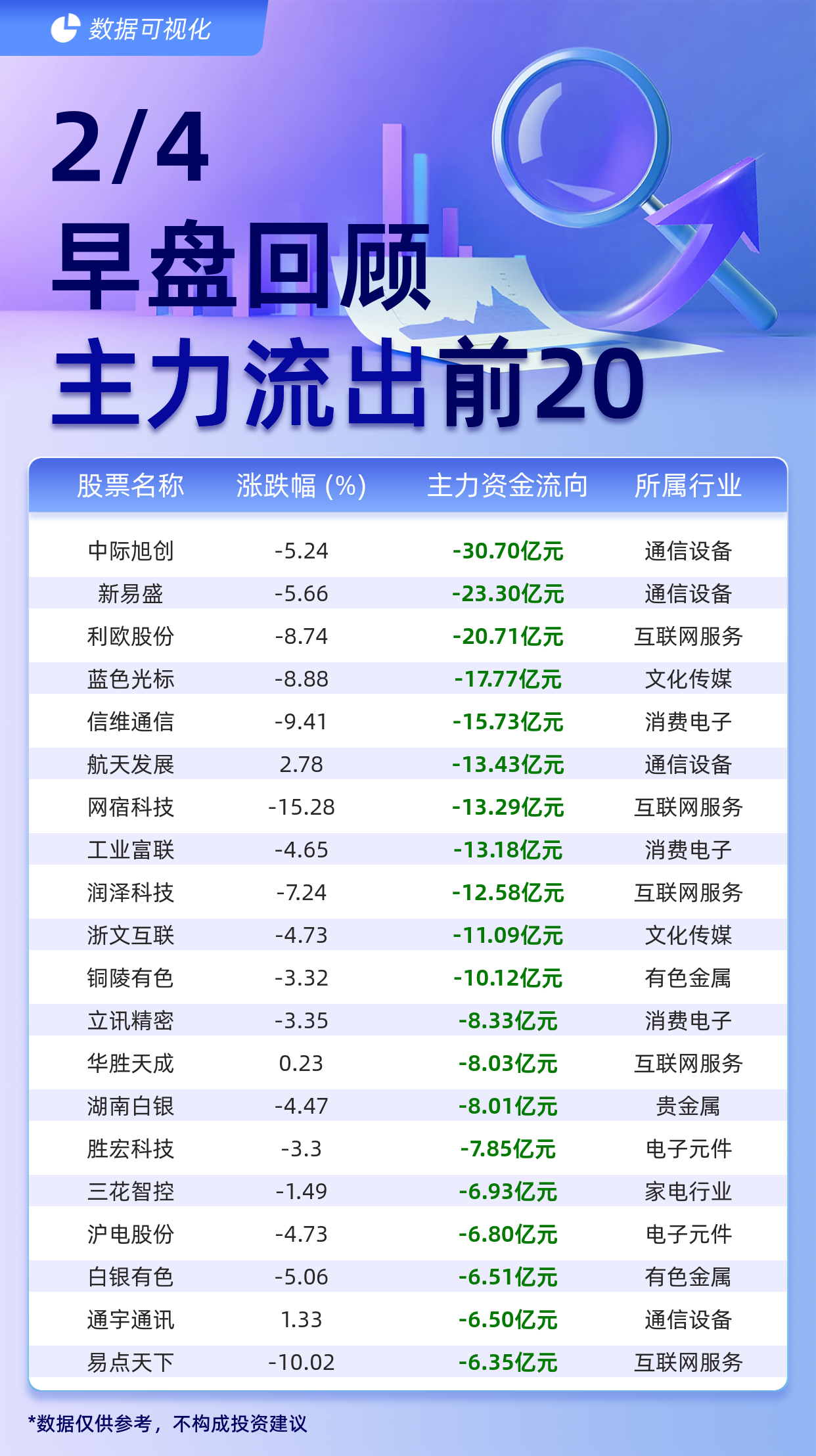
主力个股资金流出前20:中际旭创流出30.70亿元、新易盛流出23.30亿元
Jin Rong Jie· 2026-02-04 03:56
Core Viewpoint - The data indicates significant outflows of capital from various stocks, particularly in the communication equipment and internet service sectors, reflecting investor sentiment and market trends [1][2][3] Group 1: Major Stocks with Capital Outflows - Zhongji Xuchuang experienced a capital outflow of 3.07 billion, with a decline of 5.24% [2] - Xinyi Sheng saw a capital outflow of 2.33 billion, with a decline of 5.66% [2] - Liou Shares had a capital outflow of 2.07 billion, with a decline of 8.74% [2] - BlueFocus Media faced a capital outflow of 1.77 billion, with a decline of 8.88% [2] - Xinwei Communication had a capital outflow of 1.57 billion, with a decline of 9.41% [2] Group 2: Sector Analysis - The communication equipment sector showed significant outflows, with Zhongji Xuchuang and Xinwei Communication leading the losses [2][3] - The internet service sector also faced notable outflows, with Liou Shares and NetEase Technology among the top affected stocks [2][3] - The cultural media sector, represented by BlueFocus Media, experienced substantial capital outflows, indicating potential investor concerns [2][3] Group 3: Additional Stocks with Notable Outflows - Industrial Fulian had a capital outflow of 1.32 billion, with a decline of 4.65% [2] - Runze Technology saw a capital outflow of 1.26 billion, with a decline of 7.24% [2] - Hunan Silver experienced a capital outflow of 0.801 billion, with a decline of 4.47% [3]



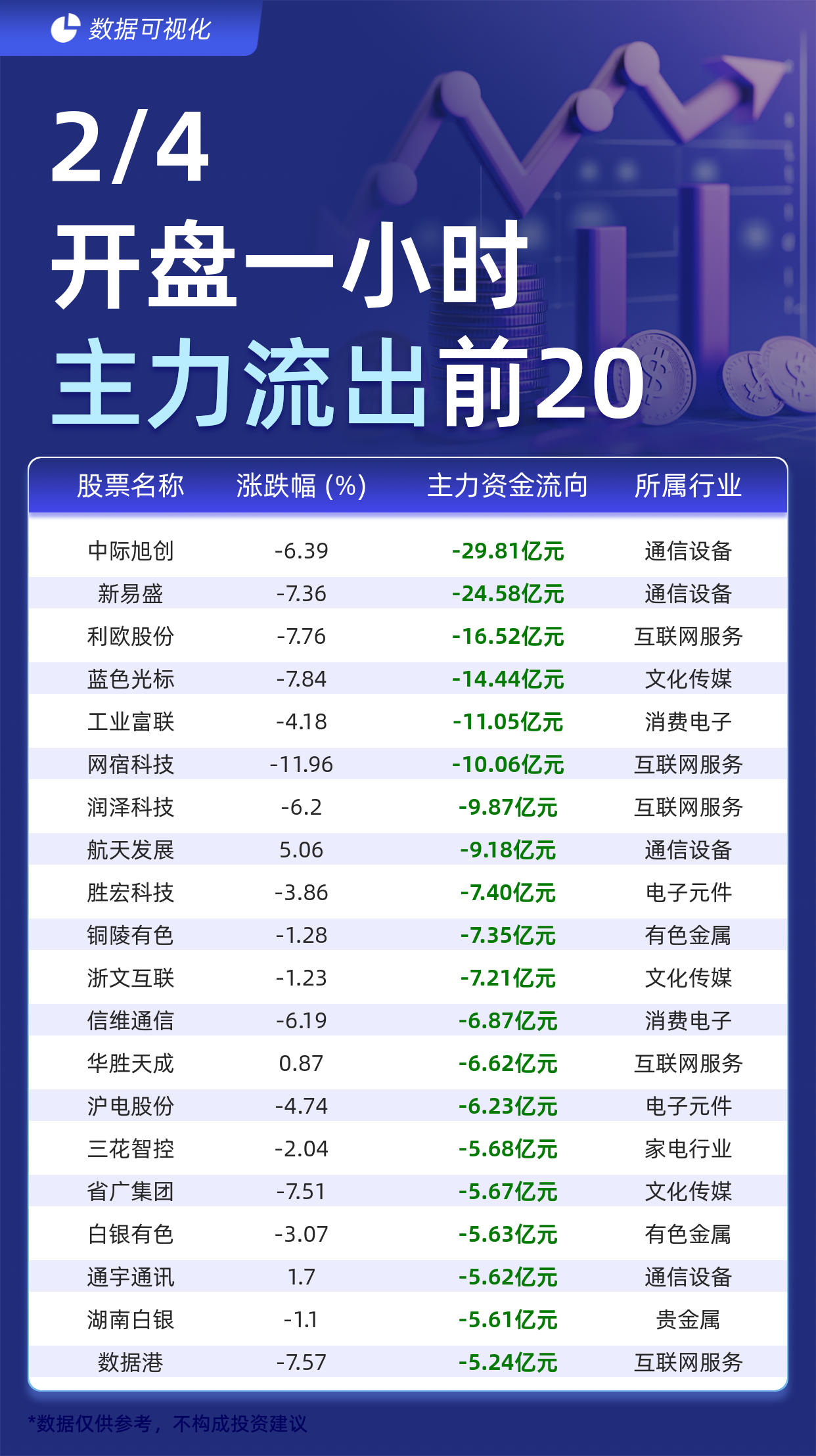
主力个股资金流出前20:中际旭创流出29.81亿元、新易盛流出24.58亿元
Jin Rong Jie· 2026-02-04 02:55
| 股票名称 | 涨跌幅 (%) | 主力资金流向 | 所属行) | | --- | --- | --- | --- | | 中际旭创 | -6.39 | -29.81亿元 | 通信设备 | | 新易盛 | -7.36 | -24.58亿元 | 通信设备 | | 利欧股份 | -7.76 | -16.52亿元 | 互联网服 | | 蓝色光标 | -7.84 | -14.44亿元 | 文化传媒 | | 工业富联 | -4.18 | -11.05亿元 | 消费电子 | | 网宿科技 | -11.96 | -10.06亿元 | 互联网服 | | 润泽科技 | -6.2 | -9.87亿元 | 互联网服 | | 航天发展 | 5.06 | -9.18亿元 | 通信设备 | | 胜宏科技 | -3.86 | -7.40亿元 | 电子元作 | | 铜陵有色 | -1.28 | -7.35亿元 | 有色金属 | | 浙文互联 | -1.23 | -7.21亿元 | 文化传媒 | 据交易所数据显示,截至2月4日开盘一小时,主力资金流出前20的股票分别为: 中际旭创(-29.81亿元)、 新易盛(-24.58亿元)、 利欧股份 ...
黄仁勋台北“夜宴”:2026年仍将是AI供应链极度吃紧的一年?
经济观察报· 2026-02-04 02:34
在1月31日的饭局结束后,黄仁勋在饭店门口接受媒体采访表 示 , 2026 年 将 是 行 业 " 极 度 吃 紧 " 的 一 年 , 对 高 带 宽 内 存 (HBM)和先进封装的需求将大幅爆发。算力,在2026年或 许依然会是资本市场的"热词"。 作者:郑晨烨 封图:视觉中国 2026年1月31日晚,一张合影开始在社交平台流传。 照片的背景是中国台湾省台北市的砖窑古早味怀旧餐厅,画面中,英伟达CEO黄仁勋与台积电董 事长魏哲家、鸿海董事长刘扬伟等多位AI供应链高管面对镜头,集体竖起了大拇指。 在这张合影中,黄仁勋坐在第一排正中央,他的身边是台积电董事长魏哲家、联发科执行长蔡力 行、广达电脑董事长林百里,纬创资通董事长林宪铭。在黄仁勋身后的,还有鸿海精密董事长刘扬 伟 、 和 硕 联 合 科 技 董 事 长 童 子 贤 、 工 业 富 联 ( 601138.SH ) 董 事 长 郑 弘 孟 、 胜 宏 科 技 (300476.SZ)董事长陈涛。全球绝大多数的AI服务器,都要在这些人的工厂里完成组装。 当天晚上,黄仁勋在台北市宴请了40多位供应链高管,根据社交平台流传的菜单,这顿饭的菜色 包括豆酥鳕鱼、芋头米 ...



美股AI软件股抛售潮传递到A股市场,低费率创业板人工智能ETF华夏(159381)、云计算ETF华夏(516630)开盘走低
Mei Ri Jing Ji Xin Wen· 2026-02-04 02:29
Group 1 - The core viewpoint of the news highlights a significant sell-off in AI software stocks in the US market, which has impacted the A-share market, particularly affecting AI-related ETFs and stocks [1] - The A-share market is experiencing increased volatility with a notable divergence among sectors, but the long-term upward trend remains intact, supported by ongoing policies for the domestic AI industry [2] - The recent sell-off in US tech stocks, especially software companies, has raised concerns about the potential threat of AI technology replacing core business functions [1] Group 2 - The AI sector is currently in a rapid development phase, with expectations for increased capital expenditure in the global computing power sector as domestic support policies continue to be implemented [2] - The Spring market rally is expected to be followed by a consolidation phase, where the focus will be on clarifying industry trends and digesting valuations [2] - The long-term outlook remains positive for sectors such as overseas computing power chains, AI applications, energy storage, robotics, and commercial aerospace [2] Group 3 - The Huaxia AI ETF (159381) tracks an index with nearly 50% weight in CPO, covering domestic software and AI application companies, and has a low fee rate of 0.20% [3] - The Huaxia Communication ETF (515050) has a scale exceeding 8 billion yuan, covering key areas such as optical modules and computing power infrastructure, with a combined weight of over 76% in CPO and CPB concept stocks [3] - The Huaxia Cloud Computing ETF (516630) focuses on domestic AI software and hardware computing power, with a combined weight of 83.7% in computer software, cloud services, and computer equipment, also featuring a low fee rate of 0.20% [3]

国内外AI年报分析展望




2026-02-04 02:27
Summary of the Conference Call on AI Annual Report Analysis Industry Overview - The conference focused on the analysis and outlook of AI annual reports, particularly in the TMT (Technology, Media, and Telecommunications) sector, with a specific emphasis on domestic and international AI companies [1][2][4]. Key Points and Arguments General Market Sentiment - The period from October 31 to March is characterized as a performance vacuum, where the focus is on thematic investments rather than immediate earnings results [2][3]. - The spring market is expected to see a resurgence, with significant activity anticipated around March [3][4]. North American Companies - North American companies, particularly those involved in AI and cloud computing, have reported earnings that exceeded expectations, indicating strong capital expenditure in AI [4][6]. - Companies like Microsoft and Meta have shown robust spending on AI infrastructure, reflecting a positive outlook for the sector [4][6]. - Despite some domestic companies underperforming, their stock prices have rebounded, suggesting that market sentiment is more focused on thematic trends rather than immediate earnings [5][6]. Domestic AI Companies - Domestic AI companies are experiencing a supply-demand imbalance, with strong demand for AI-related products and services, despite some companies reporting earnings below expectations [6][7]. - The industry is characterized by a shortage of materials and components, which is driving prices up and creating a favorable environment for growth [6][7][10]. Future Growth Projections - There is a consensus that the growth trajectory for AI companies will continue to be strong, with expectations for significant growth in 2026 and beyond [8][9]. - Many companies are currently undervalued, trading at price-to-earnings (P/E) ratios between 15x to 20x, which presents a potential investment opportunity [8][9]. Specific Company Insights - Companies like Wan, Tianfu Communication, and others are highlighted for their potential despite recent earnings misses, as the overall industry outlook remains positive [4][6][7]. - The demand for GPUs and AI chips is expected to remain high, with domestic companies like Cambrian facing challenges but still showing potential for recovery [9][10]. Application and Innovation - The conference emphasized the importance of AI applications, particularly in gaming and media, with companies like Tencent and ByteDance leading the charge [14][15]. - The emergence of AI-driven applications is seen as a significant growth area, with expectations for increased investment and innovation in this space [14][15]. Regulatory and Market Concerns - There are concerns regarding potential regulatory impacts on the gaming industry, but these are largely viewed as unfounded and not likely to affect the overall market significantly [15][16]. - The market is currently experiencing volatility, but analysts suggest that this presents buying opportunities for fundamentally strong companies [21][22]. Additional Important Insights - The conference highlighted the importance of monitoring capital expenditure trends among major tech companies, as this will influence the demand for AI infrastructure and services [36][37]. - The potential for new technologies, such as diamond-based cooling materials for semiconductors, was discussed as a future growth area [24][25]. - Analysts recommend focusing on companies with strong fundamentals and growth potential, particularly in the AI and semiconductor sectors, as the market continues to evolve [22][23][39].