Anthropic

Search documents
AI“淘汰焦虑”愈演愈烈!华尔街如今的交易逻辑:只要怕被AI替代,先抛了再说
美股IPO· 2026-02-11 04:01
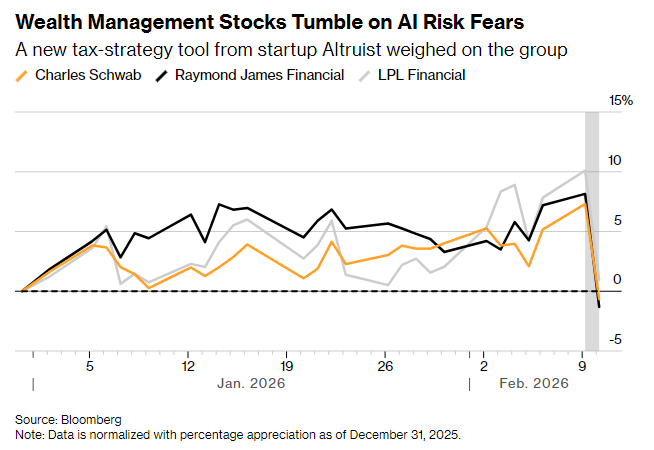
Core Viewpoint - The market is experiencing heightened anxiety regarding the potential disruption caused by artificial intelligence (AI), leading to significant stock sell-offs across various sectors, particularly those perceived to be at risk of being replaced by AI technologies [1][3][4]. Group 1: Market Reactions - A recent sell-off was triggered by the launch of a tax strategy tool by Altruist Corp, resulting in stock price declines of over 7% for major firms like Charles Schwab, Raymond James, and LPL Financial, marking some of the largest single-day drops since last April [3]. - The market sentiment has shifted from seeking AI winners to rapidly withdrawing from any companies that exhibit even a slight risk of being replaced by AI [8]. - The introduction of AI products has led to widespread panic, with significant declines in stock prices across software, financial services, asset management, and legal services sectors [9][10]. Group 2: Industry Perspectives - Gabelli Funds manager John Belton noted that companies facing potential disruption are experiencing indiscriminate sell-offs, reflecting a broader market fear [4]. - The software industry is particularly affected, with AI companies like Anthropic launching new tools that have caused stock prices to plummet across multiple sectors [9]. - There is skepticism regarding the market's rapid shift from fearing an AI bubble to fearing its disruptive potential, with some experts suggesting that the actual impact of technological disruption often unfolds more slowly than anticipated [11][12]. Group 3: Future Outlook - The future of AI technology adoption remains uncertain, with historical challenges in the banking sector from cryptocurrencies and electronic services failing to disrupt its dominance [10]. - Experts caution against premature conclusions about AI's impact, emphasizing that the AI revolution is still in its early stages and that the market is eager to make judgments without sufficient evidence [13].


周一保险经纪崩了、周二财富管理崩了,美股遍寻“下一个AI受害者”
华尔街见闻· 2026-02-11 03:38
Core Viewpoint - The launch of Altruist Corp.'s AI tool for tax strategy planning has raised concerns about the future of traditional wealth management firms, indicating a potential disruption in their core business model [1][2][4]. Group 1: Market Reaction - Following the announcement of Altruist's AI tool, shares of major wealth management firms experienced significant declines, with Charles Schwab (SCHW) dropping 9.5% intraday and closing down 7.4%, while Raymond James Financial Inc. (RJF) and LPL Financial Holdings Inc. (LPLA) saw declines of over 9% and 11% respectively [2]. - The sell-off in wealth management stocks reflects broader market anxieties regarding AI's potential to disrupt financial advisory and wealth management services, leading to fears of efficiency gains being eroded by competition and long-term fee compression [4][6]. Group 2: Broader Industry Impact - The threat posed by AI to traditional business models is spreading across various sectors, with wealth management stocks being the latest to feel the impact [5]. - Prior to the wealth management stock declines, insurance brokerage stocks had already faced significant losses, with the S&P 500 Insurance Index dropping 3.9%, marking its largest single-day decline since October 2025 [7]. - The introduction of new AI tools by companies like Insurify has raised concerns about the potential threat to the consulting business of insurance brokers, although some analysts view these tools as efficiency enhancers rather than existential threats [9]. Group 3: Market Trends and Analyst Insights - The recent sell-off in stocks across software, financial services, and asset management sectors resulted in a combined market value loss of $611 billion [10]. - Since the launch of OpenAI's ChatGPT, the potential for AI disruption has been a hot topic, with investors previously focusing on beneficiaries of AI advancements, such as semiconductor and network equipment companies [12]. - Despite the current market turmoil, analysts project a 19% growth in earnings for S&P 500 software and services constituents by 2026, indicating a potential recovery in the sector [14].




AI“淘汰焦虑”愈演愈烈!华尔街如今的交易逻辑:只要怕被AI替代,先抛了再说
智通财经网· 2026-02-11 02:49
Core Viewpoint - The market is experiencing heightened fear regarding the potential disruption caused by artificial intelligence (AI), leading to significant stock price declines across various sectors, particularly in wealth management and software companies [1][3]. Group 1: Market Reaction - A recent sell-off was triggered by the launch of a tax strategy tool by Altruist Corp, resulting in stock price drops of over 7% for major firms like Charles Schwab, Raymond James, and LPL Financial [1]. - This sell-off reflects a broader market sentiment of "sell first, ask questions later," as concerns grow over the potential for AI to disrupt entire industries [1][3]. - The stock market has seen significant volatility, with companies facing indiscriminate selling if they are perceived to have any risk of being replaced by AI [3][4]. Group 2: Industry Impact - The introduction of AI products has shifted investor focus from identifying AI winners to quickly exiting any companies that may face replacement risks [3]. - The software industry is particularly affected, with stock prices plummeting across various sectors, including financial services and legal services, following the launch of new AI tools [3][4]. - Altruist's CEO highlighted that the technology used in their product could potentially replace many roles in wealth management, emphasizing the competitive threat posed by AI [4]. Group 3: Market Sentiment and Future Outlook - There is skepticism among analysts regarding the rapid shift from concern over an AI bubble to fear of its disruptive potential, with some suggesting that technological disruption often takes longer to materialize than anticipated [4][5]. - The current market reaction indicates a heightened sensitivity to any negative signals, with stock prices dropping significantly on minor adverse news [5]. - Experts caution against making premature conclusions about the long-term impact of AI, noting that the AI revolution is still in its early stages [5].
未知机构:OpenAI首席执行官山姆奥特曼称ChatGPT增长重新加速公司即-20260211
未知机构· 2026-02-11 02:35
OpenAI 首席执行官山姆・奥特曼称 ChatGPT增长重新加速,公司即将完成 1000 亿美元融资 每周有超过 8 亿人使用 ChatGPT,但谷歌(Google)和 Anthropic 正在不断抢占市场份额。 2024 年 12 月,OpenAI 宣布进入 "红色代码"状态以改进 ChatGPT,并暂时搁置了多个项目,全力专注于这项改进 工作。 奥特曼在周五的内部消息中提到,OpenAI 的编程产品 Codex较一周前增长了约 50%。 随着竞争对手 Anthropic 升级了其编码工具,OpenAI 面临的压力不断加剧,首席执行官山姆・奥特曼正向员工 和投资者表示,公司正逐步找回发展势头。 据 CNBC 查看的内部 Slack 消息显示,奥特曼周五向 OpenAI 员工表示,公司热门人工智能聊天机器人 ChatGP OpenAI 首席执行官山姆・奥特曼称 ChatGPT增长重新加速,公司即将完成 1000 亿美元融资 随着竞争对手 Anthropic 升级了其编码工具,OpenAI 面临的压力不断加剧,首席执行官山姆・奥特曼正向员工 和投资者表示,公司正逐步找回发展势头。 据 CNBC 查看的内部 S ...
创金合信基金魏凤春:分化与扰动
Xin Lang Cai Jing· 2026-02-11 02:26
2026年贝塔的收益或将会让位于阿尔法,这是秩序重构、产业分化与策略平衡的基本诉求。我们在之前 的首席视点也反复预测过:政策驱动让位于周期演绎、真成长博弈伪成长、盈利重于叙事、择时与配置 并重。这都预示着一种分化,一种在大势已定的前提下、时间上和空间上的优化成为制胜策略的"道之 所在、法之所依"。 更明确地表达了较深层次的忧虑:当所有的资产都布局在这些低风险的领域,资本市场对价值的发现, 金融对风险定价的功能将有所缺失。长此以往,金融从业者求新、求变、对未知世界的好奇心也将不复 存在。 走出蘅皋后的世界将会如何呢?当时的希望是:泥泽中的蘅皋并不是高山,久居此地将会拔剑四顾心茫 然。一年后市场的走势如何呢:无限风光在险峰,即使是片刻的欣赏,也满眼尽是桃红柳绿。"中国资 产重估"、"ALL IN AI", "资产负债表修复"、"叙事交易"等等新的术语不断呈现,十年前"JUST DO IT"的故事重演,这些都是绚烂画卷上鲜明的LOGO。春华秋实,虽然几经风雨,2025年的青春寄语带 给大家的不仅是桃红柳绿,更是稻黄粱熟。 二、 展望未来:道法之变,从贝塔到阿尔法 2025年的资本市场更多获取的是贝塔的收益。大国博弈 ...
未知机构:广发计算机刘雪峰团队GenAI系列二十六大模型公司Coding和行-20260211
未知机构· 2026-02-11 02:25
Summary of Conference Call Notes Industry Overview - The software industry is experiencing a significant impact from AI-assisted programming, leading to increased development efficiency and lowered barriers to entry for software development [1][1] - The degree of influence from AI large models varies across software based on complexity, application scenarios, and industry sectors [1][1] Key Insights - Certain software companies with industry barriers and specific niches have long-term growth prospects [2][2] - Companies operating in specialized fields with strong data expertise that is non-public and non-generic may survive if they keep pace with AI advancements [2][2] - Data specific to client departments, such as operations and finance, often cannot be disclosed and require private, closed deployments and secondary development [2][2] - Data value service providers and consulting integrators remain essential in the industry chain, even in an AI-dominated software ecosystem [2][2] Competitive Landscape - Leading overseas AI large model companies are developing vertical AI solutions [2][2] - Anthropic launched a financial analysis solution in July 2025, enabling data integration, validation, and automation of financial analysis and modeling, which has begun to fulfill some functions of financial IT software [2][2] - This shift indicates a transition from "assisted collaboration" to "full agency" roles for AI in enterprise information systems, posing challenges for similar functional software companies [2][2] - Anthropic's financial analysis solution does not create data but operates on established financial data systems, positioning AI as a "super analytical layer" [2][2] Implementation and Partnerships - The financial analysis solution integrates data from multiple sources, including FactSet, Palantir, and S&P Global, to provide high-quality, cross-verified real-time data, significantly reducing analysis error risks from single information sources [3][3] - Key implementation partners such as Deloitte, KPMG, and PwC play a crucial role in addressing the practical application of the financial analysis solution within financial institutions [3][3] Focus Areas - Companies to watch include: - Basic general tool companies: Zhuoyi Information, Xinghuan Technology [3][3] - Companies with vertical know-how and specific data requirements: Jingtai Holdings, Hand Information, Tax Friend Co., Shiji Information, Kingdee International, Zhongkong Technology, Saiyi Information [3][3] - Companies with scene implementation and delivery capabilities: Changliang Technology, Yuxin Technology, Ruantong Power, China Software International [3][3]
海外宏观周报:日本大选获胜提振风险资产情绪
China Post Securities· 2026-02-11 02:25
Group 1: Macro Economic Insights - Japan's recent election resulted in the ruling Liberal Democratic Party (LDP) winning over two-thirds of the seats, boosting the Nikkei 225 index to a historical high, indicating strong legislative support for fiscal stimulus measures[2] - The upcoming January CPI data in the U.S. is expected to show a rebound due to seasonal effects, with a potential increase in the month-on-month rate[2] - The U.S. job market shows signs of loosening, with initial jobless claims remaining low but rising layoffs and declining job vacancies indicating potential risks[3] Group 2: Market Trends and Recommendations - The U.S. software sector has underperformed since the beginning of 2026, but signs suggest that the sell-off may have peaked, with increased trading volume and volatility indicating a potential stabilization[3] - Caution is advised in selecting stocks within the software sector, focusing on companies with strong fundamentals and rapid transformation progress[3] - The market is pricing in two additional rate cuts by the Federal Reserve within the year, reflecting expectations of a more accommodative monetary policy[24] Group 3: Risks and Considerations - Potential risks include increased tariffs leading to higher goods inflation, insufficient cooling of service inflation, and geopolitical tensions driving up energy prices, which could limit the Fed's ability to ease monetary policy[4][25] - The Federal Reserve's stance remains cautious, with officials emphasizing the need for clear evidence of inflation decline before making further policy adjustments[21][23]
未知机构:根据OpenRouter202622202629当周各类大模型to-20260211
未知机构· 2026-02-11 02:25
Summary of Key Points Industry Overview - The report discusses the usage of large model tokens in the AI industry, specifically for the week of February 2 to February 9, 2026, with a total usage of 9.81 trillion tokens, reflecting a week-over-week increase of 18.9% [1] Market Share Analysis - **Google**: - Token usage amounted to 2.12 trillion, with a week-over-week increase of 11.0%, capturing a market share of 22.1% [1] - **xAI**: - Token usage was 0.796 trillion, showing a decrease of 15.3%, resulting in a market share of 8.3% [1] - **Anthropic**: - Token usage reached 1.44 trillion, with a week-over-week increase of 7.5%, holding a market share of 15.0% [1] - **OpenAI**: - Token usage was 1.24 trillion, reflecting an increase of 8.8%, with a market share of 13.0% [1] - **DeepSeek**: - Token usage was 0.900 trillion, showing a significant increase of 17.6%, capturing a market share of 9.4% [1] Additional Insights - The overall growth in token usage indicates a rising trend in the adoption of large models within the AI sector, suggesting potential investment opportunities in companies leading this growth [1]
未知机构:据CNBC报道OpenAI首席执行官SamAltman向员工表-20260211
未知机构· 2026-02-11 02:20
Summary of Key Points Company: OpenAI - OpenAI's CEO Sam Altman reported that ChatGPT's monthly growth rate has recovered to over 10%, with more than 800 million weekly active users [1] - The company plans to launch an "updated chat mode" within the week [1] - OpenAI's coding tool Codex saw a sales increase of approximately 50% compared to the previous week, directly competing with Anthropic's Claude Code [1] - A new coding model, GPT-5.3-Codex, was released last week [1] - OpenAI will begin displaying advertisements in ChatGPT for select U.S. users to increase revenue and cover technology development costs [1] Industry: AI Sector - The competition in the AI industry is intensifying, with startups like OpenAI and Anthropic vying for customers [2] - As of the end of December last year, Google's Gemini application had over 750 million monthly active users [2]
超级碗广告大战:Anthropic攻击OpenAI,Sam Altman怒斥"不诚实",软件股崩盘进行时
3 6 Ke· 2026-02-11 02:11
Core Insights - The market is undergoing a significant shift as AI agents are perceived not just as tools to assist human work but as potential replacements for traditional software, leading to a massive loss of nearly $1 trillion in tech stock market value within a week [1][2][32] - The release of a legal document review plugin by Anthropic triggered a sell-off in legal software stocks, indicating a broader recognition that AI could replace existing software solutions [1][2][32] Market Reaction - Major legal information companies experienced drastic stock declines: Wolters Kluwer down 13%, RELX down 15.8%, LegalZoom down 18%, and Thomson Reuters down 19% [2] - The software sector's forward 12-month P/E ratio dropped from 33.1 to 23.2, a 30% contraction, nearing the lows of the 2022 bear market [2][32] AI Agent Revolution - The AI agent revolution is just beginning, with implications for the software industry that could lead to the obsolescence of traditional software solutions [3] Super Bowl Advertising Battle - Anthropic launched a Super Bowl ad contrasting its ad-free AI assistant Claude with competitors that incorporate ads, targeting enterprise decision-makers rather than general consumers [5][6] - OpenAI's CEO Sam Altman responded aggressively to Anthropic's claims, framing the debate as a philosophical conflict over the future of AI [6][8][28] Market Share Dynamics - ChatGPT's market share plummeted from 69% in January 2025 to 45.3% in January 2026, while Gemini's share rose from 14.7% to 25.1%, and Grok's from 1.6% to 15.2% [8][28] Software Industry Disruption - The traditional view that AI would enhance software is being challenged; instead, AI is seen as a force that could eliminate the need for existing software [11][12] - The four levels of disruption include: 1. Functionality replacement, where AI can create user interfaces and databases tailored to individual needs [11][12] 2. Process reengineering, where AI can automate task management, rendering tools like Asana obsolete [12][14] 3. Pricing collapse, as AI reduces the cost of services, leading to renegotiation of software pricing [15][16] 4. Valuation compression, with software companies facing reduced future cash flow expectations [16] High-Risk Software Types - High-risk categories include: 1. Interface-driven software like monday.com and Asana, which lack unique data or algorithms [19][20] 2. Vertical industry information intermediaries, such as legal databases, which may be rendered unnecessary by AI's capabilities [20][21] 3. RPA tools that rely on manual configuration, which AI can automate without pre-programmed workflows [21][22] Value Capture in AI Era - Potential beneficiaries of the AI shift include foundational model companies (OpenAI, Anthropic), cloud infrastructure providers (AWS, Azure), chip manufacturers (Nvidia), and AI-native development studios [23][24][26] - The AI revolution may not yield clear winners, as traditional software companies face erosion of revenue and profits while foundational model companies engage in intense competition [27][28] Philosophical Divide - The advertising battle between Anthropic and OpenAI highlights a deeper philosophical divide regarding the future of AI: rapid commercialization versus responsible deployment [28][30] - The outcome of this conflict could significantly impact the software industry, with potential for both rapid disruption and the establishment of protective barriers for existing companies [30][31]