宁波银行

Search documents
银行业周报(20250901-20250907):1H25商业银行资产质量表现如何?-20250907
Huachuang Securities· 2025-09-07 12:45
Investment Rating - The report maintains a "Recommended" investment rating for the banking sector, expecting the sector index to outperform the benchmark index by over 5% in the next 3-6 months [4][24]. Core Insights - The overall asset quality of commercial banks has improved in the first half of 2025, with a slight decrease in the non-performing loan (NPL) ratio to 1.49% [7][8]. - Retail loan asset quality remains under pressure, particularly in specific areas such as credit cards and personal business loans, due to ongoing economic recovery challenges [8]. - The report emphasizes the importance of long-term capital inflows and public fund reforms, suggesting that banks with high dividend yields and solid asset quality present good investment opportunities [8][9]. Summary by Sections Corporate Sector - The corporate lending sector shows improved asset quality, driven by government policies aimed at stabilizing growth, with a focus on high-tech manufacturing and key policy-supported areas [3]. - The NPL ratio in the corporate real estate sector has increased by 10 basis points to 3.59%, but the peak risk exposure phase is considered to have passed [3][8]. Retail Sector - Retail loan quality is closely linked to employment, income expectations, and consumer confidence, with the NPL ratio for mortgages, credit cards, and consumer loans showing increases of 10bp, 9bp, and 6bp respectively [8]. - The report highlights that the recovery of household balance sheets may take longer, impacting the retail loan sector's performance [8]. Investment Recommendations - The report suggests a diversified investment strategy focusing on state-owned banks and robust regional banks with high provisioning coverage, such as China Merchants Bank and CITIC Bank [8][9]. - It also recommends attention to undervalued joint-stock banks with potential for return on equity (ROE) improvement, specifically mentioning浦发银行 (Shanghai Pudong Development Bank) [8]. Performance Metrics - The banking sector's absolute performance over the past month is reported at 5.0%, with a 17.3% increase over six months and 17.7% over twelve months [5]. - The report provides earnings per share (EPS) and price-to-earnings (PE) ratios for key banks, indicating a positive outlook for banks like 宁波银行 (Ningbo Bank) and 招商银行 (China Merchants Bank) [10].



本周聚焦:2025上半年银行确认了多少金融资产处置收益?OCI浮盈有多少?
GOLDEN SUN SECURITIES· 2025-09-07 08:20
Investment Rating - The report maintains an "Increase" rating for the banking sector, indicating a positive outlook for the industry [1]. Core Insights - In the first half of 2025, the contribution of financial asset disposal gains from AC and OCI accounts to revenue reached 5.2%, an increase of 2.9 percentage points compared to 2024 [1][2]. - The investment income growth rate for 42 listed banks was 23.6%, with AC, OCI, and TPL gains showing year-on-year growth rates of 134.7%, 79.0%, and -8.4% respectively [1]. - The report highlights that the increase in disposal gains does not necessarily indicate a significant increase in asset disposal scale, as market conditions and strategies vary among banks [2]. Financial Asset Disposal Gains - The contribution of AC and OCI financial asset disposal gains to revenue was 5.2%, up 2.9 percentage points from 2024, with AC asset disposal gains contributing 2.6% [2]. - Among different types of banks, rural commercial banks had the highest contribution from AC and OCI disposal gains, reaching 11.0%, an increase of 6.2 percentage points from 2024 [2]. - Specific banks such as Jiangyin Bank, Sunong Bank, and Zijin Bank had high disposal gain ratios relative to their revenue, at 28.9%, 26.7%, and 22.7% respectively [2]. OCI Floating Profit Situation - The overall OCI floating profit decreased compared to the end of the previous year, accounting for 12.6% of the estimated profit for 2025 [3]. - Major state-owned banks like CCB and ABC reported significant OCI floating profits, with balances exceeding 30 billion [3]. - The average contribution of OCI floating profits to profits for city and rural commercial banks was notably high, with Ningbo Bank's ratio reaching 35% [3][6]. Sector Trends - The banking sector is expected to benefit from expansionary policies aimed at stabilizing the economy, with a focus on real estate and consumer spending [7]. - The report suggests a focus on banks with improving fundamentals, such as Ningbo Bank, and those with dividend strategies like Jiangsu Bank and Chengdu Bank [7]. - Attention is also drawn to banks with potential convertible bond conversion expectations, including Shanghai Bank and Industrial Bank [7].





银行股的城门立木——写在农业银行股价即将站上净资产之际
雪球· 2025-09-07 04:50
Core Viewpoint - The article discusses the contrasting performance of small-cap stocks and bank stocks in the A-share market, emphasizing the short-term gains in micro-cap and concept stocks while bank stocks have seen declines, highlighting a disconnect between market sentiment and fundamentals [2][3]. Summary by Sections Market Performance - Since July 2025, the ChiNext and STAR Market indices have risen approximately 30% in just two months, with some stocks increasing by 50-100%, while bank stocks have averaged a decline of about 10% [2]. - The article notes a peculiar trend where stocks with worsening fundamentals, such as liquor stocks, have rebounded significantly despite poor earnings, indicating a market behavior that often disregards fundamentals [2]. Investment Behavior - New investors are often swayed by short-term market movements, leading to a preference for high-volatility stocks that promise quick returns, which can result in losses when the market corrects [4][5]. - The article suggests that long-term investment in bank stocks requires a strong understanding and discipline, as many investors struggle to hold onto these stocks during downturns [3][4]. Valuation and Future Outlook - Bank stocks, particularly Agricultural Bank and China Merchants Bank, are highlighted as potential benchmarks for valuation, with Agricultural Bank's stock price nearing its net asset value, indicating a possible upward trend in valuation [6][10]. - The article identifies several city commercial banks, such as Chengdu Bank and Hangzhou Bank, as having strong fundamentals and potential for future growth, with current price-to-book ratios indicating they are undervalued [8][9]. Long-term Investment Strategy - The article advocates for a long-term investment strategy focused on banks with solid fundamentals, low valuations, and good growth potential, suggesting that investors should aim for annualized returns of 12-15% [9][10]. - It emphasizes the importance of selecting quality stocks based on fundamental analysis rather than short-term price movements, as this approach can lead to sustainable profits in the long run [10].



宁波银行(002142):首推中期分红,活期存款占比上升
Wanlian Securities· 2025-09-05 11:17
Investment Rating - The investment rating for the company is "Buy" with a target of outperforming the market by more than 15% over the next six months [12]. Core Insights - The company plans to implement its first interim dividend, proposing a dividend of 0.3 yuan per share, which corresponds to a payout ratio of 13.4% [2]. - The total assets of the company grew by 14.4% year-on-year as of the end of 1H25, with loans increasing by 19.1% and financial investments by 12.7% [2]. - The net profit attributable to shareholders for 1H25 increased by 8.2% year-on-year, while revenue grew by 7.9% [2]. - The company reported a stable asset quality with a non-performing loan ratio of 0.76% as of 1H25, remaining unchanged year-on-year and quarter-on-quarter [3]. - The company has adjusted its profit forecast slightly, expecting net profit growth rates of 5.84%, 6.28%, and 7.73% for 2025-2027 [3]. Summary by Sections Financial Performance - In 2Q25, the company's revenue and net profit attributable to shareholders grew by 10.3% and 10.8% year-on-year, respectively [2]. - For 1H25, the company reported a revenue of 70,477 million yuan and a net profit of 28,711 million yuan, with growth rates of 7.9% and 8.2% year-on-year [4]. Asset Quality - The company maintained a non-performing loan ratio of 0.76% and a coverage ratio of 374.2% as of 1H25, indicating strong risk mitigation [3]. - The retail loan non-performing ratio increased by 18 basis points compared to the end of the previous year, with personal consumption loans seeing a rise of 22 basis points [3]. Growth Projections - The company forecasts its total assets to reach approximately 3,561.5 billion yuan by the end of 2025, with a projected loan total of 1,712.2 billion yuan [9]. - The expected earnings per share for 2025 is 4.35 yuan, with a price-to-earnings ratio of 6.50 [4].

上市银行1H25业绩总结:营收利润边际改善,看好板块配置价值有限
Dongxing Securities· 2025-09-05 09:38
Investment Rating - The report maintains a positive outlook on the banking sector's allocation value, suggesting continued investment interest in the sector [4][10]. Core Viewpoints - The performance of listed banks in the first half of 2025 shows a marginal improvement in revenue and profit margins, with year-on-year growth of 1.0% in revenue and 0.8% in net profit attributable to shareholders [4][5]. - The recovery in the bond market during the second quarter has alleviated some of the pressures on bond investment returns, contributing to the overall performance improvement [4][5]. - The report anticipates that the banking sector's revenue and net profit growth will remain around 1% year-on-year for 2025, despite ongoing pressures on the banking fundamentals [4][10]. Summary by Sections Performance Overview - In the first half of 2025, listed banks experienced a year-on-year revenue growth of 1.0% and a net profit growth of 0.8%, with quarter-on-quarter improvements of 2.8 percentage points and 2 percentage points respectively [4][5]. - The growth in interest-earning assets was 9.7% year-on-year, with a stable credit growth of 8% and a significant increase in financial investments by 14.9% [4][11]. - The net interest margin for the first half of 2025 was 1.33%, showing a year-on-year decline of 13 basis points, which is less than the decline seen in the same period last year [4][5]. Non-Interest Income - Non-interest income showed a positive trend, with a year-on-year increase of 10.8% in other non-interest income and a 3.1% increase in fee income [4][5][10]. - The report highlights that the recovery in the capital market has contributed to the improvement in non-interest income [4][10]. Asset Quality - The report notes that while the non-performing loan ratio remains stable, there is an increase in the generation rate of overdue and non-performing loans, particularly in retail banking [4][10]. - The provision coverage ratio remained stable, with an increase in provisioning efforts during the first half of 2025 [4][10]. Future Outlook - The banking sector is expected to face continued pressure in 2025, but signs of a potential turning point are emerging, with improved net interest margins and non-interest income [4][10]. - The report suggests that the demand for bank stocks will increase from long-term funds, driven by favorable policies encouraging investment in the banking sector [4][10].

15.53亿元资金今日流出银行股
Zheng Quan Shi Bao Wang· 2025-09-05 09:07
Market Overview - The Shanghai Composite Index rose by 1.24% on September 5, with 30 industries experiencing gains, led by the power equipment and communication sectors, which increased by 7.19% and 5.49% respectively [1] - The banking sector was the biggest loser of the day, declining by 0.99% [1] Capital Flow Analysis - The net inflow of capital in the two markets was 44.53 billion yuan, with 20 industries seeing net inflows. The power equipment sector topped the list with a net inflow of 21.02 billion yuan, followed by the electronics sector with a net inflow of 10.78 billion yuan and a daily increase of 4.35% [1] - Conversely, 11 industries experienced net outflows, with the retail sector leading at 1.595 billion yuan, followed closely by the banking sector with a net outflow of 1.553 billion yuan [1] Banking Sector Performance - The banking sector had 42 stocks, of which only 2 rose while 37 fell. The net inflow of capital for the sector was 155.3 million yuan, with 10 stocks experiencing net inflows, including Everbright Bank, which saw a net inflow of 36.19 million yuan [2] - Major banks with significant net outflows included China Merchants Bank, Agricultural Bank of China, and Bank of Communications, with outflows of 374 million yuan, 280 million yuan, and 162 million yuan respectively [2] Individual Bank Performance - The following banks had notable performances in terms of capital flow: - China Merchants Bank: -0.67% change with a net outflow of 373.73 million yuan [2] - Agricultural Bank of China: -2.93% change with a net outflow of 279.51 million yuan [2] - Bank of Communications: -0.95% change with a net outflow of 161.95 million yuan [2] - Other banks with significant net outflows included China Construction Bank, Minsheng Bank, and Industrial and Commercial Bank of China, all showing negative changes and outflows [2][3]

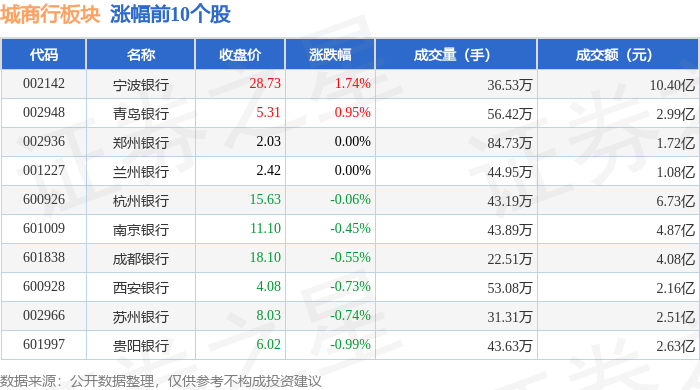
城商行板块9月5日跌0.37%,重庆银行领跌,主力资金净流出2.87亿元
Zheng Xing Xing Ye Ri Bao· 2025-09-05 08:56
Group 1 - The city commercial bank sector experienced a decline of 0.37% on September 5, with Chongqing Bank leading the drop [1] - The Shanghai Composite Index closed at 3812.51, up 1.24%, while the Shenzhen Component Index closed at 12590.56, up 3.89% [1] - Key individual stock performances in the city commercial bank sector included Ningbo Bank rising by 1.74% and Chongqing Bank falling by 1.34% [1][2] Group 2 - The net outflow of main funds from the city commercial bank sector was 287 million yuan, while retail investors saw a net inflow of 141 million yuan [2] - The trading volume for Chongqing Bank was 107,400 shares, with a transaction amount of 103 million yuan [2] - The overall trading activity showed a mixed trend, with some banks experiencing slight declines while others saw minor gains [1][2]

5.17%!农业银行成A股市值最高的上市公司
Jin Rong Jie· 2025-09-05 07:26
Core Viewpoint - The A-share market is experiencing significant differentiation, with substantial capital outflow from the technology sector and strong performance in low-positioned and defensive sectors, particularly in the banking sector [1] Group 1: Banking Sector Performance - Agricultural Bank's stock price surged by 5.17%, reaching a historical high and surpassing Industrial and Commercial Bank to become the highest market capitalization company in A-shares [1] - Since the end of 2023, the banking sector has shown a strong upward trend, with a 70% increase from the bottom in late 2023 [1] - The banking sector's performance is supported by a high dividend yield, with the China Securities Banking Index yielding over 5%, significantly higher than the 3% yield of the CSI 300 [2] Group 2: Policy Support and Economic Recovery - Monetary policy adjustments, including a 0.5% reserve requirement ratio cut and a 0.1% interest rate reduction, have lowered banks' liability costs and eased net interest margin pressure [3] - The banking sector's non-performing loan ratio decreased from 1.72% in 2023 to 1.62% by the end of 2024, indicating improved asset quality [3] - Economic recovery is reflected in a 12% year-on-year increase in long-term loans to residents in Q1 2025, contributing to banks' interest income growth [3] Group 3: Investment Shifts and Valuation - With high valuations in technology and new energy sectors, funds are shifting towards undervalued, high-dividend banking stocks, creating a "see-saw effect" [4] - The banking sector's price-to-book (PB) ratio is currently at 0.56 and the price-to-earnings (PE) ratio is approximately 6.37, both below the 10% percentile of the past decade [4] - The diversification of the banking sector's asset structure, including infrastructure loans and green finance, is expected to become new profit growth points [4]
有产品年内赚超40%,理财再现高收益!入手前先看懂这些!
Nan Fang Du Shi Bao· 2025-09-05 06:02
Core Viewpoint - The article discusses the rising trend of high-yield wealth management products in a low-interest-rate environment, highlighting the performance of equity and mixed-asset products that have achieved significant returns this year [2][3][9]. Group 1: High-Yield Wealth Management Products - Nearly a hundred wealth management products have achieved double-digit growth in annual returns this year, with some products from institutions like 招银理财 yielding over 40% [2][3]. - The majority of high-yield products are equity or mixed-asset products, with equity allocations often exceeding 50%, and in some cases, over 90% [3][7]. - As of August, the average annualized return for wealth management products was 2.12%, down 0.53 percentage points from the end of last year, making the performance of equity and mixed-asset products particularly notable [3]. Group 2: Market Trends and Institutional Behavior - The low-interest-rate environment is prompting institutional investors, such as insurance companies, to increase their allocations to equities to enhance investment returns [5][6]. - 宁银理财 has actively participated in new stock subscriptions, leading the banking wealth management sector in the number of products involved in IPOs [6][7]. - The shift towards equity investments is becoming a consensus among wealth management companies as traditional fixed-income products face declining yields [5][6]. Group 3: Investor Considerations and Risk Awareness - Investors are advised to understand the inherent risks associated with high-yield products, as those with returns exceeding 20% often experience maximum drawdowns of over 10% [8][9]. - 宁银理财 emphasizes the importance of assessing individual risk tolerance and understanding the characteristics of the products before investing [9]. - The company has developed a diverse product line covering various risk levels to cater to different investor needs, highlighting the importance of appropriate asset allocation [9].

银行业2025年半年报业绩综述:营收净利润增速转正,负债端成本普遍改善
Dongguan Securities· 2025-09-05 05:14
Investment Rating - The report maintains an "Overweight" rating for the banking industry [1][3][5] Core Insights - The banking sector has shown signs of performance recovery, with operating revenue and net profit growth turning positive in the first half of 2025. Total operating revenue reached CNY 2.92 trillion, a year-on-year increase of 1.04%, while net profit attributable to shareholders grew by 0.80% [3][14][24] - The average return on equity (ROE) for listed banks remains above 10%, standing at 10.99%, although it has decreased by 0.56 percentage points year-on-year [3][26] - The report highlights a shift in loan demand, with corporate loans showing strength while retail loans remain weak. The total loan amount increased by 7.96% year-on-year, with corporate loans accounting for 66.74% of new loans [3][39] - The net interest margin decline has slowed, with the weighted average net interest margin at 1.43%, down 13 basis points year-on-year, indicating reduced pressure on funding costs [3][50] Summary by Sections 1. Performance Recovery and Non-Interest Income - The banking sector's revenue growth turned positive, driven by a recovery in the bond market, with non-interest income increasing by 10.76% year-on-year in the first half of 2025 [3][20] - The second quarter saw a significant improvement in revenue growth, with a year-on-year increase of 3.91%, marking a turnaround from negative growth [15][20] - Individual banks showed varied performance, with some achieving substantial revenue growth, while others lagged behind [21][25] 2. Loan and Deposit Trends - The total assets of listed banks grew by 9.60% year-on-year, with city commercial banks leading in asset expansion [3][31] - The proportion of demand deposits has declined to a historical low, with a shift towards time deposits [3][50] - The report notes a cautious approach to retail lending due to rising credit risks, with banks focusing on corporate lending to support economic transformation [39][47] 3. Interest Margin and Cost of Liabilities - The average net interest margin has shown a reduced rate of decline, indicating improved conditions for banks [3][50] - The cost of liabilities has generally decreased, contributing to a more favorable operating environment for banks [3][50] 4. Asset Quality and Provision Coverage - The average non-performing loan (NPL) ratio for listed banks was stable at 1.23%, with a slight year-on-year improvement [3][4] - The provision coverage ratio has decreased slightly, reflecting some banks' decisions to release provisions to boost profits [3][4] 5. Investment Recommendations - The report suggests focusing on three main investment lines: high dividend, low valuation banks such as ICBC, ABC, BOC, and CCB; banks with regional advantages and strong performance certainty like Chengdu Bank and Hangzhou Bank; and banks benefiting from retail business recovery like China Merchants Bank and Industrial Bank [5][5]