
吉利汽车

Search documents
Geely Redefines Next-Gen Smart Vehicle Tech Unveiling Full-Domain AI 2.0 and G-ASD at CES 2026
Globenewswire· 2026-01-06 03:58
Core Insights - Geely Auto Group showcased its commitment to intelligent mobility at CES 2026 by unveiling Full-Domain AI 2.0 and G-ASD, aiming to redefine next-generation smart vehicle technology [2][6] Group 1: Full-Domain AI 2.0 - Full-Domain AI 2.0 represents a significant upgrade from the previous version, transitioning from a fragmented, module-based system to a unified vehicle-wide AI architecture [3] - The new architecture integrates vehicle-level computing power, data, and models to create a central intelligent engine, enhancing collaboration across various vehicle functions [3] - This system allows for real-time interaction and mutual access among intelligent systems in the cockpit, chassis, safety, and driving domains [3] Group 2: G-ASD (Geely Afari Smart Driving) - G-ASD is Geely's next-generation intelligent driving system, designed to facilitate the shift towards high-level autonomous driving [4][6] - The system utilizes advanced AI, extensive real-world driving data, and high-performance hardware to improve safety and driving confidence in complex traffic situations [4] - G-ASD aims to provide a more humanlike and user-friendly driving experience, integrating seamlessly with vehicle components [5]

至信股份开启申购
Zheng Quan Ri Bao Wang· 2026-01-06 03:45
Core Viewpoint - Zhixin Co., Ltd. is launching an IPO with a share price of 21.88 yuan, focusing on the development, processing, production, and sales of automotive stamping parts and related molds, positioning itself as a key supplier in the automotive industry [1][2]. Group 1: Company Overview - Zhixin Co., Ltd. specializes in automotive stamping parts and related molds, including white body stamping parts and tooling, and has established itself as a first-tier supplier for major automotive manufacturers such as Changan Automobile, Geely, and BYD [1]. - The company has a competitive advantage in the domestic automotive stamping parts market, supported by its wholly-owned subsidiaries specializing in mold development and intelligent manufacturing solutions [1][2]. Group 2: Financial Performance - The company's revenue for the years 2022, 2023, 2024, and the first half of 2025 is projected to be 2.091 billion yuan, 2.564 billion yuan, 3.088 billion yuan, and 1.604 billion yuan respectively, with a compound annual growth rate (CAGR) of 21.52% from 2022 to 2024 [2]. - The net profit attributable to shareholders after deducting non-recurring gains and losses for the same periods is expected to be 52.25 million yuan, 119.69 million yuan, 184.72 million yuan, and 87.18 million yuan, with a CAGR of 88.02% from 2022 to 2024 [2]. Group 3: Industry Outlook - The automotive parts industry in China is projected to exceed 5.5 trillion yuan in revenue by 2026, indicating a promising market outlook [3]. - Government policies supporting the automotive industry, including the development of new energy vehicles, provide a favorable environment for growth in the automotive parts sector, aligning with national economic strategies [3]. Group 4: Fundraising and Investment Plans - Zhixin Co., Ltd. plans to raise 1.329 billion yuan to expand production capacity and upgrade technology, as well as to supplement working capital [4]. - The investment projects are strategically aligned with the current market landscape and future trends in the automotive stamping parts sector, aiming to enhance the company's manufacturing capabilities and overall competitiveness [4].
中金:维持吉利汽车跑赢行业评级 目标价26.00港元
Zhi Tong Cai Jing· 2026-01-06 02:41
Group 1 - The core viewpoint of the report is that Geely Automobile (00175) is experiencing an upward product cycle and multi-brand collaboration, leading to an increase in profitability, with net profit estimates for 2025 and 2026 raised by 3.2% and 8.9% to 17.5 billion and 21.5 billion respectively, and a new estimate for 2027 net profit at 24.9 billion [1] - The company announced that it achieved a passenger vehicle sales volume of 3,024,567 units in 2025, a year-on-year increase of 39%, exceeding the original annual sales target of 3 million units [2] - In terms of brand performance, Geely's main brand, Zeekr, and Lynk & Co achieved sales of 2,449,939 units, 224,133 units, and 350,495 units respectively, with year-on-year growth of 47%, 1%, and 23%. New energy vehicle sales increased by 90% to 1,687,767 units, accounting for 55.8% of total sales [3] Group 2 - The company has set a sales target of 3.45 million passenger vehicles for 2026, representing a year-on-year increase of 14%, with new energy vehicle sales expected to grow by 32% to 2.22 million units. The sales targets for Geely, Zeekr, and Lynk & Co are set at 2.75 million, 300,000, and 400,000 units respectively [3] - The report highlights that Geely is gradually improving its product lineup across various price ranges in the new energy sector, with new models such as the Zeekr 9X, Lynk & Co 900, and Galaxy M9 being introduced to fill market gaps, while also expanding its product line in MPV and off-road categories [3] - The report anticipates that as the integration of Geely, Zeekr, and Lynk & Co progresses, the synergies in production management will gradually be realized, coupled with an upward product cycle, which is expected to demonstrate stronger profitability elasticity [3]
50亿英镑折扣撬动市场!英国2025年新车销量重回200万辆 中国品牌加速崛起
Zhi Tong Cai Jing· 2026-01-06 02:28
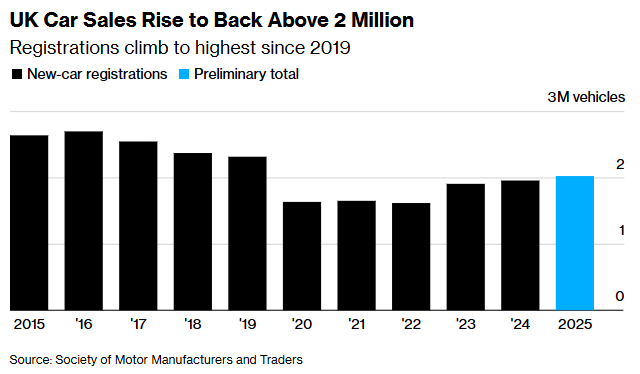
智通财经APP获悉,英国新车销量在去年自疫情以来首次突破200万辆,部分原因在于汽车制造商对电 动汽车提供了超过50亿英镑(约合67亿美元)的折扣。英国汽车制造商和贸易商协会(SMMT)周二公布的 数据显示,2025年新车注册量增长3.5%,达到202万辆。其中,纯电动车型销量增长约四分之一,整体 市场的23%。这一数据较2024年有所改善,但仍未达到政府设定的28%的电动汽车销售目标,且低于 2025年目标10个百分点。 来自中国的汽车品牌正加速进军英国市场,奇瑞和吉利去年已开始在英国销售。英国对中国品牌尤其具 有吸引力,因为它没有效仿欧盟对中国制造的电动汽车加征关税。 与此同时,中国品牌日益增长的影响力给来自日本、韩国和部分欧洲的汽车制造商带来了更大压力。此 外,这些公司还面临着电动汽车销售目标的压力,若未达标,每辆车最高可能面临1.2万英镑的罚款, 不过它们可以通过积分交易体系以及其他灵活安排来避免处罚。 SMMT援引Jato Dynamics和Auto Trader的数据称,制造商去年在电动车上的折扣总额超过50亿英镑,相 当于每辆注册的纯电动车平均优惠约1.1万英镑。该行业游说组织表示,这种做法"显 ...
中国汽车-重估拐点框架:2026 年增长放缓背景下的资本支出扩张与竞争-China Automobiles_ Revisiting inflection framework_ Capex expansion & competition amid slowing growth into 2026
2026-01-06 02:23
Summary of China Automobiles Conference Call Industry Overview - The China automobile industry is experiencing a cyclical assessment regarding overcapacity and competition, particularly as growth is expected to slow into 2026 [1] - Government subsidies and anti-involution policies have been implemented to stabilize pricing and profitability within the industry [1] Key Financial Metrics - OEMs raised a total of **US$15.6 billion (Rmb111 billion)** through equity issuance in 2025, facilitating new product investments and market competition [1][31] - OEM combined capital expenditure (capex) increased by **31% year-over-year** in Q3 2025, although this was a moderation from **66% year-over-year** in Q2 2025 [4][7] - Industry cash profit (EBITDA) declined by **10% year-over-year** in Q3 2025, compared to a **1% decline** in Q2 2025 [4][24] Market Dynamics - In 2026, **119 new NEV models** are expected to be launched, with domestic passenger vehicle growth projected to slow to **-2%** and new energy vehicle (NEV) growth at **+11% year-over-year** [2] - Exports are anticipated to be a bright spot, with overseas markets poised for NEV mass adoption [2] Competitive Landscape - Managements of various OEMs remain optimistic about their individual company growth despite a conservative outlook for the overall auto industry in 2026 [4][18] - The majority of OEMs are still above cash cost levels, indicating that industry consolidation may be prolonged due to less concern over cash positions [18][19] Company-Specific Insights - **BYD** and **XPeng** are highlighted as better positioned for overseas exposure, with expanding sales networks and new export models [2] - **Li Auto** plans to launch facelift models and increase R&D expenses while focusing on overseas markets [36] - **Nio** aims for a monthly sales volume of **50,000 units** in 1H26, driven by new model launches and improved pricing strategies [38] - **SAIC** targets **1 million units** in sales for 2026, with a focus on new model launches and cost-cutting measures [36] - **GAC** aims to increase export volume to **250,000 units** in 2026, up from **130,000 units** in 2025 [36] Investment Considerations - The effectiveness of government subsidies is expected to weaken, with a projected **15%** stimulation effectiveness in 2026, leading to an estimated **1.8 million** units of stimulated demand [51] - Domestic NEV retail sales volume is forecasted at **14 million** units in 2026, reflecting an **11% year-over-year** increase [52] - Export volume for passenger vehicles is expected to reach **7.4 million** units in 2026, with NEV exports projected to grow by **35% year-over-year** [53] Conclusion - The China automobile industry is at a critical juncture with intensifying competition and a shift towards overseas markets. Companies are focusing on cost control, R&D investments, and expanding their international presence to navigate the challenges ahead [18][35]


从小切口透视大行业 ——2025年汽车供应链变革“风暴眼”
Zhong Guo Qi Che Bao Wang· 2026-01-06 02:18
Core Insights - The automotive industry's core competitiveness is shifting from traditional mechanical performance to smart technology, safety, and integration with energy networks [3] - Eight key component areas have emerged as focal points for change in the automotive supply chain by 2025 [3] Group 1: AI and Smart Technology - AI large models, including VLA and VLM, are reshaping the perception, decision-making, and interaction systems in smart vehicles [4] - Companies like Li Auto and XPeng are actively developing and deploying VLA-based autonomous driving systems, with plans for mass production by 2026 [4] - The competition in AI models is intensifying, with a focus on the underlying support systems like computing power and data [4] Group 2: Vehicle-to-Grid (V2G) Interaction - V2G is becoming a hot topic as electric vehicles can act as distributed energy storage units within new energy systems [5] - Government policies are driving the adoption of V2G, with pilot projects and plans to expand the scope of V2G applications by 2027 [5][6] - Companies like GAC Group are implementing V2G functionalities in their models and developing charging infrastructure to support this transition [6] Group 3: Battery Safety Standards - The new national standard for electric vehicle batteries, effective July 2026, emphasizes safety by requiring batteries to be "non-flammable and non-explosive" [7] - The updated standards will compel battery manufacturers to innovate in materials, design, and production processes to meet stricter safety requirements [7] - Leading battery companies like BYD are already adapting to these new standards, which will enhance safety and consumer trust in electric vehicles [7] Group 4: Door Handle Innovations - Electric hidden door handles are becoming a focal point due to safety concerns arising from their failure in collision scenarios [8][9] - New regulations are being proposed to ensure that all door handles, including electronic ones, have a mechanical release function for emergency situations [9] Group 5: Solid-State Batteries - Solid-state batteries are gaining traction due to their advantages in energy density and safety, with several companies planning to launch new products or production lines [10] - The development of solid-state batteries is seen as a key competitive factor for companies in the next generation of electric vehicles [10][11] Group 6: Human-Car-Home Ecosystem - The "Human-Car-Home" ecosystem is emerging, integrating automotive, home, and personal devices into a cohesive smart system [12] - Companies like Haier and Midea are collaborating with automotive brands to create interconnected systems that enhance user experience [12][13] Group 7: Humanoid Robots - The automotive industry is increasingly intersecting with humanoid robotics, with companies exploring the integration of robotic technology into manufacturing processes [14][15] - The demand for precision and adaptability in manufacturing is driving the development of humanoid robots tailored for automotive applications [14] Group 8: Zero-Gravity Seats - Zero-gravity seats are becoming a key feature in mid to high-end vehicles, enhancing passenger comfort and experience [16] - The lack of standardized regulations for these seats poses challenges, particularly regarding safety during vehicle operation and collisions [16]

43家港股公司出手回购(1月5日)


Zheng Quan Shi Bao Wang· 2026-01-06 02:02
腾讯控股回购数量101.80万股,回购金额6.36亿港元,回购最高价为627.500港元,最低价为617.000港 元,年内累计回购金额12.71亿港元;小米集团-W回购数量380.00万股,回购金额1.49亿港元,回购最 高价为39.320港元,最低价为39.220港元,年内累计回购金额1.49亿港元;吉利汽车回购数量342.00万 股,回购金额6031.47万港元,回购最高价为17.900港元,最低价为17.520港元,年内累计回购金额 6031.47万港元。 集团 | 02598 | 连连数字 | 11.00 | 75.86 | 6.970 | 6.710 | 75.86 | | --- | --- | --- | --- | --- | --- | --- | | 00909 | 明源云 | 20.00 | 65.53 | 3.280 | 3.270 | 132.64 | | 02416 | 易点云 | 21.95 | 49.89 | 2.280 | 2.250 | 134.20 | | 02652 | 长风药业 | 1.50 | 48.54 | 32.920 | 31.700 | 85.42 | | ...
中国汽车第一城,易主
Di Yi Cai Jing· 2026-01-06 01:42
Core Insights - The competition for the title of "Automobile Capital" in China by 2025 is becoming clearer, with traditional automotive hubs facing transformation pressures and emerging cities leveraging their advantages in the new energy vehicle (NEV) sector [1] Group 1: Current Leaders - Chongqing leads in overall vehicle production with nearly 2.5 million units, showing a year-on-year increase of 12.1% [2] - Hefei ranks first in NEV production with over 1.2 million units, benefiting from a strategic industrial layout that includes major brands like Jianghuai, NIO, and BYD [4][3] Group 2: Emerging Competitors - Anhui province surpassed Guangdong to become the top province in automotive production, with a total output of 3.335 million vehicles and NEV production of 1.635 million units, both ranking first nationally [3] - Cities like Wuhu and Liuzhou are also making significant strides, with Wuhu's automotive production expected to rise and Liuzhou achieving a production of 1.331 million vehicles, a 37.8% increase year-on-year [5][4] Group 3: Statistical Adjustments and Impacts - The statistical reform initiated by the National Bureau of Statistics in 2021 is reshaping the automotive industry landscape, affecting production data and competitive dynamics among cities [1] - Shenzhen's automotive production has declined, with the city no longer maintaining a competitive edge in the rankings due to changes in statistical methods [7] Group 4: Future Projections - Cities like Xi'an, Zhengzhou, and Qingdao are approaching the "million vehicle club," with Xi'an's production reaching 1.576 million vehicles and Zhengzhou's expected to exceed one million units [9][10] - Wuhan aims to surpass one million vehicles in total production by the end of 2025, with current figures showing a 7.6% increase year-on-year [10]
期指:大涨后的偏强震荡
Guo Tai Jun An Qi Huo· 2026-01-06 01:32
Report Summary 1. Report Industry Investment Rating No information provided. 2. Core Viewpoints - On January 5, 2026, all four major stock index futures contracts for the current month rose, with IF up 2.07%, IH up 2.42%, IC up 2.81%, and IM up 2.37% [1]. - On the trading day, the total trading volume of stock index futures rebounded, indicating increased trading enthusiasm among investors. The total trading volume of IF, IH, IC, and IM increased by 20,649 lots, 6,347 lots, 29,217 lots, and 24,485 lots respectively. In terms of positions, the total positions of IF, IH, IC, and IM increased by 8,201 lots, 3,543 lots, 22,660 lots, and 13,346 lots respectively [2]. - The trend strength of IF and IH is 1, and that of IC and IM is also 1. The A - share market had a good start in 2026, with the Shanghai Composite Index rising by more than 1% and returning to 4,000 points, and the ChiNext Index surging nearly 3%. The Hong Kong stock market fluctuated slightly up, with the biotechnology and semiconductor industries strengthening [6][7]. 3. Summary by Relevant Catalogs 3.1. Stock Index Futures Data Tracking - **CSI 300 and Related Futures**: The CSI 300 closed at 4,717.8, up 1.90%. Among its futures, IF2601 closed at 4,714, up 2.07%, with a basis of - 3.75; IF2602 closed at 4,702.6, up 2.14%, with a basis of - 15.15; IF2603 closed at 4,697, up 2.26%, with a basis of - 20.75; IF2606 closed at 4,649.8, up 2.23%, with a basis of - 67.95 [1]. - **SSE 50 and Related Futures**: The SSE 50 closed at 3,099.8, up 2.26%. Among its futures, IH2601 closed at 3,097.4, up 2.42%, with a basis of - 2.35; IH2602 closed at 3,099.6, up 2.59%, with a basis of - 0.15; IH2603 closed at 3,098.8, up 2.55%, with a basis of - 0.95; IH2606 closed at 3,088.8, up 2.56%, with a basis of - 10.95 [1]. - **CSI 500 and Related Futures**: The CSI 500 closed at 7,651.2, up 2.49%. Among its futures, IC2601 closed at 7,664.8, up 2.81%, with a basis of 13.6; IC2602 closed at 7,624.8, up 2.95%, with a basis of - 26.4; IC2603 closed at 7,596, up 3.11%, with a basis of - 55.2; IC2606 closed at 7,417, up 3.27%, with a basis of - 234.2 [1]. - **CSI 1000 and Related Futures**: The CSI 1000 closed at 7,753.9, up 2.09%. Among its futures, IM2601 closed at 7,759.2, up 2.37%, with a basis of 5.32; IM2602 closed at 7,697.8, up 2.56%, with a basis of - 56.08; IM2603 closed at 7,639, up 2.69%, with a basis of - 114.9; IM2606 closed at 7,403.4, up 2.76%, with a basis of - 350.5 [1]. 3.2. Position Changes of the Top 20 Futures Members - For IF contracts, in IF2601, long positions decreased by 607 and short positions increased by 347; in IF2603, long positions increased by 5,858 and short positions increased by 5,971; in IF2606, long positions increased by 1,027 and short positions increased by 490 [5]. - For IH contracts, in IH2601, long positions decreased by 62 and short positions increased by 168; in IH2603, long positions increased by 2,259 and short positions increased by 2,443; in IH2606, long positions increased by 206 and short positions increased by 91 [5]. - For IC contracts, in IC2601, long positions increased by 598 and short positions increased by 1,459; in IC2603, long positions increased by 11,123 and short positions increased by 12,210; in IC2606, long positions increased by 2,786 and short positions increased by 2,146 [5]. - For IM contracts, in IM2601, long positions decreased by 1,660 and short positions decreased by 909; in IM2602, long positions increased by 2,233 and short positions increased by 2,659; in IM2603, long positions increased by 4,700 and short positions increased by 8,413 [5]. 3.3. Market Trends and Drivers - **A - share Market**: The A - share market had a good start in 2026. The Shanghai Composite Index rose 1.38% to 4,023.42 points, the Shenzhen Component Index rose 2.24%, the ChiNext Index rose 2.85%, the Beixin 50 rose 1.8%, the Kechuang 50 rose 4.41%, and the Wind All - A Index rose 1.99%. The total trading volume was 2.57 trillion yuan, compared with 2.07 trillion yuan the previous day [6]. - **Hong Kong Stock Market**: The Hong Kong stock market fluctuated slightly up. The Hang Seng Index rose 0.03% to 26,347.24 points, the Hang Seng Tech Index rose 0.09% to 5,741.63 points, and the Hang Seng China Enterprises Index fell 0.22% to 9,148.47 points. The market trading volume was HK$283.462 billion, significantly higher than the previous trading day's HK$140.864 billion [7]. - **US Stock Market**: The three major US stock indexes all closed up. The Dow Jones Industrial Average rose 1.23% to 48,977.18 points, reaching a new record high; the S&P 500 Index rose 0.64% to 6,902.05 points; the Nasdaq Composite Index rose 0.69% to 23,395.82 points [8].
中国汽车第一城易主
Di Yi Cai Jing Zi Xun· 2026-01-06 01:20
Core Insights - The competition for the title of "Automobile Capital" in China by 2025 is intensifying, with Chongqing currently leading in overall vehicle production and Hefei excelling in the new energy vehicle segment [1][2]. Group 1: Chongqing's Position - Chongqing's vehicle production reached 2.4981 million units from January to November 2025, marking a 12.1% year-on-year increase, solidifying its status as a leading automobile city [2]. - The city is home to traditional brands like Changan and emerging players like Seres, contributing to its competitive edge [2]. Group 2: Hefei's Growth - Hefei produced 1.246 million new energy vehicles in the same period, ranking first among cities in this category [4]. - The city aims to achieve a scale of 700 billion yuan in its new energy vehicle industry by 2025, with a target of producing over 3 million vehicles [4]. Group 3: Other Competitors - Anhui province, with a total vehicle production of 3.335 million units and 1.635 million new energy vehicles, has surpassed Guangdong to become the leading province [3]. - Cities like Wuhu and Liuzhou are also making significant strides, with Wuhu's production expected to rise and Liuzhou achieving a vehicle production of 1.331 million units, a 37.8% increase [5][4]. Group 4: Emerging Cities - Cities such as Xi'an, Zhengzhou, and Qingdao are approaching the "million vehicle" production threshold, with Xi'an producing 1.576 million vehicles and Zhengzhou showing a significant year-on-year growth of 89.72% [9]. - Qingdao's production reached 911,700 units, supported by major manufacturers like SAIC-GM Wuling and Chery [10]. Group 5: Challenges for Major Cities - Shenzhen's automotive production has declined, with the city no longer maintaining a competitive edge in vehicle production due to statistical adjustments [7]. - Guangzhou's traditional vehicle production fell by 20%, indicating a significant transition challenge [8].
