
海富通基金

Search documents
头部机构将齐聚21世纪基金业年会 倡议 “耐心资本定投中国”
2 1 Shi Ji Jing Ji Bao Dao· 2025-11-26 12:27
Core Insights - The Chinese public fund industry has reached a scale of 36.45 trillion yuan by the end of Q3 2025, marking a nearly 15% year-on-year growth, highlighting its increasing importance in connecting resident wealth with the real economy [1][5] - The upcoming "Southern Finance Forum 2025 Annual Meeting" will focus on the transformation and high-quality development of the fund industry, featuring discussions on ETFs and investment advisory services [1][2] Industry Development - Over the past five years, the public fund industry has shown significant transformation, including scale expansion, improved product ecosystem, and enhanced governance, with over 5 trillion yuan directed towards manufacturing and technological innovation [5] - As of August 2025, public funds held over 7 trillion yuan in A-share market capitalization, playing a crucial role in market stability and investor confidence [5] Future Outlook - The "Action Plan for Promoting High-Quality Development of Public Funds" has been introduced, emphasizing investor-centric reforms and aiming to realign the industry with its foundational principles [5] - The ETF market is expected to exceed 5 trillion yuan in 2025, with a growing adoption of ETF investment strategies among individual investors, reflecting a shift towards long-term, disciplined investment practices [7][8] Event Highlights - The 21st Century Fund Industry Annual Meeting will feature over 20 executives from major public fund institutions, alongside representatives from securities firms and private equity, fostering discussions on industry trends and strategies [2] - A special session on the "Buy-side Investment Advisory Project" will be held, including the launch of the "21st Century Gold Medal Investment Advisor Competition" [9]


天府证券ETF日报-20251126
天府证券· 2025-11-26 09:03
Report Summary 1. Market Overview - On November 26, 2025, the Shanghai Composite Index fell 0.15% to 3864.18 points, the Shenzhen Component Index rose 1.02% to 12907.83 points, and the ChiNext Index rose 2.14% to 3044.69 points. The total trading volume of A - shares in the two markets was 1797.4 billion yuan. The top - performing sectors were communications (4.64%), comprehensive (1.79%), and electronics (1.58%), while the worst - performing sectors were national defense and military industry (-2.25%), social services (-0.97%), and media (-0.82%) [2][6] 2. Stock ETFs - The top - trading - volume stock ETFs on this day were: Huaxia CSI A500 ETF, up 0.53% with a premium rate of 0.40%; E Fund ChiNext ETF, up 2.23% with a premium rate of 2.18%; Guotai CSI A500 ETF, up 0.62% with a premium rate of 0.47% [3][7] 3. Bond ETFs - The top - trading - volume bond ETFs were: Haifutong CSI Short - Term Financing ETF, unchanged (0.00%) with a premium rate of 0.00%; Bosera CSI Convertible and Exchangeable Bond ETF, down 0.80% with a premium rate of - 0.99%; Guotai CSI AAA Science and Technology Innovation Corporate Bond ETF, down 0.10% with a premium rate of - 0.11% [4][9] 4. Gold ETFs - Gold AU9999 fell 0.04% and Shanghai Gold fell 0.02%. The top - trading - volume gold ETFs were: Huaan Gold ETF, up 0.01% with a premium rate of 0.10%; Bosera Gold ETF, down 0.01% with a premium rate of 0.08%; E Fund Gold ETF, up 0.01% with a premium rate of 0.08% [12] 5. Commodity Futures ETFs - Huaxia Feed Soybean Meal Futures ETF fell 0.45% with a premium rate of 3.52%; Dacheng Non - Ferrous Metals Futures ETF rose 0.06% with a premium rate of 0.14%; Jianxin Yisheng Zhengzhou Commodity Exchange Energy and Chemical Futures ETF rose 0.74% with a premium rate of 0.54% [15] 6. Cross - border ETFs - The previous trading day, the Dow Jones Industrial Average rose 1.43%, the Nasdaq rose 0.67%, the S&P 500 rose 0.91%, and the German DAX rose 0.97%. On this day, the Hang Seng Index rose 0.13% and the Hang Seng China Enterprises Index rose 0.04%. The top - trading - volume cross - border ETFs were: GF CSI Hong Kong Innovative Drugs ETF, up 1.86% with a premium rate of 1.90%; E Fund CSI Hong Kong Securities Investment Theme ETF, up 0.20% with a premium rate of 0.20%; Huatai - Peregrine Hang Seng Technology ETF, up 0.81% with a premium rate of 0.38% [17] 7. Money ETFs - The top - trading - volume money ETFs were: Yin Hua Day - to - Day Profit ETF, Huabao Add - Benefit ETF, and Money ETF Jianxin Add - Benefit [19]
两市ETF两融余额减少12.41亿元丨ETF融资融券日报
2 1 Shi Ji Jing Ji Bao Dao· 2025-11-26 02:57
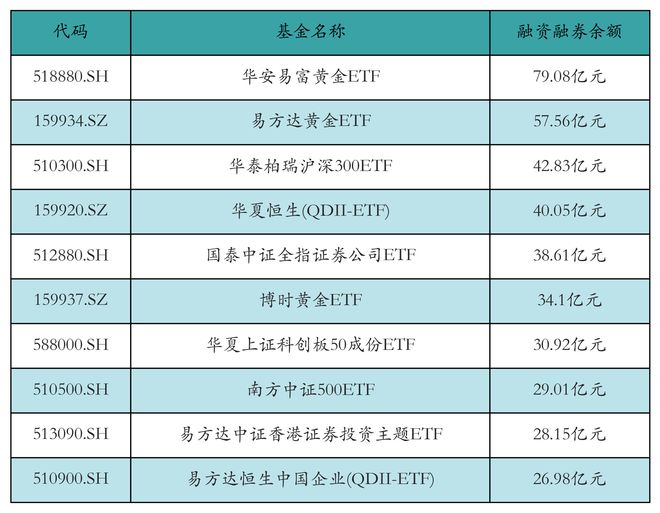
Market Overview - As of November 25, the total ETF margin balance in the two markets is 119.68 billion yuan, a decrease of 1.241 billion yuan from the previous trading day [1] - The financing balance is 112.48 billion yuan, down by 1.436 billion yuan, while the securities lending balance is 7.198 billion yuan, an increase of 196 million yuan [1] - In the Shanghai market, the ETF margin balance is 83.791 billion yuan, a decrease of 641 million yuan, with a financing balance of 77.457 billion yuan, down by 820 million yuan [1] - In the Shenzhen market, the ETF margin balance is 35.889 billion yuan, a decrease of 600 million yuan, with a financing balance of 35.025 billion yuan, down by 616 million yuan [1] ETF Margin Balance - The top three ETFs by margin balance on November 25 are: - Huaan Yifu Gold ETF (7.908 billion yuan) - E Fund Gold ETF (5.756 billion yuan) - Huatai-PB CSI 300 ETF (4.283 billion yuan) [2] - The detailed top 10 ETFs by margin balance are provided in the table [2] ETF Financing Amount - The top three ETFs by financing amount on November 25 are: - Huatai-PB Southern Dongying Hang Seng Technology Index (1.067 billion yuan) - E Fund CSI Hong Kong Investment Theme ETF (1.031 billion yuan) - Huaxia Hang Seng Technology ETF (891 million yuan) [3] - The detailed top 10 ETFs by financing amount are provided in the table [4] ETF Net Financing Amount - The top three ETFs by net financing amount on November 25 are: - Huaxia Hang Seng Technology ETF (122 million yuan) - GF CSI Hong Kong Innovation Drug ETF (105 million yuan) - E Fund CSI Hong Kong Investment Theme ETF (43.632 million yuan) [5] - The detailed top 10 ETFs by net financing amount are provided in the table [6] ETF Securities Lending Amount - The top three ETFs by securities lending amount on November 25 are: - Huatai-PB CSI 300 ETF (54.567 million yuan) - Southern CSI 500 ETF (46.885 million yuan) - Southern CSI 1000 ETF (14.959 million yuan) [7] - The detailed top 10 ETFs by securities lending amount are provided in the table [8]
债券ETF规模创新高!
证券时报· 2025-11-25 07:56
Core Viewpoint - The bond ETF market has experienced rapid expansion this year, with leading products seeing significant growth and a clear restructuring of the industry [1][2]. Overall Scale Continues to Reach New Highs - As of November 24, the total scale of bond ETFs reached 720.6 billion yuan, continuously setting historical highs [4]. - In the overall market structure, as of November 21, stock ETFs accounted for 63.93%, cross-border ETFs 15.89%, and bond ETFs 12.82%, a significant increase from 4.66% at the end of last year [4]. - The overall scale of bond ETFs was only 174 billion yuan at the end of last year, indicating a remarkable growth rate [4]. - Some bond ETFs have shown outstanding performance this year, with the Bosera CSI Convertible Bond ETF up 15.93% and the Haifutong Shanghai Stock Exchange Investment Grade Convertible Bond ETF up 12.04% as of November 21 [4]. Head Product Expansion - A considerable portion of the growth in leading products comes from net increases this year, with the Haifutong CSI Short-term Bond ETF increasing by 43.032 billion yuan, and the Pengyang 30-Year Government Bond ETF growing by 28.930 billion yuan [5]. - As of November 21, the total number of bond ETF products reached 53, with 32 launched this year, accounting for over 60% [5]. Bond ETFs as Efficient Investment Vehicles - Bond ETFs are characterized by T+0 trading, pledging capabilities, high efficiency, and low transaction costs, making them powerful tools for investors [7]. - Compared to stock ETFs, bond ETFs have four notable features: high liquidity, lower trading thresholds through index sampling replication, low transaction fees, and the ability to be used for high ratio pledging financing [7]. Institutional Dominance and Market Drivers - The bond ETF market is predominantly led by institutional investors, who account for 92%, while individual investors make up only 8% but have significant growth potential [8]. - The rapid expansion of bond ETFs is driven by three main factors: strong policy support, explosive product innovation, and a shift in market conditions leading investors to seek transparent, low-cost index tools [8][9].

两市ETF两融余额减少3.68亿元丨ETF融资融券日报
2 1 Shi Ji Jing Ji Bao Dao· 2025-11-25 02:43
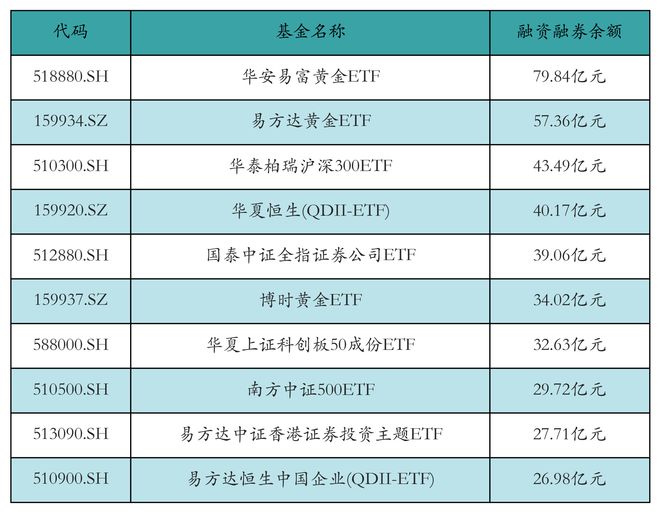
Market Overview - On November 24, the total ETF margin balance in the two markets was 120.92 billion yuan, a decrease of 368 million yuan from the previous trading day [1] - The financing balance was 113.92 billion yuan, down by 347 million yuan, while the margin short balance was 7.00 billion yuan, a decrease of 21.07 million yuan [1] - In the Shanghai market, the ETF margin balance was 84.43 billion yuan, a decrease of 27.65 million yuan, with a financing balance of 78.28 billion yuan, down by 1.48 million yuan [1] - In the Shenzhen market, the ETF margin balance was 36.49 billion yuan, a decrease of 341 million yuan, with a financing balance of 35.64 billion yuan, down by 346 million yuan [1] ETF Margin Financing Balances - The top three ETF margin financing balances on November 24 were: - Huaan Yifu Gold ETF (7.98 billion yuan) - E Fund Gold ETF (5.74 billion yuan) - Huatai-PB CSI 300 ETF (4.35 billion yuan) [2] - The detailed top 10 list includes funds such as Huaxia Hang Seng (QDII-ETF) and Guotai CSI All-Share Securities Company ETF [2] ETF Margin Financing Buy Amounts - The top three ETF financing buy amounts on November 24 were: - Huatai-PB South East Asia Hang Seng Technology Index (1.39 billion yuan) - Bosera CSI Convertible Bonds and Exchangeable Bonds ETF (1.28 billion yuan) - E Fund CSI Hong Kong Securities Investment Theme ETF (898 million yuan) [3] - The detailed top 10 list includes funds like Hai Futong CSI Short-term Bond ETF and Huaxia Hang Seng Technology (QDII-ETF) [4] ETF Margin Financing Net Buy Amounts - The top three ETF financing net buy amounts on November 24 were: - Bosera CSI Convertible Bonds and Exchangeable Bonds ETF (203 million yuan) - Huatai-PB CSI 300 ETF (115 million yuan) - Huaxia Shanghai Stock Exchange Sci-Tech Innovation Board 50 ETF (79.07 million yuan) [5] - The detailed top 10 list includes funds such as Huatai-PB South East Asia Hang Seng Technology Index (QDII-ETF) and Pengyang 30-Year Treasury ETF [6] ETF Margin Short Selling Amounts - The top three ETF margin short selling amounts on November 24 were: - Huatai-PB CSI 300 ETF (34.95 million yuan) - Southern CSI 500 ETF (7.56 million yuan) - Huaxia SSE 50 ETF (3.97 million yuan) [7] - The detailed top 10 list includes funds like Guolian An CSI All-Share Semiconductor Products and Equipment ETF [8]
债券ETF规模创新高!
券商中国· 2025-11-25 01:48
Core Viewpoint - The bond ETF market has experienced rapid expansion this year, with a significant increase in the scale of leading products and a noticeable restructuring of the industry [1][2]. Market Overview - As of November 24, the total scale of bond ETFs reached 720.6 billion yuan, continuously setting historical highs and rapidly increasing its market share within the ETF landscape [2][3]. - The proportion of bond ETFs in the overall market rose to 12.82%, a substantial increase from 4.66% at the end of last year, while the share of stock ETFs decreased from 77.38% [3]. - The performance of certain bond ETFs has been notable, with the Bosera CSI Convertible Bond ETF rising by 15.93% and the Hai Fu Tong Shanghai Stock Exchange Investment Grade Convertible Bond ETF increasing by 12.04% year-to-date [3]. Growth Drivers - The growth in the bond ETF market is driven by three main factors: strong policy support, product innovation, and a shift in investor strategy towards passive investment tools due to increased market volatility [7]. - The number of bond ETF products reached 53, with 32 launched this year, indicating a robust influx of new offerings [4]. Characteristics of Bond ETFs - Bond ETFs are characterized by high liquidity, low trading costs, and the ability to be used for collateral financing, making them an efficient investment vehicle [5][6]. - They offer T+0 trading, allowing investors to buy and sell on the same day, and typically have lower transaction fees compared to traditional bond investments [6]. Investor Composition - Institutional investors dominate the bond ETF market, accounting for 92% of the total, while individual investors represent only 8%, indicating significant growth potential in the retail segment [7].
上周超500亿资金抄底股票ETF,恒生科技、中证500、创业板指、科创50“吸金”居前
Ge Long Hui· 2025-11-25 00:40
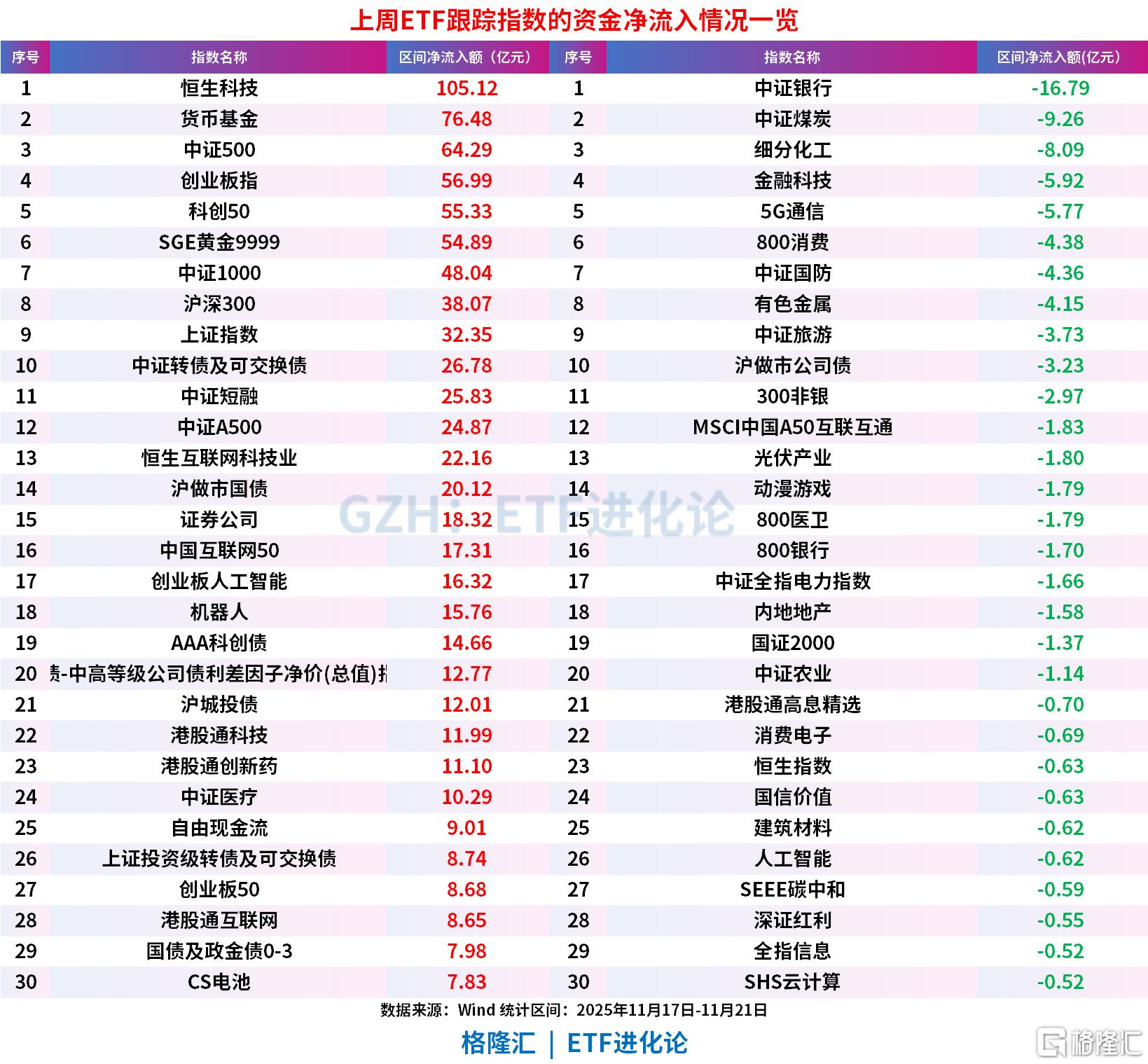
Market Performance - The A-share market saw a decline across major indices last week, with the CSI 300, Shanghai Composite Index, and SME Index showing returns of -3.77%, -3.90%, and -5.10% respectively. The ChiNext Index, CSI 1000, and CSI 500 had lower returns of -6.15%, -5.80%, and -5.78% respectively [1] - In terms of industry performance, banks, food and beverage, and media sectors had relatively better returns of -0.87%, -1.36%, and -1.39% respectively, while sectors like comprehensive, electric equipment and new energy, and basic chemicals lagged with returns of -9.47%, -9.41%, and -8.24% respectively [1] Fund Flows - The ETF market experienced a net inflow of 98 billion, with stock ETFs contributing 54.577 billion, QDII stock ETFs 15.544 billion, commodity ETFs 6.495 billion, bond ETFs 13.8 billion, and money market fund ETFs 7.648 billion. Notably, on November 21, there was a significant inflow of 50 billion aimed at "bottom-fishing" through ETFs [2] - Specific indices such as Hang Seng Technology, money market funds, CSI 500, ChiNext Index, and others saw net inflows ranging from 10.512 billion to 0.3235 billion, while sectors like CSI Bank, CSI Coal, and others experienced net outflows [2][4] ETF Performance - The top-performing ETFs included the S&P Biotechnology ETF and Emerging Asia ETF, with weekly gains of 1.35% and 0.67% respectively. Conversely, several new energy and photovoltaic ETFs saw significant declines, with losses ranging from -11.70% to -13.44% [12][14] - A total of 41 new funds were launched last week, with a combined issuance scale of 35.635 billion, marking an increase from the previous week. This included 14.022 billion in equity funds, 8.056 billion in mixed funds, and 13.557 billion in bond funds [15] Regulatory Changes - The Shanghai and Shenzhen stock exchanges announced new regulations requiring the 5.7 trillion ETF market to standardize fund names. The revised guidelines mandate that fund names must include core investment elements and the fund manager's abbreviation, with a deadline for compliance set for March 31, 2026 [15] - Sixteen hard technology-themed funds were approved on November 21, including the first seven AI ETFs, three chip ETFs, and four chip design theme ETFs, involving multiple fund management companies [16]

“避险走强、进攻收缩”!ETF资金结构生变
券商中国· 2025-11-24 23:34
Core Viewpoint - The ETF market is experiencing a shift in funding structure amid a volatile market and weak expectations, with a notable preference for low-risk, low-volatility bond ETFs over high-volatility equity ETFs [1][2]. Group 1: ETF Market Trends - In the past month, there has been a clear divergence in the scale changes of different index-linked ETFs, with low-risk bond ETFs seeing significant net inflows ranging from tens to hundreds of millions [2][3]. - The overall trend indicates that investors are increasingly favoring stable assets, with bond ETFs becoming the primary tool for enhancing portfolio stability in a turbulent market [2][3]. Group 2: Performance of Low-Risk ETFs - As of November 23, bond-related ETFs have shown substantial growth, with specific ETFs like the Hai Fu Tong Zhong Zheng Short Bond ETF increasing by 10.67 billion, making it one of the fastest-growing ETFs in the market [4]. - Other notable increases include the Hua Bao Cash Management ETF with 8.93 billion, and the Tian Hong Zhong Zheng AAA Technology Innovation Bond ETF with 5.60 billion, reflecting a strong demand for bond ETFs [4]. Group 3: Pressure on Equity ETFs - In contrast to bond ETFs, equity index ETFs have faced net outflows, with the CSI 300 index ETF seeing a decrease of 38.76 billion, marking the largest outflow among broad-based products [5][6]. - Technology-themed ETFs have also experienced declines, with the Fu Guo Zhong Zheng Hong Kong Internet ETF dropping by 8.44 billion, indicating pressure on the growth sector [5][6]. Group 4: Investor Behavior and Market Sentiment - The current market sentiment remains cautious, leading investors to prioritize stability and risk management through low-volatility bond ETFs and cash management products [7]. - The decline in trading activity has resulted in reduced interest in high-volatility equity products, as investors are more inclined to lower leverage and exposure to risky assets [7].

银行理财资产配置专题分析:25Q3 理财的基金投资有何变化?
Hua Yuan Zheng Quan· 2025-11-24 14:07
Report Industry Investment Rating There is no information provided in the text about the report's industry investment rating, so this section is skipped. Core Viewpoints of the Report - In 25Q3, the scale of wealth management increased steadily, with a super - seasonal rise of 1.5 trillion yuan. The break - even rate of wealth management first rose and then fell rapidly in October. The industry has entered the era of wealth management companies, and regulatory requirements are approaching those of public funds [2][6][13]. - In 25Q3, bank wealth management reduced its allocation to public funds. It significantly increased the allocation of cash and bank deposits, while reducing the allocation of equity assets and public funds, and the bond allocation ratio decreased [29]. - In 25Q3, wealth management reduced its allocation to bond - type funds. It mainly reduced the allocation of bond - type funds and increased the allocation of international/QDII funds, stock - type funds, and alternative investment funds [47][49]. Summary by Relevant Catalogs 1. 25Q3 Wealth Management Scale Steadily Grows - **Entering the Era of Wealth Management Companies**: Since 2018, a series of regulatory policies have been introduced, narrowing the gap between bank wealth management regulatory requirements and public funds. As of October 2025, 32 wealth management companies have been approved to be established and all are in operation. In H1 2025, the net profit of most wealth management companies increased year - on - year, with an overall growth of 1.7% [6][9][10]. - **25Q3 Scale Growth**: As of September 2025, the wealth management scale was 32.13 trillion yuan, with a super - seasonal increase of 1.5 trillion yuan in 25Q3. In October, the scale increased by 1.5 trillion yuan, higher than the seasonal increment. Most wealth management companies' scales increased in 25Q3, with different growth rates among different types of companies. Fixed - income products' Q3 scale increased compared to Q2, while equity products' Q3 scale decreased [13][14][16][18]. - **Break - even Rate and Performance Benchmark**: The break - even rate of wealth management rose from late July and then decreased rapidly in October. As of November 9, 2025, it was about 0.39%. The average performance comparison benchmark of newly issued RMB fixed - income wealth management products has been declining, and it is expected to slowly fall to around 2.0% [22][25]. 2. Bank Wealth Management Reduced Allocation to Public Funds in 25Q3 - **25Q3 Public Fund Investment Proportion Declined**: In 25Q3, wealth management significantly increased the allocation of cash and bank deposits, while reducing the allocation of equity assets and public funds. The proportion of public funds decreased by 0.3 pct compared to 25H1. The investment behavior of wealth management companies in public funds was differentiated in 25Q3 [29][30]. - **Asset Allocation Changes in H1 2025**: Large - bank wealth management companies generally increased the allocation of public funds, with the overall scale rising to 0.4 trillion yuan and the proportion rising to 3.8%. Joint - stock bank wealth management companies also generally increased the allocation of public funds and slightly increased the allocation of deposit - type assets. Most urban and rural commercial bank wealth management companies increased the allocation of deposit - type and public fund - type assets and reduced the allocation of bond - type assets in H1 2025. The indirect investment proportion has increased in recent years [34][38][43]. 3. 25Q3 Wealth Management Reduced Allocation to Bond - Type Funds - **Overall Public Fund Allocation**: In 25Q3, the allocation of public funds by wealth management decreased slightly. As of September 2025, the scale of public funds allocated by wealth management was about 1.3 trillion yuan, with a proportion of 3.9%, a decrease of 0.3 pct compared to 25Q2 [47]. - **Allocation of Different Types of Public Funds**: Bond - type funds are still the main type of public funds allocated by bank wealth management. In 25Q3, wealth management increased the allocation of international/QDII funds, stock - type funds, and alternative investment funds, while reducing the allocation of bond - type funds. Among bond - type funds, it increased the allocation of secondary bond funds, medium - and long - term pure bond funds, and convertible bond funds, and reduced the allocation of short - term pure bond funds. Among stock and hybrid funds, it increased the allocation of passive index - type stock funds [49][56][65].
债券ETF跟踪:信用债类ETF大幅净流入
ZHONGTAI SECURITIES· 2025-11-24 12:27
Report Summary 1. Report Industry Investment Rating No information about the industry investment rating is provided in the report. 2. Core Viewpoints - Bond - type ETFs had significant net inflows in the past week, with credit - type ETFs leading the way, and large cumulative net inflows throughout the year [3]. - The net values of various bond ETF products recovered significantly in the past week, with some products performing well and others showing different trends [4]. - Credit - bond ETFs and science - innovation bond ETFs had certain increases in unit net value, and their discount rates were at specific levels [5]. 3. Summary by Relevant Catalogs 3.1 Funds Flow - As of November 21, 2025, bond - type ETFs had a total net inflow of 12.729 billion yuan in the past week. Interest - rate, credit, and convertible - bond ETFs had net inflows of 3.538 billion yuan, 6.636 billion yuan, and 2.555 billion yuan respectively. Among credit - type ETFs, short - term financing, corporate bonds, and urban investment bonds had net inflows of 2.598 billion yuan, 1.269 billion yuan, and 1.212 billion yuan respectively, while market - making credit bonds had a net outflow of 252 million yuan, and science - innovation bonds had a net inflow of 1.809 billion yuan. - As of November 21, 2025, the cumulative net inflows of interest - rate, credit, and convertible - bond ETFs for the year were 74.2 billion yuan, 445.363 billion yuan, and 25.137 billion yuan respectively, with a total of 544.7 billion yuan [3]. 3.2 Net Value Performance - Throughout the week, the net values of various bond ETF products recovered significantly. As of November 21, 2025, the 5 - year local - bond ETF and 10 - year local - bond ETF performed well, rising 0.15% and 0.14% respectively. The government - financial bond ETF and 0 - 4 local - bond ETF both rose 6BP. Treasury - bond ETFs and state - development - bond ETFs performed steadily. Convertible - bond ETFs and Shanghai - Stock - Exchange convertible - bond ETFs fell 1.72% and 1.37% respectively last week [4]. 3.3 Performance of Credit - Bond ETFs and Science - Innovation Bond ETFs - As of November 21, 2025, the median unit net values of credit - bond ETFs and science - innovation bond ETFs were 1.0126 and 1.0008 respectively, rising 0.01% and 0.02% throughout the week. Among credit - bond ETFs, Dacheng Credit - Bond ETF performed well, rising 0.04%. Among science - innovation bond ETFs, Fuguo, Boshi, and JingShun Science - Innovation Bond ETFs performed relatively well. As of November 21, 2025, the median discount rate of credit - bond ETFs was 25BP, and that of science - innovation bond ETFs was 22BP [5]. 3.4 Credit - Type ETF Duration Tracking - As of November 21, 2025, the holding durations of short - term financing ETFs, corporate - bond ETFs, and urban - investment - bond ETFs were 0.40 years, 1.84 years, and 2.21 years respectively. Among market - making credit - bond ETFs, the median holding durations of products tracking the Shanghai - market - making corporate - bond and Shenzhen - market - making corporate - bond indexes were 3.789 years and 2.87 years respectively. Among science - innovation bond ETFs, the median holding durations of products tracking the AAA science - innovation bond, Shanghai - AAA science - innovation bond, and Shenzhen - AAA science - innovation bond indexes were 3.47 years, 3.56 years, and 3.24 years respectively [8]. 3.5 Report Abstract - Last week, the ChinaBond New Composite Index rose 0.03% throughout the week. Short - term pure - bond and medium - long - term pure - bond funds rose 0.02% and 0.02% respectively. The ChinaBond AAA Science - Innovation Bond Index and the Shanghai Stock Exchange Benchmark Market - Making Corporate - Bond Index rose 0.03% and 0.03% respectively [7].