
科伦博泰

Search documents
“假药”还是保健品?饶毅和刘革新争的是什么
Cai Jing Wang· 2025-06-10 06:57
Core Viewpoint - The ongoing public dispute between Kelong Pharmaceutical's chairman Liu Gexin and Peking University professor Rao Yi has inadvertently boosted the market value management of Kelong, particularly through the promotion of its product, ergothioneine capsules, despite the product facing allegations of being a "fake drug" [1][2][11]. Group 1: Product and Market Performance - Ergothioneine is a natural sulfur-containing amino acid, currently not classified as a health product or food, with plans for gradual approval in China [2][5]. - Following the controversy, Kelong's stock price experienced a slight decline of approximately 4.98% over two days but later rebounded, with sales of ergothioneine capsules increasing significantly by 14.82 million yuan in just two days [2][10]. - Kelong's first-quarter revenue and profit both declined, yet the stock price surged by 20%, reaching a historical high during the publicity surrounding the "muscle show" [3][15]. Group 2: Regulatory and Scientific Context - The ergothioneine capsules are marketed as dietary supplements imported from Japan, with a minimum price of 1,199 yuan for a bottle of 60 capsules [5][12]. - Kelong has not yet registered or filed for the ergothioneine capsules with the National Health Commission, which is necessary for health product approval in China [8][9]. - The product's promotion has raised concerns about misleading advertising, as Kelong has been accused of implying health benefits that have not been scientifically validated [9][12]. Group 3: Company Background and Strategic Shift - Kelong Pharmaceutical, founded in 1996, has seen a significant decline in its traditional intravenous infusion business, which previously contributed over 10 billion yuan in revenue [14][15]. - The company is pivoting towards the health sector, with ergothioneine being a key focus, as it seeks to adapt to changing market conditions and regulatory environments [11][14]. - Despite the controversies, Kelong and its subsidiaries have seen stock price increases, indicating a potential market advantage from the heightened visibility [15][16].

医疗健康领域投融资日报(6月5日):科伦博泰获得2.5亿美元战略投资
Sou Hu Cai Jing· 2025-06-09 09:28
Summary of Key Points Core Viewpoint - The report highlights a total of 28 financing events disclosed on June 5, 2025, involving 16 domestic companies and 12 foreign companies, with a total financing amount of approximately 12.38 billion RMB. The healthcare sector leads in the number of events, while the automotive sector leads in financing amount. Group 1: Domestic Healthcare Sector - The domestic healthcare sector saw 4 companies receiving funding, totaling approximately 1.92 billion RMB [1] - Kelun-Biotech received a strategic investment of 250 million USD, ranking in the top 10% of all strategic investments this year [1] - Qiyu Biotech completed a C round financing of several hundred million RMB, with the investor being Yifeng Capital [1] - Ruizhou Biotech secured A+ round financing of several tens of millions RMB, ranking in the top 50% of all A+ round financings this year [1] - Sipure completed an angel round financing of 200 million RMB, ranking in the top 1% of all angel round financings this year [1] Group 2: Foreign Healthcare Sector - The foreign healthcare sector reported 2 companies being acquired and 1 company receiving funding, totaling approximately 410 million RMB [2] - Focal Medical was acquired by Continuity Biosciences, a US-based biopharmaceutical service provider [2] - Biocrates Life Sciences was acquired by Bruker, an Australian analytical reagent kit developer [2] - Holoeyes completed B+ round financing of 1.6 million USD, focusing on VR organ model technology [2]

生物医药企业集体大涨,中国生物药原创时代来了吗?
Di Yi Cai Jing· 2025-06-09 06:53
Core Viewpoint - The innovation speed and cost-effectiveness of Chinese biopharmaceutical companies have surpassed that of American companies, leading to a surge in stock prices for several Chinese biopharma firms [1][2]. Group 1: Market Performance - On June 9, 2023, Chinese biopharmaceutical companies saw a collective stock price increase, with Kelun-Botai (6990.HK) rising nearly 6% to a market cap exceeding HKD 80 billion, BeiGene (688235.SH) up over 8%, and Junshi Biosciences (688180.SH) up over 5% [1]. - The optimism surrounding original drug licensing contributed to the stock price increases, particularly following data presentations from Chinese companies at the recent ASCO annual meeting [1]. Group 2: International Interest - In recent months, American and European pharmaceutical companies have invested billions in acquiring Chinese-developed drugs, yielding returns for these companies [2]. - During the ASCO conference, BioNTech's resale of a tumor dual-antibody drug acquired from China's Pumice Biotech for over USD 10 billion to Bristol-Myers Squibb (BMS) highlighted the market's excitement [2]. - BMS is betting on a dual-antibody drug targeting PD-L1 and VEGF for treating various solid tumors, which shows potential to replace Merck's leading cancer drug, Keytruda [2]. Group 3: Competitive Landscape - The valuation of Chinese innovative drugs is considered reasonable by multinational companies, as they seek products with patent protection for lifecycle management [4]. - China has surpassed the U.S. in the number of clinical trials and has seen a significant increase in patent filings, attracting multinational pharmaceutical companies [4]. - AstraZeneca announced a USD 2.5 billion investment to establish a research center in Beijing, reflecting the growing interest in China's biopharmaceutical sector [4]. Group 4: Innovation and Development - Chinese biopharmaceutical companies have made rapid advancements in innovation over the past decade, although they still have a long way to go in achieving "original innovation" [4]. - The PD-L1/VEGF dual-antibody drug represents a significant innovation compared to traditional combination therapies, offering easier administration and potential cost reductions [4]. - Local companies like Kelun-Botai and InnoCare Pharma are actively investing in the development of antibody-drug conjugates (ADCs) in the competitive oncology market [4]. Group 5: Clinical Achievements - On June 6, 2023, Kelun-Botai's ADC drug, SKB264, received approval from the National Medical Products Administration (NMPA) and became the first TROP2 ADC drug approved for lung cancer indications globally [5]. - InnoCare Pharma presented data at ASCO indicating that its HER3-targeting ADC drug has potential comparable to Kelun-Botai's SKB264 for treating EGFR-resistant non-small cell lung cancer [5].

港股医药新股增发规模破纪录,资本涌入下是业绩潮还是减持潮?
2 1 Shi Ji Jing Ji Bao Dao· 2025-06-06 08:05
Core Viewpoint - The pharmaceutical industry in China is experiencing a significant influx of capital, driven by a wave of refinancing and large business development (BD) transactions, which are reshaping the funding landscape for innovative drug development [1][6][10] Company Summary - Kolon Biotech (科伦博泰) announced a placement of 5.918 million H-shares at a price of HKD 331.8, raising approximately USD 250 million (around CNY 1.796 billion), setting a record for new share placements in the Hong Kong biopharmaceutical market this year [1] - The company has completed three rounds of financing, raising a total of approximately CNY 2.894 billion, with the latest placement supported by existing shareholders and new heavyweight investors [5] - Kolon Biotech has a strong pipeline with over 30 candidates in development, including three products in commercialization, which are under continuous cash flow pressure due to the high costs associated with drug development [4][5] Industry Summary - The Chinese pharmaceutical sector is transitioning from a phase of "scale expansion" to "value creation," with R&D investments growing at an average annual rate exceeding 20% during the 14th Five-Year Plan period [6][7] - The total R&D expenditure in China's pharmaceutical industry reached USD 32.6 billion in 2022, accounting for 13.5% of global pharmaceutical R&D spending, and is projected to reach USD 67.5 billion by 2030 [6][7] - The recent surge in refinancing and BD transactions indicates a structural shift in the market, allowing innovative drug companies to secure funding earlier in the development process, thus shortening the investment return cycle [2][10]
港股创新药继续飙涨,港股创新药ETF、恒生医疗ETF、恒生生物科技ETF上涨
Ge Long Hui· 2025-06-06 07:52
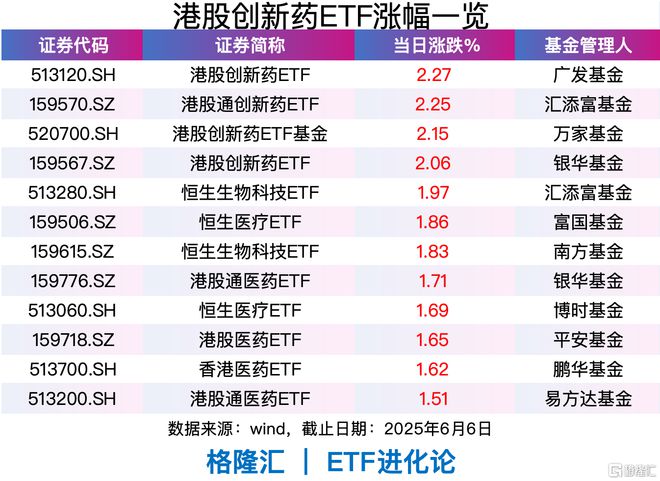
Group 1 - The Hong Kong stock market for innovative drugs has seen significant gains, with notable increases in shares of companies such as CSPC Pharmaceutical Group rising over 13%, Lepu Biopharma increasing by 9%, and King’s Ray Biotechnology up over 5% [1] - Various Hong Kong innovative drug ETFs have also performed well, with several funds, including GF Hong Kong Innovative Drug ETF and Huatai-PineBridge Hong Kong Innovative Drug ETF, rising over 2% [1][2] - The approval of CSPC's adenosylcobalamin capsules by the National Medical Products Administration of China is expected to enhance the company's product line in the blood and nervous system treatment areas [4] Group 2 - Lepu Biopharma announced that its candidate drug MRG003, an innovative antibody-drug conjugate for treating recurrent or metastatic nasopharyngeal carcinoma, will present key clinical research results at the 2025 American Society of Clinical Oncology annual meeting [4] - King’s Ray Biotechnology reported that its affiliate Legend Biotech submitted a 6-K form to the SEC, revealing long-term results from the CARTITUDE-1 study, indicating that one-third of patients did not experience disease progression for five years or more after a single CARVYKTI infusion [5] - According to research reports, the pharmaceutical sector is expected to experience a turning point this year, with strong growth in profitability anticipated over the next two years, driven by favorable policies and macroeconomic recovery [5][6]
科伦博泰SKB264大样本疗效数据有所下滑 肺癌细分适应症仍占据优势 | 2025ASCO
Xin Lang Zheng Quan· 2025-06-06 05:37
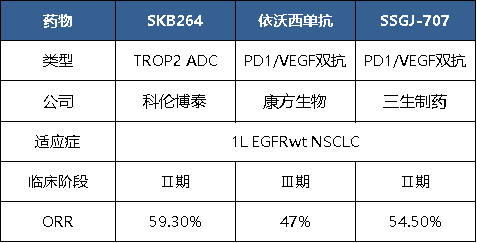
Core Insights - The 2025 ASCO Annual Meeting will showcase significant research results from domestic innovative drugs, highlighting their potential in oncology treatments [1] Group 1: Clinical Data and Drug Performance - The TROP2 ADC SKB264 from Kelun-Biotech reported a 59.3% overall response rate (ORR) and a 91.4% disease control rate (DCR) in a Phase II trial for non-small cell lung cancer (NSCLC) [2] - The median progression-free survival (mPFS) for the same patient group was 15.0 months, with ORR varying by PD-L1 expression levels: 47.1% for TPS<1%, 68.1% for TPS≥1%, and 77.8% for TPS≥50% [2] - Compared to previous data, the ORR decreased from 72.7% to 59.3% in a larger sample size [2] - SKB264 demonstrated superior efficacy over other PD-1/VEGF dual antibodies, with ORR of 54.5% for SSGJ-707 and 47% for Ivosidenib [3] Group 2: Safety and Adverse Effects - The incidence of grade 3 or higher adverse reactions for SKB264 was 40%, higher than SSGJ-707's 24.1% and Ivosidenib's 29% [3] - However, the discontinuation rate due to adverse effects for SKB264 was 0%, lower than Ivosidenib's 2% and SSGJ-707's 6% [3] Group 3: Comparative Efficacy in EGFR Mutant NSCLC - In a separate study for EGFR mutant NSCLC, SKB264 showed a 45.1% ORR and mPFS of 6.9 months, statistically significant compared to Docetaxel [4] - Despite a decrease in ORR and mPFS in larger sample sizes, SKB264 still outperformed Dato-DXd (43%) and HER3-DXd (35.2%) in efficacy [4] - Other domestic competitors also showed promising results, with Ivosidenib achieving an ORR of 50.6% and BL-B01D1 reaching 52.5% in their respective trials [4][5]
全球新药研发市场变天!哈佛最新报告:中国生物技术有望超越美国
Di Yi Cai Jing· 2025-06-06 05:26
Group 1 - The balance of global biotechnology power is shifting, with China rapidly emerging as a potential leader in original innovation, particularly in drug development [1][2] - A recent report from Harvard's Belfer Center indicates that China has the best chance of surpassing the US in biotechnology, despite the US's current lead in key technology sectors [2] - China's advantages in biotechnology stem from its dominant position in pharmaceutical manufacturing and a larger talent pool compared to the US [2] Group 2 - China's drug approval process is more efficient and flexible than that of the US, contributing to a higher number of clinical trials and a significant increase in patent filings [2] - Major pharmaceutical companies from the US and Europe have invested billions in acquiring Chinese-developed drugs, indicating growing interest in China's biotech sector [2][3] - BioNTech's recent acquisition of a drug from a Chinese company for over $10 billion highlights the value of Chinese innovations in the global market [3] Group 3 - The US biotechnology sector is experiencing layoffs and project stagnation due to funding cuts, contrasting with the rising interest in Chinese biotech companies [4] - Goldman Sachs has released a report indicating that China's innovative capabilities in biotechnology are gaining global recognition, with expectations for several leading companies to reach breakeven by 2025/2026 [4] - China is becoming a hub for the development of innovative drugs like antibody-drug conjugates (ADCs), which are in high demand from multinational pharmaceutical companies [4] Group 4 - Chinese biopharmaceutical companies listed in the US have seen significant stock price increases, reflecting renewed market interest [5] - The Hong Kong stock market is also witnessing a resurgence in biopharmaceutical demand, with a major new share issuance by Kelun-Biotech [5] - For Chinese biopharmaceutical companies to succeed globally, they must adapt to various regulatory requirements and leverage global clinical resources for cost efficiency [5]
创新药全球价值系列:ASCO年会数据解读
2025-06-06 02:37
Summary of Key Points from the Conference Call Industry Overview - The conference focused on the innovative drug sector, particularly in oncology, highlighting advancements in treatments for non-small cell lung cancer (NSCLC), triple-negative breast cancer (TNBC), and other malignancies [1][4][24]. Core Insights and Arguments - **Innovative Drug Performance**: - **Innovent Biologics IBI363**: In NSCLC, the objective response rate (ORR) for squamous cell carcinoma patients reached 43.3%, with a progression-free survival (PFS) of 7.3 months. For adenocarcinoma patients, ORR was 28% with a PFS of 4.2 months, indicating potential in immune-resistant patients [1][5][6]. - **Kanglongda SKP164**: Demonstrated strong data in EGFR-mutant NSCLC in both third-line and first-line treatments, with promising results in TNBC [1][4][7]. - **Zhongjin Tianqing**: The combination of PD-1 with chemotherapy and Anlotinib showed significant superiority over standard treatments in squamous cell carcinoma [1][4]. - **Baiyi Tianheng ADC**: Achieved an overall survival (OS) of 15 months and an ORR of 70%-80% in second-line NSCLC treatment [1][4]. - **3SBio 707**: A PD-1/LAG3 bispecific antibody that has shown promising early data in NSCLC and has entered a licensing agreement with Pfizer [1][4][8]. - **Emerging Competitors**: - **Zejing ZG006**: A DL3/CD3 triantibody showing superior ORR compared to Teclistamab, indicating strong potential in its category [1][4][8]. - **Zejing 005**: A PD-1/TIGIT bispecific antibody with promising early data in cervical cancer [1][4][8]. Additional Important Insights - **Clinical Data as a Key Factor**: High-quality and differentiated clinical data are essential for innovative drugs to demonstrate their unique value and competitiveness in the global market [2]. - **Potential Best-in-Class Candidates**: Several domestic innovative molecules are positioned to become best-in-class, including 3SBio 707 and Zejing's products, based on their clinical performance [8][24]. - **Focus on Unmet Medical Needs**: IBI363's efficacy in immune-resistant tumors like NSCLC, colorectal cancer, and melanoma highlights its potential in addressing significant unmet medical needs [9][10]. - **Regulatory and Market Dynamics**: The conference underscored the importance of regulatory approvals and market strategies for the successful commercialization of these innovative therapies [24]. Conclusion - The conference highlighted significant advancements in the innovative drug sector, particularly in oncology, with several products showing promising clinical data. The emphasis on high-quality clinical evidence and the potential for best-in-class candidates suggests a competitive landscape for future drug development and market entry.
健讯Daily 丨国药集团在北京成立科技创新研究院公司;德国默克集团与泽璟制药达成战略合作
2 1 Shi Ji Jing Ji Bao Dao· 2025-06-05 23:49
Policy Developments - The National Healthcare Security Administration has revised the medical price and procurement credit evaluation system to combat commercial bribery and encourage integrity among pharmaceutical companies [2][3] - The revised system aims to increase the cost of dishonesty for companies and promote compliance, quality improvement, and effective market participation through collective procurement and national negotiations [2][3] Industry Updates - The internal whistleblower reward system for drug and medical device quality safety has been announced, incentivizing individuals who provide clear evidence of violations that lead to administrative penalties or criminal prosecution [4] - A notification has been issued to promote pain relief services during childbirth across various medical institutions, with goals set for 2025 and 2027 to ensure comprehensive service availability [5] Company News - Puluo Pharmaceutical has received approval for the listing application of Succinic Acid Desvenlafaxine, a third-generation antidepressant for treating major depressive disorder [7] - China Pharmaceutical has obtained a drug registration certificate for Sulfhydryl Clopidogrel Tablets, aimed at secondary prevention of atherosclerotic thromboembolic events in specific patient groups [8] - Shanghai Sipurei Pharmaceutical Technology has completed over 200 million RMB in angel round financing, with funds allocated for preclinical and early clinical development [11] - Kelun Pharmaceutical's subsidiary plans to raise approximately 1.943 billion HKD through a share placement to support product development and operational needs [12] - Merck KGaA has entered a strategic partnership with Zai Lab to commercialize a recombinant human thyroid-stimulating hormone in mainland China [14] - China National Pharmaceutical Group has established a technology innovation research institute with a registered capital of 1 billion RMB, focusing on various research and development activities [15] Management Changes - Tongrentang Technology announced the resignation of its chairman and general manager due to work changes, indicating potential shifts in company leadership [17]


港股创新药“翻倍股”涌现!出海加速与政策共振引爆价值重估
Ge Long Hui· 2025-06-05 18:32
Group 1 - The Hong Kong innovative drug sector is undergoing an unprecedented wave of value reassessment, with around 12 innovative drug concept stocks rising over 50% year-to-date, including Rongchang Biopharma and Sanofi Biotech, which have surged over 200% [1] - The ASCO annual meeting served as a key catalyst, showcasing over 70 research results from Chinese pharmaceutical companies, with Innovent Biologics' IBI363 clinical data generating significant attention due to its breakthrough efficacy in treating advanced non-small cell lung cancer [2] - License-out transactions have become a core engine for valuation reshaping, with 41 outbound transactions totaling $36.93 billion in Q1 2025, nearing the total for the entire year of 2023 [3] Group 2 - Domestic drug approvals are accelerating, with the National Medical Products Administration approving 11 innovative drugs from 8 companies, including 9 domestically developed drugs, indicating a robust pipeline for commercialization [4] - The policy environment is favorable, with the National Healthcare Security Administration constructing a multi-tiered payment system to support innovative drugs throughout their lifecycle, enhancing the attractiveness of the sector [5] - The pharmaceutical sector is expected to see strong performance in H1 2025, driven by favorable external conditions and the ongoing trend of self-sufficiency in drug development [6]
