
长安汽车

Search documents
2025年1-10月中国载货汽车产量为307.1万辆 累计增长11.6%
Chan Ye Xin Xi Wang· 2025-12-19 03:18
Core Viewpoint - The report highlights the growth trajectory of China's cargo vehicle industry, projecting significant increases in production and market potential from 2025 to 2031 [1] Group 1: Industry Overview - In October 2025, China's cargo vehicle production reached 317,000 units, marking a year-on-year increase of 27.3% [1] - From January to October 2025, the cumulative production of cargo vehicles in China totaled 3.071 million units, reflecting a cumulative growth of 11.6% [1] Group 2: Key Companies - Notable companies in the cargo vehicle sector include FAW Jiefang (000800), China National Heavy Duty Truck Group (000951), Foton Motor (600166), Jiangling Motors (000550), Ankai Bus (000868), Changan Automobile (000625), Dongfeng Motor (600006), Hanma Technology (600375), GAC Group (601238), and Aoxin Bus (600213) [1] Group 3: Research and Analysis - The report titled "2025-2031 China Cargo Vehicle Industry Market Research Analysis and Investment Outlook" was published by Zhiyan Consulting, a leading industry consulting firm in China [1] - Zhiyan Consulting specializes in providing in-depth industry research reports, business plans, feasibility studies, and customized services, focusing on delivering comprehensive industry solutions to empower investment decisions [1]


港股智能驾驶概念股集体走强,佑驾创新涨15%
Ge Long Hui· 2025-12-19 02:43
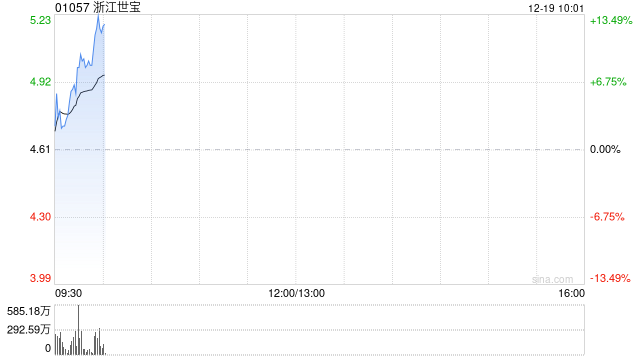
格隆汇12月19日|港股市场智能驾驶概念股集体走强,其中,佑驾创新涨15%,浙江世宝涨近12%,地 平线机器人-W涨7%,小鹏汽车-W、黑芝麻智能涨超4%,速腾聚创、禾赛-W、知行科技涨超3%,小马 智行-W、零跑汽车涨2%。 消息面上,日前,我国首批L3级有条件自动驾驶车型准入许可正式公布,分 别为长安牌SC7000AAARBEV型纯电动轿车和极狐牌BJ7001A61NBEV型纯电动轿车。根据《汽车驾驶 自动化分级》国家标准,L3级自动驾驶属于"有条件自动驾驶",即在特定设计运行条件下,车辆系统可 以完全接管动态驾驶任务,允许驾驶员脱手,但驾驶员仍需保持警觉并随时准备接管。 交银国际指 出,辅助驾驶功能已逐渐成为中国消费者购车决策的重要考量因素,部分车企已具备L3级智驾方案和 L3级车型量产能力。L3级自动驾驶法规的正式落地将成为2026年行业发展的关键催化剂,值得重点跟 踪。 ...

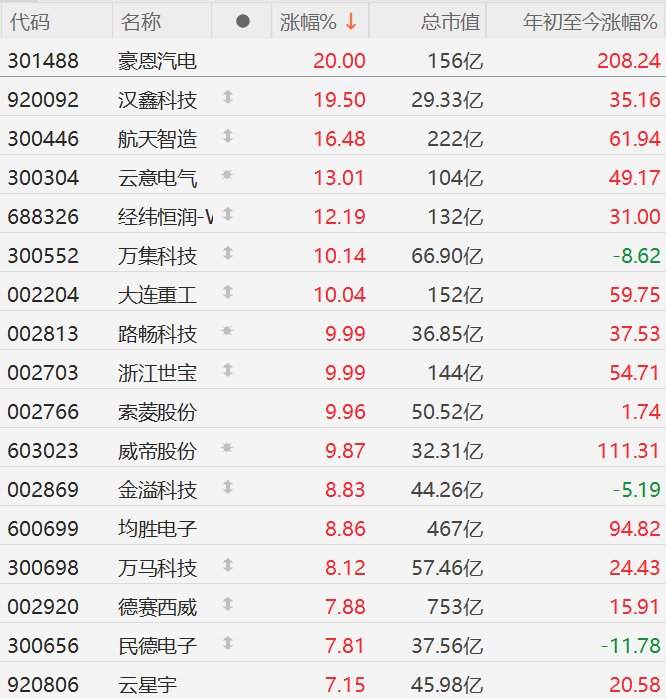
A股无人驾驶概念再度活跃,豪恩汽电20CM涨停,汉鑫科技涨19%,浙江世宝四连板!L3级自动驾驶法规正式落地将成明年行业发展关键催化剂
Ge Long Hui· 2025-12-19 02:37
Core Viewpoint - The autonomous driving concept stocks in the A-share market are experiencing significant activity, driven by the recent approval of L3-level conditional autonomous driving vehicles in China [1][2]. Group 1: Stock Performance - Haon Auto Electric reached a 20% limit up, with a total market value of 15.6 billion and a year-to-date increase of 208.24% [2]. - Hanxin Technology rose by 19.5%, with a market cap of 2.933 billion and a year-to-date increase of 35.16% [2]. - Aerospace Intelligent Manufacturing increased by 16.48%, with a market value of 22.2 billion and a year-to-date increase of 61.94% [2]. - Yunyi Electric gained 13.01%, with a market cap of 10.4 billion and a year-to-date increase of 49.17% [2]. - Jingwei Hengrun rose by 12.19%, with a market value of 13.2 billion and a year-to-date increase of 31.00% [2]. - Wanji Technology increased by 10.14%, with a market cap of 6.69 billion but a year-to-date decrease of 8.62% [2]. - Other notable stocks include Dalian Heavy Industry and Luchang Technology, both reaching a 10% limit up [1]. Group 2: Regulatory Developments - The first batch of L3-level conditional autonomous driving vehicle approvals includes Changan's SC7000AAARBEV and Arcfox's BJ7001A61NBEV, which are fully electric cars [2]. - L3-level autonomous driving allows the vehicle system to take over driving tasks under specific conditions, while the driver must remain alert and ready to take control [2]. Group 3: Industry Insights - According to Jiangyin International, advanced driver assistance systems are becoming a crucial factor in Chinese consumers' car purchasing decisions [3]. - The formal implementation of L3-level autonomous driving regulations is expected to be a key catalyst for industry development by 2026, warranting close monitoring [3].

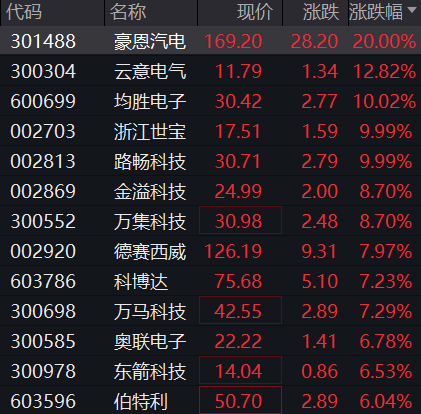
L3智能驾驶准入破冰!豪恩汽电20CM涨停,云意电气涨超12%,均胜电子、浙江世宝、路畅科技涨停
Jin Rong Jie· 2025-12-19 02:28
Core Viewpoint - The autonomous driving sector is experiencing significant activity, driven by the recent approval of L3-level autonomous vehicle licenses, which marks a transition from technology development to commercial application [1][3]. Group 1: Market Performance - The autonomous driving sector saw active trading, with notable stock performances including: - Haoen Automotive Electronics (涨停, 20% increase) - Yunyi Electric (涨超12%) - Junsheng Electronics (涨10.02%) - Zhejiang Seabow (涨9.99%) - Luchang Technology (涨9.99%) [1][2]. Group 2: Policy and Industry Developments - The Ministry of Industry and Information Technology recently issued the first batch of L3-level conditional autonomous vehicle licenses, with Changan Automobile and BAIC Jihe being the first approved companies. Their vehicles will conduct pilot tests in designated congested and highway areas [3]. - The listing of Xidi Zhijia on the Hong Kong Stock Exchange marks it as the first publicly traded company in the commercial vehicle autonomous driving sector, focusing on smart mining and logistics [3]. Group 3: Impacted Sectors - L3-level autonomous vehicle manufacturers are expected to benefit from commercial opportunities, enhancing product competitiveness and market share as pilot operation data accumulates [4]. - The commercial vehicle intelligent driving solutions sector is poised for growth due to urgent demand in mining and logistics, supported by policy and leading company listings [4]. - The demand for high-precision sensors and core components will increase with the mass production of L3-level vehicles, benefiting upstream suppliers of lidar, cameras, and radar systems [4].


脱手开车不再违法?一次全说清L3落地真相:人人都能开吗?出了事算谁的?...
3 6 Ke· 2025-12-19 02:12
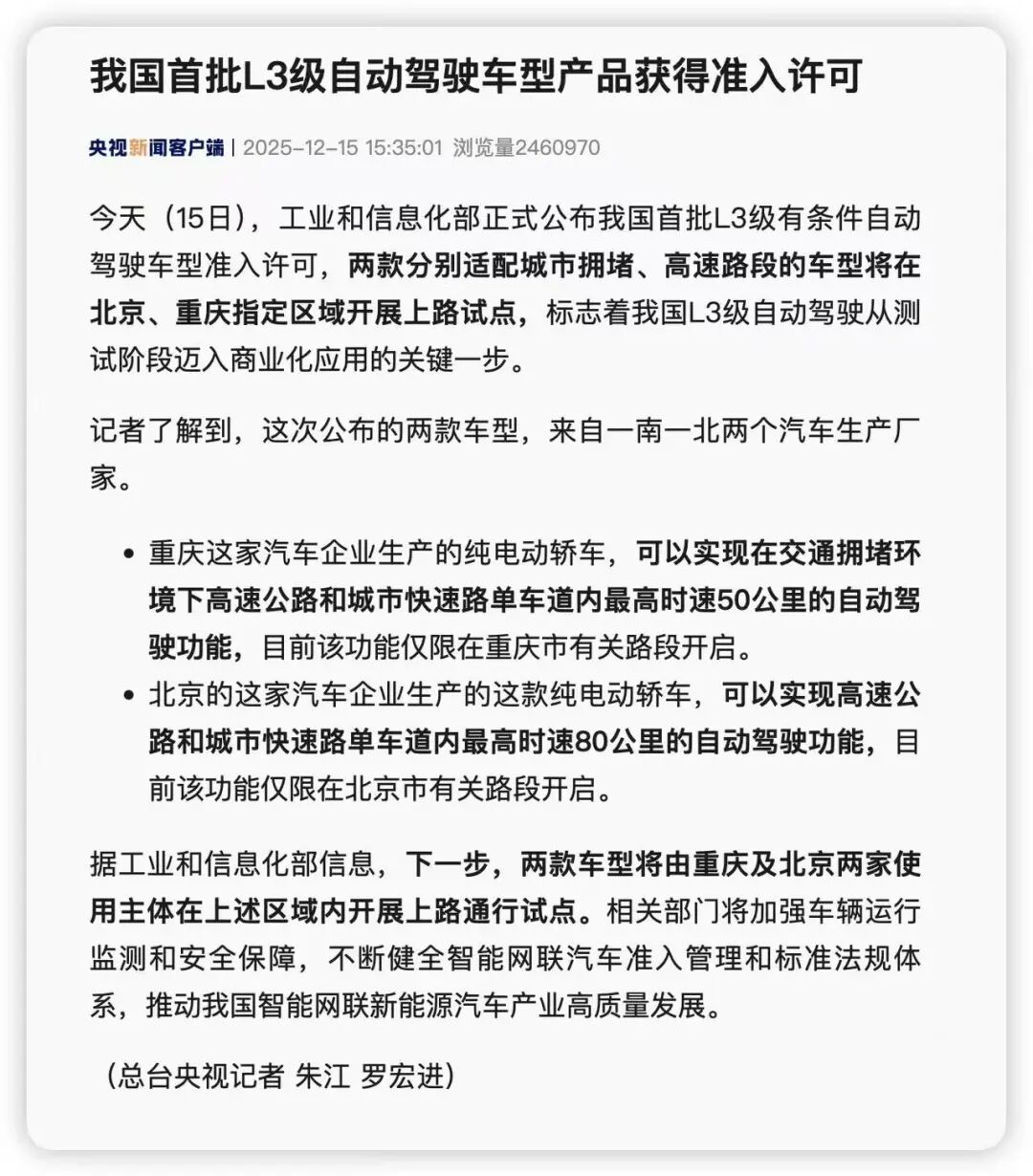
L3自动驾驶终于要来了! 最近,国内汽车圈被一则重磅消息点燃了——工业和信息化部正式公布我国首批L3级有条件自动驾驶车型准入许可。 相信不少人刷新闻也看到了,北汽、长安一南一北俩车企率先拿到"入场券",它们旗下特定的两款车型将在北京、重庆等指定城市区域开展上路试点。 紧接着这两天,问界、小鹏、理想、比亚迪等热门品牌纷纷跟进,自家L3测试车开上马路。 一时间,L3仿佛从遥不可及的技术概念,变成了触手可及的"明日科技",不再是车企在封闭区域里瞎折腾,而是有望大规模上路了! 不过兴奋归兴奋,估计不少人心里也在打鼓:L3到底是啥?开车真能全程脱手不碰方向盘?普通人能开上不?出了事算谁的?那么今天咱就好好捋一 捋,把L3自动驾驶的底细给扒清楚。 政策开闸,北汽长安先上路 而今年12月,就是L3自动驾驶的关键转折点,算是真正迈开了步子。先是传统车企成为第一批吃螃蟹的人,12月15日,长安深蓝与北汽极狐两款L3级有 条件自动驾驶车型上路试点获得批准。 官方公告显示,这两款测试车型对应为极狐阿尔法S(L3版)、长安深蓝SL03。 这次L3的真正到来,算是政策和技术一块儿发力的结果。2023年底的时候,《关于开展智能网联汽车准 ...



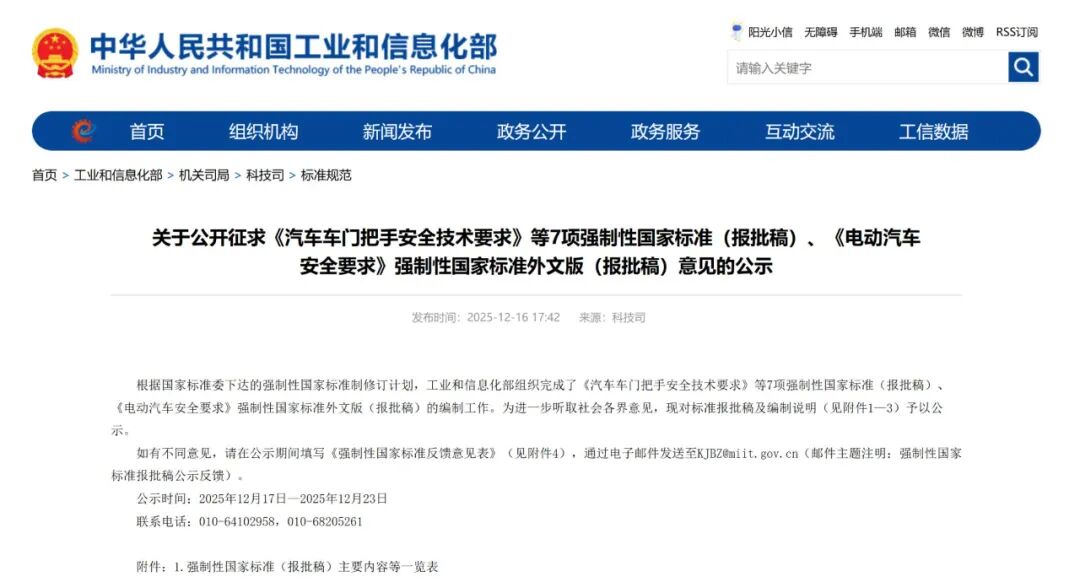
全隐藏式门把手“退场”倒计时,国标新规2027年落地,车企人员:车辆改动成本不小
3 6 Ke· 2025-12-19 02:11
Core Viewpoint - The article discusses the safety concerns surrounding hidden door handles in electric vehicles, particularly Tesla, and the introduction of new mandatory safety standards for car door handles in China to address these issues [1][2][10]. Group 1: Safety Concerns - A recent lawsuit in Wisconsin highlights the dangers of hidden door handles, as a Tesla Model S accident resulted in five fatalities due to the inability to open the doors during a fire [1]. - Consumers are increasingly worried about the safety risks associated with hidden door handles, prompting regulatory action [2][5]. - The new standards require that every car door must have a mechanical release handle, ensuring that doors can be opened even in emergencies [4][7]. Group 2: New Regulations - The Ministry of Industry and Information Technology has completed the drafting of new mandatory national standards for car door handles, which include safety technical requirements [2][10]. - The standards specify that each car door must be equipped with a mechanical release handle, even if the vehicle has electronic locking mechanisms [4][7]. - The regulations also define the required hand operation space for door handles, ensuring accessibility for users [9]. Group 3: Industry Impact - The introduction of these standards is expected to lead to significant changes in the automotive industry, potentially phasing out models with hidden door handles that do not comply [10][12]. - Many new energy vehicles currently feature hidden door handles, with approximately 60% of the top 100 electric vehicle models in China equipped with them, indicating a need for adjustments to comply with the new regulations [10][12]. - Companies like Toyota and Leap Motor are already planning to adapt their designs to meet the new requirements, indicating a shift in industry practices [10][12].

11月新能源汽车表现亮眼 | 投研报告
Zhong Guo Neng Yuan Wang· 2025-12-19 02:04
Core Insights - November automotive sales reached 3.429 million units, a year-on-year increase of 3.4%. Cumulative sales from January to November totaled 31.127 million units, reflecting an 11.4% year-on-year growth [1][2] - The comprehensive inventory coefficient for automotive dealers in November was 1.6, up 41.4% year-on-year and 34.2% month-on-month. The inventory warning index stood at 55.6%, an increase of 3.8 percentage points year-on-year and 3 percentage points month-on-month [2] Sales Performance - In November, the sales of new energy vehicles (NEVs) reached 1.823 million units, marking a 20.6% year-on-year increase, with a penetration rate of 53.2%. From January to November, NEV sales totaled 14.78 million units, up 31.2% year-on-year, with a penetration rate of 47.5% [2] Investment Strategy - The automotive sector should focus on undervalued leading companies in vehicle manufacturing and parts due to performance improvements. Key areas of interest include: - Domestic car manufacturers with first-mover advantages in the NEV sector, such as BYD, Changan Automobile, Geely, and Li Auto [3] - Stable performance low-valuation leading parts manufacturers like Huayu Automotive and Fuyao Glass [3] - Core players in the electrification and intelligentization sectors, including Desay SV, Ruikeda, Kobot, and Bertley [3] - Opportunities arising from domestic circulation and local replacements, such as Lingdian Electric Control, Sanhua Intelligent Control, Xingyu Co., and Shangsheng Electronics [3] - Strong vehicle manufacturers driving demand for core components, including Top Group, Wencan Co., and Xusheng Group [3] Market Overview - The automotive sector experienced a weekly change of 0.16%, ranking 9th among 31 sectors. The automotive industry outperformed the CSI 300 index during the week [5] - The weekly performance of major indices was as follows: Shanghai Composite Index -0.34%, CSI 300 -0.08%, Shenzhen Component Index 0.84%, and ChiNext Index 2.74% [5] - In sub-sectors, the weekly performance was: automotive services -5.23%, automotive parts 0.11%, passenger vehicles 0.23%, commercial vehicles 0.25%, and motorcycles and others 1.70% [5] Top Performing Stocks - The top five performing stocks in the automotive sector for the week were: Chaojie Co., Huamao Technology, Yueling Co., Huapei Power, and Zhenghe Industrial [6] Underperforming Stocks - The bottom five performing stocks in the automotive sector for the week were: Xiamen Xinda, Rongtai Co., Longji Machinery, Kailong High-Tech, and Disengli [7]


港股智能驾驶概念股走高,浙江世宝涨超11%
Xin Lang Cai Jing· 2025-12-19 02:01
港股智能驾驶概念股上扬,浙江世宝涨超11%,佑驾创新涨超8%,小鹏汽车、速腾聚创涨超3%,禾赛 涨超2%。 炒股就看金麒麟分析师研报,权威,专业,及时,全面,助您挖掘潜力主题机会! 热点栏目 自选股 数据中心 行情中心 资金流向 模拟交易 客户端 12月15日,工业和信息化部正式公布了我国首批获得L3级有条件自动驾驶车型准入许可的企业及车 型,长安汽车和北汽蓝谷成为首批获此殊荣的企业。这一举措标志着我国L3级自动驾驶汽车从测试验 证阶段向规模化商业应用迈出了关键一步。 新浪声明:此消息系转载自新浪合作媒体,新浪网登载此文出于传递更多信息之目的,并不意味着赞同 其观点或证实其描述。文章内容仅供参考,不构成投资建议。投资者据此操作,风险自担。 责任编辑:郝欣煜 热点栏目 自选股 数据中心 行情中心 资金流向 模拟交易 客户端 炒股就看金麒麟分析师研报,权威,专业,及时,全面,助您挖掘潜力主题机会! 港股智能驾驶概念股上扬,浙江世宝涨超11%,佑驾创新涨超8%,小鹏汽车、速腾聚创涨超3%,禾赛 涨超2%。 12月15日,工业和信息化部正式公布了我国首批获得L3级有条件自动驾驶车型准入许可的企业及车 型,长安汽车和北 ...
L3级试点,为什么是北京、重庆?
Xin Hua Wang· 2025-12-19 01:55
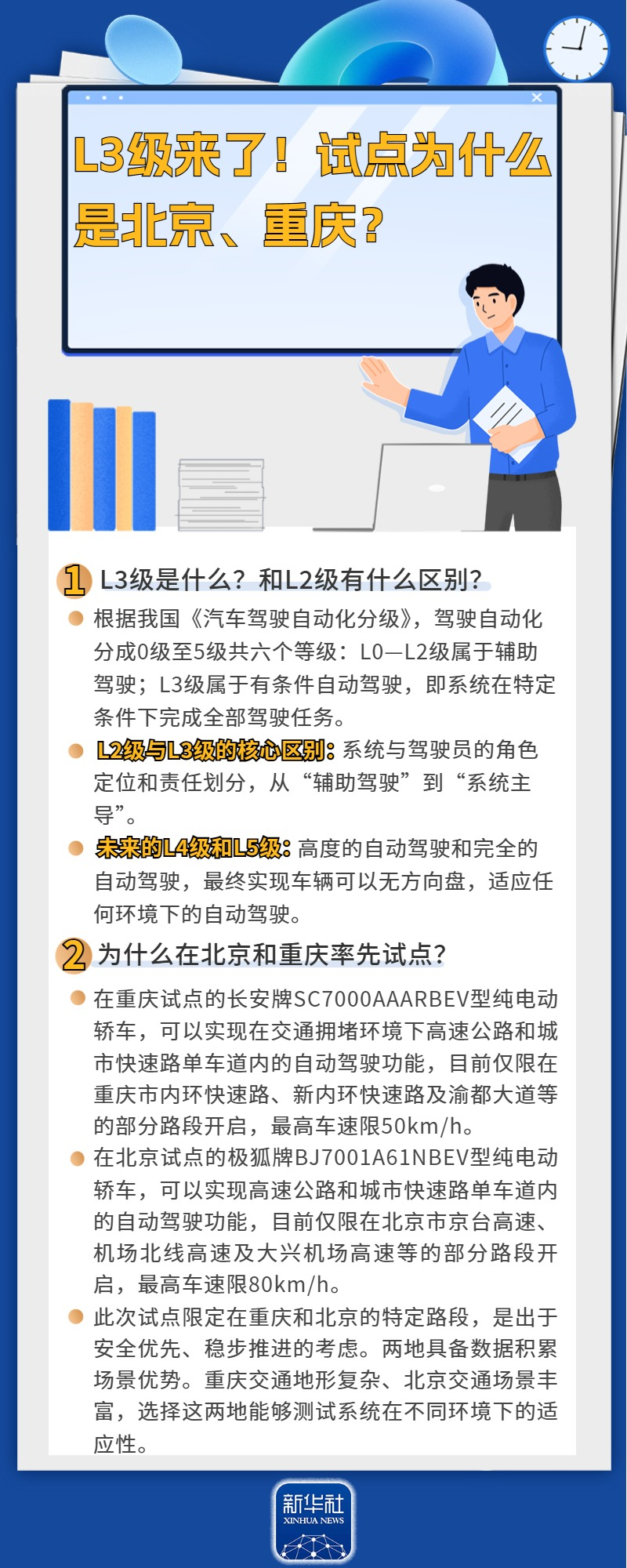
Core Viewpoint - The Ministry of Industry and Information Technology has officially announced the first batch of L3 conditional autonomous driving vehicle permits in China, with two models set to pilot in designated areas of Beijing and Chongqing, marking a significant step in the development of autonomous driving technology in the country [1]. Group 1: Pilot Locations - Beijing and Chongqing were chosen for the pilot due to their advantages in data accumulation and diverse traffic scenarios, allowing for effective testing of the systems in different environments [7]. - The pilot in Chongqing involves the Changan SC7000AARBEV model, which can operate in congested traffic and on highways, limited to specific routes with a maximum speed of 50 km/h [7]. - The pilot in Beijing features the Arcfox BJ7001A61NBEV model, capable of similar functions but with a maximum speed of 80 km/h on designated highways [7]. Group 2: Vehicle Approval Process - The Ministry, in collaboration with relevant departments, conducted comprehensive assessments of the pilot production companies' R&D, testing, and emergency response capabilities [11]. - Third-party testing organizations and experts were involved to evaluate the expected functional safety and cybersecurity risks of the pilot models [11]. - The L3 level allows the system to act as a "temporary driver" under specific conditions, requiring the driver to be ready to take control when requested by the system [11][12]. Group 3: Implications for the Industry - The introduction of L3 level autonomous driving signifies a shift from technical validation to mass application, indicating that intelligent features are now essential for automotive companies [17]. - The advancement of intelligent connected vehicles will inject strong momentum into technological innovation and upgrades in the automotive sector, providing valuable practical experience for standard formulation [19]. - The commercial application of L3 autonomous driving models is expected to strengthen the position of domestic new energy vehicles in the market and accelerate their global expansion, positioning them as leaders in the intelligent connected vehicle sector [19].
L3级来了!试点为什么是北京、重庆?
Xin Hua Cai Jing· 2025-12-19 01:43
Core Viewpoint - The Ministry of Industry and Information Technology has officially announced the first batch of L3 conditional autonomous driving vehicle permits in China, with two models set to pilot in designated areas of Beijing and Chongqing, marking a significant step in the development of autonomous driving technology in the country [1]. Group 1: Pilot Locations - The L3 autonomous driving models are being piloted in Beijing and Chongqing due to their unique traffic conditions and data accumulation advantages. Chongqing's complex traffic terrain and Beijing's rich traffic scenarios provide a diverse testing environment for the systems [7]. - The pilot in Chongqing involves the Changan SC7000AARBEV model, which can operate in congested traffic and on single lanes of highways, limited to specific routes with a maximum speed of 50 km/h [7]. - The pilot in Beijing features the Arcfox BJ7001A61NBEV model, capable of similar functions but with a higher speed limit of 80 km/h on designated routes [7]. Group 2: Vehicle Approval Process - The Ministry, in collaboration with relevant departments, conducted comprehensive assessments of the research, testing, and emergency response capabilities of the pilot production companies [11]. - Third-party testing organizations and experts were involved in systematic testing of the expected functional safety and cybersecurity risks associated with the pilot models [11]. - The approval process emphasized the management capabilities of the pilot cities and their emergency response capabilities, leading to the selection of two joint ventures for the pilot program [11]. Group 3: Implications of L3 Level - L3 conditional autonomous driving allows the system to act as a "temporary driver" under specific conditions and scenarios, although drivers must remain responsible for the vehicle [11][12]. - The pilot program is limited to specific low-risk scenarios to ensure safety and orderly advancement of autonomous driving technology [15]. - As the pilot progresses and the industry gains a better understanding of safety risks, restrictions may gradually be relaxed, allowing for broader public access to autonomous driving features [15]. Group 4: Industry Opportunities - The pilot signifies a shift from technical validation to mass production application in China's autonomous driving sector, presenting new opportunities for the industry [17].