
三花智控

Search documents
智通港股通活跃成交|10月28日
智通财经网· 2025-10-28 11:02
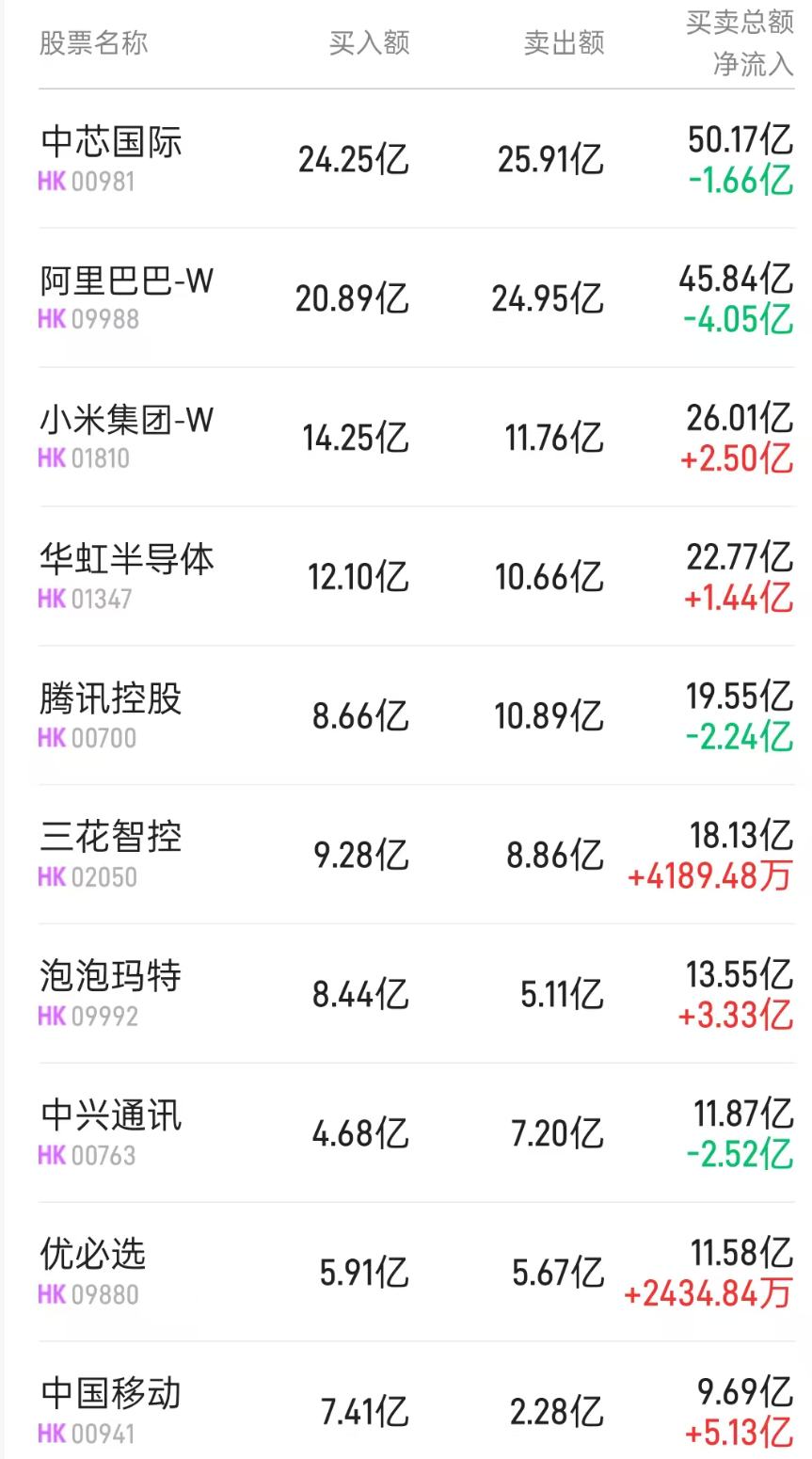
Core Insights - On October 28, 2025, SMIC (00981), Alibaba-W (09988), and Xiaomi Group-W (01810) were the top three companies by trading volume in the Southbound Stock Connect, with transaction amounts of 50.17 billion, 45.84 billion, and 26.01 billion respectively [1] - The same companies also led in the Shenzhen-Hong Kong Stock Connect, with transaction amounts of 37.90 billion, 30.78 billion, and 18.37 billion respectively [1] Southbound Stock Connect (Shanghai-Hong Kong) - Top active companies by trading volume included: - SMIC (00981): 50.17 billion with a net buy of -1.66 billion - Alibaba-W (09988): 45.84 billion with a net buy of -4.05 billion - Xiaomi Group-W (01810): 26.01 billion with a net buy of +2.50 billion - Hua Hong Semiconductor (01347): 22.77 billion with a net buy of +1.44 billion - Tencent Holdings (00700): 19.55 billion with a net buy of -2.24 billion - Other notable companies included Sanhua Intelligent Control (02050), Pop Mart (09992), ZTE Corporation (00763), UBTECH Robotics (09880), and China Mobile (00941) [2] Southbound Stock Connect (Shenzhen-Hong Kong) - Top active companies by trading volume included: - SMIC (00981): 37.90 billion with a net buy of +2.43 billion - Alibaba-W (09988): 30.78 billion with a net buy of -1.17 billion - Xiaomi Group-W (01810): 18.37 billion with a net buy of -2.14 billion - Hua Hong Semiconductor (01347): 14.60 billion with a net buy of +2.52 billion - ZTE Corporation (00763): 11.30 billion with a net buy of +1.66 billion - Other notable companies included Tencent Holdings (00700), Pop Mart (09992), Sanhua Intelligent Control (02050), Meituan-W (03690), and Li Auto-W (02015) [2]



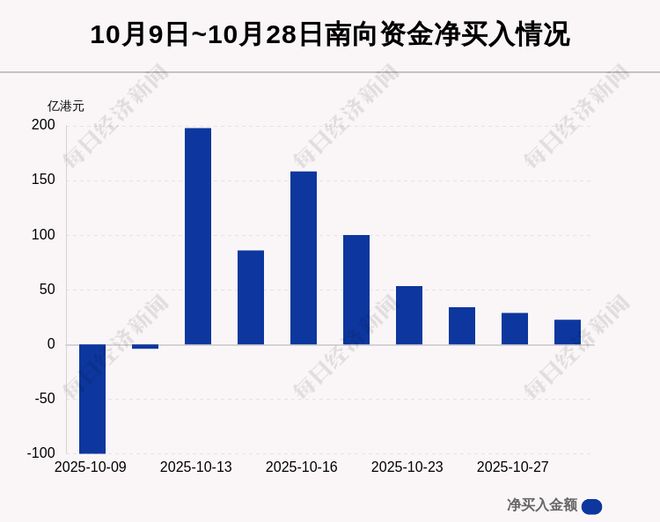
最新出炉!10月28日港股通净流入22.58亿港元,其中5.125亿港元都买了它
Mei Ri Jing Ji Xin Wen· 2025-10-28 10:47
Group 1 - The core point of the article highlights the active trading of southbound funds, with a total of 8 stocks experiencing net buying, led by China Mobile with a net purchase of 512.5 million HKD [2][4] - The most significant net selling stock was Alibaba-W, with a net sell amounting to 522.6 million HKD [2][4] Group 2 - The list of actively traded stocks includes China Mobile (0941.HK) with a closing price of 85.55 HKD and a net buying amount of 5.13 billion HKD, reflecting a price increase of 0.41% [4] - Other notable stocks with net buying include Huahong Semiconductor (1347.HK) with 396 million HKD and a closing price of 86.15 HKD, and Pop Mart (9992.HK) with 323 million HKD and a closing price of 228.2 HKD, both showing slight declines [4] - Conversely, Alibaba-W (9988.HK) had a closing price of 171.0 HKD and a net selling amount of 5.23 billion HKD, indicating a decrease of 1.50% [4]

数据复盘丨氟化工、PCB等概念走强 66股获主力资金净流入超1亿元
Zheng Quan Shi Bao Wang· 2025-10-28 10:24
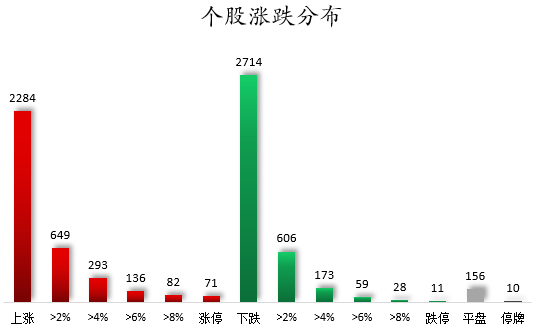
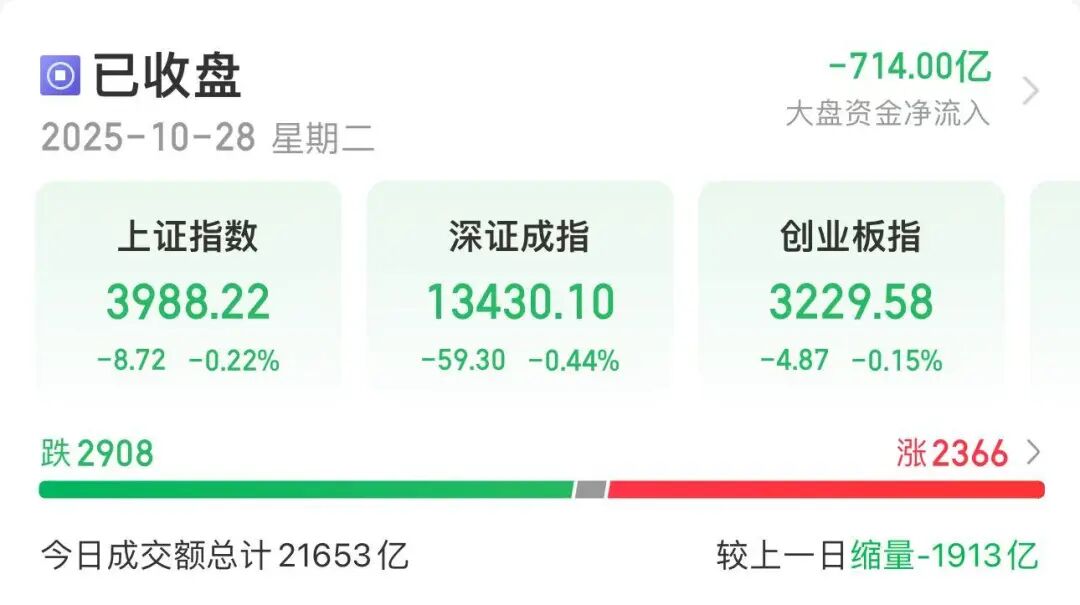
Market Overview - The Shanghai Composite Index closed at 3988.22 points, down 0.22%, with a trading volume of 940.8 billion yuan. The Shenzhen Component Index fell 0.44% to 13430.10 points, with a trading volume of 1207.1 billion yuan. The ChiNext Index decreased by 0.15% to 3229.58 points, with a trading volume of 573.27 billion yuan. The STAR Market 50 Index dropped 0.84% to 1471.73 points, with a trading volume of 87.8 billion yuan. The total trading volume for both markets was 2147.9 billion yuan, a decrease of 192.23 billion yuan from the previous trading day [1]. Sector Performance - Among industry sectors, defense and military, transportation, textiles and apparel, communications, and environmental protection showed the highest gains. In contrast, sectors such as non-ferrous metals, beauty care, steel, construction decoration, coal, pharmaceutical biology, securities, and oil and petrochemicals experienced significant declines [3]. - The fluorochemical and PCB concepts were particularly strong, with ST Zhongdi achieving an 8-day consecutive limit-up [2][4]. Individual Stock Performance - A total of 2284 stocks rose while 2714 stocks fell, with 156 stocks remaining flat and 10 stocks suspended. Excluding newly listed stocks, there were 71 stocks that hit the daily limit-up and 11 that hit the limit-down [3]. - The top net inflow stocks included Sanhua Intelligent Control with a net inflow of 1.098 billion yuan, followed by Duofluor and Heyuan Biological with inflows of 955.6 million yuan and 825 million yuan, respectively [10][11]. Fund Flow Analysis - The net outflow of main funds from the Shanghai and Shenzhen markets was 34.079 billion yuan, with the ChiNext experiencing a net outflow of 11.392 billion yuan and the CSI 300 seeing a net outflow of 10.192 billion yuan. The electronic sector had the largest net outflow of 10.889 billion yuan [5]. - Five sectors saw net inflows, with the defense and military sector leading with a net inflow of 999.3 million yuan [5]. Institutional Activity - Institutional investors had a net buy of approximately 370 million yuan, with Hengbao Co. being the most purchased stock at a net buy of about 193 million yuan. The most sold stock was Zhongtung High-tech, with a net sell of approximately 105 million yuan [17][19].


图解丨南下资金连续6日净买入中芯国际,共计30亿港元
Ge Long Hui A P P· 2025-10-28 10:12
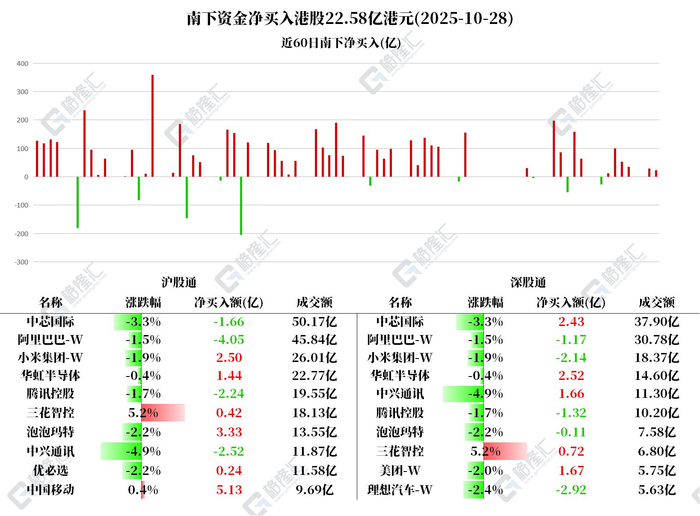
Group 1 - Southbound funds net bought Hong Kong stocks worth 2.258 billion HKD today [1] - The top net purchases included China Mobile at 512 million HKD, Hua Hong Semiconductor at 396 million HKD, Pop Mart at 322 million HKD, Meituan-W at 166 million HKD, and Sanhua Intelligent Control at 114 million HKD [1] - The top net sales included Alibaba-W at 522 million HKD, Tencent Holdings at 356 million HKD, and Li Auto-W at 292 million HKD [1] Group 2 - Southbound funds have net bought SMIC for six consecutive days, totaling 3.01773 billion HKD [1]




北水动向|北水成交净买入22.58亿 内资加仓中国移动(00941)超5亿港元 绩前抛售中兴通讯(00763)
智通财经网· 2025-10-28 10:03
Core Insights - The Hong Kong stock market saw a net inflow of 22.58 billion HKD from northbound trading on October 28, with the Shanghai-Hong Kong Stock Connect contributing 18.12 billion HKD and the Shenzhen-Hong Kong Stock Connect contributing 4.46 billion HKD [1] Group 1: Stock Performance - The most bought stocks included China Mobile (00941), Hua Hong Semiconductor (01347), and Pop Mart (09992) [1] - The most sold stocks included Alibaba-W (09988), Tencent (00700), and Li Auto-W (02015) [1] Group 2: Detailed Stock Transactions - China Mobile (00941) received a net inflow of 5.12 billion HKD, driven by its "AI+" action plan announced at the 2025 Global Partner Conference, which aims to double its investment in AI by the end of 2028 [4] - Hua Hong Semiconductor (01347) and SMIC (00981) saw net inflows of 3.96 billion HKD and 767.7 million HKD respectively, with a focus on domestic technology self-sufficiency amid global tech competition [5] - Pop Mart (09992) attracted a net inflow of 3.22 billion HKD, with HSBC highlighting its growth potential and global expansion strategy [5] - Meituan-W (03690) had a net inflow of 1.66 billion HKD, as it announced key personnel changes to enhance its international business strategy [5] - Sanhua Intelligent Controls (02050) received a net inflow of 1.14 billion HKD, with a board meeting scheduled to discuss its upcoming quarterly results [6] Group 3: Notable Sell-offs - ZTE Corporation (00763) faced a net outflow of 866.4 million HKD, with ongoing board discussions about its quarterly performance [7] - Alibaba-W (09988), Tencent (00700), and Li Auto-W (02015) experienced significant net outflows of 5.22 billion HKD, 3.56 billion HKD, and 2.92 billion HKD respectively [7]
35股特大单净流入资金超2亿元
Zheng Quan Shi Bao Wang· 2025-10-28 09:37
Market Overview - The two markets experienced a significant net outflow of 28.615 billion yuan, with 1,791 stocks seeing net inflows and 2,975 stocks experiencing net outflows [1] - The Shanghai Composite Index closed down by 0.22% [1] Industry Performance - Eight industries saw net inflows from large orders, with the defense and military industry leading with a net inflow of 2.507 billion yuan and an index increase of 1.07% [1] - The basic chemical industry followed with a net inflow of 1.202 billion yuan and a slight increase of 0.10% [1] - A total of 23 industries experienced net outflows, with the electronics sector facing the largest outflow of 10.562 billion yuan, followed by non-ferrous metals with 6.922 billion yuan [1] Individual Stock Performance - A total of 35 stocks had net inflows exceeding 200 million yuan, with C禾元-U leading at 1.326 billion yuan and a price increase of 213.49% [2] - Other notable stocks with significant inflows include 多氟多 (1.266 billion yuan, 10.01% increase) and 三花智控 (1.152 billion yuan, 8.21% increase) [2] - Stocks with the largest net outflows included 寒武纪-U with 2.218 billion yuan and a price decrease of 3.40%, followed by 北方稀土 with 1.836 billion yuan [4] Summary of Net Inflows - The top stocks by net inflow are as follows: - C禾元-U: 1.326 billion yuan, 213.49% increase [2] - 多氟多: 1.266 billion yuan, 10.01% increase [2] - 三花智控: 1.152 billion yuan, 8.21% increase [2] Summary of Net Outflows - The top stocks by net outflow are as follows: - 寒武纪-U: -2.218 billion yuan, -3.40% decrease [4] - 北方稀土: -1.836 billion yuan, -4.20% decrease [4] - 中际旭创: -1.160 billion yuan, 0.80% increase [4]


港股收盘(10.28) | 恒指收跌0.33% 黄金股跌幅居前 汇丰控股(00005)绩后涨超4%
智通财经网· 2025-10-28 08:52
Market Overview - The Hong Kong stock market failed to maintain its previous day's gains, with the Hang Seng Index closing down 0.33% at 26,346.14 points and a total turnover of HKD 242.7 billion [1] - The Hang Seng China Enterprises Index fell by 0.97% to 9,375.79 points, while the Hang Seng Tech Index dropped 1.26% to 6,093.44 points [1] Blue-Chip Performance - HSBC Holdings (00005) led the blue-chip stocks, rising 4.41% to HKD 106.5, contributing 92 points to the Hang Seng Index [2] - HSBC reported a pre-tax profit of USD 7.3 billion for Q3 2025, a decrease of USD 1.2 billion year-on-year, but a fixed-rate pre-tax profit of USD 9.1 billion, up 3% year-on-year [2][6] - Other notable blue-chip movements included Xinyi Solar (00968) up 4.27% and AIA Group (01299) up 3.4%, while Zijin Mining (02899) fell 5.59% [2] Sector Performance - Large tech stocks generally declined, with Tencent and Alibaba both dropping over 1% [3] - Gold stocks experienced significant declines, with Chifeng Jilong Gold Mining (06693) down over 6% [3] - Hong Kong banking stocks rose against the trend, with HSBC's strong Q3 performance boosting investor confidence [5][6] New Listings - Four new stocks debuted positively, with Dipo Technology (01384) surging 150.56% and Baima Tea (06980) rising 86.7% [4][5] - Dipo Technology's IPO was highly sought after, with a subscription rate of 7,590 times, attracting approximately 239,000 investors [5] Gaming and Gambling Sector - Macau's gaming revenue showed signs of recovery, with October's revenue potentially reaching MOP 23 billion, the highest in 71 months [6] - Notable gains were seen in gaming stocks, with Sands China (01928) up 2.46% and Melco International Development (00200) up 1.24% [6] Notable Stock Movements - Fuyao Glass (06865) saw a strong performance, rising 12.29% after reporting a 21% year-on-year revenue increase [7] - Bilibili (09626) gained 5.31% following the successful launch of its new game, which sold over 200,000 copies shortly after release [8] - China Southern Airlines (01055) rose 3.01% after reporting a 2.23% increase in revenue for the first three quarters of 2025 [10]

10月28日主力资金流向日报
Zheng Quan Shi Bao Wang· 2025-10-28 08:47
Market Overview - The Shanghai Composite Index fell by 0.22%, the Shenzhen Component Index decreased by 0.44%, the ChiNext Index dropped by 0.15%, and the CSI 300 Index declined by 0.51% [1] - Among the tradable A-shares, 2,362 stocks rose, accounting for 43.52%, while 2,908 stocks fell [1] Capital Flow - The main capital experienced a net outflow of 48.369 billion yuan throughout the day [1] - The ChiNext saw a net outflow of 8.319 billion yuan, while the STAR Market had a net outflow of 3.603 billion yuan [1] - The CSI 300 constituent stocks faced a net outflow of 20.911 billion yuan [1] Industry Performance - Out of the 28 first-level industries classified by Shenwan, 10 industries saw an increase, with the top gainers being the comprehensive sector and defense industry, rising by 2.06% and 1.07% respectively [1] - The industries with the largest declines were non-ferrous metals and beauty care, which fell by 2.72% and 1.51% respectively [1] Industry Capital Inflow and Outflow - The defense industry led in net capital inflow, with a total of 2.138 billion yuan, while it also increased by 1.07% [1] - The building materials sector had a slight increase of 0.01% with a net inflow of 0.286 billion yuan [1] - The electronics industry experienced the largest net outflow, totaling 12.127 billion yuan, with a decline of 0.37% [1] - Other significant outflows were seen in the non-ferrous metals sector, which fell by 2.72% with a net outflow of 10.828 billion yuan [1] Individual Stock Performance - A total of 1,809 stocks had a net inflow of funds, with 685 stocks seeing inflows exceeding 10 million yuan [3] - The stock with the highest net inflow was C He Yuan-U, with 1.776 billion yuan, followed by C Yi Cai-U and Sanhua Intelligent Control with net inflows of 1.295 billion yuan and 1.228 billion yuan respectively [3] - Conversely, 201 stocks experienced net outflows exceeding 100 million yuan, with Northern Rare Earth, ZTE Corporation, and Huayou Cobalt seeing the largest outflows of 2.242 billion yuan, 1.359 billion yuan, and 1.235 billion yuan respectively [3]


2000亿巨头,大涨!热榜第一名
Zhong Guo Zheng Quan Bao· 2025-10-28 08:41
Market Overview - On October 28, A-shares experienced a pullback after reaching a high, with all three major indices closing lower. The Shanghai Composite Index fell by 0.22% to 3988.22 points, the Shenzhen Component Index dropped by 0.44%, and the ChiNext Index decreased by 0.15%. The total market turnover exceeded 2.16 trillion yuan [1]. Sector Performance - Regional concept stocks were active, particularly in Fujian, with multiple stocks hitting the daily limit. Notable performers included Road and Bridge Information, which reached a "30CM" limit, and Haixia Innovation, which achieved a "20CM" limit. Other stocks like Fujian Cement and Zhangzhou Development also saw significant gains [3]. - The Free Trade Zone concept was notably active, with sectors such as Fujian Free Trade Zone, Hainan Free Trade Zone, and Guangdong Free Trade Zone showing strong performance. Additionally, military equipment, transportation, and battery-related sectors also posted gains, while previously strong sectors like non-ferrous metals, precious metals, steel, and rare earths experienced a pullback [3]. Robotics Sector - The humanoid robot concept saw a resurgence in activity, with stocks like Yongmaotai and Fangzheng Electric hitting the daily limit. Sanhua Intelligent Controls experienced a sharp rise, reaching a historical high before closing with an 8.21% increase at 52.61 yuan per share, with a trading volume of 180.85 billion yuan and a market capitalization of 221.43 billion yuan [4][6]. Investment Insights - Ping An Securities reported that the medium to long-term technology market is expected to continue, highlighting investment opportunities in advanced manufacturing sectors such as semiconductors, general aviation, and innovative pharmaceuticals. By 2025, domestic policy support and industrial innovation are anticipated to bolster the A-share market's technology trends [8]. - CITIC Securities noted that the market style remains in a high-level oscillation, focusing on technology themes. The current period coincides with the intensive disclosure of third-quarter earnings, with themes like "anti-involution," AI computing power, and semiconductors expected to maintain investor interest [8]. Precious Metals Market - The gold and non-ferrous metal sectors experienced significant declines, with industrial metals leading the drop. Notable declines included Tongling Nonferrous Metals hitting the daily limit down, along with other major players like Jincheng Gold and Jiangxi Copper [9]. - Guoxin Futures reported that the global precious metals market underwent a typical "breakout-high-retracement" phase in October, with prices reaching historical highs. As the month ends, easing geopolitical tensions and profit-taking by investors have led to noticeable price corrections, although the overall strong trend remains intact. The outlook for November suggests continued high-level oscillation in the precious metals market [11].

百亿基金经理,调仓新动向
Zhong Guo Zheng Quan Bao· 2025-10-28 08:40
Core Insights - In the third quarter, several billion-dollar fund managers achieved significant performance increases, with returns exceeding 50% for some products and over 40% for others [1][2] - The successful funds capitalized on opportunities in sectors such as computing power, chips, robotics, and consumer electronics, while also increasing positions in innovative pharmaceuticals, non-ferrous metals, and new consumption [1][2] Fund Performance - Notable funds like Ruiyuan Growth Value A and Xinguang He Run A saw returns over 50% and 30% respectively, while others like Yongying Ruixin A and Huashang Runfeng A also performed well [1][2] - Specific stocks such as Industrial Fulian and Zhongji Xuchuang saw price increases of over 200% and 170% respectively, with continued upward trends into October [2] Stock Adjustments - Some funds reduced their holdings in stocks that had seen significant price increases, such as Xinyi Sheng and Shenghong Technology, indicating a strategy of profit-taking [3] - The funds also made new purchases in companies like Industrial Fulian and Zhongji Xuchuang, reflecting a focus on high-growth potential stocks [2][3] Market Outlook - Fund managers believe that most sectors are at historical high valuations, suggesting a shift from broad market rallies to selective stock picking based on fundamentals [4] - The interaction between basic economic conditions and liquidity is expected to drive long-term market trends, with a focus on sectors like technology and high-end manufacturing [4][5] Sector Focus - Key sectors identified for future growth include semiconductors, consumer electronics, medical services, non-ferrous metals, and photovoltaics, with a strong outlook for artificial intelligence [5] - The pharmaceutical sector is also highlighted, with a focus on companies with first-in-class and best-in-class potential [5] Hong Kong Market Insights - The Hong Kong market underperformed in the third quarter due to macroeconomic factors and increased competition in sectors like e-commerce and electric vehicles [6] - However, the "anti-involution" policies are expected to alleviate some pressures, providing potential opportunities for investment in core companies with strong growth logic [6]

