
易方达基金

Search documents
近三年首次扩容,券商账户管理功能优化试点扩至20家;中泰证券60亿元定增落地 | 券商基金早参
Mei Ri Jing Ji Xin Wen· 2025-11-26 01:37
Group 1 - The first expansion of the broker account management function optimization pilot in nearly three years has been announced, with eight new brokers added, bringing the total to 20 [1] - This expansion marks a new phase in the construction of a comprehensive account service system for brokers, enhancing their wealth management capabilities and client retention [1] - The pilot expansion is expected to accelerate the digital transformation of the industry and improve the overall competitiveness of the securities sector [1] Group 2 - Zhongtai Securities has successfully completed a private placement of A-shares, raising a total of 6 billion yuan at an issue price of 6.02 yuan per share [2] - The major shareholder, Zhaokang Group, along with several institutional investors, participated in the placement, indicating market recognition of the company's long-term value [2] - The raised funds will strengthen Zhongtai Securities' capital base and support business expansion, potentially boosting stock performance and market confidence [2] Group 3 - Fund distributions have increased significantly as the year-end approaches, with total distributions exceeding 200 billion yuan, driven mainly by equity funds [3] - The surge in distributions reflects improved market conditions and a focus on enhancing investor experience by fund managers [3] - This trend is expected to invigorate related sectors and provide new momentum for year-end capital allocation [3] Group 4 - Public fund institutions are limiting the issuance of bond funds while actively increasing their positions in equity index products, indicating a positive outlook on the medium to long-term market [4] - This strategy suggests that institutions believe current market risks have been partially mitigated and that excessive caution may lead to missed opportunities [4] - The differentiated strategy may guide capital flows and influence market style shifts, warranting close attention from investors [4]

ETF简称规范倒计时 重塑市场竞争格局的“正名之战”
2 1 Shi Ji Jing Ji Bao Dao· 2025-11-25 23:30
Core Viewpoint - The new regulation for ETF naming in China aims to standardize the naming convention, requiring all ETFs to include the fund manager's name in their abbreviated titles by March 31, 2026, addressing long-standing issues of investor confusion due to naming chaos [1][2][3]. Group 1: Regulation Details - The Shanghai and Shenzhen Stock Exchanges have issued revised guidelines mandating that ETF abbreviations follow the structure of "core elements of the investment target + ETF" and include the fund manager's abbreviation [3][4]. - Existing ETFs must complete their renaming by the specified deadline, with some funds already initiating the process [5][6]. Group 2: Industry Impact - The new naming standard is expected to shift the competitive landscape from a focus on "name advantages" to "brand strength," enhancing market concentration and potentially leading to a new wave of fee reductions in the ETF sector [2][9]. - The regulation is likely to benefit larger fund companies, as clearer identification of fund managers will lead investors to prefer well-established brands with higher liquidity and reputation [8][9]. Group 3: Competitive Dynamics - The previous system allowed for identical ETF names across different fund companies, complicating investor choices; the new rule eliminates this issue by ensuring unique identifiers for each product [6][7]. - The focus on brand reputation and historical performance will become crucial for fund companies, especially for those with weaker brand recognition [8][10]. Group 4: Fund Company Strategies - Fund companies are adopting varied strategies for the renaming process, with many opting for a phased approach to minimize disruption to existing investors [11][12]. - The costs associated with renaming primarily involve updating marketing materials and operational systems, with the main challenge being the timely completion of system updates across various platforms [12].
基金年底加大分红力度 今年派发额已超2000亿元
Shang Hai Zheng Quan Bao· 2025-11-25 18:14
Core Insights - The total dividend distribution by funds has exceeded 200 billion yuan this year, with equity funds contributing nearly 50 billion yuan, significantly surpassing last year's total [1][2] Fund Dividend Overview - As of November 25, over 1,000 funds have distributed dividends this year, totaling 204.19 billion yuan, a 25% increase compared to the same period last year [2] - Equity funds have distributed 49.46 billion yuan in dividends, far exceeding last year's total of 36.40 billion yuan [2] - The largest four CSI 300 ETFs have all distributed dividends, with Huatai-PB CSI 300 ETF leading at 8.39 billion yuan [2] Conditions for Dividend Distribution - Funds must meet three conditions to distribute dividends: covering previous losses, maintaining unit net value above par, and not having current net losses [3] Trends in Dividend Distribution - Both large ETFs and actively managed equity funds have shown a notable increase in dividend distributions this year [4] - Dividend frequency has increased for dividend-themed funds, with some funds like Western Asset Central Enterprise Preferred Stock Fund distributing dividends 17 times this year [4] - Growth-style equity funds have also begun to distribute dividends, with some funds achieving over 40% returns this year [4][5] Performance of Growth Funds - The Wanji North Exchange Wisdom Two-Year Regular Open Mixed Fund announced its first dividend this year, with returns exceeding 60% [5] - The E-Fund Kexun Mixed Fund distributed 756 million yuan in dividends, with returns exceeding 88% this year [5]
告别“脸盲”困扰!ETF命名持续规范化
Guo Ji Jin Rong Bao· 2025-11-25 15:57
Core Viewpoint - The recent standardization of ETF naming by the Shanghai and Shenzhen Stock Exchanges aims to enhance product identification and reduce confusion in the market, addressing the issue of product homogeneity and low recognition [1][4][5]. Group 1: Standardization Guidelines - The revised guidelines require that ETF names include "investment target core elements + ETF" and the fund manager's abbreviation, with a deadline for existing ETFs to comply by March 31, 2026 [1][4]. - Other fund types such as LOF, FOF, and REITs also have specific naming requirements to reflect their core attributes [3][4]. - The guidelines emphasize clarity and alignment with actual investment targets to avoid misleading names [4][5]. Group 2: Industry Response - Major public fund institutions like E Fund, Huaxia, and Tianhong have begun to adjust their ETF names to align with the new standards, setting a benchmark for the industry [1][7][9]. - E Fund changed the names of 17 ETFs in January 2023, adopting the new naming structure [7]. - Other firms, including Huaxia and Jiashi, have also announced similar name changes for their ETFs throughout the year [8][9]. Group 3: Market Impact - The standardization is expected to improve product recognition and decision-making efficiency for investors, particularly benefiting novice investors by simplifying product selection [5][9][10]. - The initiative is seen as a crucial step towards the high-quality development of index investment in China's capital market [5][10].

中泰证券,60亿元定增落地!
券商中国· 2025-11-25 14:47
Core Viewpoint - The article discusses the successful completion of a 6.02 yuan per share private placement by Zhongtai Securities, raising a total of 60 billion yuan, with significant participation from major institutional investors [1][2][5]. Group 1: Issuance Details - The private placement raised a total of 60 billion yuan, with a net amount of 59.19 billion yuan after deducting issuance costs [2][5]. - The largest subscription came from the controlling shareholder, Zaozhuang Mining Group, which acquired approximately 359.7 million shares for about 21.65 billion yuan, with a lock-up period of 60 months [3][4]. - Other notable investors included Caizhong Fund (approximately 7.29 billion yuan), Nord Fund (approximately 6.51 billion yuan), and Huatai Asset Management (approximately 3.10 billion yuan) [3][4]. Group 2: Shareholding Changes - Following the issuance, Zaozhuang Mining Group's shareholding increased from 32.84% to 33.25%, while other investors also saw increases in their respective holdings [5]. - The shareholding of Shandong Lixin Investment Holding Group rose from 3.97% to 4.10%, and Shandong State-owned Assets Investment Holding increased from 1.75% to 2.16% [5]. Group 3: Use of Proceeds - The raised funds will be used to increase the company's capital, optimize its business structure, and enhance market competitiveness [5]. - Specific allocations include up to 15 billion yuan for information technology and compliance risk control, up to 10 billion yuan for alternative investment business, and up to 5 billion yuan for purchasing government and corporate bonds [6]. Group 4: Industry Context - The article notes a trend of accelerated refinancing among securities firms in 2023, with Zhongtai Securities being one of several firms completing significant private placements [7]. - Other firms mentioned include Tianfeng Securities, which completed a 40 billion yuan placement, and Nanjing Securities, which received approval for a 50 billion yuan plan [7].

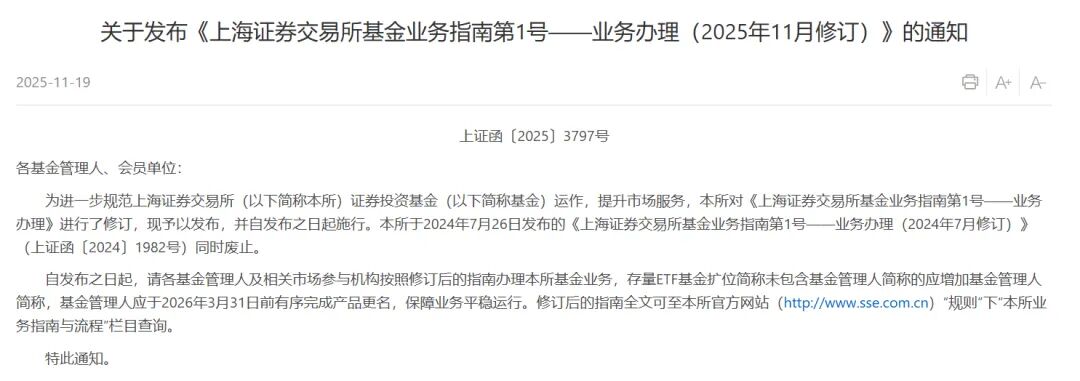
ETF简称规范倒计时:重塑市场竞争格局的“正名之战”
2 1 Shi Ji Jing Ji Bao Dao· 2025-11-25 13:31
Core Viewpoint - The new regulation for ETF naming in China aims to standardize the naming convention by requiring the inclusion of the fund manager's name, which is expected to enhance investor recognition and reduce confusion in the market [1][3][5]. Group 1: Regulatory Changes - The Shanghai and Shenzhen Stock Exchanges have issued revised guidelines mandating that all existing ETFs must change their names to include the fund manager's name by March 31, 2026 [1][3]. - The new naming structure will follow the format of "core elements of the investment target + ETF" and will help clarify product identity for investors [4][6]. Group 2: Industry Impact - The regulation is seen as a shift from a focus on "name dividends" to a competition based on "brand strength," which may lead to increased market concentration and a "stronger getting stronger" dynamic [1][7]. - Major fund companies like E Fund and Huaxia have already begun to implement the new naming convention, indicating a proactive approach to the changes [4][6]. Group 3: Competitive Landscape - The new rules are expected to benefit larger fund companies, as clearer identification of fund managers will likely lead investors to prefer products from well-established brands with strong reputations [6][7]. - The competition will shift from merely securing popular names to emphasizing brand loyalty and historical performance, which may disadvantage smaller firms [6][7]. Group 4: Naming Strategy - Fund companies are adopting a phased approach to renaming their ETFs, prioritizing less popular products for early changes while delaying adjustments for high-volume products to minimize disruption [8][9]. - The costs associated with renaming are primarily related to updating marketing materials and operational systems, with a focus on ensuring all platforms are synchronized to avoid trading errors [9][10].

QDII基金交易热!管理人频繁提示溢价风险,部分产品限购
Bei Jing Shang Bao· 2025-11-25 13:18
Core Viewpoint - Multiple fund managers have issued warnings regarding the premium risk of their QDII funds, indicating that over 20 funds may be affected by secondary market trading price premiums, despite the majority showing strong performance this year [1][3]. Group 1: Premium Risk Warnings - On November 25, several fund management companies, including Huaxia, GF, and Huitianfu, announced premium risk warnings for their QDII funds, affecting more than 20 products [3]. - The funds involved track indices such as the Nasdaq 100, S&P 500, and MSCI US 50, with these indices showing significant gains of 18.38%, 18.07%, and 14% year-to-date, respectively [3]. - The warnings are not new; for instance, Huaxia Nomura Nikkei 225 ETF has issued premium risk alerts up to 30 times since November [3]. Group 2: Market Performance and Fund Management Actions - As of November 21, 92.16% of the 689 QDII funds reported positive returns this year, with some funds, like Huitianfu Hong Kong Advantage Mixed QDII, achieving returns exceeding 122% [6]. - In response to the premium risks, 165 QDII funds have suspended subscriptions or limited large subscriptions, with some funds imposing strict limits on subscription amounts [7][8]. - The tightening of QDII quotas has led to a supply-demand imbalance, contributing to the premium phenomenon as investors rush to buy into these funds [5][8]. Group 3: Market Dynamics and Investor Behavior - The premium risk is exacerbated by a failure in the arbitrage mechanism due to the suspension of the primary market for subscriptions and redemptions, making it difficult to correct the premiums quickly [5]. - High-frequency trading and speculative activities have further amplified price volatility in the QDII funds, particularly those allowing T+0 trading [5]. - Analysts suggest that investors should wait for market adjustments before purchasing QDII funds to avoid chasing high prices, while also being mindful of the overall market conditions and potential risks [8].

指数产品投资运作远非“简单复制” 易方达基金解读指数投资的专业性
Zheng Quan Ri Bao Wang· 2025-11-25 13:15
本报讯 (记者昌校宇)近年来,国内指数投资市场发展迅速。自2003年首只完全复制指数的基金问世以来,公募指数产品 规模用时16年突破1万亿元;而到2024年,仅用5年时间便突破5万亿元。截至2025年三季度末,全市场非货币ETF、ETF联接基 金及其他场外指数基金总规模已接近8万亿元。其中,易方达基金旗下的公募指数产品总规模已突破万亿元,位列行业之首。 据易方达基金指数研究部人员介绍,指数产品的投资运作远非"简单复制",从跟踪误差的控制、超额收益的获取,到全流 程的风险管理,每一个环节都充满了技术细节。指数投资的专业性,体现在管理人对细微之处的极致追求和经年累月的打磨之 中。 此外,上述指数研究部人员认为,指数业务专业性不仅体现在投资环节,更贯穿产品从发行到存续的全生命周期管理。一 套覆盖发行上市、日常运作、风险监控、应急处置的完整体系,是产品长期稳健运作的保障。与此同时,提升指数业务的专业 性,还离不开基金公司投研、交易、IT等平台体系的系统性支持。 (编辑 李波) 在精准控制跟踪误差的基础上,通过精细化管理创造超额收益,既是指数投资专业化的进阶方向,也是提升投资者体验的 关键。这一过程既需要不断优化各类成 ...
科技股爆发,场内千基上涨
Zhong Guo Zheng Quan Bao· 2025-11-25 13:15
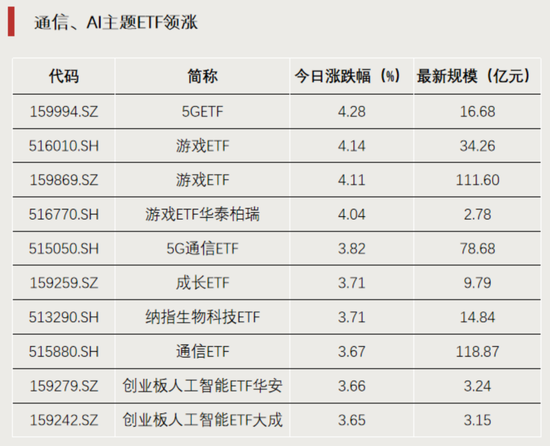
Group 1 - The technology growth sector, represented by optical modules, saw a collective surge on November 25, with some 5G and gaming-themed ETFs rising over 4% and multiple communication and AI-themed ETFs increasing over 3% [1][2] - The A-share market experienced wide fluctuations, leading to broad-based ETFs like CSI 300 and CSI 500 becoming a "safe haven" for funds, with net inflows exceeding 5.3 billion yuan for CSI 300 ETFs on November 24 [1][7] - Several funds reported the first batch of sci-tech entrepreneurship robot ETFs, and a semiconductor ETF was also submitted for approval, indicating a growing interest in these sectors [1][11] Group 2 - The AI sector led the gains on November 25, with stocks like Zhongji Xuchuang and Xinyi Sheng rising by 5% and 4% respectively, while the gaming and non-ferrous metals sectors also performed well [2] - The 5G ETF (159994) and multiple gaming-themed ETFs saw increases of over 4%, with over a thousand ETFs closing higher overall [2][3] - The recent volatility in the AI industry has led to more reasonable valuations, with performance improvements expected to drive continued upward movement in the sector [2] Group 3 - The Hong Kong stock market saw active trading in thematic ETFs, with significant increases in trading volumes for Hong Kong Securities ETF and Hong Kong Innovative Drug ETF compared to the previous trading day [5][6] - The broad-based ETFs have attracted significant net inflows, with the CSI 300 ETF leading with over 3.6 billion yuan in net inflows, marking a trend of consistent investment in these funds [7][8] - The recent performance of various sector ETFs indicates a shift in investor focus, with technology and growth sectors gaining traction while traditional sectors like coal and banking are seeing reduced interest [7][9] Group 4 - The first batch of sci-tech entrepreneurship robot ETFs was reported by several major fund companies, highlighting a strategic focus on robotics and semiconductor sectors [11] - The indices for the newly proposed ETFs include companies that provide essential software and hardware for robotics, as well as significant players in the semiconductor industry [11]
首批,定档开卖!
Zhong Guo Ji Jin Bao· 2025-11-25 12:40
Core Viewpoint - The first batch of dual innovation artificial intelligence ETFs is set to be launched on November 28, providing investors with a new tool to invest in "hard technology" and potentially attracting more incremental capital to the market [1][2]. Group 1: ETF Issuance Details - Seven ETFs from various fund companies, including E Fund, Huatai-PB, and others, will be issued on November 28, with a minimum fundraising period of three days [2][4]. - The fundraising limits for these ETFs vary, with E Fund's and Huatai-PB's ETFs set at 80 billion and 50 billion units respectively [4][5]. - Three of the ETFs will be listed on the Shanghai Stock Exchange, while the others will be listed on the Shenzhen Stock Exchange [5]. Group 2: Significance of the ETFs - The launch of these ETFs aligns with the Chinese government's strategic push towards an "intelligent economy" by 2035, as outlined in the "Artificial Intelligence+" action plan [6]. - The index underlying these ETFs combines the characteristics of the Sci-Tech Innovation Board and the Growth Enterprise Market, providing a unique investment opportunity in the AI industry [6]. - The AI industry is characterized by high growth potential and elasticity, driven by technological breakthroughs and increasing demand [6]. Group 3: Market Context and Performance - The China Sci-Tech Innovation Entrepreneurship AI Index, launched in May, has seen a year-to-date increase of over 70%, outperforming similar indices [7]. - The index includes 50 leading companies focused on AI technology development and application, covering a broad spectrum of the AI industry chain [7]. - Morgan Asset Management (China) highlights the significant investment value of the AI industry in China, noting its critical role in the global semiconductor and AI supply chain [8].
