宁波银行

Search documents
外资加仓中国资产
2 1 Shi Ji Jing Ji Bao Dao· 2025-09-02 15:34
Group 1 - Foreign investment attitudes towards Chinese assets are changing, with active foreign capital starting to flow into A-shares for the first time since October of the previous year [2][4][5] - In the first half of the year, foreign capital net increased holdings in domestic stocks and funds by $10.1 billion, reversing a two-year trend of net reductions [2][6] - The Shanghai Composite Index has risen by 15.11% year-to-date, with significant gains in various indices, indicating a strong performance of A-shares [4][5] Group 2 - Active foreign capital inflow into A-shares reached $9.145 million in the week of August 25-29, marking a significant reversal from previous outflows [4][5] - Passive foreign capital inflow into A-shares has also increased, with $15 billion flowing in during the week of August 21-27, compared to $5.5 billion the previous week [5][6] - The trend of foreign investment is expected to continue, driven by the depreciation of the US dollar and the appreciation potential of the RMB [7][10] Group 3 - Foreign investors are showing a preference for specific Chinese stocks, with Xiaomi, Tencent, and BYD being among the top choices [9][10] - The top ten A-shares held by foreign investors include leading companies such as CATL and Kweichow Moutai, with significant market values exceeding 100 billion yuan [10][11] - The focus of foreign investment is on sectors with global competitiveness, such as innovative pharmaceuticals and renewable energy [10][11]




外资加仓中国资产
21世纪经济报道· 2025-09-02 15:26
Core Viewpoint - The attitude of foreign capital towards Chinese assets is changing, with a notable increase in inflows into A-shares and a slowdown in outflows from Hong Kong stocks and ADRs [1][5][6]. Group 1: Foreign Capital Inflows - Active foreign capital has begun to flow into A-shares for the first time since October of the previous year, with accelerated inflows observed in late August [1][5]. - In the first half of the year, foreign capital net increased its holdings in domestic stocks and funds by $10.1 billion, reversing a two-year trend of net reductions [1][6]. - From May to July, long-term stable foreign institutional funds flowed into Hong Kong stocks amounting to approximately HKD 67.7 billion, while short-term flexible funds totaled about HKD 16.2 billion [1][6]. Group 2: Performance of Chinese Assets - As of September 2, the Shanghai Composite Index has risen by 15.11% year-to-date, with significant gains in other indices such as the ChiNext Index and the STAR Market [3]. - The A-share market has shown a notable profit effect since August, with the Shanghai Composite Index increasing nearly 8% and the ChiNext Index rising over 20% [3]. - The Hang Seng Index has also performed well, increasing by 27.10% year-to-date [3]. Group 3: Investment Preferences of Foreign Capital - Foreign investors are primarily interested in high-growth sectors such as innovative pharmaceuticals, internet leaders in Hong Kong, and the new energy sector [8][9]. - The top holdings of foreign capital in A-shares include companies like CATL, Kweichow Moutai, and Meituan, with significant market values exceeding CNY 100 billion [8]. - Recent trends indicate a shift of foreign capital from Hong Kong stocks to A-shares due to better performance in the latter [8]. Group 4: Future Outlook - Analysts suggest that the ongoing depreciation of the US dollar and the potential for RMB appreciation could lead to a sustained inflow of foreign capital into Chinese assets [7][9]. - Investment opportunities are identified in sectors with high export growth, clear upward trends, and globally competitive core assets [9].

狂买49亿股!险资二季度重仓买了这些 投资者能“抄作业”吗
Xin Jing Bao· 2025-09-02 14:30
Core Viewpoint - Insurance companies are increasingly investing in equity assets, particularly high-dividend stocks, to enhance returns amid a declining interest rate environment and to better match the duration of their assets and liabilities [1][4][5]. Group 1: Insurance Companies' Stock Holdings - As of the end of Q2, insurance companies held a total of 926.99 billion shares across 731 stocks, an increase of 49.24 billion shares from the previous quarter [2][3]. - The total balance of funds utilized by insurance companies exceeded 36 trillion yuan, a year-on-year increase of 17.4%, with stock investments reaching 3.07 trillion yuan, marking a significant rise in allocation to equities [2][4]. - The top ten stocks heavily held by insurance companies include Minsheng Bank, Shanghai Pudong Development Bank, and China Unicom, with each holding over 10 billion shares [2][3]. Group 2: Investment Trends and Strategies - Insurance companies are focusing on high-dividend, low-volatility stocks, reflecting a shift from traditional fixed-income investments due to the low yield environment [4][6]. - The recent trend shows a significant increase in equity investments, with 174 new stocks added to their portfolios by the end of Q2 [2][3]. - The insurance sector is also experiencing a wave of shareholding increases, with nearly 30 instances of shareholding increases reported by mid-August [3][4]. Group 3: Market Outlook and Future Investments - Most insurance institutions maintain an optimistic outlook for the A-share market in the second half of the year, expecting the Shanghai Composite Index to remain between 3200 and 3800 points [7][8]. - Key sectors of interest include pharmaceuticals, electronics, banking, and communication, with a focus on new productive forces and high-dividend assets [7][8]. - Major insurance companies plan to enhance their equity investment strategies, emphasizing the importance of investment capabilities in their competitive positioning [6][8].
谁在加仓中国资产
2 1 Shi Ji Jing Ji Bao Dao· 2025-09-02 13:19
Group 1 - Foreign investment attitudes towards Chinese assets are changing, with active foreign capital starting to flow into A-shares for the first time since October of the previous year [1][5] - In the first half of the year, foreign capital net increased holdings in domestic stocks and funds by $10.1 billion, reversing a two-year trend of net reductions [1][9] - The Shanghai Composite Index has risen 15.11% year-to-date, with significant gains in various indices, indicating a strong performance of A-shares [3][4] Group 2 - Active foreign capital inflow into A-shares accelerated recently, with $9.145 million entering during the week of August 25-29, compared to $1.985 million the previous week [5][7] - Long-term stable foreign institutions have cumulatively invested approximately 67.7 billion HKD from May to the end of July, while short-term flexible foreign institutions added about 16.2 billion HKD [8] - The trend shows that foreign investors are increasingly interested in Chinese assets, particularly as the RMB appreciates and the profitability of A-shares and H-shares improves [6][10] Group 3 - Foreign investors are favoring specific Chinese stocks, with Xiaomi, Tencent, and BYD being among the top choices [12][13] - The preference for A-shares is growing, with foreign capital shifting from Hong Kong stocks to A-shares due to better performance [14] - Investment opportunities are seen in high-growth sectors such as hard technology, innovative pharmaceuticals, and core assets with global competitiveness [15]
你追我赶!长三角头部城商行业绩背后:新排序靠什么?
Nan Fang Du Shi Bao· 2025-09-02 12:59
Core Viewpoint - The performance of the five leading city commercial banks in the Yangtze River Delta region listed on A-shares showed growth in revenue and net profit for the first half of 2025, but the growth rate has generally slowed compared to the previous year, with significant differentiation among them [2][3]. Group 1: Financial Performance - Jiangsu Bank led with a revenue of 44.86 billion yuan and a net profit of 21.06 billion yuan, maintaining its top position [3][4]. - Nanjing Bank surpassed Shanghai Bank in revenue, dropping Shanghai Bank to fourth place, while net profit rankings remained consistent [2][3]. - All five banks reported year-on-year growth in net profit, with Hangzhou Bank achieving the highest growth rate of 16.7% due to a reduction in credit impairment losses [5][12]. Group 2: Revenue and Profit Growth Rates - Revenue growth rates for the five banks showed a decline compared to last year, with Hangzhou Bank experiencing the largest drop from 9.6% to 3.9% [4][5]. - Jiangsu Bank and Ningbo Bank had revenue growth rates around 8%, while Shanghai Bank and Hangzhou Bank lagged behind with growth rates around 4% [4][5]. Group 3: Interest Income and Non-Interest Income - All five banks saw an increase in net interest income, with Nanjing Bank achieving the highest growth rate of 22.13% [5][6]. - Non-interest income showed mixed results, with four banks reporting growth while Shanghai Bank experienced a decline of 6% [7][11]. Group 4: Asset Quality and Capital Adequacy - The non-performing loan (NPL) ratios remained low, with only Shanghai Bank exceeding 1% at 1.18% [12][13]. - Jiangsu Bank's core Tier 1 capital adequacy ratio fell below 9%, the lowest among the five banks, while Shanghai Bank led with a ratio of 10.78% [14]. Group 5: Financial Investment and Loan Composition - Financial investment assets accounted for a significant portion of total assets, with Hangzhou Bank having the highest ratio at 46.8% [8][9]. - Jiangsu Bank's financial investment assets grew at a rate nearly double that of its loan assets, indicating a shift in asset allocation strategy [10][11].






江苏银行晋升城商行“一哥” 长三角四小龙携手迈向3万亿
2 1 Shi Ji Jing Ji Bao Dao· 2025-09-02 11:01
Core Viewpoint - The major city commercial banks in the Yangtze River Delta region have reported strong performance in the first half of the year, achieving growth in both revenue and net profit despite challenges such as narrowing interest margins and weakened credit demand [1][2]. Group 1: Financial Performance - Jiangsu Bank has the highest total assets among city commercial banks, reaching 4.79 trillion yuan, with a year-on-year growth of 26.99% [2][6]. - Ningbo Bank and Shanghai Bank also reported total assets exceeding 3 trillion yuan, with figures of 3.47 trillion yuan and 3.29 trillion yuan respectively [2]. - The net profit growth for Jiangsu Bank was 7.78%, while Ningbo Bank, Nanjing Bank, and Shanghai Bank reported growth rates of 7.91%, 8.64%, and 4.18% respectively [2][4]. Group 2: Asset Quality - The non-performing loan (NPL) ratios for these banks are below 1%, with Ningbo Bank having the lowest at 0.76%, followed by Jiangsu and Nanjing Banks at 0.84%, and Shanghai Bank at 1.18% [3][2]. Group 3: Loan Growth - Jiangsu Bank's loan and advance scale reached 2.37 trillion yuan, with a year-on-year growth of 18.79% [6][7]. - Ningbo Bank's loans and advances totaled 1.67 trillion yuan, with a growth of 13.36% [8]. - Nanjing Bank's total loans reached 1.39 trillion yuan, with a growth of 10.41% [6]. Group 4: Market Performance - The stock prices of these banks have shown an upward trend in the first half of the year, with Ningbo Bank experiencing the highest increase of 23.18% [5]. Group 5: Retail Business Challenges - Retail banking performance has lagged behind corporate banking, with Jiangsu Bank's retail loan growth at only 3.07% compared to 23.30% for corporate loans [11][12]. - Nanjing Bank's personal loan balance increased by 3.67%, while Shanghai Bank's personal loan balance decreased by 4.86% [13][12]. Group 6: Capital Adequacy Concerns - Concerns regarding capital adequacy have arisen due to rapid asset expansion, prompting banks to focus on optimizing asset structures and maintaining stable profit accumulation [9][10].

A股纺织龙头,能否走出营收利润双降困局
21世纪经济报道· 2025-09-02 09:37
Core Viewpoint - After consolidating the French high-end children's clothing brand BONPOINT, YOUNGOR is set to narrate a new story in the "fashion industry" amidst challenges in its real estate business and the transformation of its fashion segment [1]. Financial Performance - In the first half of 2025, YOUNGOR reported revenue of 5.11 billion yuan, a year-on-year decline of 10.50%, and a net profit attributable to shareholders of 1.72 billion yuan, down 8.04% [1]. - The fashion segment's revenue grew by 7.82% to 3.68 billion yuan, but the net profit attributable to shareholders fell by 39.28% to 238 million yuan due to increased costs and expenses [5]. - The investment segment contributed significantly to the overall profit, with a net profit of 1.39 billion yuan, accounting for over 80% of the total net profit [7]. Brand Strategy - YOUNGOR is implementing a multi-brand development strategy, holding eight brands including its main brand YOUNGOR, MAYOR, and HANP, as well as high-end sports and outdoor brands like HART MARX and HELLY HANSEN [3]. - The acquisition of BONPOINT, which generated revenue of 832 million yuan and accounted for 25.24% of the fashion segment's sales, marks a significant step in expanding its portfolio [5]. Market Positioning - BONPOINT targets new middle-class families in first- and second-tier cities, operating approximately 130 stores across 30 countries, with an annual revenue of about 1.5 billion euros (approximately 1.15 billion yuan) [5]. - The high-end children's clothing segment is seen as a potential growth area in a competitive apparel market, with BONPOINT expected to contribute to YOUNGOR's performance in the future [5]. Investment Adjustments - YOUNGOR has been adjusting its investment structure, selling off financial assets worth 4.175 billion yuan, which is about 10.13% of its audited net assets as of the end of 2024 [8]. - The company is focusing on enhancing cash flow management and strategically increasing stakes in key investments while reducing or exiting financial investment projects [8][9].


金工定期报告20250902:预期高股息组合跟踪
Soochow Securities· 2025-09-02 09:04
Quantitative Models and Construction Methods - **Model Name**: Expected High Dividend Portfolio **Model Construction Idea**: The model aims to construct a portfolio with high expected dividend yield by leveraging historical dividend data, fundamental indicators, and short-term factors like reversal and profitability[5][10][16] **Model Construction Process**: 1. **Dividend Yield Calculation**: - Phase 1: Calculate dividend yield based on annual report profit distribution announcements - Phase 2: Predict and calculate dividend yield using historical dividend data and fundamental indicators[5][10] 2. **Screening Process**: - Exclude suspended and limit-up stocks from the CSI 300 constituents[15] - Remove the top 20% of stocks with the highest short-term momentum (21-day cumulative return)[15] - Exclude stocks with declining profitability (quarterly net profit YoY growth < 0)[15] 3. **Final Selection**: - Rank the remaining stocks by expected dividend yield - Select the top 30 stocks with the highest expected dividend yield and construct an equally weighted portfolio[11] **Model Evaluation**: The model demonstrates strong historical performance with significant excess returns and controlled drawdowns, making it a robust strategy for high-dividend stock selection[13] Model Backtesting Results - **Expected High Dividend Portfolio**: - Cumulative Return: 358.90% - Cumulative Excess Return (vs CSI 300 Total Return Index): 107.44% - Annualized Excess Return: 8.87% - Maximum Rolling 1-Year Drawdown of Excess Return: 12.26% - Monthly Excess Win Rate: 60.19%[13] Quantitative Factors and Construction Methods - **Factor Name**: Expected Dividend Yield Factor **Factor Construction Idea**: Predict future dividend yield by combining historical dividend data, fundamental indicators, and short-term influencing factors[5][16] **Factor Construction Process**: 1. Calculate historical dividend yield based on profit distribution announcements[5][10] 2. Predict future dividend yield using fundamental indicators and historical dividend patterns[5][10] 3. Incorporate two short-term factors: - **Reversal Factor**: Accounts for short-term price reversals - **Profitability Factor**: Reflects the company's earnings performance[5][16] **Factor Evaluation**: The factor effectively identifies high-dividend stocks and serves as a reliable input for portfolio construction[16] - **Factor Name**: Red Dividend Timing Framework (Composite Signal) **Factor Construction Idea**: Combines multiple single-factor signals to assess the market's outlook on dividend stocks[25][28] **Factor Construction Process**: 1. Evaluate five single-factor signals: - **Inflation**: PPI YoY (High/Low) - **Liquidity**: M2 YoY (High/Low) - **M1-M2 Gap**: Scissors Difference (High/Low) - **Interest Rate**: US 10-Year Treasury Yield (High/Low) - **Market Sentiment**: Dividend Stock Turnover Ratio (Up/Down)[28] 2. Assign binary signals (1 for bullish, 0 for bearish) to each factor 3. Aggregate the signals into a composite indicator[28] **Factor Evaluation**: The framework provides a systematic approach to timing dividend stock investments, though the September 2025 signal suggests a cautious stance[25][28] Factor Backtesting Results - **Expected Dividend Yield Factor**: - August 2025 Portfolio Average Return: 5.69% - Excess Return (vs CSI 300 Index): -4.80% - Excess Return (vs CSI Dividend Index): +4.70%[5][16] - **Red Dividend Timing Framework (Composite Signal)**: - Latest Signal (September 2025): 0 (Neutral)[25][28]






城商行的二十年:展望“十五五”,谁是未来大赢家?
NORTHEAST SECURITIES· 2025-09-02 09:02
Investment Rating - The report rates the industry as "Outperforming the Market" [4] Core Insights - The report emphasizes that the evolution of local government financing behavior and regulatory adjustments over the past two decades have significantly influenced the financial sector. It predicts that the proportion of bank credit in local government debt will increase from 38% to 42% during the "14th Five-Year Plan" period, with an annual growth rate fluctuating between 10% and 17% [1][18][19] - City commercial banks (CCBs) have played a crucial role in supporting local government debt resolution, with their credit growth in government-related loans outpacing that of other banks. The report identifies a complementary relationship between CCBs' government-related loan growth and the issuance of urban investment bonds [1][2] - The report forecasts that CCBs will take on greater responsibilities in the future, driven by increasing state ownership, leadership changes reflecting regulatory attributes, and strong local government relationships. This will enhance local market competitiveness and provide growth opportunities for CCBs [2][18] Summary by Sections 1. Changes in Local Government Financing Structure - The report outlines the historical evolution of local government debt and financing needs, highlighting the significant role of regulatory and policy adjustments in shaping the financial sector [14][18] - It provides a detailed analysis of local government debt structure changes from 2008 to 2025, noting the shift from bank loans to urban investment bonds and shadow banking during various phases [19][24] 2. CCBs' Role in Debt Resolution - CCBs have shown proactive engagement in local government debt resolution, with their government-related loan growth significantly higher than that of other banks. The report indicates that CCBs have effectively supplied funds during periods of heightened repayment pressure [1][2][19] 3. Future Prospects for CCBs - The report identifies several CCBs, including Chongqing Bank, Xiamen Bank, and Shanghai Bank, as potential winners during the "14th Five-Year Plan" period, expecting them to achieve faster expansion and higher returns for investors [2][3] - It predicts that the overall valuation of CCBs will have substantial room for improvement, estimating a price-to-book (PB) ratio of 0.7x by the end of 2026 and 1.22x by the end of 2030 [2][3] 4. Investment Recommendations - The report recommends focusing on specific CCBs such as Chongqing Bank, Xiamen Bank, Shanghai Bank, Qilu Bank, and Chengdu Bank for potential investment opportunities [3][6]

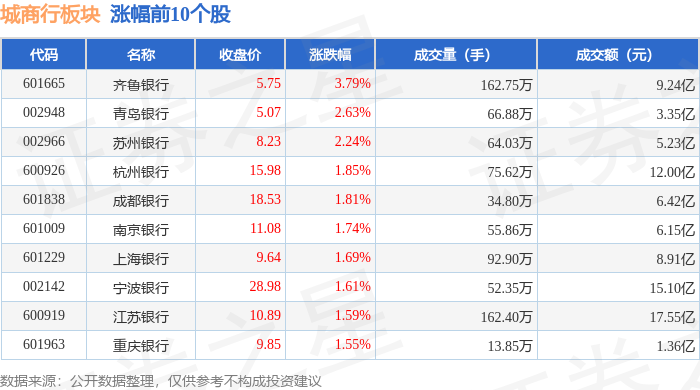
城商行板块9月2日涨1.65%,齐鲁银行领涨,主力资金净流入3.41亿元
Zheng Xing Xing Ye Ri Bao· 2025-09-02 08:59
Group 1 - The city commercial bank sector increased by 1.65% on September 2, with Qilu Bank leading the gains [1] - The Shanghai Composite Index closed at 3858.13, down 0.45%, while the Shenzhen Component Index closed at 12553.84, down 2.14% [1] - Qilu Bank's closing price was 5.75, reflecting a 3.79% increase, with a trading volume of 1.6275 million shares and a transaction value of 924 million [1] Group 2 - The city commercial bank sector saw a net inflow of 341 million from main funds, while retail funds experienced a net outflow of 138 million [2] - Jiangsu Bank had a net inflow of 140 million from main funds, but a net outflow of 90.16 million from speculative funds [3] - The overall trading activity in the city commercial bank sector indicates a mixed sentiment among different types of investors, with main funds showing positive interest while retail and speculative funds withdrew [2][3]