三星

Search documents
8点1氪:贾国龙首次回应西贝预制菜风波;京东发布年终奖计划:采销平均25薪,上不封顶;王思聪名下资产被法拍
36氪· 2025-12-26 00:01
Group 1 - The founder of Xibei, Jia Guolong, expressed that the recent turmoil had a greater impact on the company than any previous operational crisis, stating he relied on sleeping pills for 40 consecutive days to cope with stress [3][4] - Jia acknowledged his mistakes during the crisis, admitting he should not have confronted customers directly and emphasized the importance of listening to customer feedback in the future [3][4] - Since the onset of the crisis, Xibei's nationwide stores have undergone over 80 inspections by various government regulatory bodies, with no violations reported [4] Group 2 - JD.com announced its 2025 year-end bonus plan, with average bonuses reaching 25 times the monthly salary, with top performers receiving up to 24 times their monthly salary [4] - BYD won a court case against several accounts that spread false information about the company, resulting in a compensation of 2 million yuan [8] - The Chinese government expressed strong opposition to the U.S. imposing additional tariffs on semiconductor products, emphasizing the need for fair trade practices [6][7]


8点1氪|贾国龙首次回应西贝预制菜风波;京东发布年终奖计划:采销平均25薪,上不封顶;王思聪名下资产被法拍
3 6 Ke· 2025-12-26 00:00
Group 1 - JD.com announced its 2025 year-end bonus plan, with average bonuses reaching 25 times the monthly salary, with no upper limit [2] - Employees with an A+ performance rating will receive a year-end bonus equivalent to 10 times their monthly salary, totaling 22 times their salary [2] - The sales of duty-free shops in Sanya surged to 535 million yuan from December 18 to 22, marking a 50.3% year-on-year increase [3] Group 2 - ByteDance reported internal violations, resulting in the dismissal of 120 employees, with 28 being publicly named for serious offenses [7] - BYD won a court case against several accounts that spread false information, resulting in a compensation of 2 million yuan [7] - The Chinese government expressed strong opposition to the US imposing additional tariffs on semiconductor products, emphasizing the negative impact on global supply chains [5] Group 3 - The Chinese Ministry of Commerce stated that it hopes for a balanced solution regarding TikTok's establishment of a joint venture in the US, aligning with Chinese laws [6] - Reports indicate that Brazil is considering implementing visa exemptions for Chinese tourists, aiming to strengthen trade relations [6] - The housing market in major cities like Shenzhen and Shanghai may see relaxed purchase restrictions, following similar policies in Beijing [5] Group 4 - Toyota's global sales and production both declined in November, with sales down 1.9% to 965,919 vehicles and production down 3.4% to 934,001 vehicles [13] - Major silicon wafer manufacturers have raised prices significantly, with average increases of 12% due to rising raw material costs [14] - Silver futures prices reached a new high, closing at $71.685 per ounce, driven by increased industrial and investment demand [14] Group 5 - OpenAI is reportedly considering integrating advertisements into ChatGPT responses, aiming to prioritize promotional content in user queries [14] - The Chinese government plans to integrate artificial intelligence deeply into various sectors by 2035, enhancing economic development [20] - Major pharmaceutical e-commerce platforms are expected to benefit from the growing demand for AI medical applications [21] Group 6 - Xiaomi announced the pricing for its new Xiaomi 17 Ultra model, starting at 6,999 yuan, with pre-sales already underway [24] - "FenYinTa Technology" secured nearly 100 million yuan in Series A funding, focusing on AI applications in elder care [25] - "YunShenChu Technology" completed a Pre-IPO round of financing amounting to several hundred million yuan, led by the National AI Industry Fund [26]
存储短缺白热化,科技巨头开始驻韩\"抢芯\"
Xuan Gu Bao· 2025-12-25 23:38
Group 1 - The global competition for AI computing power has intensified, making high-performance memory like HBM a strategic resource, with major tech companies like Microsoft, Google, and Meta establishing procurement teams in South Korea to secure limited capacities from Samsung and SK Hynix [1] - Google has recently laid off some procurement leaders due to failure in signing long-term agreements, which has led to supply chain risks, highlighting the tight supply situation for storage chips [1] - The price increase cycle for storage chips is expected to start in Q3 2025, with Samsung, SK Hynix, and Micron collectively raising contract prices for DRAM and NAND Flash by up to 60%, driven by the dual demand from AI servers and smartphone upgrades [1] Group 2 - HBM is projected to reach a global market size of $5.61 billion in 2024, with an expected growth to $57.09 billion by 2034, reflecting a compound annual growth rate of 26.1%, as leading manufacturers prepare for HBM4 mass production [2] - The price increase in storage chips has affected various sectors including HBM, storage modules, and automotive-grade storage, indicating a comprehensive impact across the supply chain, with domestic storage industries poised for rapid development during this super cycle [2] Group 3 - Demingli, a company focused on the storage industry, is expected to quickly realize short-term benefits from inventory price increases and restocking due to its core control chip-based storage solutions [3] - Zhaoyi Innovation, a leading fabless Flash supplier, is involved in multiple storage categories including NOR, NAND, and DRAM, positioning itself favorably in the market [4]




消费电子行业迎来多重驱动 产业链估值有望提升
Mei Ri Jing Ji Xin Wen· 2025-12-25 14:57
Core Viewpoint - The consumer electronics industry is expected to experience a significant recovery and innovation cycle driven by AI technology, with new product launches and price increases anticipated in 2026, leading to improved valuations across the supply chain [1][7]. Group 1: Market Trends and Innovations - Major companies are set to launch a variety of AI-enabled consumer electronics, including AI smartphones, AI glasses, and AI speakers, marking the beginning of a new innovation cycle [2][3]. - Apple plans to expand its smartphone product line significantly, with at least seven new flagship models expected by 2027, including its first foldable iPhone [2][4]. - Google is collaborating with various partners to develop AI glasses and AR products, with the first models expected to hit the market in 2026 [3][4]. Group 2: Financial Performance and Valuation - The consumer electronics sector saw a 42.87% increase in the Shenwan Consumer Electronics Index from early 2025 to December 18, 2025, although it remains undervalued compared to other electronic sectors [6]. - As of December 18, 2025, the PE-TTM for the consumer electronics sector was 37.76 times, significantly lower than the semiconductor sector at 96.72 times [6]. - The sector's revenue and net profit grew by 27.12% and 34.95% year-on-year, respectively, in Q3 2025, indicating a positive financial trend [6]. Group 3: Demand and Pricing Dynamics - The global smartphone market showed signs of recovery, with a 2.6% year-on-year increase in shipments in Q3 2025, driven by high-end models and AI smartphones [7]. - Price increases for consumer electronics are anticipated due to rising storage chip costs, with major companies like Dell and HP considering price hikes for their products [7]. - The combination of structural price increases and cost-sharing strategies among industry players is expected to be implemented around the upcoming New Year [7]. Group 4: Opportunities in the Industry - The introduction of foldable smartphones by leading brands like Apple is expected to create a significant growth opportunity for the entire supply chain [8]. - The complexity of foldable devices is likely to increase demand for components such as batteries and PCBs, leading to potential price and volume increases in these segments [8]. - New product innovations will necessitate upgrades in production lines and automation processes, presenting new order opportunities for equipment manufacturers [8].
消费电子行业迎来多重驱动,产业链估值有望提升
Mei Ri Jing Ji Xin Wen· 2025-12-25 14:43
Core Viewpoint - The consumer electronics sector is expected to experience a significant recovery and innovation cycle driven by AI technology, with new product launches and price increases anticipated in 2026, leading to improved industry valuations [1][7]. Group 1: Market Trends and Innovations - Major companies are set to launch new AI-enabled consumer electronics, including AI smartphones, AI glasses, and foldable phones, marking a new innovation cycle in the industry [2][3]. - Apple plans to expand its smartphone product line significantly, with at least seven new flagship models expected by 2027, including its first foldable phone [2][4]. - Google is collaborating with various partners to develop AI glasses and AR products, with significant launches planned for 2026 [3][4]. Group 2: Financial Performance and Valuation - The consumer electronics sector saw a 42.87% increase in the Shenwan Consumer Electronics Index from early 2025 to December 18, 2025, but remains undervalued compared to other electronic sectors [6]. - As of December 18, 2025, the PE-TTM for the consumer electronics sector was 37.76 times, significantly lower than the semiconductor sector at 96.72 times [6]. - The sector's revenue and net profit grew by 27.12% and 34.95% year-on-year, respectively, in Q3 2025, indicating strong performance despite previous market fluctuations [6]. Group 3: Demand and Pricing Dynamics - The global smartphone market showed signs of recovery in Q3 2025, with a 2.6% year-on-year increase in shipments, driven by high-end models and AI smartphones [7]. - Price increases for consumer electronics are expected due to rising storage chip costs, with major companies like Dell and HP considering price hikes for their products [7]. - The introduction of innovative products such as foldable and AI smartphones is anticipated to drive demand for components, leading to potential growth in the supply chain [8].

挑战台积电:三星有望拿下谷歌 AI 芯片代工大单
Xin Lang Cai Jing· 2025-12-25 12:46
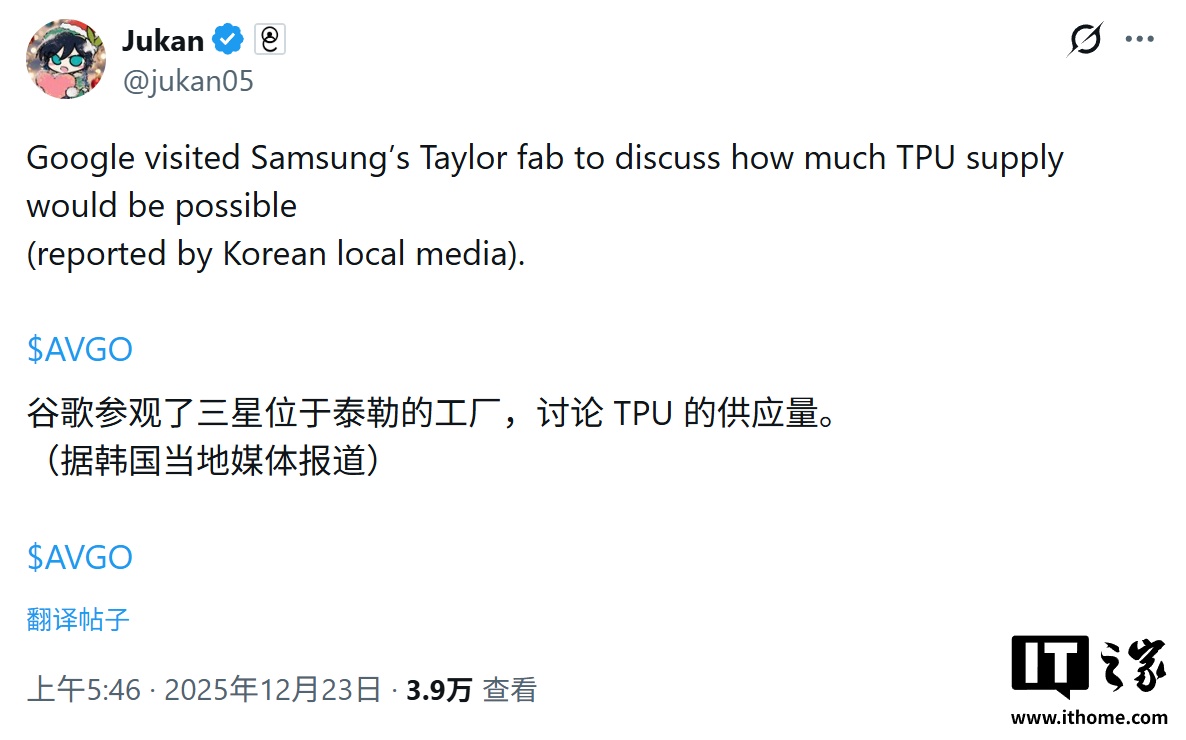
IT之家 12 月 25 日消息,消息源 @jukan05 于 12 月 23 日在 X 平台发布推文,爆料称谷歌高管近期造访了三星位于美国得克萨斯州泰勒市的半导体工厂,双 方就外包生产 TPU 事宜展开了谈判。 IT之家援引博文介绍,在访问期间,双方不仅讨论了技术细节,还重点商讨了三星未来可能供应的 TPU 数量。这一动向表明,谷歌寻求更具优势的生产方 案,正计划将其自研 AI 芯片的制造业务部分外包给三星。 尽管大量资金涌入人工智能领域,但由于昂贵的硬件投入和数据中心运营开销,多数 AI 公司目前仍处于亏损状态。 谷歌此前与博通合作开发的 TPU,据称在性能相当甚至更优的情况下,成本比英伟达的 H100 低 80%。若谷歌能达成与三星的代工合作,有望进一步降低芯 片制造成本,从而大幅削减构建及升级数据中心的总体支出,为未来的 AI 盈利模式铺平道路。 谷歌研发的 TPU 与英伟达的 GPU 在设计理念上存在本质区别。英伟达的 GPU 旨在处理广泛的 AI 相关工作负载,而谷歌 TPU 则专为神经网络数学运算量 身定制,能更高效地加速机器学习任务,如训练 Gemini 模型、图像识别及推理运算等。 IT之家 ...

从华为到苹果,谁才是远程学习王者平板?
Xin Lang Cai Jing· 2025-12-25 12:45
Core Insights - The article discusses the emergence of high-end tablets priced above 5000 yuan, which are redefining the digital learning experience for remote learners, students, and content creators [1][6][10] Product Summaries - Huawei MatePad Pro 12.2-inch 2025 model priced at 5099 yuan features a Kirin 9020A processor, a 12.2-inch dual-layer OLED screen with a resolution of 2800×1840 and a refresh rate of 144Hz, a 10100mAh battery with 100W fast charging, and weighs only 508 grams, making it highly portable [2][7] - Samsung Galaxy Tab S9 priced at 6499 yuan offers an 11-inch OLED display with a resolution of 2560×1600 and a 120Hz refresh rate, powered by the Snapdragon 8 Gen2 processor, and includes an S Pen with IP68 water and dust resistance [3][8] - Apple iPad Pro 11-inch 2025 model priced at 8999 yuan is equipped with the new M5 chip, featuring a powerful GPU, Ultra Retina Tandem OLED display with peak brightness of 1600 nits, and enhanced video conferencing capabilities [3][8] - Apple iPad Pro 11-inch 2024 model, also priced at 8999 yuan, utilizes the M4 chip with ray tracing support, and features an OLED screen with peak brightness of 1600 nits, designed for AR applications in fields like medicine and architecture [5][9] - Huawei MatePad Pro 13.2-inch priced at 5199 yuan emphasizes a "giant screen office" concept with a 2880×1920 resolution and a 94% screen-to-body ratio, making it suitable for document and chart processing [5][9] Comparative Analysis - Huawei excels in eye protection, cross-device collaboration, and cost-effectiveness, while Samsung balances audio-visual quality with practical features of the S Pen, and Apple secures the high-end market with its M-series chips and integrated ecosystem [6][10]
在鸟巢开过发布会的陈凯峰,决定不再做手机品牌|我们的四分之一世纪
Xin Lang Cai Jing· 2025-12-25 12:41
Core Insights - The article chronicles the journey of Chen Kaifeng, the chairman of KUSAI Intelligent, from a young salesman in 1997 to a leader in the smartphone industry, selling over 6 million phones globally by 2025, highlighting the evolution of China's mobile communication industry [1][42][43] Industry Evolution - In the early 2000s, domestic mobile phone manufacturers primarily acted as intermediaries, lacking core technology, which was held by overseas brands [5][45] - By 2004, the long lead time for orders from overseas revealed the weaknesses of this model, as market dynamics could change drastically within the 12-week production cycle [6][46] - The introduction of MediaTek's "Turnkey Solution" in 2005 significantly lowered the technical and financial barriers for manufacturers, allowing them to produce market-ready phones without extensive R&D [7][46] Product Innovation - In 2006, Chen's team capitalized on a MediaTek chip that lacked a camera by focusing on audio capabilities, creating a product tailored for laborers in noisy environments, which became known as a "shanzhai" phone [10][52] - The design included features like powerful speakers and long battery life, catering to the needs of low-income workers, thus democratizing mobile phone access [12][52] Brand Development - In 2009, Chen launched the "Koobee" brand, influenced by the "smile curve" theory, which posits that value is highest at the ends of the production chain [15][54] - Initially successful, the brand faced challenges as the market shifted towards major players like Xiaomi and OPPO, leading to a significant contraction for smaller brands [20][59] Strategic Shift - By 2017, recognizing the entrenched market dynamics, Chen pivoted KUSAI's focus from domestic branding to international markets, seeking opportunities in niches overlooked by larger competitors [23][61] - The company began to serve as an "invisible factory" for U.S. carriers, adapting products to meet specific local needs, which allowed KUSAI to thrive in a competitive landscape [71][72] Technological Capability - KUSAI established three R&D centers in China, employing nearly a thousand engineers to support diverse customization needs, which became a competitive advantage [73][76] - The company is now exploring applications beyond smartphones, such as smart screens for fitness equipment and automotive technology, indicating a broader strategic vision [77][78]
在鸟巢开过发布会的陈凯峰,决定不再做手机品牌
Jing Ji Guan Cha Wang· 2025-12-25 12:11
Core Viewpoint - The article chronicles the evolution of the Chinese mobile phone industry through the experiences of Chen Kaifeng, highlighting the transition from basic feature phones to smart devices and the strategic pivots made by companies like KuSai Intelligent in response to market changes [2][10][22]. Industry Evolution - In the late 1990s, mobile phones were luxury items in China, with high costs for both calls and devices, leading to a burgeoning electronic communication industry [2]. - By the early 2000s, domestic manufacturers primarily acted as intermediaries, lacking core technology and relying on foreign designs for assembly [3][4]. - The introduction of MediaTek's "Turnkey Solution" in 2005 significantly lowered the technical and financial barriers for manufacturers, allowing them to produce phones without extensive R&D [5]. Company Development - Chen Kaifeng founded his company in 2006, initially focusing on a unique product that catered to specific user needs, such as loudspeakers for construction workers and long battery life [6][7]. - The "shanzhai" (copycat) phones, while often viewed negatively, provided affordable access to mobile technology for lower-income consumers, contributing to the growth of the Shenzhen electronics industry [8][9]. - In 2009, the company shifted focus to branding, launching the "Koobee" brand, which initially thrived due to its understanding of the market [10][11]. Market Challenges - The smartphone market began to consolidate around major players like Xiaomi and OPPO, leading to increased competition and pressure on smaller brands [12][14][15]. - By 2017, the company faced significant challenges as the market became dominated by a few key brands, prompting a strategic pivot towards international markets and niche segments [15][21]. Strategic Shift - The company transitioned from a focus on branding to becoming an "invisible factory" for local brands in overseas markets, emphasizing customized solutions for specific regional needs [21][22]. - KuSai Intelligent began to explore specialized markets, such as rugged phones for industrial use, integrating advanced features like thermal imaging and laser measurement [18][19][20]. Future Outlook - The company is now leveraging its engineering capabilities to expand beyond mobile phones into other technology sectors, such as fitness equipment and robotics [24][25]. - Chen Kaifeng emphasizes the importance of surviving and thriving within the industry ecosystem rather than seeking fame, focusing on building a sustainable business model [26].
华为折叠屏引领行业七年进化,重塑折叠主力机心智标杆
Xin Lang Cai Jing· 2025-12-25 11:11
Core Insights - The folding screen smartphone market is transitioning from a niche curiosity to a mainstream practical choice, driven by technological maturity and price reductions [1][5][20] - The user base is expanding, with 17.9% of users aged 18-24, and over 90% of consumers considering a folding screen for their next phone [1][8] Market Trends - In 2024, China's folding screen smartphone shipments are expected to reach 9.69 million units, with 7.62 million units shipped in the first three quarters of 2025 [3] - Huawei leads the market with nearly 70% share and has surpassed 15 million cumulative shipments of folding screen devices [3][7] Technological Advancements - The transition is fueled by advancements in hardware technology, particularly in hinge and screen design, moving from basic functionality to comprehensive user experience [5][20] - Huawei has pioneered key technologies such as the water-drop hinge and the Tian Gong hinge system, which significantly enhance the design and functionality of folding screens [7][13] Consumer Demographics - Young users are increasingly attracted to folding screen smartphones for their technological appeal and entertainment capabilities, with a higher percentage citing these reasons compared to the overall consumer base [8][10] - Among young users, women represent a higher proportion, with 34% being regular employees, followed by general management and students [10] Brand Preference - Huawei is the preferred brand for 67.4% of consumers considering a folding screen smartphone, highlighting its strong market position [10] - The company offers a complete range of folding screen designs, differentiating itself from competitors [13] Software and Ecosystem - Huawei's Mate XTs integrates PC-level applications, enhancing productivity across various scenarios, and supports multi-window interactions [15] - The integration of AI capabilities is expected to redefine user interactions with folding screens, making them more efficient and versatile [17][19] Future Outlook - The combination of AI and folding screens is anticipated to drive a new wave of growth, transforming smartphones into intelligent hubs capable of handling complex tasks [22][23] - As folding screens gain mainstream acceptance, they are expected to become a dominant choice in the consumer market, with Huawei continuing to lead the way in innovation and user experience [20][23]