招商银行

Search documents
招联金融再收50万罚单,涉合作机构与贷后管理问题
Nan Fang Du Shi Bao· 2025-12-31 13:32
公开资料显示,招联金融成立于2015年3月,注册于深圳前海,由招商银行与中国联通各持股50%,注 册资本100亿元,是经银保监会批准设立的持牌消费金融机构。 中国联通2024年年报披露的财务数据显示,招联金融当年业绩出现成立以来首次"三降":营业收入 173.18亿元,同比下降11.65%;净利润30.16亿元,同比下滑16.22%;总资产1637.51亿元,同比减少 7.18%。资产质量方面,截至2024年末,公司不良贷款率为1.95%,虽较2023年的2.45%有所下降,但信 用减值损失仍高达114.24亿元,占当年营业收入的65.97%。 12月31日,国家金融监督管理总局深圳监管局发布的行政处罚信息公示表显示,招联消费金融股份有限 公司(下称"招联金融")因合作机构管理不审慎、贷后资金用途管理不到位,被罚款50万元,相关责任 人盛莲同时被给予警告。 作为大湾区首家消费金融公司,招联金融此次并非首次因合规问题受罚。2020年10月,原银保监会消保 局就曾通报其存在营销夸大误导、合作商管控不力等四项侵害消费者权益行为;2022年2月,该公司因 营销宣传夸大误导、催收行为不当等八项违规,被处以290万元罚款 ...
欧陆通接待53家机构调研,包括睿远基金、天风证券、国华兴益保险资管、国信证券等
Jin Rong Jie· 2025-12-31 13:03
Core Viewpoint - Eurotech announced a successful investor meeting with 53 institutions, showcasing strong revenue growth and strategic plans for future expansion in the data center power supply sector [1][2]. Group 1: Financial Performance - For the first three quarters of 2025, Eurotech achieved a revenue of 3.387 billion yuan, representing a year-on-year growth of 27.16% [1]. - The third quarter revenue reached 1.267 billion yuan, showing a year-on-year increase of 19% and a quarter-on-quarter growth of 2.81% [1]. - The net profit attributable to shareholders for the first three quarters was 222 million yuan, up 41.53% year-on-year, with a net profit margin of 6.54%, an increase of 0.66 percentage points [1]. - After excluding the impact of stock incentives and convertible bond expenses, the operating net profit was 257 million yuan, reflecting a year-on-year increase of 57.63% [1]. Group 2: Product and Market Strategy - Eurotech offers a diverse range of products in the data center power supply sector, including power supplies below 800W, between 800-2,000W, and above 2,000W [2]. - The company has launched key products such as the 3,200W titanium M-CRPS server power supply and the 1,300W-3,600W titanium CRPS server power supply, serving major domestic server manufacturers [2]. - Eurotech is actively expanding its overseas business, establishing teams in Taiwan and the United States to engage with various international clients [2]. - The company aims to focus on core competencies through technological innovation, targeting high power, high efficiency, and advanced semiconductor applications [2]. Group 3: Shareholder Information - As of September 30, 2025, Eurotech had 21,551 shareholders, an increase of 4,376 from the previous count, with an average holding value of 1.1266 million yuan per shareholder [3]. - The top shareholder is the investment fund managed by China Merchants Bank, which emphasizes value-driven and long-term investment strategies [3].


低开低走大跳水,互联网、科技、医疗、银行等紧随其后
Ge Long Hui· 2025-12-31 13:03
低开低走大跳水,截至目前恒生指数下跌0.87%,大消费跌幅居前,恒生互联网、恒生科技、恒生医 疗、银行等紧随其后。 银行低开低走后探底回升,截至目前下跌0.61%。其中农业银行下跌1.7%,招商银行下跌1.7%,工商银 行下跌1.28%,交通银行、建设银行、重庆银行等股均小幅下跌。 内容只是个人观点,仅供参考,不作为投资依据!欢迎关注交流,互相学习、共同探讨! 大消费低开低走跌幅居前,截至目前下跌1.34%。三生制药大跌2.98%,信达生物下跌2.72%,蜜雪集 团、泡泡玛特、创科实业、比亚迪股份等近10职个股跌幅在2%上方。 恒生科技低开低走下跌1.21%,目前出现止跌企稳的迹象。其中网易下跌2.71%,京东集团、美团、阿 里巴巴、快手等股跌幅均在1%上方;百度集团、小米集团逆势小涨。 ...


存钱送电动车还垫钱?2025银行揽储卷疯了,背后藏着国际资本暗战
Sou Hu Cai Jing· 2025-12-31 12:52
Core Viewpoint - The banking sector in China is experiencing intense competition for deposits, with various strategies employed by different types of banks to attract customers, leading to potential risks and unsustainable practices in the long term [1][10]. Group 1: Deposit Strategies - State-owned banks leverage their strong financial backing, with some increasing large deposit rates by 5% without offering incentives [3]. - Joint-stock banks are targeting middle-class consumers with promotional offers, such as airport lounge access for large deposits [5]. - City and rural commercial banks are engaging in aggressive tactics, including offering physical goods like cooking oil for deposits [5][7]. Group 2: Risks and Consequences - Some bank employees are resorting to personal funds to incentivize clients, indicating a desperate attempt to meet performance targets [7]. - There are reports of unethical practices, such as using public funds for gifts, which can lead to significant financial losses for the banks involved [8]. - The intense competition for deposits is causing banks to face rising costs, with some reporting a 20% drop in profits in the first three quarters of the year [16]. Group 3: External Influences - Foreign investment in RMB assets has reached 10.42 trillion, the highest in 43 months, driven by stable interest rates and currency [10][12]. - The influx of foreign capital is crucial for banks to maintain lending capabilities, supporting domestic enterprises in global markets [14]. Group 4: Regulatory Response - The central bank has increased the emphasis on the stability of funding costs in its assessments, indicating a shift towards more sustainable banking practices [21]. - Banks are beginning to adapt by promoting products with social or environmental benefits, such as "green deposits" for renewable energy projects [21]. Group 5: Future Outlook - The banking sector must transition from aggressive deposit acquisition to sustainable practices that focus on effective management of resources [23]. - Consumers are advised to prioritize the safety of their deposits over promotional offers, emphasizing the importance of deposit insurance [24].
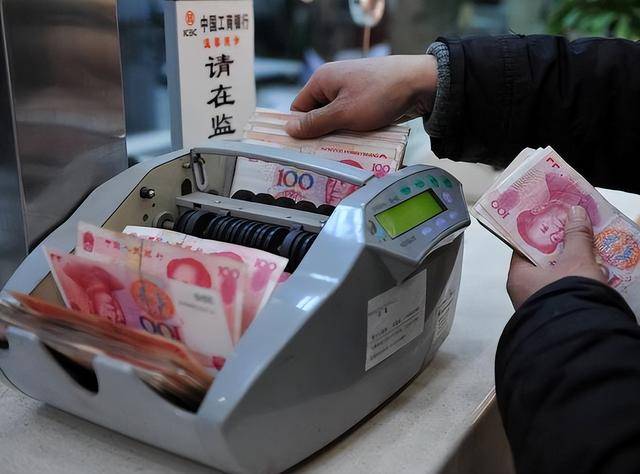
胡薄走访慰问财税金融系统干部职工
Xin Lang Cai Jing· 2025-12-31 12:43
滨州日报/滨州网讯在元旦佳节来临之际,12月31日下午,市委常委、副市长、市政府党组副书记胡薄 走访慰问财税金融系统干部职工,向大家致以新年的问候与祝福。 胡薄先后到招商银行滨州分行、建设银行滨州西城支行、人民银行滨州市分行、国家金融监督管理总局 滨州监管分局走访,参观营业大厅、业务办公区,与一线干部职工亲切交流,详细询问各项工作运行情 况,对大家一年来的辛勤付出表示感谢。 胡薄指出,金融是国民经济的血脉。今年以来,全市财税金融系统围绕中心工作,迎难而上、奋力进 取,在助力滨州经济稳健向好中发挥了重要作用。新的一年,要继续保持昂扬的斗志,用足用好各项优 惠政策,加强和改进金融服务,为产业发展、企业转型、科技创新、民生改善提供有力保障,为品质滨 州建设作出新贡献。 张博参加活动。 原标题:胡薄走访慰问财税金融系统干部职工 ...


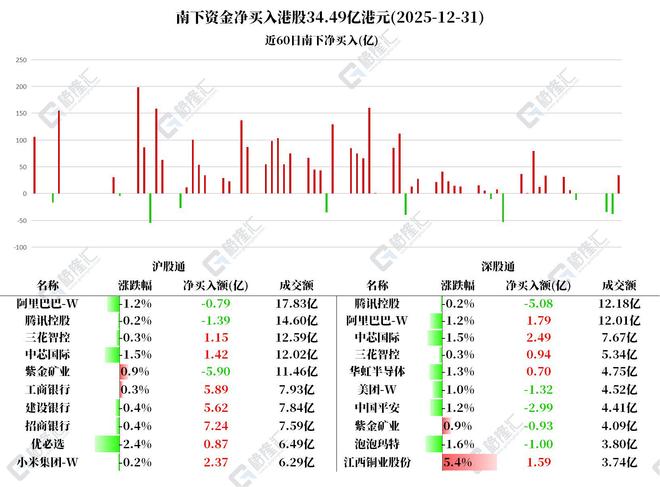
图解丨2025年最后一天,南下资金大举买入中资银行股
Xin Lang Cai Jing· 2025-12-31 12:33
Group 1 - Southbound funds net bought Hong Kong stocks worth 3.449 billion HKD today [1] - The top net purchases included China Merchants Bank at 724 million HKD, Industrial and Commercial Bank of China at 589 million HKD, and China Construction Bank at 562 million HKD [1] - Notable net sales included Zijin Mining at 682 million HKD, Tencent Holdings at 646 million HKD, and China Ping An at 298 million HKD [1] Group 2 - Southbound funds have recorded a continuous net sell of Tencent for five consecutive days, totaling 3.94334 billion HKD [2]



银行业“十五五”展望系列专题(上篇):回眸“十四五”,监管引导和主动求变下的银行经营理念重构
Shenwan Hongyuan Securities· 2025-12-31 11:51
Investment Rating - The report maintains a positive outlook on the banking industry, indicating a "buy" rating for the sector during the "15th Five-Year Plan" period [1]. Core Insights - The banking sector is transitioning from a focus on quantity to quality, emphasizing risk management and efficiency in capital utilization. This shift is driven by the need to support the real economy while managing risks effectively [2][3]. - The report highlights that the return on equity (ROE) for listed banks has remained resilient, averaging around 10%, with city commercial banks leading at 11%-12% ROE, while state-owned banks maintain about 10% [2][3]. - Key changes observed during the "14th Five-Year Plan" include a shift away from scale-driven growth towards a balanced approach between capital and efficiency, a stabilization of net interest margins, and an increased focus on capital markets as a revenue source [2][3]. Summary by Sections 1. From Quantity to Quality - The banking industry has evolved through three five-year plans, with a core transformation focusing on risk and efficiency rather than mere volume [2][3]. 2. High-Quality Development During the "14th Five-Year Plan" 2.1 ROE: Resilience of State-Owned and City Commercial Banks - Listed banks' ROE has slightly declined but remains around 10%, reflecting operational pressures while showcasing resilience [23]. 2.2 Credit: Balancing Capital and Efficiency - The focus has shifted from merely increasing credit volume to optimizing the structure of credit distribution, with significant changes in loan allocation towards technology and green sectors [16][19]. 2.3 Net Interest Margin: Stabilization Efforts - Regulatory support is expected to stabilize net interest margins, which have reached record lows, with proactive measures to prevent further declines [2][3]. 2.4 Risk Management: Provisioning for Stability - The banking sector has moved past peak risk levels, with provisions supporting ROE stability, while new economic challenges require ongoing risk management [2][3]. 2.5 Capital Markets: A New Revenue Stream - Capital market activities have become increasingly important, with banks leveraging these for revenue amidst pressure on interest income [2][3]. 3. Investment Analysis Opinion - The report suggests a focus on stable, high-quality development, with an expectation for bank valuations to return to 1x price-to-book (PB) ratios. It emphasizes a dual strategy of investing in leading banks and quality city commercial banks [3][4].




工行、农行、中行、建行、交行、邮储,集体宣布
2 1 Shi Ji Jing Ji Bao Dao· 2025-12-31 11:49
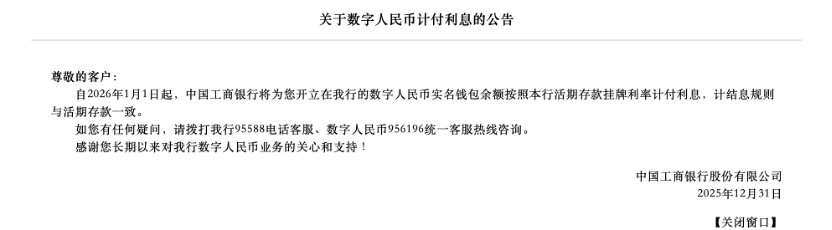
Core Viewpoint - The digital renminbi will officially end its "interest-free era" as major state-owned banks announce that starting January 1, 2026, the balance in real-name digital renminbi wallets will earn interest based on the current deposit rate [1][4][5]. Group 1: Digital Renminbi Interest Policy - Six major state-owned banks, including ICBC, ABC, BOC, CCB, Bank of Communications, and Postal Savings Bank, will implement interest payments on digital renminbi wallet balances according to the current deposit rate [1][4]. - The interest payment policy is a result of the People's Bank of China's recent action plan aimed at enhancing the management and service system for digital renminbi [4][5]. - The new interest mechanism marks the transition of digital renminbi from a "digital cash" to a "digital deposit currency" [5][8]. Group 2: Digital Renminbi Overview - Digital renminbi is a legal digital currency issued by the People's Bank of China, applicable in various scenarios such as transportation, dining, shopping, and public services [6]. - The pilot program for digital renminbi has expanded from select cities to entire provinces, with applications in both consumer and governmental sectors [6]. - As of November 2025, digital renminbi has processed 3.48 billion transactions totaling 16.7 trillion yuan, with 230 million personal wallets opened [7]. Group 3: Future Implications of Interest Payments - The introduction of interest payments changes the liability nature of digital renminbi, making it a liability of commercial banks rather than the central bank, thus aligning it more closely with traditional bank deposits [8]. - This shift is expected to enhance the monetary elasticity of digital renminbi, allowing it to support credit activities and deposit expansion mechanisms [8]. - The future digital renminbi will be a modern digital payment and circulation tool, regulated by the central bank and possessing attributes of commercial bank liabilities [8].





银河金工指数分析系列:市场基准分析:主要单市场指数
Yin He Zheng Quan· 2025-12-31 11:46
- The report focuses on the analysis of single-market indices, including comprehensive indices (e.g., Shanghai Composite Index, Shenzhen Composite Index) and component indices (e.g., SSE 50, ChiNext Index), highlighting their construction principles, industry distribution, and performance characteristics [1][3][50] - Comprehensive indices aim to cover the entire market or a specific segment without subjective selection, reflecting the overall market performance through total market capitalization weighting [3][4][10] - Component indices, such as SSE 50 and ChiNext Index, are constructed by selecting representative stocks based on criteria like market capitalization, liquidity, and industry position, aiming to efficiently reflect the performance of specific stock groups [50][51][52] - Comprehensive indices exhibit "broad coverage, low concentration" characteristics, with diluted individual stock weights due to the large number of constituents, while component indices show "high concentration" in both industry and stock weights, reflecting their focus on large-cap stocks [10][57][62] - The industry distribution of comprehensive indices is relatively balanced, with traditional large-cap sectors like banking having weight advantages, whereas component indices are more concentrated in specific industries, such as technology for ChiNext and banking for SSE 50 [5][53][57] - Market valuation analysis reveals that technology-focused indices (e.g., ChiNext, STAR 50) have higher PE and PB ratios compared to market-wide indices, indicating different pricing logic for growth-oriented sectors [21][65][69] - Performance analysis shows that technology-oriented indices outperformed in 2025 due to structural market trends, but their risk-adjusted returns (e.g., Sharpe ratio) are comparable to market-wide indices due to higher volatility [23][71][83] - Dividend analysis indicates that market-wide indices (e.g., Shanghai Composite, Shenzhen Composite) have higher dividend yields compared to technology-focused indices, reflecting their composition of more mature, dividend-paying companies [41][80][87] - Profitability metrics, such as ROE and net profit growth, show that technology-focused indices generally have higher growth potential but exhibit greater volatility, while market-wide indices demonstrate more stable returns [43][89][93]
2025年中国创投:重拾向上动能,奔赴投资新程
Zheng Quan Shi Bao Wang· 2025-12-31 11:43
Group 1: Industry Recovery and Trends - In 2025, China's venture capital industry emerged from a two-year downturn, showing signs of recovery across the entire investment chain, driven by a combination of funding and project highlights, as well as supportive policies [1] - The year-end activities of venture capitalists indicate a strong return to the industry, fueled by a new wave of technological changes and ongoing policy benefits [1] Group 2: Government Investment Fund Policies - The State Council issued a significant document aimed at promoting the high-quality development of government investment funds, focusing on stricter controls on new fund establishments and optimizing investment policies [2] - Various local governments have responded by issuing supporting policy documents, further regulating the operation of government investment funds to promote high-quality industry development [2] Group 3: Banking Sector Involvement - Since the announcement of expanded pilot programs for bank-affiliated financial asset investment companies (AICs), banks have accelerated their entry into the primary market, with several major banks successfully establishing AICs [3] - As of now, AICs from six major state-owned banks and three national joint-stock banks have been established, with total investments reaching 45.272 billion yuan, a year-on-year increase of approximately 37.7% [3] Group 4: Special Bonds for Government Guidance Funds - Several local governments have issued special bonds to support government guidance funds, breaking the previous norm that prohibited such investments [4] - A total of 52 billion yuan in special bonds have been issued by nine provinces and cities, significantly enhancing the funding pool for the venture capital industry [4] Group 5: Long-Term Government Guidance Funds - New government guidance funds established this year have extended their duration beyond the typical 10 years, with some lasting up to 20 years, providing long-term support for projects [5] - This trend of extending fund durations is expected to create a more patient investment environment, allowing for better exit strategies [5] Group 6: Mergers and Acquisitions - The introduction of policies supporting private equity funds in acquiring listed companies has led to a surge in related acquisition cases, with several venture capital firms actively pursuing stakes in public companies [6][7] - The trend of startups acquiring listed companies is also on the rise, indicating a new strategy for both startups and venture capital firms to explore exit routes [7] Group 7: Domestic PE Firms Acquiring Foreign Brands - Domestic top-tier private equity firms have increasingly acquired the Chinese operations of overseas consumer brands, highlighting a trend of local capital participating in the localization of foreign brands [8] - This trend is driven by the combination of ample funding, local operational expertise, and the stable cash flow of established foreign brands [8] Group 8: Technology Innovation Bonds - The introduction of technology innovation bonds has opened new fundraising channels for venture capital institutions, with several private firms successfully issuing bonds at competitive interest rates [9] - The issuance of these bonds has significantly boosted market confidence and marked a transition towards a more normalized support phase for private venture capital institutions [9] Group 9: Mainland VC/PE Expansion into Hong Kong - Several mainland investment institutions have established offices in Hong Kong, attracted by the region's supportive environment for technological innovation [10] - The Hong Kong government's initiatives, including the establishment of a significant innovation and technology fund, have further encouraged mainland VC/PE firms to expand into the market [10] Group 10: Return of Dollar LPs to China - Multiple venture capital firms have successfully raised dollar-denominated funds, indicating a renewed interest from international investors in the Chinese market [11][12] - The return of dollar LPs coincides with the rapid growth of China's AI industry, highlighting the potential undervaluation of Chinese assets [11][12] Group 11: National Entrepreneurship Investment Fund - The establishment of a "carrier-level" national entrepreneurship investment fund aims to support startups across key economic regions in China, with a focus on early-stage investments [13] - This fund features a long duration of 20 years and aims to provide substantial financial backing to venture capital institutions and startups, enhancing the overall investment landscape [13]