古越龙山

Search documents
需求58万吨,年轻人爱上“战备物资”,有巨头年销800亿
3 6 Ke· 2025-11-24 01:17
Core Insights - The Chinese luncheon meat market is projected to exceed 50 billion yuan by 2026, driven by changing consumer preferences and the rise of domestic brands [1] - Domestic brands are innovating to overcome the negative perceptions of luncheon meat as unhealthy, focusing on health trends and product quality [6][10] Market Overview - The Chinese luncheon meat industry began in 1957, with initial products primarily serving military and export purposes [6] - The market has evolved from being seen as a strategic food resource to a common emergency food, with various brands emerging in the 1980s [6] Consumer Trends - Chinese consumers have historically viewed canned foods, including luncheon meat, with skepticism, associating them with high calories and low nutritional value [1][6] - Recent trends show a shift towards healthier options, with brands reducing salt and fat content while increasing meat content to meet consumer demands [10][12] Brand Innovations - Brands are adopting three main strategies to differentiate themselves: 1. Enhancing product quality by increasing meat content and reducing salt [8][10] 2. Developing new flavors and types, such as beef and fish luncheon meat, to cater to diverse consumer tastes [11] 3. Introducing new product forms like low-temperature luncheon meat, which offers a fresher taste but requires refrigeration [12] Competitive Landscape - The market features a mix of established brands like Zhongliang Meilin and newer entrants like "Zhu Zhangmen," which focus on appealing to younger consumers through innovative marketing and packaging [15] - The influence of international brands like SPAM remains strong, with SPAM's parent company reporting significant sales in China, indicating robust demand for luncheon meat [13] Market Potential - Despite the growth potential, luncheon meat accounts for only 0.57% of total meat consumption in China, compared to 8.7% to 9.6% in the U.S. in 2016, highlighting significant room for market expansion [15]


毕马威:2025年中国黄酒产业中期研究报告
Sou Hu Cai Jing· 2025-11-23 18:02
Core Insights - The report analyzes the current state, market environment, consumer characteristics, and future direction of the Huangjiu industry in China, highlighting its transition period between tradition and innovation, facing both challenges and opportunities from policies and market dynamics [1][2]. Industry Overview - Huangjiu production is widespread across China, with a concentration in the Jiangsu, Zhejiang, and Shanghai regions, particularly in Shaoxing, which is recognized as the "Hometown of Huangjiu" [15]. - Leading companies such as Guyue Longshan and Kuaijishan are driving industry development, with a focus on high-end and innovative products to attract younger consumers [15][2]. Market Performance (2024-2025) - The Huangjiu industry is expected to see a rise in both volume and price, with total revenue projected to reach 20 billion yuan in 2024, reflecting a 5.26% increase year-on-year [21]. - The three A-share Huangjiu listed companies reported a combined revenue of 4.146 billion yuan in 2024, marking a 10% increase from the previous year [22]. - Online sales for the top three companies surged by 42.3% year-on-year, indicating a strong shift towards e-commerce channels [26]. Market Environment - Continuous policy support has been observed, with Huangjiu being recognized as a classic industry, leading to various local governments implementing supportive measures [2]. - Major companies have collectively raised prices, enhancing the revenue share of mid-to-high-end products [2]. Consumer Insights - Male consumers dominate the market, accounting for 68.7%, with the primary age group being over 25 years old [2]. - Consumption scenarios primarily include social gatherings and family meals, with health and wellness being key motivators for purchasing decisions [2]. Future Development Suggestions - The report suggests several strategies for the Huangjiu industry, including leveraging traditional techniques for product innovation, enhancing brand culture, and promoting national and international expansion [2]. - The industry faces challenges in internationalization, particularly in cultural differences and channel development, necessitating a collaborative effort across the sector [2].



不在办公室就在烧烤摊,年销2万吨啤酒,他的方法是什么?|千商访谈
Sou Hu Cai Jing· 2025-11-22 04:43
Core Insights - The article highlights the entrepreneurial journey of Bai Xuejun, who has over 40 years of experience in the liquor industry, emphasizing the importance of practical action, market presence, and strategic thinking in achieving success [3][5][16] Group 1: Entrepreneurial Journey - Bai Xuejun started from a poor background and faced significant challenges, including dropping out of school due to financial constraints, but he persevered and gradually built a successful liquor business [7][8] - His initial foray into the market involved selling low-cost beverages and later transitioning to logistics for breweries, which laid the foundation for his future success in the liquor industry [7][8] - Bai's innovative approach to business included recycling beer bottles and establishing a supply chain, which allowed him to become a key supplier for local breweries [7][11] Group 2: Market Strategy - Bai Xuejun's strategy involved direct engagement with the market, where he visited stores and built relationships with local business owners to understand their needs and drive product sales [9][10] - He implemented a successful promotional campaign by offering free tastings of his products, which significantly boosted sales and market penetration in his region [10][11] - His company, Bai's Liquor Store, became the largest beer distributor in the Linyi area, selling approximately 20,000 tons of Qingdao beer annually, and was recognized as a benchmark case by Qingdao Beer at national distributor conferences [11][12] Group 3: Industry Insights - Bai Xuejun has shown a keen ability to identify market trends, such as the rising popularity of yellow wine among younger consumers, and has secured new agency contracts to capitalize on this growth [12][13] - His understanding of the liquor market's dynamics, including the importance of supply chain management and sales strategies, has positioned his business favorably amidst industry changes [11][16] - Bai's unique approach, termed "Bai's Military Strategy," combines supply chain management, market presence, and trend forecasting, serving as a practical model for other liquor businesses facing industry challenges [16]

茅台1935动销猛增!吃喝板块韧性彰显,食品ETF(515710)显著跑赢沪指!左侧布局时机浮现?
Xin Lang Ji Jin· 2025-11-21 11:38
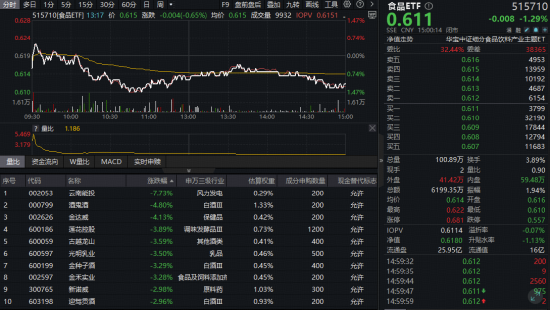
Core Viewpoint - The food and beverage sector demonstrates resilience amid market corrections, with the food ETF (515710) showing fluctuations in performance, reflecting the overall market sentiment [1][3]. Group 1: Market Performance - The food and beverage sector ranks among the top three in performance across 30 CITIC primary industries, despite a broader market downturn [1]. - The food ETF (515710) experienced a decline of 1.29% by the end of the trading day, after an initial rise [1][2]. - Key stocks such as Yunnan Energy Investment fell by 7.73%, while others like Jiu Gui Jiu and Jin Da Wei dropped over 4%, negatively impacting the sector's overall performance [1][2]. Group 2: Sales and Demand Insights - Recent research indicates that Moutai 1935 has seen over 20% year-on-year sales growth in several markets since Q3, with some areas reporting growth exceeding 30% [1][3]. - High opening rates and positive feedback from distributors suggest strong recognition of the product in both distribution and consumer channels [3]. Group 3: Valuation and Investment Opportunities - The food and beverage sector is currently at a historical low in terms of valuation, presenting a potential opportunity for left-side positioning [3]. - As of November 20, the food ETF's underlying index had a price-to-earnings ratio of 21, placing it in the lower 10.2% percentile over the past decade, indicating favorable long-term investment potential [3]. - Analysts predict that the food and beverage sector will experience a shift from valuation recovery to performance-driven growth starting in 2026, with expectations of improved earnings across various segments [4]. Group 4: Sector Composition and Focus - The food ETF (515710) tracks the CSI sub-index for the food and beverage industry, with approximately 60% of its holdings in leading high-end and mid-range liquor stocks, and nearly 40% in other segments like beverages and dairy [5]. - Key stocks in the ETF include major brands such as Moutai, Wuliangye, and Yili, indicating a strong focus on established market leaders [5].


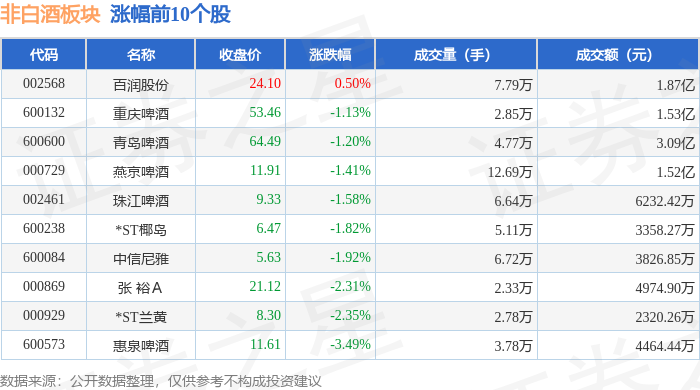
非白酒板块11月21日跌1.81%,会稽山领跌,主力资金净流出1.55亿元
Zheng Xing Xing Ye Ri Bao· 2025-11-21 09:33
Market Overview - The non-liquor sector experienced a decline of 1.81% on November 21, with Kuaijishan leading the drop [1] - The Shanghai Composite Index closed at 3834.89, down 2.45%, while the Shenzhen Component Index closed at 12538.07, down 3.41% [1] Stock Performance - Kuaijishan (601579) saw a significant drop of 5.97%, closing at 20.94 with a trading volume of 169,100 shares and a turnover of 368 million yuan [2] - Other notable declines include: - Caogao Co. (600543) down 5.81% to 6.00 - ST Xifa (000752) down 4.99% to 11.61 - Weilang Co. (603779) down 4.18% to 6.87 [2] Capital Flow - The non-liquor sector experienced a net outflow of 155 million yuan from institutional investors, while retail investors saw a net inflow of 116 million yuan [2] - The capital flow for specific stocks includes: - Zhongxin Niya (600084) with a net inflow of 2.65 million yuan from retail investors [3] - Zhang Yu A (000869) with a net outflow of 3.54 million yuan from retail investors [3] - Kuaijishan (601579) had a significant net outflow of 799.52 million yuan from institutional investors [3]
产品、营销玩法频出 跨界混搭能成黄酒出圈正解吗
Bei Jing Shang Bao· 2025-11-20 13:45
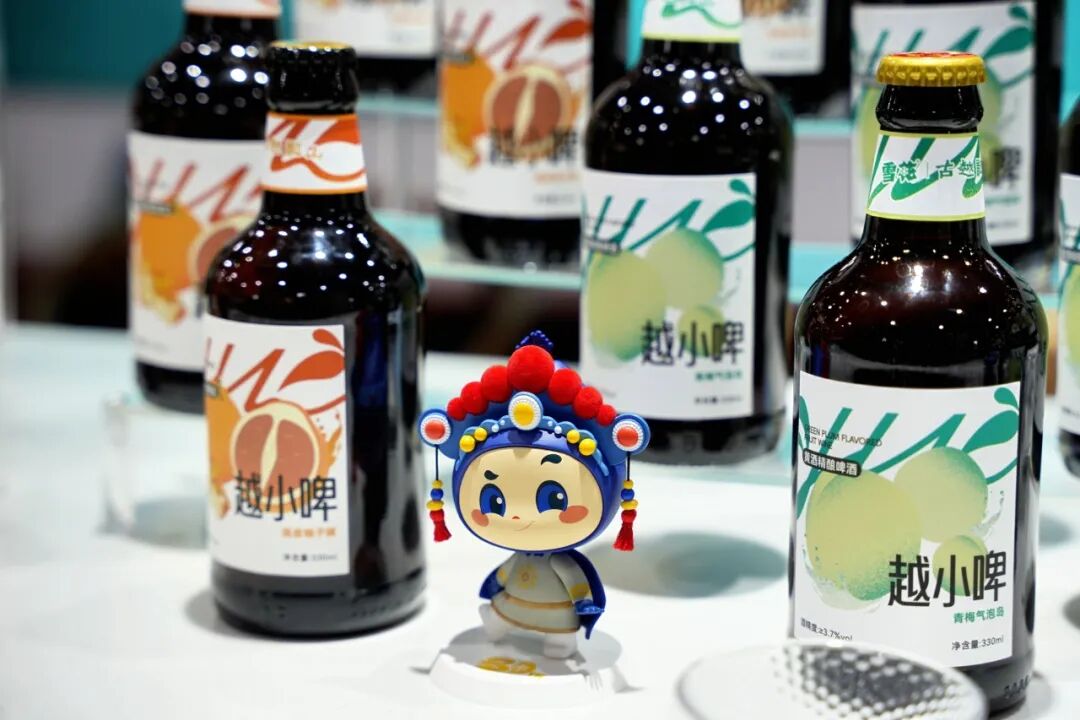
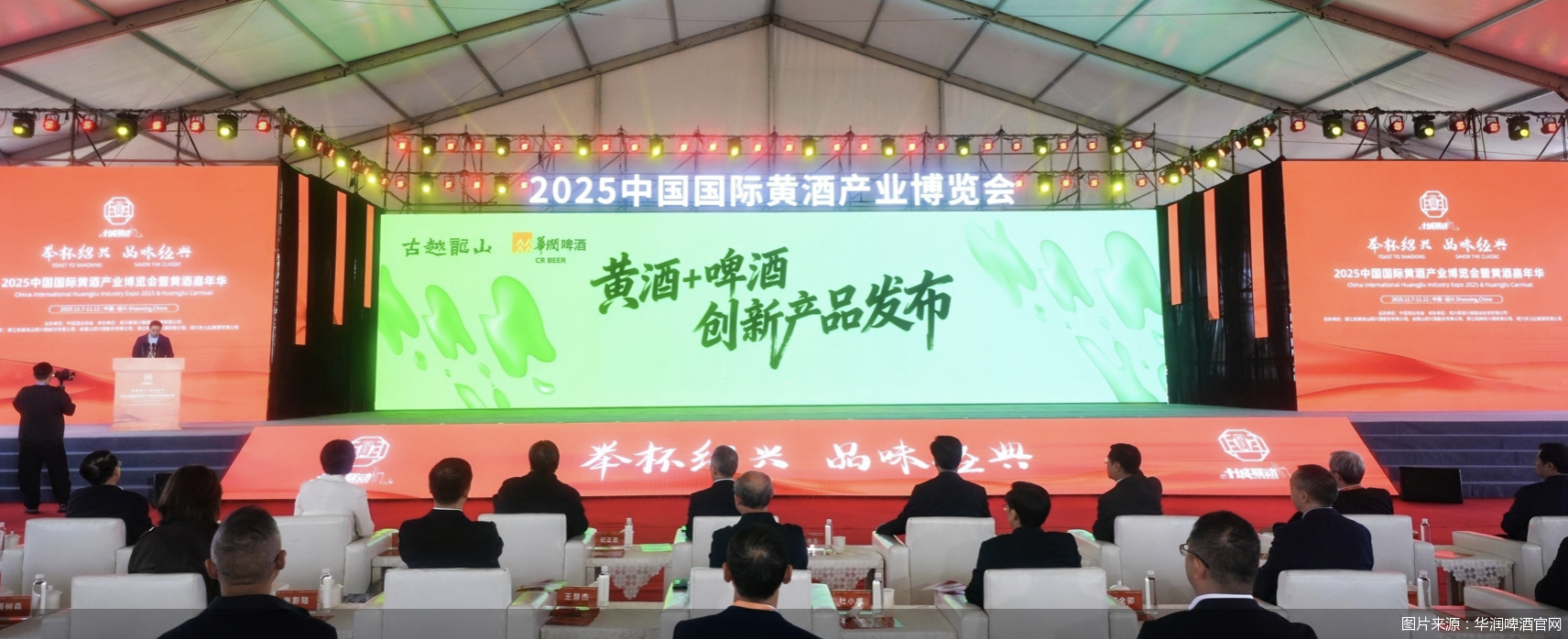
Core Insights - The traditional yellow wine industry is at a transformative crossroads, with leading brands exploring cross-industry collaborations to expand their consumer market [1][3] - The industry faces multiple challenges, including limited consumption regions and scenarios, prompting companies to seek new growth opportunities through innovative partnerships [1][6] Group 1: Industry Trends - Major yellow wine brands like Guyue Longshan and Kuaijishan are actively engaging in cross-industry collaborations, such as the launch of "Yue Xiao Pi" in partnership with China Resources Beer [3][4] - Guyue Longshan has introduced various innovative products, including coffee-infused yellow wine and a whiskey variant, indicating a shift towards younger consumer preferences [4][10] - The yellow wine market is experiencing a trend towards diversification, with brands exploring new consumption scenarios beyond traditional settings [4][9] Group 2: Market Dynamics - The yellow wine market is highly concentrated, with the Jiangsu, Zhejiang, and Shanghai regions accounting for over 70% of sales, leading to intense competition [6][7] - Financial reports reveal that Guyue Longshan and Kuaijishan derive a significant portion of their revenue from these regions, highlighting the geographical limitations of the market [6][7] - Despite the challenges, the yellow wine industry is projected to grow, with sales expected to exceed 300 billion yuan by 2025, driven by a shift in consumer preferences towards lower-alcohol beverages [9][10] Group 3: Consumer Engagement - Marketing experts suggest that yellow wine brands should enhance their appeal to younger consumers through innovative marketing strategies, including social media and influencer collaborations [5][11] - The emergence of "slow bars" and other experiential venues is seen as a way to engage consumers and gather valuable data on preferences and behaviors [10][11] - The industry must address the perception issues surrounding yellow wine, which has been labeled as "cooking wine," to improve brand recognition and value [7][8]
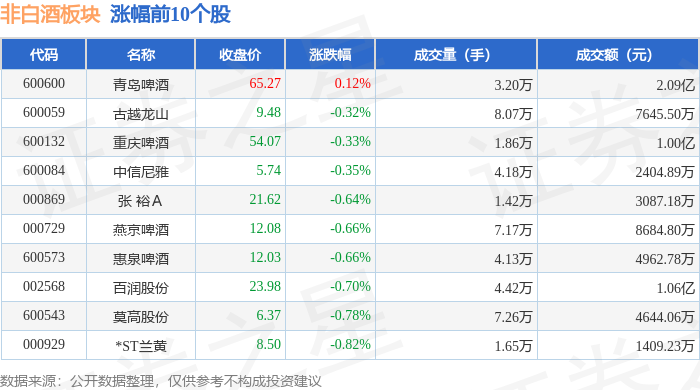
非白酒板块11月20日跌0.59%,会稽山领跌,主力资金净流出7488.33万元
Zheng Xing Xing Ye Ri Bao· 2025-11-20 09:09
Core Points - The non-liquor sector experienced a decline of 0.59% on the trading day, with Kuaijishan leading the drop [1] - The Shanghai Composite Index closed at 3931.05, down 0.4%, while the Shenzhen Component Index closed at 12980.82, down 0.76% [1] Non-Liquor Sector Summary - Kuaijishan (601579) closed at 22.27, down 2.15%, with a trading volume of 99,600 shares and a transaction value of 222 million yuan [2] - Other notable declines include ST Xifa (000752) down 2.00% and ST Yedao (600238) down 1.49% [2] - The overall net capital flow for the non-liquor sector showed a net outflow of 74.88 million yuan from main funds, while retail investors saw a net inflow of 78.72 million yuan [2]
东方财富证券:食品饮料加速出清 板块投资价值有望提升
智通财经网· 2025-11-19 08:11
Core Viewpoint - The report from Dongfang Caifu Securities indicates that the supply-demand mismatch in 2024 will lead to deteriorating industry operations, but as companies gradually lower growth targets to adapt to demand in 2025, this will alleviate supply-demand conflicts and enhance investment value in the sector. The expectation is for positive growth in financial statements by the second or third quarter of next year [1]. Group 1: Industry Overview - In Q1-Q3 2025, under weak demand, industry revenue showed slight growth while profits were under pressure, with the food and beverage sector experiencing a revenue decline of -4.9% and a net profit drop of -14.6% in Q3 2025 [1]. - Traditional consumption is hindered by slow recovery in consumption scenarios, with the liquor sector, particularly baijiu, facing accelerated clearance and weak performance in beer demand [1]. - Sectors like snacks and beverages that have opportunities for new product launches and channel expansion continue to show positive momentum, with products like konjac experiencing rapid growth since 2024 [1]. Group 2: Category Analysis and Outlook - **Baijiu**: The industry is accelerating clearance with clearer turning points. In Q3 2025, overall revenue and net profit declined by -18.4% and -22.2% respectively, but demand is expected to improve, stabilizing prices and leading to better financial performance by Q2 2026 [2]. - **Low-Alcohol Beverages and Beer**: Beer revenue and net profit grew by +2.0% and +11.8% respectively in Q3 2025, with cost advantages continuing. Demand recovery is anticipated in 2026, influenced by changes in retail channels [3]. - **Dairy Products**: The raw milk sector is gradually bottoming out, with demand expected to stabilize and prices recover. The low-temperature fresh milk segment is projected to grow, replacing some ambient milk [4]. - **Snacks**: Categories like konjac and oats are expected to maintain high growth, with a shift towards emerging channels and significant growth in instant retail [4]. Group 3: Investment Recommendations - **Baijiu**: Focus on companies that are clearing inventory early and have strong brand momentum, such as Gujing Gongjiu and Luzhou Laojiao, as well as those with strong product matrices and channel capabilities like Moutai and Wuliangye [5]. - **Low-Alcohol Beverages**: Highlighting head companies like Kweichow Moutai and Qingdao Beer, which are expected to benefit from demand recovery [5]. - **Dairy and Snacks**: Emphasizing the potential for recovery in the raw milk sector and recommending companies like Yili and Mengniu, as well as snack companies that can leverage product and channel adjustments [6].

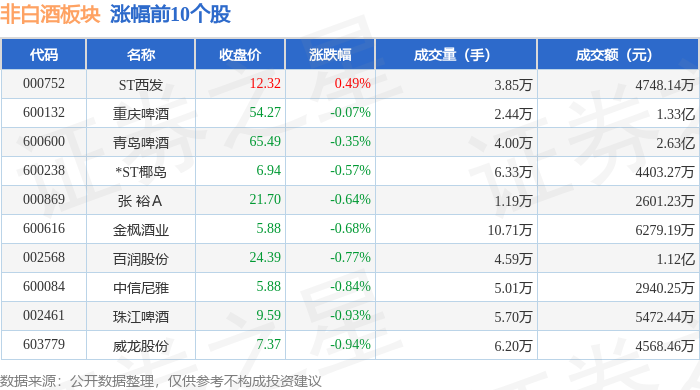
非白酒板块11月18日跌0.95%,燕京啤酒领跌,主力资金净流出1.09亿元
Zheng Xing Xing Ye Ri Bao· 2025-11-18 08:04
Market Overview - The non-liquor sector experienced a decline of 0.95% on November 18, with Yanjing Beer leading the drop [1] - The Shanghai Composite Index closed at 3939.81, down 0.81%, while the Shenzhen Component Index closed at 13080.49, down 0.92% [1] Stock Performance - Key stocks in the non-liquor sector showed varied performance, with ST Xifa closing at 12.32, up 0.49%, while other notable declines included Caijing Beer down 2.41% to 12.14 and Huichuan Beer down 2.41% to 12.15 [2] - The trading volume and turnover for selected stocks indicated significant activity, with Chongqing Beer recording a turnover of 1.33 billion and ST Xifa at 47.48 million [1][2] Capital Flow - The non-liquor sector saw a net outflow of 109 million from major funds, while retail investors contributed a net inflow of 115 million [2] - Detailed capital flow data showed that ST Xifa had a net inflow of 671,900 from major funds, while other stocks like ST Yedao experienced significant outflows [3]


古越龙山有点“啤”,跨界混搭会是突围正解吗?
Xin Lang Cai Jing· 2025-11-14 02:55
Core Viewpoint - The collaboration between Guyue Longshan and China Resources Beer to launch "Yue Xiao Pi" represents a strategic attempt to innovate and attract younger consumers in the face of declining performance and increasing competition in the yellow wine market [1][8]. Group 1: Product Launch and Features - "Yue Xiao Pi" is a cross-category product that combines elements of yellow wine and beer, featuring two flavors: Qingmei Sparkling Island and Chenpi Pomelo Shop, with an alcohol content of ≥3.7% vol [3][4]. - The product aims to appeal to younger consumers by adopting a lighter drinking style and modern packaging similar to beer bottles, moving away from the traditional heavy perception of yellow wine [4][10]. - Previous attempts at product innovation include the launch of a craft yellow beer that generated over 10 million yuan in orders within the first month, although it has since become less visible on major e-commerce platforms [4][7]. Group 2: Market Performance and Competition - Guyue Longshan's recent financial performance shows a decline, with a revenue drop of 8.11% and a net profit decrease of 34.07% in the first three quarters of the year, leading to a loss of its position as the leading yellow wine brand to Kuaijishan [8][10]. - Over the past decade, Kuaijishan has outpaced Guyue Longshan in growth, with Kuaijishan's revenue increasing from 859 million yuan to 1.631 billion yuan, a growth rate of approximately 8.99%, compared to Guyue Longshan's 4.47% [8][10]. - The competitive landscape is intensifying, with Kuaijishan launching innovative products like sparkling yellow wine and leveraging social media for marketing, prompting Guyue Longshan to follow suit with its own new offerings [10][11]. Group 3: Strategic Partnerships and Future Outlook - The partnership with China Resources Beer is seen as a strategic move for Guyue Longshan to leverage the latter's extensive distribution network and operational expertise to expand its market reach beyond its traditional base in Jiangsu, Zhejiang, and Shanghai [10][11]. - The collaboration has generated positive market reactions, with Guyue Longshan's stock price rising following the announcement, indicating investor optimism about the potential success of the cross-category product [10][11]. - Industry analysts emphasize that the success of "Yue Xiao Pi" will depend on effective channel management and whether the partnership can translate the beer channel's advantages into increased sales for yellow wine [10][15].