
长安汽车

Search documents
研报掘金丨长江证券:维持长安汽车“买入”评级,回购计划开启凸显公司发展前景
Ge Long Hui A P P· 2026-02-12 07:53
Group 1 - The core viewpoint of the article highlights that Changan Automobile's share repurchase plan underscores the company's growth prospects and strengthens investor confidence [1] - The repurchase plan includes a minimum of 700 million yuan and a maximum of 1.4 billion yuan for A-shares, and a minimum of 300 million yuan and a maximum of 600 million yuan for B-shares [1] - The repurchase is based on the company's strong confidence in its strategic development and intrinsic value, aiming to enhance shareholder rights and increase earnings per share [1] Group 2 - Changan Automobile is actively developing intelligent driving technologies and is strategically positioning itself in robotics and flying car businesses to build future competitiveness [1] - The company has strong capabilities in product development and is undergoing a transformation towards electric and intelligent vehicles, with rapid overseas expansion [1] - The acceleration of the electric and intelligent transformation is expected to drive sales growth, with projected net profits of 5.16 billion yuan and 7.59 billion yuan for 2025 and 2026, respectively, corresponding to PE ratios of 21.5 and 14.7 [1]

阿维塔IPO遭证监会六连问 股权转让瑕疵是否成上市“绊脚石”?
Xin Lang Cai Jing· 2026-02-12 07:25
来源:新浪财经 随着智能汽车收集用户数据能力的增强,证监会还特别询问了阿维塔在数据安全方面的安排,包括开 发、运营的网站、小程序、APP、公众号等产品情况,是否涉及向第三方提供信息内容,以及采取了哪 些信息内容安全保护措施。 日前,证监会向正在筹备香港上市的阿维塔发出一份涉及六大领域的备案反馈意见,对这家号称"央企 新能源第一股"的企业展开了全面问询。 监管函件中,证监会明确要求阿维塔就股权合规、控制权认定、股权激励、业务合规性、外资准入和数 据安全等关键问题补充说明并出具法律意见,每项问题直指企业上市的合规性核心。 阿维塔历次增资及股权转让是否合法合规、对价是否公允的问题,被重点问询。监管特别关注的是1元 或零对价转让股权的情形,要求公司说明交易真实性,以及是否存在股权代持。同一批次入股价格不一 致的问题,也被要求说明合理性,核查是否存在利益输送。 这种对历史股权变动合规性的严格审查,显示出监管对阿维塔作为央企背景企业上市的特殊关注。 阿维塔在控制权认定上出现了备案材料和招股说明书之间的重大差异,引发了监管层的重点关注。 招股书披露,现在的控股股东为长安汽车和中国长安汽车集团,上市后的控股股东则包括中国长安 ...
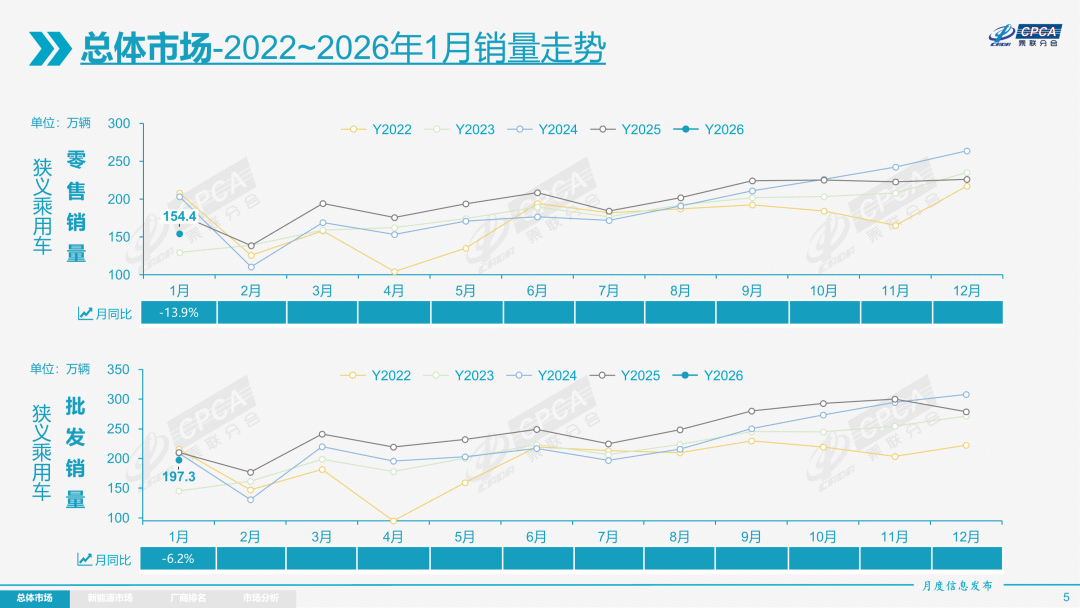
乘联分会:1月全国乘用车市场零售154.4万辆 新能源车渗透率为38.6%
智通财经网· 2026-02-12 06:41
Core Insights - The overall retail sales of passenger cars in January decreased by 13.9% year-on-year, with a total of 1.544 million units sold. The retail sales of new energy vehicles (NEVs) reached 596,000 units, representing a penetration rate of 38.6%, down 3 percentage points from the previous year [1][11]. Retail Market Overview - In January, the retail sales of self-owned fuel passenger cars were 250,000 units, up 17% year-on-year, while self-owned NEVs sold 226,000 units, marking a significant increase of 115%. NEVs accounted for 47.5% of self-owned exports, indicating growing international influence [2]. - The retail sales of self-owned brands totaled 890,000 units, down 18% year-on-year, with a domestic market share of 57.5%, a decrease of 3.5 percentage points [2]. - Mainstream joint venture brands sold 470,000 units, down 4% year-on-year, with German brands increasing their market share to 19.8%, up 1.4 percentage points [2]. Production and Wholesale Analysis - In January, the production of passenger cars was 2.003 million units, down 4.4% year-on-year. The wholesale volume was 1.973 million units, a decrease of 6.2% year-on-year [4]. - The wholesale of self-owned brands was 1.326 million units, down 8%, while luxury car wholesale increased by 4% to 228,000 units [4]. - The overall wholesale landscape is changing, with some mid-tier companies showing strong performance, such as SAIC-GM-Wuling and NIO [4]. New Energy Vehicle Insights - The production of NEVs reached 938,000 units, a slight decrease of 0.6% year-on-year, while wholesale sales were 864,000 units, down 3.3% [5][6]. - NEV retail sales were 596,000 units, down 20% year-on-year, with conventional fuel vehicles selling 948,000 units, down 10% [7]. - NEV exports reached 286,000 units, a remarkable increase of 103.6%, accounting for 49.6% of total passenger car exports [11][12]. Market Trends and Future Outlook - The new energy vehicle market is expected to face challenges in February due to the impact of the Spring Festival, which may lead to lower sales volumes [16]. - The transition from merely selling cars to exporting entire industrial chains is anticipated, indicating a shift towards quality growth in the automotive export sector [17].





乘联分会:1月新能源乘用车出口28.6万辆,同比增长103.6%
Xin Lang Cai Jing· 2026-02-12 06:19
2月12日,乘联分会数据显示,1月新能源乘用车出口28.6万辆,同比增长103.6%。占乘用车出口 49.6%,较去年同期增长12.5个百分点;其中纯电动占新能源出口的65%(去年同期67%),作为核心焦 点的A00+A0级纯电动车占纯电动出口的50%(去年同期41%)。伴随着中国新能源车的规模优势显现 和市场扩张需求,中国制造的新能源品牌产品越来越多地走出国门,在海外的认可度持续提升。其中插 混占新能源出口的33%(去年同期32%),虽然近期受到外部国家的一些干扰,但自主插混出口发展中 国家增长迅猛,前景光明。 1月厂商新能源出口方面优秀的企业是:比亚迪汽车(96,859辆)、特斯拉中国(50,644辆)、吉利汽车 (32,117辆)、奇瑞汽车(27,033辆)、零跑汽车(14,523辆)、上汽乘用车(13,071辆)、上汽通用五 菱(11,097辆)、东风汽车(6,745辆)、长城汽车(6,102辆)、长安汽车(4,952辆)、光束汽车 (3,713辆)、长安马自达(3,391辆)、沃尔沃亚太(3,316辆)、小鹏汽车(3,204辆)、极星汽车 (2,758辆)、赛力斯汽车(湖北)(2,108辆)、智马达 ...
【月度分析】2026年1月份全国乘用车市场分析
乘联分会· 2026-02-12 06:06
Overall Market - In January 2026, the retail sales of passenger cars reached 1.544 million units, a year-on-year decrease of 13.9% [14] - The decline in retail sales is attributed to complex market factors and a historical pattern of fluctuating sales in January [14] - The end of the new energy vehicle purchase tax exemption in December 2025 has led to a recovery period for the new energy vehicle market, with some consumers having made purchases in December to take advantage of the policy [14] - January 2026 saw a significant increase in exports, with passenger car exports reaching 576,000 units, a year-on-year increase of 52.0% [16] - The production of passenger cars in January 2026 was 2.003 million units, a year-on-year decrease of 4.4% [16] - The wholesale volume for January 2026 was 1.973 million units, a year-on-year decrease of 6.2% [17] New Energy Market - In January 2026, retail sales of new energy vehicles (NEVs) totaled 596,000 units, down 20.0% year-on-year [18] - The penetration rate of NEVs in the domestic market was 38.6%, while the export penetration rate was 49.6% [15] - The production of NEVs reached 938,000 units, a slight decrease of 0.6% year-on-year [18] - The wholesale volume of NEVs was 864,000 units, down 3.3% year-on-year [18] - The export of NEVs reached 286,000 units, a significant increase of 103.6% year-on-year, accounting for 49.6% of total passenger car exports [22] Company Performance - BYD, Geely, and Chery are leading in the new energy vehicle market, with BYD's sales reaching 205,518 units in January 2026 [24] - The market share of domestic brands in the new energy sector is increasing, with a notable rise in the export of new energy vehicles to Europe and Southeast Asia [15][22] - The new energy vehicle market is characterized by a shift towards higher quality products, with an increase in the proportion of high-end NEVs [15] Market Outlook - February 2026 is expected to see lower sales due to the shorter working days caused by the extended Spring Festival holiday [27] - The market is anticipated to stabilize post-holiday, with potential recovery in the entry-level electric vehicle segment [28] - The overall sentiment in the consumer market remains cautious, influenced by high costs and economic factors [28]



宁德时代上涨,据报计划联合长安汽车于年内快速落地多款纳电车型
Zhi Tong Cai Jing· 2026-02-12 05:44
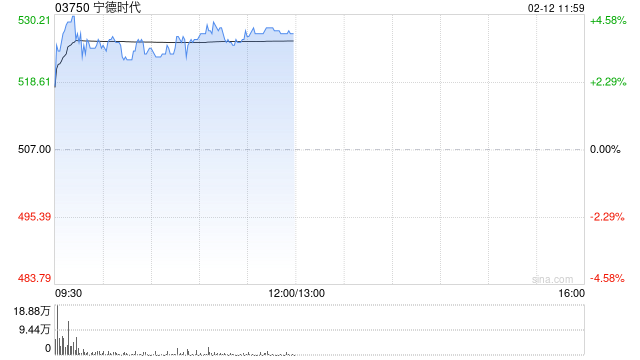
Core Viewpoint - CATL (03750) shares rose over 4%, reaching HKD 527.5 with a trading volume of HKD 8.82 billion, following the announcement of sodium-ion battery collaboration with Changan Automobile [1][1]. Group 1: Company Developments - CATL's CTO Gao Huan revealed that the sodium-ion battery cells have an energy density of up to 175 Wh/kg, enabling electric vehicles to achieve a range exceeding 400 kilometers, with future upgrades potentially reaching 500-600 kilometers [1][1]. - The company plans to establish 3,000 battery swap stations across over 140 cities this year, in collaboration with Changan Automobile, aiming to launch multiple sodium-ion models by 2026 [1][1]. Group 2: Industry Insights - As of February 12, lithium carbonate futures surged to 150,000 CNY/ton, indicating a shift in lithium demand dynamics, with energy storage becoming a core growth driver for lithium battery demand [1][1]. - UBS suggests that the industry is approaching a critical point regarding cost, range, and charging time, where declining costs could stimulate end-user consumption, creating a positive cycle of "technological cost reduction—demand expansion—resource value reassessment" [1][1].
港股午评:恒指跌0.89%险守27000点、科指跌1.68%,科网股,影视娱乐股调整,AI应用概念股走势分化,电力股拉升,中石化创新高!
Jin Rong Jie· 2026-02-12 04:10
Market Overview - The Hong Kong stock market experienced a collective decline, with the Hang Seng Index down 0.89% to 27,024.06 points, the Hang Seng Tech Index down 1.68% to 5,407.59 points, and the China Enterprises Index down 0.96% to 9,179.06 points [1] - Major technology stocks fell, including Alibaba down 2.12%, Tencent down 2.65%, and Meituan down 4.16% [1] Sector Performance - AI application stocks showed resilience, with Zhiyuan (智谱) surging over 33% after the release of its new flagship model GLM-5, which achieved state-of-the-art performance [2] - New energy and resource stocks were active, with CATL (宁德时代) rising over 4% due to a partnership with Changan Automobile to introduce sodium-ion batteries [2] - Precious metals and mining stocks also saw gains, with Zijin Mining (紫金矿业) up over 4% after a target price upgrade from Citigroup [2] Individual Stock Movements - Capital Airport (首都机场) fell over 3% due to a negative earnings forecast, with expected net losses for 2025 reaching 600 to 760 million yuan [3] - Budweiser APAC (百威亚太) dropped over 4% as its 2025 revenue is projected to decline by 7.7% [3] - Dongfeng Motor Group (东风集团股份) rose over 3% after meeting all conditions for privatization and the spin-off of its Lantu brand [3] Institutional Insights - Analysts noted that the market is in a phase of volume contraction, with a focus on structural opportunities in essential retail and tech hardware sectors [4] - Despite inflows from southbound funds, the overall trading volume in the Hong Kong market remains low, indicating a cautious market sentiment [4] - The Hang Seng Index is currently at a historical low valuation, with a PE ratio of only 12 times, suggesting potential for a rebound in quality stocks that have been oversold [4]
宁德时代午前涨逾4% 据报计划联合长安汽车于年内快速落地多款纳电车型
Xin Lang Cai Jing· 2026-02-12 04:01
Group 1 - The core point of the article is that CATL (宁德时代) has seen a stock price increase of 3.95% to 527 HKD, driven by the introduction of sodium-ion batteries in collaboration with Changan Automobile, which will launch sodium battery passenger vehicles across multiple brands [1][4]. - CATL's sodium-ion battery cells have a maximum energy density of 175 Wh/kg, allowing pure electric models to achieve a range exceeding 400 kilometers, with future upgrades potentially reaching 500-600 kilometers, and hybrid models exceeding 300-400 kilometers [1][4]. - CATL plans to establish 3,000 battery swap stations in over 140 cities this year and aims to rapidly launch multiple sodium battery models with Changan Automobile by 2026 [1][4]. Group 2 - As of February 12, lithium carbonate futures reached a peak of 150,000 CNY per ton, indicating a significant demand for lithium resources [1][4]. - Analysts suggest that energy storage is becoming the core incremental demand for lithium batteries, with solid-state batteries expected to enhance lithium consumption per battery due to their energy density and safety advantages [1][4]. - UBS believes the industry is approaching a critical point regarding cost, range, and charging time, where declining costs will stimulate end-user consumption, creating a virtuous cycle of "technological cost reduction—demand expansion—resource value reassessment" [1][4].
港股异动 | 宁德时代(03750)午前涨超4% 据报计划联合长安汽车于年内快速落地多款纳电车型
智通财经网· 2026-02-12 03:48
Core Viewpoint - CATL (Ningde Times) has seen a stock increase of over 4%, currently trading at 527.5 HKD, with a transaction volume of 8.82 billion HKD, following the announcement of a partnership with Changan Automobile to introduce sodium-ion batteries in passenger vehicles [1] Group 1: Company Developments - CATL's CTO Gao Huan revealed that the energy density of their sodium-ion battery cells can reach up to 175 Wh/kg, enabling pure electric vehicles to achieve a range exceeding 400 kilometers, with future upgrades potentially reaching 500-600 kilometers [1] - The company plans to establish 3,000 battery swap stations across over 140 cities this year, in collaboration with Changan Automobile, aiming to launch multiple sodium-ion models by 2026 [1] Group 2: Market Context - As of February 12, lithium carbonate futures surged to 150,000 CNY/ton, indicating a strong demand for lithium driven by energy storage solutions replacing electric vehicles as the core growth driver [1] - UBS suggests that the industry is approaching a critical point regarding cost, range, and charging time, where declining costs will stimulate end-user consumption, creating a positive cycle of "technological cost reduction—demand expansion—resource value reassessment" [1]
宁德时代午前涨超4% 据报计划联合长安汽车于年内快速落地多款纳电车型
Zhi Tong Cai Jing· 2026-02-12 03:47
Core Viewpoint - Contemporary Amperex Technology Co., Limited (CATL) has seen a stock increase of over 4%, currently trading at 527.5 HKD, with a transaction volume of 8.82 billion HKD, following the announcement of a partnership with Changan Automobile to introduce sodium-ion batteries in passenger vehicles [1] Group 1: Company Developments - CATL's Chief Technology Officer, Gao Huan, announced that the energy density of their sodium-ion battery cells can reach up to 175 Wh/kg, enabling electric vehicles to achieve a range exceeding 400 kilometers, with future upgrades potentially reaching 500-600 kilometers [1] - The company plans to establish 3,000 battery swap stations across over 140 cities this year, in collaboration with Changan Automobile, aiming to launch multiple sodium-ion models by 2026 [1] Group 2: Industry Insights - As of February 12, lithium carbonate futures surged to 150,000 CNY per ton, indicating a strong demand for lithium driven by energy storage solutions replacing electric vehicles as the core growth driver [1] - UBS analysts suggest that the industry is approaching a critical point regarding cost, range, and charging time, where declining costs could stimulate end-user demand, creating a positive cycle of "technological cost reduction—demand expansion—resource value reassessment" [1]