华为

Search documents
迈入“产品共创”新阶段,华为乾崑与阿维塔共同进驻工厂
Guan Cha Zhe Wang· 2026-01-20 09:45
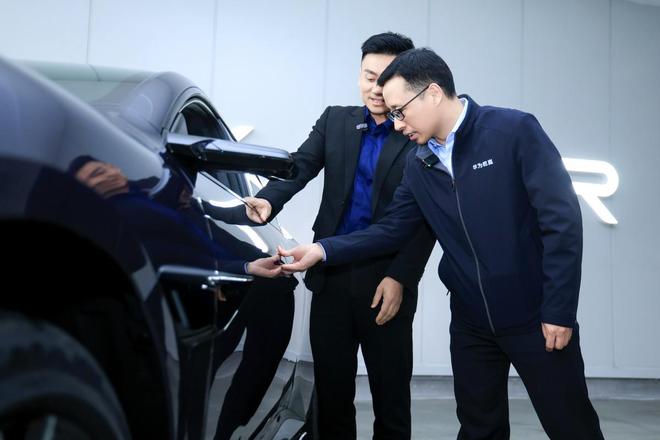
Group 1 - The core viewpoint of the article highlights the strategic collaboration between Huawei and Avita, marking a transition from product development to practical implementation [1][3] - The partnership began in 2022, focusing on areas such as intelligent driving and smart cockpit, with significant product launches in 2023, including Avita 11 and Avita 12 [3] - The collaboration has now upgraded to phase 2.0 in 2024, expanding from single technology integration to deeper joint development and system collaboration [3] Group 2 - The newly unveiled Avita 12 is the first product resulting from the upgraded strategic partnership, featuring Huawei's latest "Four Laser" intelligent driving solution [5] - The Avita 12 includes systematic upgrades in perception hardware, chassis control, safety redundancy, and overall vehicle intelligence, showcasing a new design with a semi-open door handle for enhanced emergency response [5] - During a factory visit, executives from both companies engaged in production, calibration, and validation processes, with Huawei's CEO noting significant improvements in the overall completeness of the new Avita 12 compared to previous models [5]

王腾新公司成立14天获数千万融资,资方阵容强大但没小米
Xin Lang Cai Jing· 2026-01-20 09:38
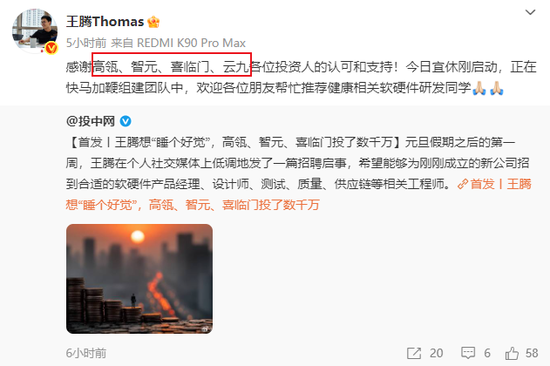
Core Viewpoint - Wang Teng, former General Manager of Xiaomi's China Marketing Department, has founded a new company named "Today Yixiu," focusing on sleep health products, and has recently completed a seed round financing of several tens of millions of yuan [1][8]. Company Overview - "Today Yixiu" aims to develop products related to sleep health, targeting over 300 million people in China suffering from sleep disorders [5][12]. - The company was established on January 6, 2026, and secured financing within 14 days, indicating strong interest in the startup within the investment community [5][12]. Financing Details - The seed round financing was led by investors including GL Ventures, Zhiyuan Robotics, Xilinmen, and Yunjiu Capital [1][8]. - The total scale of the financing is reported to be several tens of millions of yuan [1][8]. Team and Operations - The initial team consists of members primarily from leading tech companies such as Xiaomi and Huawei [3][10]. - The company plans to maintain competitive salary levels and benefits similar to large tech firms, with a focus on stock incentives [5][12]. - The headquarters is located in Beijing, with potential plans to establish branches in Shenzhen and Hangzhou in the future [5][12]. Product Development - "Today Yixiu" will leverage AI and brain science technology to provide a closed-loop solution for sleep monitoring, intervention, and energy management, differentiating itself from traditional sleep aid hardware [5][12].
卡倍亿:已具备224G铜缆产品量产能力 推进全球化产能布局
Zheng Quan Shi Bao Wang· 2026-01-20 09:32
Core Insights - The company has achieved significant advancements in the research and industrialization of high-speed copper cable products, establishing a comprehensive technical system and scalable delivery capabilities driven by AI computing demand [1][2] - The company has successfully mass-produced 56G, 112G, and 224G co-extruded products, with a particular emphasis on the 224G physical foaming products, which are now ready for mass production [1] - The company has a variety of mainstream structural design solutions for high-speed copper cables, showcasing its strong technological foresight and continuous innovation capabilities [1] Technical Developments - The company has fully mastered the mass production capabilities for 56G, 112G, and 224G products, with a complete product matrix established [1] - The company has successfully passed certification from major North American clients for its high-speed copper cable products, validating its technical specifications and quality management [2] - The performance and quality of the company's products meet the requirements of global tech giants like NVIDIA, Amazon, Google, and Huawei in AI computing clusters and large-scale data centers [2] Production Capacity and Global Strategy - The company has successfully deployed production lines for 224G foaming equipment, with three lines in Shanghai and two in Mexico, aimed at enhancing global capacity and responsiveness to market demands [1] - The company plans to strengthen its global capacity layout in line with its strategic and refinancing plans [1] - The company is committed to focusing on high-speed transmission and increasing R&D investment while deepening its global supply chain and production capacity layout [2]

小米反超苹果成中国手机市场激活量第二,卢伟冰回应
Xin Lang Cai Jing· 2026-01-20 09:25
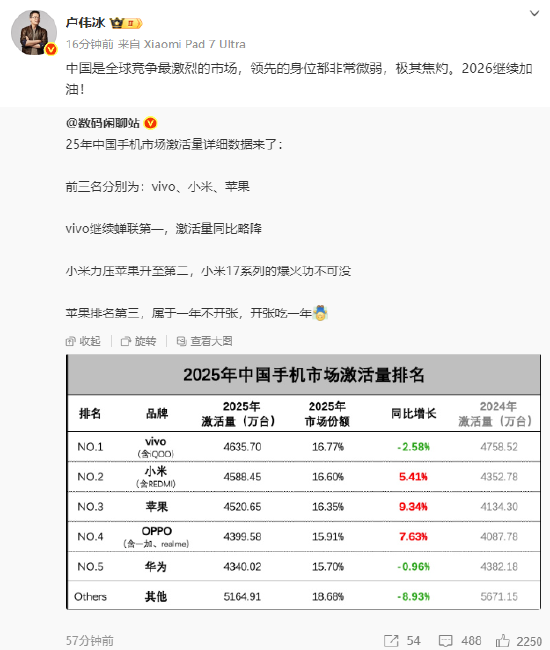
Core Insights - The Chinese smartphone market is highly competitive, with very narrow leading positions among brands, indicating a fierce battle for market share [1][3] - In 2025, Xiaomi surpassed Apple to become the second-largest smartphone brand in China, following Vivo, largely attributed to the success of the Xiaomi 17 series [1][2][3] Market Rankings - The top three brands in the 2025 Chinese smartphone market by activation volume are: 1. Vivo: 4,635.70 thousand units, 16.77% market share, a decrease of 2.58% from 2024 [2][3] 2. Xiaomi: 4,588.45 thousand units, 16.60% market share, an increase of 5.41% from 2024 [2][3] 3. Apple: 4,520.65 thousand units, 16.35% market share, an increase of 9.34% from 2024 [2][3] - Other notable brands include OPPO with 4,399.58 thousand units (15.91% market share) and Huawei with 4,340.02 thousand units (15.70% market share) [2][3]


华为哈勃押注,成立仅半年融资三连跳,这家公司凭什么成为“世界模型黑马”?
机器人大讲堂· 2026-01-20 09:11
Core Viewpoint - Manifold AI, founded by a former key member of SenseTime, aims to redefine embodied intelligence through its World Model technology, enabling robots to not only perceive but also predict physical interactions in their environment [1][4][12]. Group 1: Financing and Growth - Manifold AI has completed over 300 million yuan in financing within just seven months of its establishment, showcasing a rapid fundraising pace that reflects strong market interest in "Physical AI" [2][7]. - The company has successfully raised funds in three rounds: a seed round led by Inno Angel Fund, followed by two angel rounds, each exceeding 100 million yuan [4][7]. - The latest funding round included notable investors such as Meihua Venture Capital, Junlian Capital, and Huawei Hubble, indicating a strong backing from the industry [1][9]. Group 2: Technology Development - Manifold AI's technology focuses on World Model Action (WMA), which allows robots to predict physical state changes based on first-person perspective videos, moving beyond traditional visual-language models (VLM) [12][14]. - The company's WorldScape model enables robots to simulate and interact with their environment autonomously, marking a shift from mere execution of pre-set codes to possessing "brain-like" capabilities [14][15]. - Manifold AI is developing multiple specialized models, including DriveScape for autonomous driving, RoboScape for physical interaction, and AirScape for drones, all built on the foundational WorldScape model [15]. Group 3: Future Aspirations - The company aims to equip over 10% of robots in the market with its "Manifold Brain," pushing the boundaries of Physical AI agents [19][20]. - The long-term vision includes transitioning World Models from experimental stages to practical applications in warehouses, factories, and homes within the next three years [20][21]. - The strategy emphasizes creating a universal embodied world model while simultaneously commercializing sub-domain models to generate revenue and support further development [20].
启明星辰:公司已经与华为持续开展脆弱性研究等安全领域的合作
Zheng Quan Ri Bao Wang· 2026-01-20 08:45
Core Viewpoint - The company, Qiming Star (启明星辰), is focusing on cybersecurity as its main business, with strategic layouts in "AI + Security" and quantum security [1] Group 1: AI + Security - The company is developing security intelligent agents to be applied in security operations, threat detection, and data security products or services [1] - A series of large model security products have been launched to ensure the safety of AI applications, forming a systematic solution [1] Group 2: Quantum Security - The company has upgraded its quantum-resistant encryption system, integrating post-quantum cryptographic algorithms and quantum key distribution technology [1] - Successful implementations of these technologies have been achieved in critical information infrastructure sectors such as finance and telecommunications [1] Group 3: Collaboration and Future Outlook - The company is collaborating with Huawei on vulnerability research and other security-related projects [1] - As new productive forces develop, the company acknowledges the increasing complexity and severity of cybersecurity challenges and aims to continuously track new security demands while focusing on technological innovation [1]

浪潮软件人事“地震”:核心管理层集体离任,新帅能否力挽狂澜?
Xin Lang Cai Jing· 2026-01-20 08:35
Core Insights - The sudden resignation of key executives at Inspur Software, including Chairman Zhao Shaoxiang and Vice Presidents Huang Lei and Xiao Shouming, has raised concerns about the company's future amidst significant financial losses [1][2][3] - The company reported a revenue decline of 29.61% year-on-year to 727 million yuan for the first three quarters of 2025, with a net loss of 211 million yuan, marking a 122.78% increase in losses compared to the previous year [1][3] - The third quarter alone saw a revenue drop of 36.16% to 298 million yuan, with a net loss of 63.19 million yuan, further exacerbating the company's financial challenges [1][3] Company Overview - The management shake-up is described as a comprehensive overhaul affecting decision-making, execution, and client relations, despite the company's claim that it will not impact daily operations [2][5] - New board candidate Xue Junli, aged 48, has a background in product management and market operations, but it remains to be seen if he can effectively address the strategic and execution gaps left by the departing executives [2][5] Industry Context - The challenges faced by Inspur Software reflect broader issues within the traditional software industry, particularly as tech giants like Huawei and Alibaba Cloud aggressively enter the digital government sector with standardized products [3][6] - Increased competition has led to a price war among traditional players, compounded by stretched local government budgets and elongated project payment cycles, which have intensified cash flow pressures for Inspur Software [3][6] - The company is under pressure to undergo a difficult transformation in its technology architecture, product models, and business strategies to navigate the rapidly changing industry landscape [3][6]

新款阿维塔12实车首次曝光,华为靳玉志评价脱胎换骨
Huan Qiu Wang· 2026-01-20 08:28
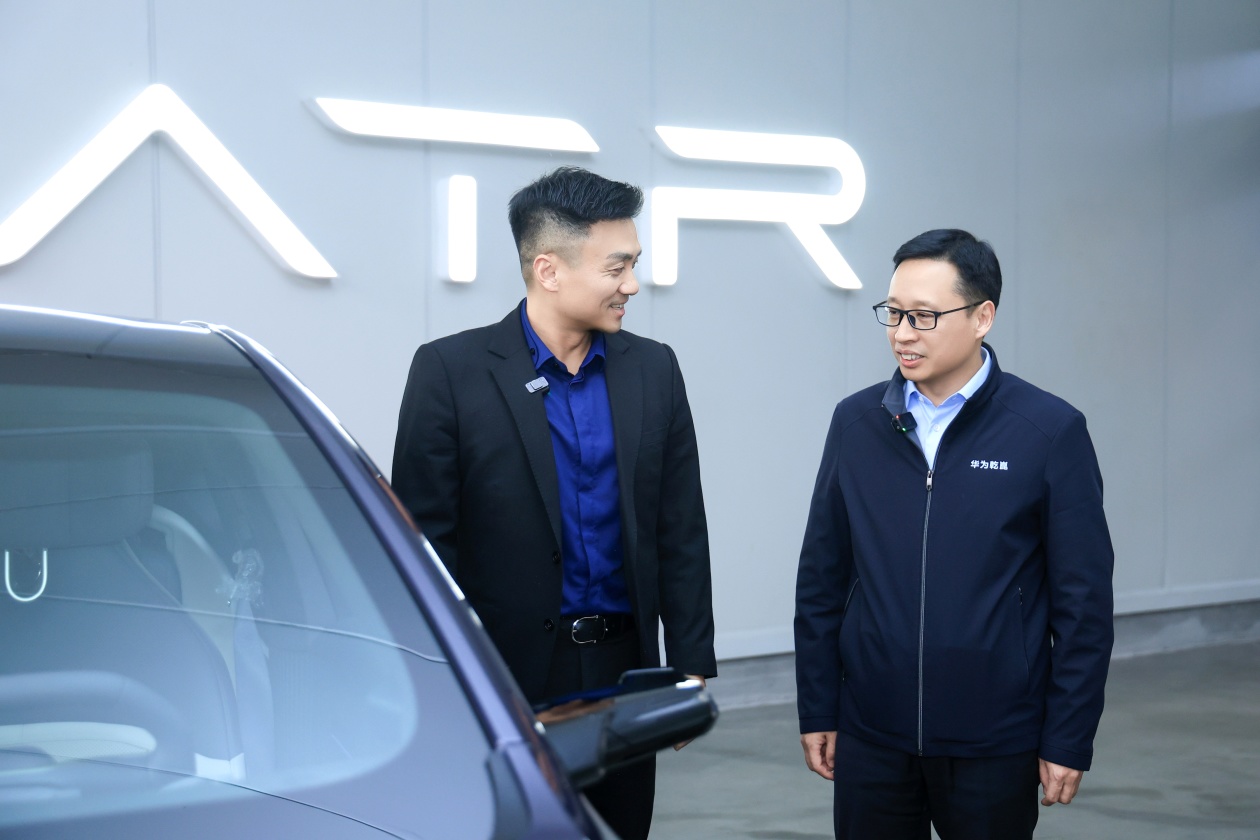
同日,阿维塔科技董事长王辉与华为智能汽车解决方案BU CEO靳玉志共同率队前往阿维塔智能制造基地,开展现场联合办公,并深度体验了即将推出的新 款阿维塔12。作为双方携手打造的旗舰轿车,新款阿维塔12在设计、动力、操控与智能驾驶等方面实现全域升级。靳玉志在试驾后高度评价:"新款阿维塔 12是自去年双方官宣深度战略合作2.0以来,阿维塔与华为整合技术、流程、质量三大核心能力,以一个团队的模式共同打造的全新产品。这次升级改款, 带来了更强的驾控、更强的豪华感、更强的智能,如果要用四个字来形容,那就是'脱胎换骨'。" M , 网维塔 12 898 11 11 6 5 12 and and the start 根据此前信息,新车动力系统也迎来全面升级,涵盖增程与纯电版本,增程版驱动电机峰值功率(后左/后右):200kW/200kW;纯电动2电机,驱动电机峰 值功率(后左/后右):251kW/251kW;纯电动3电机,驱动电机峰值功率(前/后左/后右):210kW/251kW/251kW。 2026年1月19日,新款阿维塔12实车首次曝光。新车搭载顶置激光雷达,并首次在B柱设计增加"乾崑智驾ADS"标识,将以领先的感知硬 ...
汽车视点丨技术突围易,生态融入难?汽车隐形独角兽面临“成长的烦恼”
Xin Hua Cai Jing· 2026-01-20 08:23
Core Viewpoint - The article discusses the emergence of "invisible unicorns" in the Chinese automotive industry, highlighting their role in driving innovation and addressing structural growth challenges in a competitive market environment [1][2]. Industry Overview - The Chinese automotive industry is transitioning from an incremental market to a stock competition phase, with production expected to reach over 34 million vehicles by 2025, maintaining a range of 35 to 37 million in the following five years [2]. - Structural growth indicates a shift in focus from scale expansion to value creation and technological breakthroughs, providing a fertile ground for invisible unicorns to develop [2]. Technological Advancements - The penetration rate of new energy vehicles is projected to rise from 60% to 80% by 2030, with continuous iterations in key technologies like intelligent driving and smart cockpits injecting strong momentum into the industry [3]. - Despite a slight decrease in the number of automotive tech unicorns globally, their total valuation is expected to grow by 5.89% to 1.48 trillion yuan by 2025, indicating that technological value is becoming a key support for enterprise valuation [3]. Consumer Demand - Younger consumers prioritize new energy and smart features when purchasing vehicles, while older demographics may become significant users of intelligent vehicles due to advancements in smart driving technology [3]. Globalization Impact - China's automotive exports are anticipated to reach 8 to 9 million vehicles in the next five years, accounting for 30% of total production, thus providing new growth opportunities [3]. Unicorn Enterprises' Performance - Since 2018, 120 companies have been recognized as automotive invisible unicorns, with 40 establishing partnerships with major manufacturers, 3 becoming unicorns, and 4 going public [4]. - The total valuation of China's invisible unicorns is projected to exceed 2.2 trillion yuan by 2025, with an average valuation of 440 million yuan, and 34 companies in the automotive sector [4]. Challenges Faced - Nearly 40% of invisible unicorns are currently operating at a loss, with over 35% having profits of only 10 million yuan or less, indicating weak overall profitability [5]. - The automotive industry faces systemic challenges from macroeconomic conditions, industry ecology, and globalization, with over 50% of upstream companies expected to incur losses by mid-2025 [5][6]. Recommendations for Overcoming Challenges - Policy recommendations include enhancing innovation procurement and financial support, establishing a credit risk compensation mechanism, and creating a comprehensive financial support system for unicorns [10]. - The industry ecosystem needs to be restructured to foster open collaboration and innovation networks, with leading companies taking the initiative to build open innovation platforms [11]. - Unicorn enterprises should enhance their strategic resilience, focusing on sustainable profit models and adapting organizational structures and market strategies to navigate global expansion effectively [12].
AI玩具崛起,投融界解码“情感科技”创业新范式
Sou Hu Cai Jing· 2026-01-20 07:34
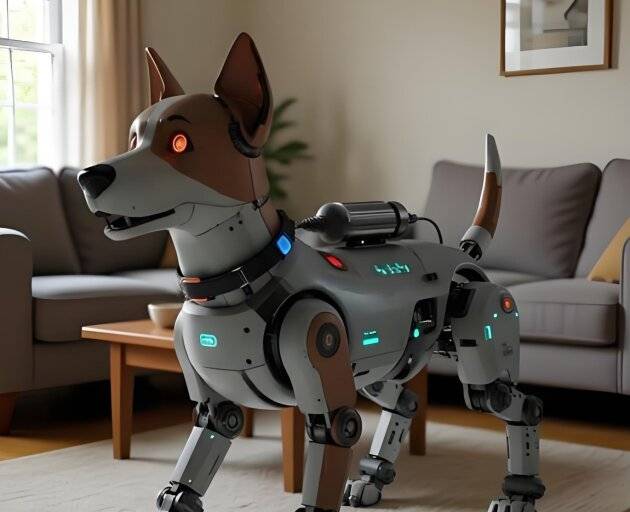
Core Insights - The article highlights the rising trend of AI toys, which are becoming emotional companions for users, reflecting a growing demand for low-burden companionship in modern fragmented lifestyles [1][4]. Group 1: Emotional Connection and Technological Integration - AI toys have evolved from being merely observed to being perceived, with capabilities such as emotional recognition and interactive memory, allowing them to "understand" users better [1][2]. - The transition from functional response to emotional resonance is driven by the democratization of AI technology, enabling toys to provide continuous emotional support and integrate seamlessly into daily life [2][4]. Group 2: Market Growth and Ecosystem Development - The AI toy market in China is projected to grow from approximately 24.6 billion yuan in 2024 to 29 billion yuan in 2025, with the global market expected to reach 58 billion USD by 2030 [4]. - The ecosystem of AI toys includes agile startups, tech giants leveraging their advantages, and traditional toy companies exploring AI transformation, indicating a diverse competitive landscape [4][5]. Group 3: Challenges and Future Directions - Key challenges for AI toys include achieving natural and long-term emotional companionship, balancing personification with privacy concerns, and creating sustainable product differentiation [4][5]. - The future of AI toys is anticipated to focus on deeper emotional connections, moving from novelty to becoming integral companions in daily life, with a shift in consumer spending from functionality to emotional resonance [5][6].