工商银行

Search documents
金价疯涨,银行积存金“戴着镣铐跳舞”
3 6 Ke· 2026-01-16 00:22
Core Viewpoint - The recent surge in gold prices, reaching a historical high of $4643 per ounce, has led to increased investor interest in gold accumulation products offered by banks, which are seen as accessible and flexible investment options [1] Group 1: Market Trends - From January 2 to January 14, 2026, the London spot gold price increased by 7.35% [1] - Banks are responding to the rising demand for gold accumulation products by lowering fees while simultaneously raising minimum investment thresholds and enhancing risk warnings [1][5] Group 2: Business Strategies - Banks are marketing gold accumulation products as "pain-free gold saving," promoting low entry barriers to attract individual investors [3] - Some banks, like Jiangsu Bank, have launched promotional campaigns encouraging customers to convert small expenditures into gold investments [3] - Various banks are offering temporary fee discounts to lower the cost of entry for investors, such as Industrial and Commercial Bank of China (ICBC) waiving fees for purchases made between January 1 and March 31, 2026 [3] Group 3: Risk Management - Banks are tightening risk management measures in response to the volatility in gold prices, transitioning gold accumulation products from general savings alternatives to medium-risk investment products [5] - ICBC has raised the minimum investment amount for its gold accumulation products from 1000 yuan to 1100 yuan as of January 8, 2026 [5][6] - Risk assessment requirements for investors have been increased, with banks like ICBC requiring a minimum risk rating of C3 (balanced) for new accounts and investments [6][7] Group 4: Investor Suitability - The increase in risk assessment levels aims to ensure that only investors with appropriate risk awareness and capacity can participate, thereby protecting them from potential losses during price fluctuations [7] - The dual strategy of raising entry barriers while offering fee discounts is designed to attract qualified investors and enhance market share, reflecting a balanced approach to risk management and business growth [7]

黄金热居高不下 多家银行发行挂钩黄金的结构性存款
Xin Lang Cai Jing· 2026-01-16 00:17
Core Viewpoint - In 2025, international gold prices experienced a historic bull market, with London spot gold prices rising from approximately $2646 per ounce at the beginning of the year to over $4367.8 per ounce by year-end, marking an annual increase of about 65% [1][6]. Group 1: Market Trends - The current domestic bank deposit rates are at a low, with some short-term deposit rates starting with "0", such as the Industrial and Commercial Bank of China's 3-month deposit rate at 0.65% and large-denomination certificates of deposit at only 0.9% [2][7]. - In contrast, the gold market has been on the rise, prompting multiple banks to launch gold-linked structured deposit products to cater to risk-averse investors seeking higher returns [2][8]. Group 2: Structured Deposit Products - Banks like China Merchants Bank and Bank of Communications have introduced various gold-linked structured deposit products, offering features like "principal protection + floating returns" and flexible term options [2][8]. - For instance, China Merchants Bank's "Point Gold" series includes products with terms ranging from 7 to 181 days, with expected annualized returns of 1%, 1.58%, or 1.78% based on gold price fluctuations [2][8]. - Bank of Communications offers a series of structured deposits with annualized returns ranging from 0.5% to 3.2%, depending on the performance of the Shanghai Gold Exchange AU99.99 contract [2][8]. Group 3: Investment Considerations - While structured deposits are generally considered safe with principal protection, the potential for returns is tied to the performance of the underlying assets, such as gold prices [4][10]. - Analysts suggest that the first quarter of 2026 will see a peak in the maturity of higher-rate fixed deposits, making structured deposits an attractive option for banks to maintain funding stability [4][10]. - Investors are advised to thoroughly understand the terms and risks associated with structured deposits, as they cannot be withdrawn early and the highest advertised returns may not be guaranteed [5][11].
中信建投:A股预计迎来可观量级的增量资金,有望推动慢牛持续
Xin Lang Cai Jing· 2026-01-16 00:00
Core Viewpoint - The A-share market is expected to welcome a significant amount of incremental funds in 2026, which may sustain a slow bull market. The first quarter is projected to be the peak period for the maturity of fixed deposits, with funds likely flowing from insurance and wealth management channels into the equity market, marking the most abundant time for incremental funds throughout the year [3][4][62]. Group 1: Incremental Funds Sources - Incremental funds are primarily sourced from the migration of household deposits and pressures from asset scarcity, with insurance premium income continuing to grow significantly. By Q3 2025, the equity allocation ratio is expected to rise to 15.5%, nearing historical highs, which could release over 840 billion yuan into the market [4][6][66]. - The total amount of fixed deposits maturing in 2026 is estimated to be around 45 trillion yuan, which will likely lead to increased allocations in wealth management and "fixed income+" products, contributing over 900 billion yuan in medium to long-term funds to the A-share market [4][14][17]. - Public funds are expected to see a net inflow of approximately 230 billion yuan in 2026, driven by the recovery of fund net values and the enhanced motivation of individual investors to enter the market [4][33][34]. Group 2: Market Dynamics - The market's main contradictions in 2026 will shift towards verifying economic prosperity and performance realization, with medium to long-term funds providing a safety net. Active funds from public and private sectors are anticipated to further strengthen the "technology + resource products" dual mainline market, with accelerated sector rotation [4][62][64]. - The "national team" funds are expected to see a significant reduction in inflows, with a projected net inflow of about 200 billion yuan in 2026, as their role shifts in a bull market environment [19][22][23]. - High-risk funds, represented by margin trading and private equity, are expected to remain active, with margin trading net inflows estimated at around 450 billion yuan and private equity assets projected to grow to 8.5 trillion yuan, contributing approximately 700 billion yuan in incremental funds [4][26][31]. Group 3: Global and Domestic Influences - Overseas funds are anticipated to strategically allocate to Chinese assets, with northbound capital expected to net inflow around 100 billion yuan in 2026, although this impact on the overall market is expected to be limited [4][36][39]. - The macro liquidity environment is favorable, with a global interest rate cut cycle entering its later stages, but the marginal improvement in policies is expected to gradually converge. The micro-funding situation is likely to improve significantly, supporting a strong performance in equities over fixed income [4][45][49].



多家中小银行密集上调存款利率,各家银行为揽储开启“花式”营销
Zhong Guo Ji Jin Bao· 2026-01-15 23:33
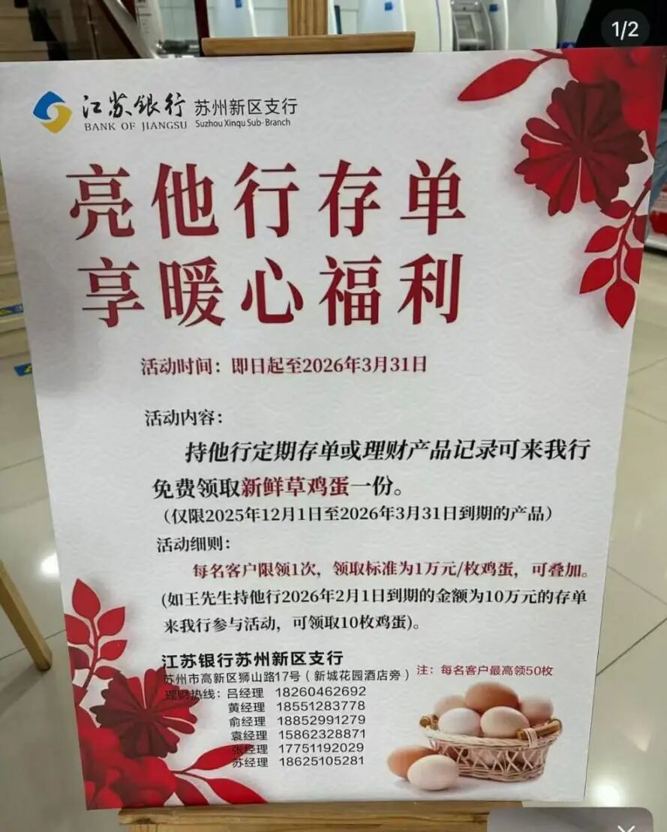
Group 1 - The core viewpoint of the articles highlights that many small and medium-sized banks are increasing their fixed deposit rates and offering promotional gifts to attract depositors, although the rate increases are more restrained compared to previous years [1][2][6] - Several small banks have announced specific rate increases, such as Shanxi Zuoyun Rural Commercial Bank raising its three-year and five-year fixed deposit rates from 1.45% and 1.50% to 1.65% [2] - Jiangsu Bank has introduced a unique promotional activity where customers can receive fresh eggs based on their deposits, indicating a creative approach to customer retention [3] Group 2 - The increase in deposit rates this year is generally modest, with most banks raising rates by only 10 to 20 basis points, reflecting a more cautious strategy compared to previous years [6] - Analysts suggest that the current trend of small banks raising short-term deposit rates is a temporary marketing strategy rather than a long-term trend, as overall deposit rates are expected to continue declining [6][7] - Larger banks appear less aggressive in their deposit strategies, with fewer promotional activities and rate increases observed, indicating a divergence in approach between small and large banks [6]
抢滩“开门红”揽储 中小行限时上调利率,大行分层经营稳成本
2 1 Shi Ji Jing Ji Bao Dao· 2026-01-15 23:22
Core Viewpoint - The banking sector is experiencing a "New Year" deposit rush, with small and medium-sized banks facing pressure to attract deposits despite a decrease in the overall enthusiasm compared to previous years [2][5]. Group 1: Deposit Rate Adjustments - Several small and medium-sized banks have recently raised their fixed deposit rates, albeit by limited margins compared to previous years, reflecting a balance between managing funding costs and maintaining market competitiveness [2][4]. - For instance, the DeShang Village Bank in Henan increased its one-year and three-year fixed deposit rates from 1.50% and 1.70% to 1.55% and 1.73%, respectively [3]. - Other banks, such as the Jiangsu Bank and Shenyang Bank, have also introduced higher interest rate products, with some three-year fixed deposits offering rates as high as 1.90% [3][4]. Group 2: Marketing Strategies and Competitive Pressures - To attract deposits, some banks are employing promotional strategies, such as offering shopping vouchers for depositors, indicating a competitive environment among small banks [4]. - Analysts suggest that the recent rate increases by small banks are primarily short-term marketing tactics to meet year-end deposit targets, rather than indicative of a long-term trend [5]. Group 3: Large Banks' Strategies - Major state-owned banks have not followed suit in raising deposit rates but have adjusted the minimum deposit thresholds for their products, indicating a strategic shift towards customer relationship management [6][7]. - For example, the Industrial and Commercial Bank of China has set a minimum deposit of 1 million for certain high-yield products, while the Agricultural Bank of China has varied its minimum deposit requirements significantly across different products [6]. Group 4: Future Outlook - Industry experts predict that banks may continue to lower funding costs, with potential downward adjustments in deposit rates as net interest margins remain under pressure [8]. - The average cost of deposits may decrease by approximately 35 basis points in 2026, potentially improving net interest margins by 10 to 15 basis points, which could provide more room for future interest rate cuts by the central bank [8].

抢滩“开门红”揽储 中小行限时上调利率 大行分层经营稳成本
2 1 Shi Ji Jing Ji Bao Dao· 2026-01-15 23:17
Core Viewpoint - The banking sector is experiencing a "New Year" deposit rush, with small and medium-sized banks facing pressure to attract deposits despite a decrease in the intensity of this year's deposit campaigns compared to previous years [2][5]. Group 1: Deposit Rate Adjustments - Several small and medium-sized banks have recently raised their fixed deposit rates, albeit by limited margins compared to previous years, reflecting a balance between managing funding costs and maintaining market competitiveness [2][4]. - For instance, the DeShang Village Bank in Henan raised its one-year and three-year fixed deposit rates from 1.50% and 1.70% to 1.55% and 1.73%, respectively [3]. - Other banks, such as the Jiangsu Bank and Shenyang Bank, have also introduced higher interest rates for specific deposit products, indicating a trend among smaller banks to attract deposits through competitive rates [3][4]. Group 2: Market Dynamics and Strategies - The current market for deposits is generally abundant, but small regional banks are under significant pressure to attract deposits, especially at the beginning of the year [5]. - Analysts suggest that the recent rate increases by small banks are primarily short-term marketing strategies rather than indicative of a long-term trend in interest rates [5][8]. - Large state-owned banks, while not increasing deposit rates, are adjusting the minimum deposit thresholds for their products, indicating a shift in strategy to manage customer relationships and optimize funding structures [6][7]. Group 3: Future Outlook - Industry experts predict that banks may continue to lower funding costs, with potential downward adjustments in deposit rates as net interest margins remain under pressure [8]. - The average cost of deposits may decrease by approximately 35 basis points in 2026, potentially improving net interest margins by 10 to 15 basis points, which could provide more room for future interest rate cuts by the central bank [8].
“长钱长投”显优势 多举措促进企业年金保值增值
2 1 Shi Ji Jing Ji Bao Dao· 2026-01-15 22:53
0:00 企业年金是我国养老保险体系第二支柱的组成部分,发挥重要的补充养老保险作用。近日,人力资源社 会保障部、财政部印发《关于进一步做好企业年金工作的意见》,提出扩大企业年金制度覆盖范围、简 化建立程序等举措。 除了扩大覆盖面外,提高收益率也是企业年金制度发展的一大关键。那么,如何实现企业年金的保值增 值,提升职工参加年金制度的积极性? 数据显示,截至2025年三季度,全国建立企业年金的用人单位17.5万户,参加职工3332.05万人,积累基 金4.09万亿元,初步显现补充养老功能。 中国工商银行养老金融部总经理 韩强:目前工商银行为近7万户企业提供年金服务,涉及职工约1400万 人。 据了解,从收益表现来看,2007年至2024年,全国企业年金基金年均投资收益率6.17%,累计创造投资 收益超7500亿元,展现了长期投资的稳健潜力。 业内人士表示,企业年金作为典型的长期资金,天然适合穿越经济周期的波动。在投资层面上应该发挥 这种"长钱长投"的优势,通过长期持有优质资产,充分利用复利效益实现滚雪球式的增长。 在北京工作的莫女士,在2022年加入年金制度。她告诉记者,一般到年底,自己都会到个人账户看看累 计金 ...
中国工商银行股份有限公司深圳市分行与中国信达资产管理股份有限公司深圳市分公司债权转让通知暨债务催收联合公告
Jing Ji Ri Bao· 2026-01-15 21:51
Core Viewpoint - The Industrial and Commercial Bank of China (ICBC) Shenzhen Branch has signed an asset transfer agreement with China Cinda Asset Management Co., Ltd. Shenzhen Branch, transferring its creditor's rights and related rights under guarantee contracts to Cinda, effective December 23, 2025 [1]. Group 1: Agreement Details - The asset transfer agreement is identified as "Shenzhen 2025 SZ001" and involves the transfer of principal debts and guarantee rights from ICBC to Cinda [1]. - Borrowers and guarantors are required to fulfill their repayment obligations to Cinda as per the original loan and guarantee contracts [1]. - The announcement includes a list of borrowers and guarantors, detailing their respective principal and interest amounts as of the transfer benchmark date of May 20, 2025 [1][4]. Group 2: Financial Obligations - Borrowers and guarantors must pay interest, penalties, and other dues as stipulated in the loan and guarantee contracts until actual repayment [1]. - Legal fees incurred during litigation, which have been advanced by ICBC, are to be borne by the borrowers and guarantors as per the relevant legal documents [1]. Group 3: Contact Information - Contact details for both ICBC and Cinda are provided for any inquiries related to the announcement [2][3].
“花式”揽储:有银行送鸡蛋吸引他行储户,多家中小银行上调存款利率……
Sou Hu Cai Jing· 2026-01-15 21:31
Core Viewpoint - Several small and medium-sized banks in China have recently raised their deposit rates and launched various promotional activities to attract depositors, although the increase in rates is more restrained compared to previous years, indicating a cautious approach in the current market environment [1][11]. Group 1: Deposit Rate Adjustments - Multiple small and medium-sized banks have increased their fixed deposit rates, with Shanxi Zuoyun Rural Commercial Bank raising its three-year and five-year deposit rates from 1.45% and 1.50% to 1.65% [3]. - Baoying Rural Commercial Bank has also announced an increase in its three-year fixed deposit rate from 1.7% to 1.8%, reflecting a rise of 10 basis points [4]. - Shengjing Bank and Jilin Bank have also adjusted their deposit rates, with Jilin Bank raising its three-year fixed deposit annualized rate from 1.75% to 2% [5]. Group 2: Promotional Activities - To meet their deposit targets, many small and medium-sized banks have introduced various promotional activities, such as Beijing Shunyi Yinzuo Village Bank's lottery for new customers, where deposits can earn chances to win household items [6]. - Jiangsu Bank has launched a unique promotion where customers can receive free fresh eggs based on their existing deposits with other banks, allowing for multiple claims [8]. - Some bank staff have resorted to personal incentives, such as offering gift cards or small gifts to attract depositors, indicating a competitive environment for customer acquisition [10]. Group 3: Market Trends and Strategies - The increase in deposit rates this year is generally modest, with most adjustments ranging from 10 to 20 basis points, reflecting a more cautious strategy compared to previous years when increases were often larger [12]. - Analysts suggest that the current strategy of small increases in deposit rates and setting minimum deposit thresholds is aimed at precise customer acquisition without significantly raising costs, indicating a short-term marketing tactic rather than a long-term trend [12]. - Larger banks appear less affected by the need for aggressive deposit acquisition strategies, with fewer promotional activities observed compared to smaller banks [12].

金价迷雾解读:1月15日最新报价,为何从银行到金店价格千差万别?
Sou Hu Cai Jing· 2026-01-15 20:37
Core Viewpoint - The article discusses the significant price differences in gold from international markets to retail stores, highlighting the various factors that contribute to these discrepancies. Price Chain Analysis - The international gold price on January 15 was approximately $4,622 per ounce, translating to around 1,030 RMB per gram, which serves as the global benchmark influenced by economic and exchange rate factors [1] - The domestic raw gold price, based on the Shanghai Gold Exchange's AU99.99, closed at about 1,033 RMB per gram on the same day, incorporating the impact of the RMB exchange rate [1] - Investment gold bars sold by banks are priced between 1,048 and 1,053 RMB per gram, closely aligned with raw material costs, while retail gold bars from stores like Chow Tai Fook range from 1,259 to 1,390 RMB per gram, reflecting brand premiums [2] - Brand gold jewelry prices, such as those from Chow Tai Fook and Chao Hong Ji, were between 1,395 and 1,436 RMB per gram, with the largest wholesale market in Shenzhen quoting 1,158 to 1,215 RMB per gram for 999 pure gold [2] Brand Premium Breakdown - The additional cost of 200 to 300 RMB per gram for branded jewelry includes three main components: 1. Physical store presence and services, which involve high rental and operational costs [4] 2. Design and craftsmanship value, where intricate designs and advanced manufacturing techniques can exceed the cost of the gold itself [4] 3. Brand reputation and assurance, where established brands provide trust in quality and after-sales service, representing a significant intangible asset [4] Consumer Guidance - For investment purposes, bank gold bars are recommended due to their lower costs and better liquidity, while branded jewelry is justified for personal use or gifts due to its design and service [5] - Consumers are advised to compare prices and inquire about processing fees before purchasing, and to be aware of wholesale market prices to avoid overpaying [5] - A suggested strategy is to use bank gold bars as a stable asset for value preservation while separately purchasing a desired piece of branded jewelry for personal enjoyment [8]