荣耀

Search documents
吴声2025年度演讲:场景革命十年,哲学生活方式到来
凤凰网财经· 2025-08-03 14:04
Core Viewpoint - The article discusses the ongoing AI scene revolution and its impact on business, emphasizing the need for reconstructing meaning in specific scenarios to adapt to the evolving landscape of consumer needs and technological advancements [5][22][28]. Group 1: Scene Creation and Evolution - The concept of "scene creation" has evolved over the past decade, highlighting the importance of well-designed scenarios in driving the growth of new business entities [13][21]. - Companies like Sanwing Bird and Red Star Macalline exemplify the evolution of scene brands, focusing on personalized solutions and integrating various home-related services to enhance consumer experience [16][19]. - The article notes that understanding user needs within specific scenarios is crucial for brands to innovate and adapt in the AI era [17][21]. Group 2: Instant Emergence and Meaning Reconstruction - The term "instant emergence" refers to the necessity of believing in the emergence of scenarios at every technological moment, which is essential for navigating the rapid changes brought by AI [24][26]. - The article emphasizes that AI's evolution is not just about technology but also involves a cognitive revolution that redefines human existence and experience [26][28]. - The reconstruction of meaning in everyday life is highlighted as a key aspect of the AI scene revolution, where philosophical considerations become integral to understanding technology's role [28][30]. Group 3: Connection and Interaction - The article introduces the concept of "NOW," focusing on the importance of real-time connections in the attention economy, as exemplified by platforms like Xiaohongshu [35][36]. - The evolution of human-machine interaction is discussed, with an emphasis on creating seamless experiences that enhance user engagement and satisfaction [55][56]. - The emergence of "smart agents" as a new form of digital self is highlighted, showcasing how AI can enhance user experiences by understanding and anticipating needs [56][59]. Group 4: Physical and Digital Integration - The integration of physical and digital experiences is emphasized, with examples of companies like Xiaomi and Jiumu showcasing how they leverage AI to enhance user interactions in real-world scenarios [42][73]. - The article discusses how brands are rethinking physical spaces to create meaningful consumer experiences, transforming retail environments into engaging community hubs [82][84]. - The rise of emotional commerce, particularly through collectible toys, reflects a shift towards products that resonate with consumers' identities and emotions [89][90].

吴声2025年度演讲:场景革命十年,哲学生活方式到来
3 6 Ke· 2025-08-03 13:34
Group 1 - The core theme of the event is "Momentary Emergence," focusing on the AI scene revolution and its impact on business and philosophy [3][16] - Wu Sheng, the founder of Scene Laboratory, emphasizes the importance of reconstructing meaning coordinates in specific scenarios [3][22] - The event outlines four innovative methods for "meaning reconstruction": NOW (connection in the moment), FLOW (smooth human-machine interaction), HERE (narrative beyond presence), and EGO (the core question of self) [3][22] Group 2 - The evolution of scene creation over the past decade is highlighted, showcasing how meticulously designed scenarios drive the growth of new species in business [9][15] - The case of Sanwing Bird illustrates the shift from product-focused to solution-oriented approaches in smart home scenarios, emphasizing personalized family scene customization [11][15] - Red Star Macalline's transformation into an "AI home life destination" reflects the deep understanding of lifestyle changes brought by AI, integrating home appliances, furniture, and decoration [13][15] Group 3 - The concept of "Momentary Emergence" suggests that the future of AI applications will evolve through carefully designed scenarios, avoiding superficial trends [16][20] - The advancements in AI technology, such as Amazon's robotics and Google's Gemini Robotics, indicate a shift towards cognitive capabilities in machines [18][20] - The potential economic impact of AI is significant, with projections suggesting a possible GDP growth of 20-30% due to AI advancements [20] Group 4 - The "philosophical lifestyle cycle" is introduced, emphasizing the need to find and reconstruct meaning coordinates in everyday life through specific scenarios [22][24] - The importance of user-generated content (UGC) in platforms like Xiaohongshu is highlighted, showcasing its role in connecting people and information in real-time [27][29] - The concept of "effective time" is emerging as a new standard in family living, replacing the traditional focus on effective space [11][15] Group 5 - The evolution of physical retail spaces, such as Anta's innovative store designs, reflects a shift towards creating immersive and community-oriented shopping experiences [63][64] - The integration of AI in physical spaces is transforming how consumers interact with products, enhancing the overall shopping experience [60][65] - The rise of emotional commerce, particularly in the context of trendy toys, illustrates the changing landscape of consumer engagement and brand connection [70][71]
游戏大厂秀肌肉、国产3A游戏火爆、机器踢足球……这届ChinaJoy热闹非凡
Cai Jing Wang· 2025-08-03 08:36
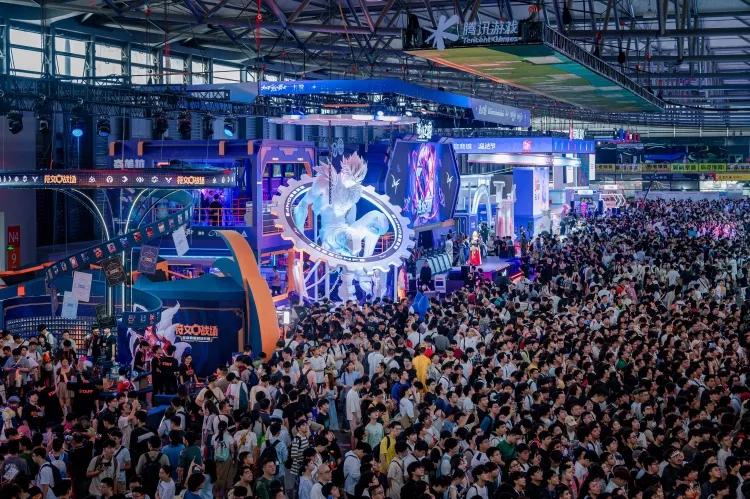
Core Insights - The 22nd ChinaJoy has commenced in Shanghai, attracting 743 exhibitors, including 237 foreign companies from 37 countries, accounting for 31.9% of total participation [1] - The event showcases a total exhibition area of 110,000 square meters dedicated to BTOC interactive entertainment, featuring over 280 companies [1] Group 1: Game Companies Participation - Major gaming companies like Tencent, NetEase, Century Huatong, Perfect World, and Giant Network have set up engaging booths with game trials, drawing significant player interest [3] - Tencent is showcasing 17 products, occupying nearly half of the N4 hall, with popular titles like "League of Legends: Battle Card" and "Valorant: Source Action" available for immersive trials [3] - NetEase is presenting 45 games, including six unique titles in a dedicated area, with "Yanyun Sixteen Sounds" gaining substantial popularity since its launch [5] Group 2: New and Classic Game Releases - Century Huatong is featuring 13 premium games, including classic IPs like "Legend of Blood" and new titles such as "Hungry Wilderness" [7] - Giant Network is debuting new games like "Supernatural Action Team" and showcasing classic IP collaborations, with "Journey" celebrating its tenth anniversary [9] - Perfect World is presenting seven products across various genres, including popular titles like "DOTA2" and its new game "Yihuan," which recently completed its second test [11] Group 3: Broader Industry Presence - The event has expanded beyond gaming, with internet giants like Baidu and Alibaba showcasing their services, indicating the growing influence of ChinaJoy beyond the gaming sector [3][17] - Hardware manufacturers are also prominent, with innovations like Samsung's 27" UHD 165Hz naked-eye 3D gaming monitor attracting attention [17] - A new "Smart Entertainment Robot" theme area has been established, featuring robot soccer competitions, highlighting the event's diversification into robotics and AI [18][19]
华为OPPOvivo荣耀四款折叠屏横评,万元预算选购指南
Xin Lang Cai Jing· 2025-08-02 18:15
Group 1 - The article discusses the selection of foldable smartphones within a budget of 10,000 yuan, highlighting options such as Huawei Mate X6, OPPO Find N5, vivo X Fold5, and Honor Magic V5 [2]
高通侯明娟:以技术创新推动数字娱乐形态演进
Huan Qiu Wang Zi Xun· 2025-08-02 08:49
Core Viewpoint - The 2025 ChinaJoy and the China International Digital Entertainment Industry Conference (CDEC) highlight the advancements in the digital entertainment industry, with Qualcomm showcasing its technological innovations and ecosystem development in mobile gaming and AI integration [1][3]. Group 1: Technological Innovations - Qualcomm's Snapdragon 8 Gen 2 mobile platform features over 40% improvements in CPU, GPU, and NPU performance, enhancing mobile gaming and multitasking capabilities [3]. - The platform supports over 180 terminal designs from brands like Honor, OPPO, vivo, and Xiaomi, providing top-tier experiences in mobile gaming, social media, and multimedia [3]. - The integration of the seventh-generation Snapdragon Elite Gaming suite brings PC-level gaming experiences to mobile devices, improving graphics and frame rates [3]. Group 2: AI and 5G Integration - Qualcomm is actively promoting the deployment of generative AI on the device side, exemplified by the Xiaomi AI glasses that utilize Qualcomm chips for real-time AI interactions [5]. - The Snapdragon AR1+ platform has been reduced in size by 26% and offers lower power consumption, supporting small language models for AI smart glasses [5]. - The acceleration of 5G-A network commercialization, combined with AI and spatial computing, opens new possibilities for digital entertainment [5]. Group 3: Ecosystem Development - Qualcomm has built a comprehensive digital entertainment ecosystem across multiple devices, including smartphones, PCs, XR, and automotive applications [6]. - Over 30 flagship Android smartphones based on the Snapdragon 8 Gen 2 and fourth-generation Snapdragon 8s platforms were showcased, enhancing user experiences [6]. - The collaboration with 75 partners resulted in over 100 terminal demonstrations and more than 50 multi-terminal game titles, showcasing the strength of Qualcomm's ecosystem [6]. Group 4: Interactive Experiences - The Snapdragon theme pavilion at ChinaJoy features multi-dimensional interactive scenarios, including the upgraded "Snapdragon XR Fantasy Journey" that offers ultra-8K resolution and low-latency immersive experiences [7]. - Online and offline engagement strategies, such as social media campaigns and promotional events, have attracted significant user participation [7]. - Qualcomm aims to innovate and collaborate with partners to create a new chapter in digital entertainment and consumption [7].


2025 ChinaJoy骁龙主题馆开幕 展现数字娱乐技术与生态实力
Ren Min Wang· 2025-08-02 01:50
Core Insights - The 2025 ChinaJoy event in Shanghai features Qualcomm's sixth "Snapdragon Theme Pavilion," showcasing cutting-edge technology and digital entertainment experiences with 75 industry partners [1][3] - Qualcomm aims to provide a comprehensive digital entertainment experience, presenting over 100 devices across 10 categories and more than 50 multi-device game titles [3][4] - The Snapdragon 8 Gen 2 processor enhances gaming performance and efficiency, supporting advanced technologies like AI image motion engine and super-resolution [4] Group 1 - Qualcomm's Snapdragon Theme Pavilion is designed to deliver an immersive digital entertainment experience, featuring a variety of mobile games and cross-device applications [3][5] - The pavilion includes 15 XR devices covering AR, VR, and MR, providing multi-dimensional interactive experiences [4] - The "Snapdragon Gear Library" showcases a robust digital entertainment ecosystem with over 30 flagship Android smartphones and AI PCs [4] Group 2 - Qualcomm emphasizes its leadership in connectivity, AI on-device capabilities, and high-performance low-power computing to enhance cross-device experiences [4] - The event includes interactive gaming sessions and opportunities for fans to engage with professional esports players [4] - Qualcomm reaffirms its commitment to technological innovation and industry collaboration to shape the future of digital entertainment [5]
直击WAIC:大模型走进“中场战事”
3 6 Ke· 2025-08-01 12:12
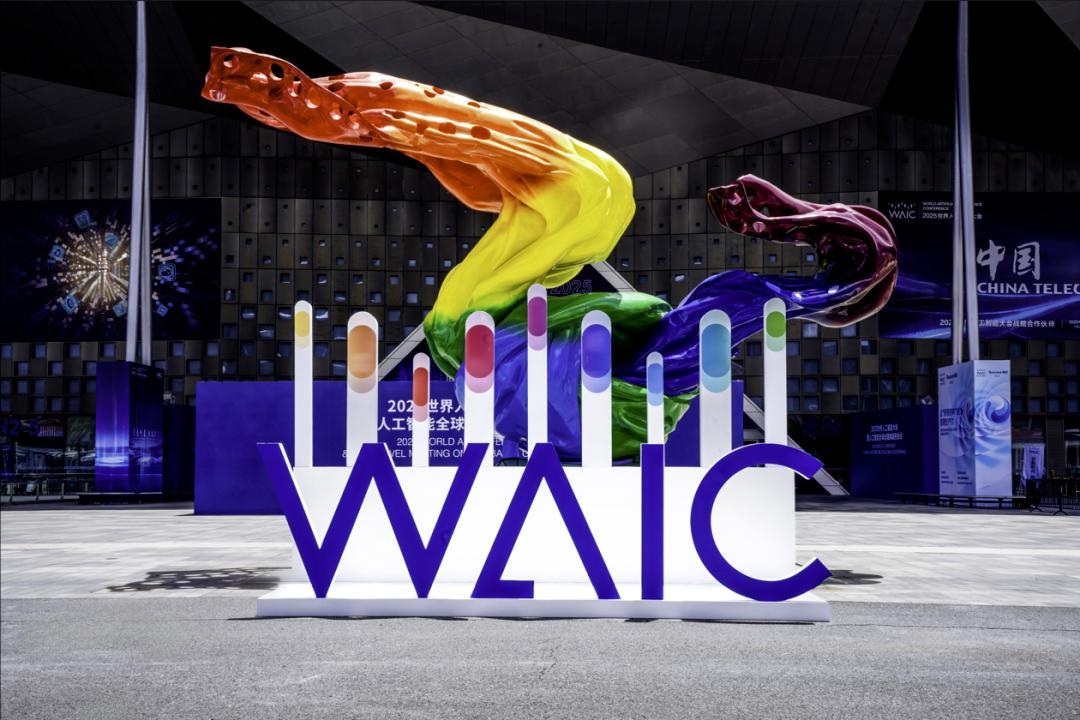
Core Insights - The 2025 WAIC has seen unprecedented interest, highlighting the rapid evolution of the domestic large model industry since 2025, characterized by three major trends: the rise of reasoning models as a new technological high ground, the transition from conceptual applications to practical implementations, and significant breakthroughs in domestic computing power [2][29]. Group 1: Industry Trends - The competition landscape of large models is shifting from chaotic "hundred model battles" to a more rational and intense "midfield battle," with a focus on reasoning models [2][29]. - The number of companies in the robotics industry at WAIC 2025 surged from 18 in 2024 to 80, indicating a growing interest and investment in this sector [4]. - Major players are no longer solely competing on model parameters but are showcasing diverse application ecosystems, emphasizing the importance of industrial ecology, business models, and international competitiveness [5][29]. Group 2: Technological Developments - The emergence of reasoning models marks a qualitative leap from basic capabilities to advanced cognitive functions, with DeepSeek-R1's launch being a pivotal event [6][7]. - Since the release of DeepSeek-R1 in January 2025, numerous leading firms have introduced their own reasoning models, indicating a rapid technological advancement [8]. - The competition now emphasizes model architecture, reasoning mechanisms, and parameter strategies, with a shift towards hybrid architectures to meet performance demands [10][14]. Group 3: Application and Market Dynamics - The transition from technology demonstration to practical application is evident, with companies focusing on B-end and C-end strategies [15][22]. - Companies like Tencent and Alibaba are leveraging their platforms to enhance user experience, while smaller firms are concentrating on B-end capabilities [15][18]. - The integration of large models into various industries, such as finance and healthcare, is accelerating, showcasing their practical utility [22][23]. Group 4: Domestic Computing Power - Domestic computing power is gaining momentum, with Huawei's Ascend 384 super node showcasing significant advancements in AI chip technology [24][25]. - The rapid increase in daily token usage by companies like Alibaba and ByteDance highlights the growing demand for computing resources [24]. - The establishment of the "MoXin Ecological Innovation Alliance" reflects a trend towards collaborative development among domestic chip and infrastructure manufacturers [27]. Group 5: Future Outlook - The large model industry is entering a phase of refinement, focusing on core technologies, key applications, and building ecological moats [30]. - Future trends indicate that reasoning models will evolve towards multimodal reasoning and embodied intelligence, while domestic computing power will shift from a catch-up mode to a competitive mode [30].



科技大事件 丨 苹果回应首次在中国关停直营店;美团承诺绝不下场与商家竞争
Sou Hu Cai Jing· 2025-08-01 11:45
Group 1: Apple Store Closures and Openings - Apple will close its first official retail store in China, the Dalian Century City store, on August 9, 2023, due to multiple retailers leaving the shopping center [1] - The Dalian store opened on October 24, 2015, and is the first Apple Store to shut down in the country [1] - Apple plans to open a new retail store in Shenzhen on August 16, 2023, marking its third store in the city [1] Group 2: Legal Challenges - Apple has issued a strong statement against the U.S. Department of Justice (DOJ) regarding antitrust lawsuits, claiming all 236 allegations are unfounded [2] - The lawsuit threatens the core principles that allow the iPhone to stand out in a competitive market, according to Apple [2] - Apple is expected to engage in a prolonged legal battle, with the potential for a resolution taking several years [2] Group 3: Financial Partnerships - Apple is reportedly in talks with JPMorgan Chase to take over the Apple Card credit card business from Goldman Sachs [3] - Negotiations between Apple and JPMorgan began in early 2022, with recent developments accelerating the process [3] - Although no agreement has been signed yet, Goldman Sachs has hinted at the possibility of ending the partnership before the original contract expiration in 2030 [4] Group 4: Securities Fraud Allegations - Apple faces a new class-action lawsuit related to delays in the upgrade of its Siri digital assistant, which has been postponed to after iOS 18 [5] - The Rosen Law Firm is seeking investors who purchased Apple securities between June 10, 2024, and June 9, 2025, to join the lawsuit [5] Group 5: Real Estate Investments - Apple has signed a deal to acquire the Mathilda campus in Sunnyvale for $365 million, marking its third major real estate transaction in the Bay Area this year [6] - The total investment for office space expansion in the Bay Area over the past three months approaches $882 million [6] - Despite high vacancy rates in the tech industry, Apple continues to expand its office space in the Bay Area [6]



比亚迪上线全面兼容功能 手车互联:从封闭生态到“壁垒”打开
Zhong Guo Qi Che Bao Wang· 2025-08-01 11:25
Core Viewpoint - BYD has officially launched the vehicle-to-phone connectivity feature across all its brand models, enhancing the smart experience for users by integrating with major domestic smartphone brands [2][3]. Group 1: Vehicle-to-Phone Connectivity Features - The vehicle-to-phone connectivity has become a significant highlight in the automotive industry, with increasing collaboration between automakers and smartphone manufacturers to meet growing consumer demand for smart mobility [3]. - BYD's connectivity feature supports three major ecosystems: Carlink, HUAWEI HiCar, and Honor Car Link, offering various functionalities such as screen mirroring, privacy mode, navigation transfer, and music continuation [3]. - Other automakers, like MG and Deep Blue, are also exploring vehicle-to-phone connectivity, with MG announcing a partnership with OPPO to implement comprehensive connectivity features in their new models [4][5]. Group 2: Evolution and Development of Vehicle-to-Phone Connectivity - The concept of vehicle-to-phone connectivity began in 2004 with Nokia and BMW, evolving significantly with the introduction of technologies like MirrorLink, CarPlay, and Android Auto [6]. - The industry is transitioning from a basic connectivity model to a more integrated approach, where mobile devices and vehicle systems seamlessly share information and functionalities [7]. - Experts believe that the future of vehicle-to-phone connectivity will involve deeper integration, allowing for a more unified ecosystem between smartphones and vehicle systems [8]. Group 3: User Experience and Market Trends - Enhancing user experience is crucial for the success of vehicle-to-phone connectivity, as consumers seek more convenient ways to integrate their mobile and driving experiences [8]. - The market is witnessing a trend where vehicle manufacturers are not creating proprietary smartphone brands but are instead focusing on interoperability with existing mobile ecosystems [8]. - The integration of AI technology is expected to further enhance the vehicle-to-phone connectivity experience, providing personalized services and improving overall functionality [9][13]. Group 4: Future Prospects and Challenges - The future of vehicle-to-phone connectivity appears promising, with potential advancements in AI and new business models that could lead to enriched application ecosystems and differentiated insurance pricing based on driving behavior [13]. - However, challenges such as connectivity stability and user interface responsiveness remain significant hurdles that need to be addressed for broader adoption [10].


群智咨询:预计今年全球智能手机需求仍将维持微降态势 出货量同比下降0.5%
智通财经网· 2025-08-01 11:08
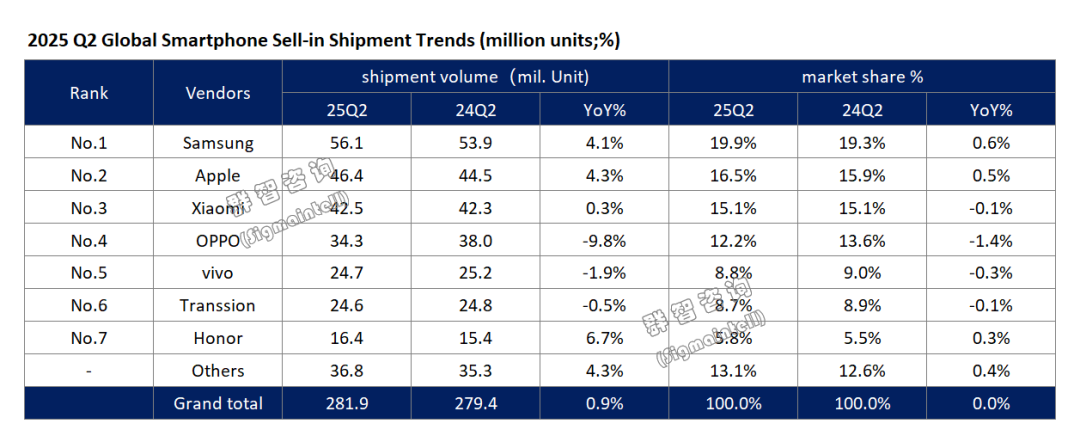
Global Market Overview - In Q2 2025, global smartphone shipments are expected to reach approximately 280 million units, reflecting a year-on-year growth of 0.9% [1][4] - Samsung leads the global market with shipments of 56.1 million units, a 4.1% increase year-on-year, maintaining a market share of 19.9% [4] - Apple follows with 46.4 million units shipped, a 4.3% increase year-on-year, achieving a market share of 16.5% [4] - Xiaomi's shipments are approximately 42.5 million units, showing a slight increase of 0.3% year-on-year, with a market share of 15.1% [4] - OPPO and vivo experience declines in shipments, with OPPO down 9.8% to 34.3 million units and vivo down 1.9% to 24.7 million units [4][3] China Market Insights - In Q2 2025, China's smartphone shipments are projected to be around 67.9 million units, reflecting a year-on-year decline of 1.0% [6][8] - Huawei shows strong performance with shipments of 12.1 million units, an 18.6% increase year-on-year, capturing a market share of 17.9% [8] - OPPO and vivo face challenges with declines in shipments, attributed to market segmentation and competition from Xiaomi [6][3] - Xiaomi's growth is supported by the launch of its automotive brand and strong sales of high-end models [6] Future Outlook - Global smartphone demand is expected to decline slightly, with a forecast of 1.18 billion units shipped in 2025, a decrease of 0.5% year-on-year [9] - The domestic market in China may see a slight increase in shipments to 280 million units, driven by favorable policies [9]