
Boliden

Search documents
ABB advances electrification, automation at Boliden’s Aitik copper facility
Yahoo Finance· 2025-12-19 16:23
Automation company ABB has upgraded electrification and automation infrastructure to support the safe and efficient expansion of one of Europe’s key tailings facilities at Boliden’s Aitik copper mine. Situated just south of Gällivare in northern Sweden, Atik is the largest open-pit copper mine in the country. The upgraded systems aim to improve water storage, recycling and monitoring capabilities, helping the mine scale up its operations in line with rising global copper demand. The International Energ ...
2026年铅期货年度行情展望:供需双弱,上下有限
Guo Tai Jun An Qi Huo· 2025-12-19 09:59
Report Industry Investment Rating No relevant information provided. Core Viewpoints of the Report - Based on the judgment that the lead market will maintain a situation of strong supply and weak demand in 2026, prices are expected to fluctuate within a range. The main operating range for Shanghai lead is 16,000 - 18,000 yuan/ton, and for London lead, it is 1,900 - 2,100 US dollars/ton [1][67]. - In 2026, the domestic market may have a slight surplus. The supply of lead ore is expected to improve, the supply of waste batteries may increase slightly, and the production of refined lead will continue to grow. The demand side may be supported by the continued replacement consumption and the positive growth of two - wheeled electric vehicles. The energy storage demand is growing explosively, and the incremental space for lead - carbon batteries is broad. However, the export of lead - acid batteries may face pressure, and the overall supply - demand situation is weak, with prices remaining range - bound. The price - holding intention in the waste battery recycling sector is strengthening year by year, which is expected to continuously lift the bottom of the lead price [1][67]. - It is recommended to pay attention to seasonal fluctuation opportunities. After the small spring of consumption at the beginning of the year, consumption weakens marginally, and prices may fall under pressure. In the middle of the year, battery manufacturers replenish stocks in advance for the consumption peak season, while the supply of waste batteries does not increase significantly during the replacement consumption peak season, which may bring a temporary supply - demand gap and inject upward momentum into prices [2][67]. Summary by Directory 1. 2025 Review: First Decline then Rise, with a Slow Uptrend in the Center of Gravity - In January 2025, the lead price declined due to the end of downstream inventory preparation, high finished - product inventory, and a potentially longer Spring Festival holiday. In February, the price rose initially but then fluctuated after factoring in the expected production increase of large downstream manufacturers. In March, the price increased as consumption recovered and downstream battery companies increased inventory. In April, it declined due to macro - tariff impacts and the entry into the consumption off - season. In May and June, prices fluctuated in a weak supply - demand situation [7]. - From July to December, the lead price showed a complex trend. In July, it first rose and then fell due to changes in supply and demand. In August, it fluctuated weakly. In September, it rose after a period of fluctuation. In October, it trended strongly with obvious supply pressure on primary lead and incremental demand. In November, it climbed and then declined as primary lead production increased and secondary lead production grew rapidly [8][9]. 2. Supply - Demand Weakness, with Dull Fundamental Contradictions 2.1 Lead Ore Supply is Rigid, but There Will Be Increment in the Next Year - In the long - term, overseas mining enterprises' capital expenditure in lead ore has been low, resulting in relatively rigid global lead ore production. The supply cycle of lead ore is more closely related to that of zinc ore. In 2025, global lead ore supply disturbances increased, and overseas production increments were limited. For 2026, there is an expected increment of 100,000 tons, with a year - on - year growth rate of 2.2% [10][13][14]. 2.2 Domestic Mines Increased Production This Year, but Realistic Contradictions Still Exist - In 2025, from January to November, China's lead concentrate production increased by 10.4% year - on - year, mainly due to the production increase of mines such as Xinjiang Huoshaoyun. It is expected to contribute an increment of 100,000 tons in 2026. The continuous tight supply of lead concentrate has squeezed the profit margin of primary lead smelting. China's lead raw material import structure is becoming more diversified, but the import profit of lead concentrate is meager [20][26]. 2.3 Insufficient Endogenous Power, Driven by By - Product Profits - Since March 2025, the thickening of primary lead plant profits has driven high - level production. By - product profits such as silver and sulfuric acid have become the main factors driving the supply elasticity of primary lead plants. Assuming that the prices of by - products remain high in 2026, primary lead supply is expected to continue to grow slightly, and supply elasticity may increase [33][34]. 2.4 Problems in Secondary Lead Supply Still Exist, Forming a Strong Constraint - China's secondary lead production capacity is severely over - supplied, and the shortage of raw materials has led to low - level production. Since the second quarter, secondary lead enterprises have suffered losses, and it is expected that the production of secondary lead will continue to decline in 2026. Although there will be more incremental supply in the long - term, the growth rate of capacity expansion may slow down, and some enterprises are transforming to a multi - raw material production mode [36][37]. 3. Is the Demand Really Collapsing: A Flash in the Pan or a Steady Stream? 3.1 Policy Boosts Consumption, Electric Bicycles Return to Positive Growth, and Automobile Exports Contribute Significantly - In 2025, new national standards and national subsidy policies have stimulated the growth of the electric bicycle industry. Automobile consumption policies have also continuously increased, and the trade - in policy has effectively boosted consumption. It is expected that the trade - in subsidy scale will continue to be maintained at 300 billion yuan in 2026 [46][52][53]. 3.2 Explosive Growth in Energy Storage Demand, Vast Incremental Space in the Future - The energy storage demand for lead - acid/lead - carbon batteries is growing explosively. Lead - acid batteries have cost, safety, recycling, and low - temperature performance advantages, but also have performance shortcomings. In 2025, the lead consumption of lead - carbon batteries was 27,300 tons in the first three quarters, and it is expected to increase by 28,300 tons in 2026, with a marginal contribution to consumption of 0.4% [60][61]. 3.3 High Domestic - Foreign Price Ratio and Tariff Impacts Weigh on Lead - Acid Battery Exports - In 2025, the export volume of lead - acid batteries declined rapidly due to the expansion of the domestic - foreign price ratio and tariff impacts. The anti - dumping tariff imposed by the GCC on Chinese lead - acid batteries will take effect in 2026, which may significantly reduce the export volume [64]. 4. Conclusion and Investment Outlook - In 2026, the lead market will maintain a situation of weak supply and demand, with prices fluctuating within a range. The main operating range for Shanghai lead is 16,000 - 18,000 yuan/ton, and for London lead, it is 1,900 - 2,100 US dollars/ton. It is recommended to pay attention to seasonal fluctuation opportunities [67].
矿业股 2026 年展望:铜市看涨-Mining Equities_ 2026 Outlook_ Copper Bulls
2025-12-16 03:26
Summary of Mining Equities Conference Call Industry Overview - **Sector Performance**: In 2025, mining equities outperformed equity benchmarks, primarily driven by gold and copper, while ferrous metals and energy remained flat or declined [1][15] - **2026 Outlook**: Expectations for copper, aluminium, and lithium to outperform due to supply constraints and energy transition, with a cautious view on traditional end markets in developed economies [2][15] Key Commodities Insights Copper - **Market Dynamics**: The medium-term outlook for copper remains bullish, with expectations of market tightness in 2026 due to limited growth in global mine output and a deficit in refined output [3][4] - **Investment Opportunities**: Freeport is highlighted as a top pick due to its discounted valuation and expected production recovery at the Grasberg mine [4][23] Aluminium - **Demand vs Supply**: The outlook for aluminium is mixed; while demand holds up, supply constraints are expected, particularly from China and developed markets [5][24] - **Investment Recommendation**: A buy recommendation for Norsk Hydro is reiterated, with expectations of stable operations and potential cash returns [8][24] Gold - **Market Sentiment**: Gold remains a consensus macro trade, with equities delivering strong returns in 2025. However, valuations are less compelling than at the start of the year [9][22] - **Top Picks**: Barrick and Newmont are identified as top picks, with potential for further catalysts in 2026 [10][22] Iron Ore - **Price Forecast**: The medium-term outlook for iron ore is bearish, with prices expected to stabilize around $100/t in the short term and decline to $90/t by 2027 due to increased supply from Simandou [11][20] Coal - **Market Conditions**: Met coal prices have risen above $200/t due to demand and supply disruptions, while thermal coal remains stable at $110/t [12][20] Diversified Miners - **Performance Comparison**: Vale outperformed in the bulks sector, while RIO and BHP performed in line with benchmarks. A preference for RIO over Vale and BHP is noted due to better growth prospects [13][25] Earnings and Price Target Changes - **Adjustments**: Earnings estimates and price targets have been adjusted based on commodity price forecasts, with notable upgrades for copper miners like FCX and KGHM [28][29] Conclusion - **Investment Strategy**: The report emphasizes a selective investment approach in mining equities, focusing on commodities with strong fundamentals and potential for price gains, particularly copper, aluminium, and gold [2][15][22]






锌年报:元素过剩锌承压宏观暖意蕴转机
Tong Guan Jin Yuan Qi Huo· 2025-12-10 09:11
Report Industry Investment Rating The provided content does not mention the report industry investment rating. Core Viewpoints of the Report - In 2026, supported by the dual - loose expectations of monetary and fiscal policies in the US, the economy is expected to recover moderately, and the US dollar is likely to fluctuate at a high level, reducing the suppression of risk assets. China will enter the first year of the "15th Five - Year Plan", with the economy growing steadily, and fiscal and monetary policies remaining moderately loose. The resonance of domestic and foreign policies is expected to improve the marginal demand for commodities [4][107]. - In terms of supply, the global zinc concentrate increment in 2026 will be about 500,000 metal tons, narrowing compared to 2025, and the raw material supply - demand will turn to a tight balance. The long - term processing fee is expected to rise, but the recovery of overseas refined zinc supply is limited. In China, the smelting capacity continues to expand, but the growth rate of refined zinc production will slow down to 5%, and the actual capacity release of the Huoshaoyun project is the core variable of the domestic supply pattern [4][107]. - The demand shows the characteristics of "slowing growth and sector differentiation". The infrastructure investment growth rate is expected to recover to 4% - 5%, and the projects will be launched in advance. The policy of replacing old with new supports durable - goods consumption, but the growth of automobile production and sales slows down, the policy effect of home appliances weakens, and exports are under pressure. The real estate is still at the bottom - grinding stage, and its drag on zinc consumption is weakening. In the new energy field, the new photovoltaic installations turn negative due to the high base, while the wind power maintains positive growth. The export resilience of primary products will provide consumption increments [4][107]. - Overall, the global zinc mining and smelting are still in the expansion cycle, the supply growth of zinc elements exceeds the demand growth, and the oversupply situation expands slightly. The core logic of zinc price pressure remains unchanged. However, the macro - drive is positive, and the positive expectations of copper and aluminum are expected to partially offset the short - board of zinc fundamentals. In 2026, the zinc price is difficult to show a unilateral market, and it is expected to fluctuate widely in the range of 21,000 - 24,500 yuan/ton. There will be phased unilateral opportunities during the macro - micro resonance stage, and the structural opportunities are anchored on the main line of price ratio repair [4][108]. Summary According to the Directory I. Zinc Market Review - In 2025, the zinc market was weak overall, with prominent internal - external structural contradictions. The price fluctuated downward under the influence of macro - policies and fundamental factors. In the first half of the year, factors such as Trump's possible tariff policy and the Fed's suspension of interest - rate cuts suppressed the zinc price. In the second half, the market was in a pattern of "repeated policy expectations and stalemate fundamentals", and the Shanghai zinc main contract fluctuated in the range of 21,600 - 23,200 yuan/ton. The LME zinc showed a trend of first falling and then rising, and the price rebounded due to the decline in LME inventory [9][10]. II. Macroeconomic Analysis 2.1 US - In 2025, the US economy achieved a soft landing. The GDP growth rate was 2%, lower than 2.8% in 2024. The ISM manufacturing PMI was in the contraction range, the employment market declined, and inflation rebounded moderately. The Fed started preventive interest - rate cuts in September. In 2026, the GDP growth rate is expected to be 2.1%. The impact of tariffs will weaken, and inflation may decline slightly. The fiscal and monetary policies are expected to remain loose, but the change of the Fed chairman may affect the interest - rate cut path. The US dollar is expected to fluctuate, which will relieve the suppression of commodities [13][14]. 2.2 Eurozone - In 2025, the Eurozone economy recovered slightly in the first three quarters, with a GDP growth rate of 1.2%. Inflation dropped to 2.1%, and the ECB kept the key interest rate unchanged since July. In 2026, the GDP growth rate is expected to be 1.1%, and the internal differentiation will continue. Germany's economy may recover, while France's growth may slow down. Inflation is expected to stabilize around 2%, and the ECB's monetary policy is expected to remain stable. The fiscal policy may expand structurally [15][16]. 2.3 China - In 2025, China's economic growth showed a "high - in - the - front and low - in - the - back" feature, with an annual growth rate of about 5%. Exports were strong, but domestic consumption and private investment were weak. In 2026, as the first year of the "15th Five - Year Plan", the economy is expected to grow steadily, with a GDP growth target of about 5%. The quarterly growth rate may be "low - in - the - front and high - in - the - back". Exports are expected to benefit from the relaxation of Sino - US trade frictions and the fiscal loosening in Europe and the US. The fiscal policy will be more active, and the monetary policy will remain moderately loose [17][18]. III. Zinc Fundamental Analysis 3.1 Zinc Ore Supply - In 2025, the global zinc concentrate new capacity was 700,000 tons, with an increment of 700,000 metal tons to 12.7 million tons. In 2026, the new capacity will narrow to 500,000 tons to 13.2 million tons. The domestic market will contribute the main increment. The supply - demand pattern is expected to turn from loose to tight balance [29][30]. - The internal and external processing fees first rose and then fell in 2025. The domestic zinc concentrate processing fee dropped to 2,000 yuan/metal ton at the end of the year. The import processing fee also declined in November. The CZSPT proposed a 2026Q1 import processing fee guidance of 105 - 120 US dollars/dry ton. In 2025, the zinc ore import increased significantly, and it is expected to remain above 5 million tons in 2026 [36][37][38]. 3.2 Refined Zinc Supply - In 2025, the global refined zinc production increased by 4.12% year - on - year. Overseas production decreased by 5.48% in the first nine months, while China's increased by 7.03%. In 2026, overseas refined zinc production is expected to increase slightly by 50,000 - 100,000 tons, but the recovery is limited due to factors such as cost and raw material supply [44][48]. - In 2025, China's refined zinc production increased by 10.7% year - on - year. In 2026, the production is expected to increase by 350,000 tons to 7.2 million tons, with a growth rate slowing down to 5.1%. The actual production of the Xinjiang Kunlun Zinc Industry project is an important variable. In 2025, the net import of refined zinc was about 250,000 - 260,000 tons, and in 2026, the import and export volume may offset each other [53][54][57]. 3.3 Refined Zinc Demand - Globally, in 2025, the refined zinc consumption increased by 3.9% year - on - year. In 2026, India's zinc demand is expected to continue to expand, the US zinc consumption is expected to grow steadily, and Europe's traditional consumption may improve marginally while the green industry will support consumption [67][68]. - In China, in 2025, the apparent consumption increased by more than 8%, but the actual consumption was weak. The primary product exports were strong, and the galvanized sheet export is expected to continue to grow in 2026. Traditional consumption such as infrastructure and real estate was weak in 2025, and infrastructure investment is expected to recover in 2026. The real estate is still at the bottom - grinding stage, and its drag on zinc consumption will weaken. The growth of automobile and home appliance sales will slow down in 2026. In the new energy field, the new photovoltaic installations may turn negative, while the wind power will maintain positive growth [71][73][77]. 3.4 Global Visible Inventory - In 2025, the global visible inventory had prominent structural contradictions. The LME inventory decreased, and the low inventory supported the LME zinc price. The domestic inventory increased, suppressing the Shanghai zinc price. In 2026, the LME inventory is expected to have limited recovery, and the domestic high - inventory pressure may be difficult to relieve, especially in Q1 [105][106]. IV. Summary and Outlook for the Future - The macro - environment in 2026 is expected to be favorable for the zinc market. The supply - demand pattern will change, with the supply growth narrowing and the demand showing sector differentiation. The zinc price is expected to fluctuate widely, and there will be phased and structural opportunities [107][108].
Boliden (OTCPK:BDNN.Y) Update / Briefing Transcript
2025-12-05 09:02
Boliden (OTCPK:BDNN.Y) Update Summary Company Overview - **Company**: Boliden - **Industry**: Mining and Metals Key Points and Arguments 2026 Guidance and Outlook - The 2026 guidance includes the first full year of operations for Somincor and Zinkgruvan, contributing to overall production increases [2][3] - Higher grades are expected in open pit mines, with increased mill volume across several mines [2][3] - Aitik's milled volume is projected at 41 million tons, an improvement from the previous year, with copper grades at 0.18% and gold grades at 0.08 grams per ton [6][30] - Garpenberg's production is expected to be 3.7 million tons at 2.9% zinc and 95 grams silver, slightly down from the previous year [6][7] Mine Developments and Permits - An extended permit for Garpenberg allows for higher throughput, although it is subject to potential appeals [3][24] - The Kristineberg expansion and Tara ramp-up are expected to contribute to increased throughput [3][4] - The company is actively working on mine extensions and optimizations, particularly in Somincor and Zinkgruvan [9][11] Financials and CAPEX - The total CAPEX for 2026 is guided at SEK 15 billion, with mine sustaining CAPEX at approximately SEK 6.5 billion [4][35] - The maintenance stop in smelters is expected to impact EBIT by SEK 450 million in 2026, down from SEK 500 million in 2025 [18] - Rönnskär's ramp-up is on track, with an expected annual EBITDA increase of around EUR 150 million as it reaches full production [14][15] Operational Challenges and Adjustments - Odda's commissioning has been delayed by approximately two months due to mechanical and electrical issues [13][70] - The company has encountered oxidization issues in Aitik, which are independent of the diorite problem [22][94] - The Finnish parliament is discussing potential tax increases, which could impact operational costs [3][4] Market Conditions and Pricing - The company has confirmed strong interest from buyers for leach products, indicating favorable market conditions [13] - Rönnskär's updated metal recoveries are expected to positively impact operating profit by SEK 400 million in Q4 2025 [19] Future Investments and Strategic Projects - Future investments are anticipated to maintain production levels, particularly at Garpenberg, which may require additional CAPEX for a new shaft [24][88] - The company is focusing on strategic projects, including the completion of the Aitik dam and the Kristineberg expansion [35][38] Environmental and Compliance Updates - Boliden has completed compliance with global industry standards on tailings management, which is crucial for future operations [11][12] Additional Important Information - The company plans to provide a deeper breakdown of CAPEX and strategic projects during the Capital Markets Day in March [35][39] - Working capital levels are expected to increase with the ramp-up of Odda and Rönnskär, estimated at SEK 500 million and SEK 1 billion respectively [57][58] This summary encapsulates the key points from Boliden's update, highlighting the company's operational outlook, financial guidance, and strategic initiatives for 2026.
Boliden (OTCPK:BDNN.Y) Earnings Call Presentation
2025-12-05 08:00
Mines Outlook - In 2026, the first full year will include Somincor and Zinkgruvan operations[6] - Higher grades are expected in open pits[6] - Increased milled volume is anticipated at Aitik, Garpenberg, the Boliden Area, and Tara mines[6] - Potential cost increases of EUR 20-30 million are expected annually at Kevitsa[6] - Milled volume is expected to be stable at approximately 4.5 Mtonnes in coming years for Somincor[11] - Milled volume is expected to be stable at approximately 1.5 Mtonnes in coming years for Zinkgruvan[14] Smelters Outlook - Increased zinc and precious metal production is expected in Odda[6] - The Odda expansion is expected to increase annual capacity by 150 ktonnes of zinc and 45 ktonnes of leach product, improving annual EBITDA by approximately EUR 150 million at full production[18] - The ramp-up of the new tankhouse in Rönnskär is planned for H2 2026, with an annual copper cathode capacity of 230 ktonnes and an expected annual EBITDA increase of approximately SEK 1.2 billion when completed[19, 20] - Planned maintenance shutdowns at smelters are estimated to impact operating profit by SEK -450 million for the full year 2026[6, 21] Capital Expenditure - Group capital expenditure (capex) is projected to be SEK 15 billion, including mine sustaining capex of SEK 6.5 billion[6]
德银:月产5000万只!当Labubu不再稀缺,泡泡玛特拿什么接棒?
美股IPO· 2025-12-01 10:38
Group 1: Availability Paradox and Market Dynamics - Deutsche Bank warns that Pop Mart is facing an "Availability Paradox" as its production capacity aggressively expands to 50 million units per month by year-end, leading to Labubu transitioning from a scarce trendy IP to a mass consumer product, which may signal a decline in popularity for trend-driven toys [1] - If Labubu's popularity peaks in 2026 without new hit products, valuation pressure on Pop Mart will increase significantly [1] Group 2: Copper Market Supply and Price Forecast - Deutsche Bank indicates that the global copper market is experiencing a supply squeeze, with severe supply disruptions pushing copper prices close to historical highs [3] - The report predicts a decline in mine supply by 2025, with only a 1% rebound expected the following year, resulting in a "clear deficit" in the market [3] - As a result, Deutsche Bank raises its copper price forecast for 2026 to $10,600 per ton, with potential peaks exceeding $11,000 per ton in the first half of 2026 [3][6] Group 3: Key Company Updates and Investment Focus - Glencore is set to hold its first Capital Markets Day (CMD) in two years, aiming to restore market confidence in its operational capabilities, while Rio Tinto focuses on business simplification and capital discipline [4][9] - Deutsche Bank lists Anglo Teck, Glencore, and Freeport as preferred stocks, adjusting ratings for Boliden to "Buy" and First Quantum to "Hold" [7] - Glencore's CMD on December 3 is highly anticipated, with expectations that it will provide guidance on copper production and capital expenditures, while also addressing potential M&A discussions [8] Group 4: Rio Tinto's Strategic Focus - Rio Tinto's CMD on December 4 is expected to emphasize capital discipline, business simplification, and divestment of non-core assets, with a projected annual capital expenditure guidance of $10-11 billion [10] - The market will closely monitor production guidance for the Simandou project, amid concerns of potential oversupply [10]



德银预警:严重供应中断+行业大整合,明年铜市赤字状态恐将持续
Hua Er Jie Jian Wen· 2025-12-01 07:23
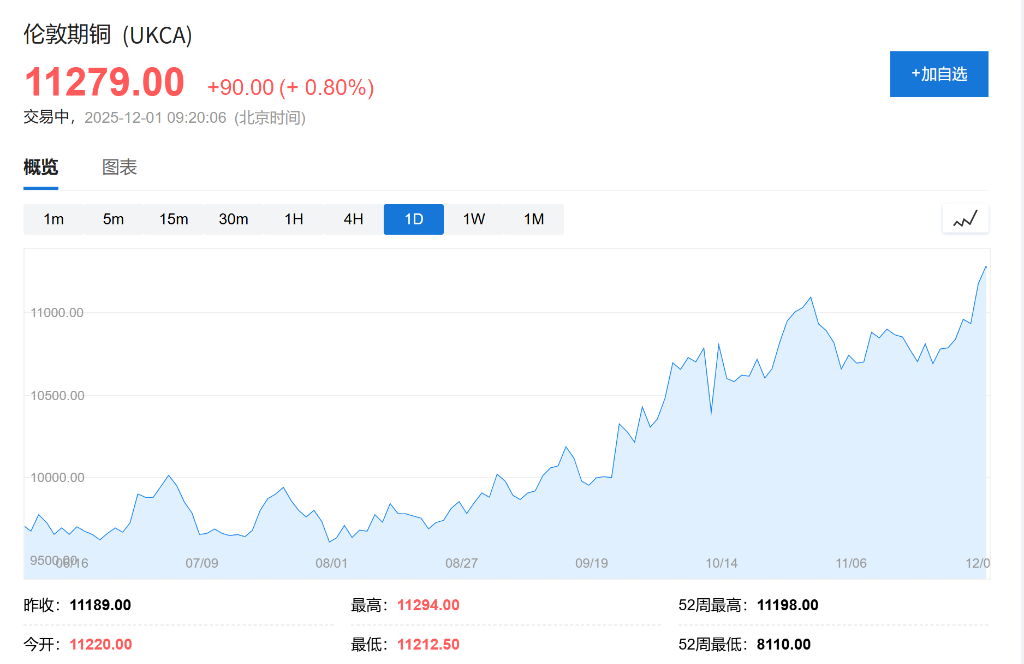
Core Viewpoint - Deutsche Bank's analysis indicates a supply squeeze in the global copper market, driven by severe supply disruptions and accelerated industry consolidation, pushing copper prices close to historical highs [1][3]. Group 1: Copper Market Outlook - As of December 1, copper prices reached $11,279 per ton, marking a historical peak [2]. - Deutsche Bank forecasts a decline in mine supply by 2025, with only a 1% rebound expected the following year, leading to a "clear deficit" in the market [1][3]. - The long-term drivers for copper prices include the electrification and digitalization trends, with global electricity demand growth outpacing GDP growth in 2024 [3]. Group 2: Company Recommendations - Deutsche Bank has identified Anglo American, Glencore (GLEN), and Freeport-McMoRan (FCX) as preferred stocks in the copper sector [3][6]. - The report has upgraded Boliden (BOL) to a "buy" rating while downgrading First Quantum (FM) to "hold" [3]. Group 3: Glencore's Capital Markets Day - Glencore is set to hold its first Capital Markets Day since 2022 on December 3, aiming to restore investor confidence in its operational capabilities and showcase growth options in its copper business [4][6]. - If Glencore limits its 2026 production guidance to copper and maintains its recovery targets for 2027/28, the market is likely to respond positively [4]. - The potential for mergers and acquisitions (M&A) discussions during the event is a significant focus, with Glencore reportedly in talks to sell its Kazzinc business [4]. Group 4: Rio Tinto's Focus - Rio Tinto will host its Capital Markets Day on December 4, emphasizing business simplification, capital discipline, and divestment of non-core assets [7]. - The company is expected to reaffirm its annual capital expenditure guidance of $10-11 billion and may introduce cost targets while updating plans to sell smaller divisions [7]. Group 5: Investor Implications - Deutsche Bank has raised its 2026 copper price forecast to $10,600 per ton, with expectations that prices could peak above $11,000 per ton in the first half of 2026 [6]. - Investors are advised to closely monitor upcoming Capital Markets Days from major mining companies, particularly Glencore's M&A activities and its attractive projected free cash flow yield of 10% for 2026 [6].
铜市场:尽管供应中断,全球库存仍持续上升-Copper Dashboard_ Global inventories continue to rise despite supply disruptions
2025-12-01 01:29
Summary of J.P. Morgan Copper Dashboard Industry Overview - **Industry**: Copper Mining - **Current Trends**: Global copper production is experiencing a 4% year-to-date increase through August, but growth is slowing due to recent supply disruptions. Global demand has risen by 7% year-to-date as of August, with notable contributions from China, although demand from the rest of the world (RoW) is declining. Global visible inventories have increased to approximately 730,000 tons, which is about 200,000 tons higher than in 2024 and at a five-year seasonal high [1][2][3]. Key Insights 1. **Production and Demand**: - Global copper production increased by 4% year-to-date through August, but there has been a year-over-year decline in output for July and August [1]. - Global demand for copper rose by 7% year-to-date as of August, with Chinese demand growth being offset by a decline in RoW consumption [1]. - The refined copper market is expected to face a deficit of 333,000 tons in 2026 and 162,000 tons in 2027 due to acute supply disruptions [2]. 2. **Price Movements**: - LME copper prices have increased by 25% this year, reaching $4.91 per pound, significantly outperforming aluminum, which saw an 11% increase [1]. - The forward curves for copper are slightly backwardated, indicating potential upside risks to prices due to recent supply disruptions pushing the market into a deficit [1]. 3. **Equity Preferences**: - J.P. Morgan continues to favor specific companies in the copper sector, including Capstone Copper (Overweight), BHP (Overweight), Antofagasta (Overweight), Freeport (Overweight), and First Quantum (Overweight) [1]. 4. **Regional Insights**: - In Chile, overall copper output is expected to remain flat at around 5 million tons per annum, with Codelco facing production challenges. Miners are focusing on technology and innovation to extend mine life and reduce costs, although regulatory reforms are slow [3]. - Labor and equipment markets are tightening, with new activities primarily centered on brownfield projects rather than major expansions [3]. 5. **Market Dynamics**: - High-frequency data shows mixed signals: treatment charges and refining charges (TC/RCs) are firmly negative, while LME net speculative positioning is increasing. However, cancelled warrants and smelter operating rates are declining [1]. - The copper market is expected to tighten as Chinese demand begins to pull on the market, potentially leading to a bullish backdrop for LME copper prices [2]. Additional Important Points - **Global Inventory Trends**: The increase in global visible inventories to ~730,000 tons indicates a significant build-up, which could impact future pricing and supply dynamics [1]. - **Technological Innovations**: The industry is pushing for technological advancements, particularly in ore sorting and chloride-based leaching, to enhance efficiency and reduce costs [3]. - **Investment Recommendations**: J.P. Morgan's coverage includes various companies with differing ratings, highlighting potential investment opportunities and risks within the copper sector [7]. This summary encapsulates the key points from the J.P. Morgan Copper Dashboard, providing insights into the current state of the copper industry, production and demand trends, pricing dynamics, and investment recommendations.



铅锌日评20251124:沪铅上方承压;沪锌震荡偏弱-20251124
Hong Yuan Qi Huo· 2025-11-24 02:40
祁玉蓉(F03100031, Z0021060),联系电话:010-8229 5006 | 铅锌日评20251124:沪铅上方承压;沪锌震荡偏弱 | | | | | | | | | --- | --- | --- | --- | --- | --- | --- | --- | | 2025/11/24 | | 指标 | 单位 | 今值 | | 变动 | 近期趋势 | | 元/吨 | | SMM1#铅锭平均价格 | | 17,075.00 | | -0.29% | | | 沪铅期现价格 | | 期货主力合约收盘价 | 元/吨 | 17,165.00 | | -0.32% | | | 元/吨 | | 沪铅基差 | | -90.00 | | 5.00 | | | 元/吨 | | 升贴水-上海 | | 25.00 | | - | | | 美元/吨 | | 升贴水-LME 0-3 升贴水-LME 3-15 | 美元/吨 | -22.41 -85.30 | | 6.50 - | | | 价差 | | 沪铅近月-沪铅连一 | 元/吨 | -5.00 | | 15.00 | | | 元/吨 | | 沪铅连一-沪铅连二 | | ...