
银精矿

Search documents
陆港赋能“全球买卖” 湖南郴州加速拥抱全球市场
Zhong Guo Xin Wen Wang· 2026-01-29 08:34
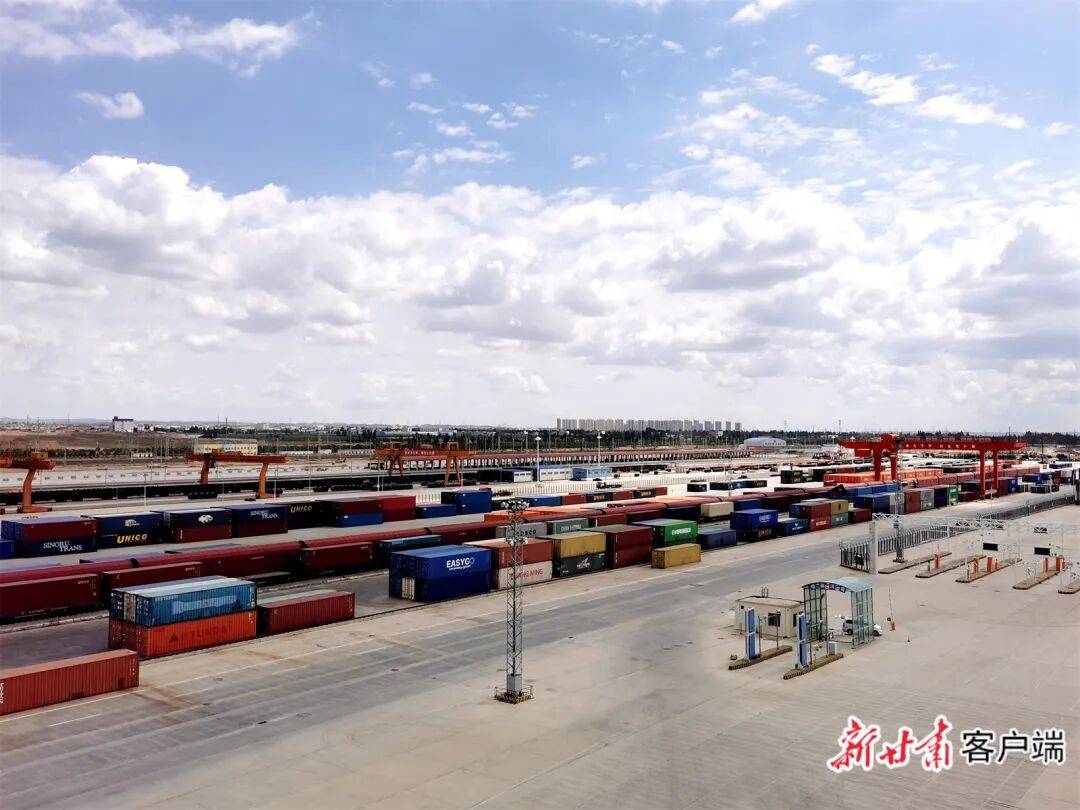
Core Viewpoint - The logistics transformation in Chenzhou is enhancing the efficiency and competitiveness of the local non-ferrous metal industry, particularly through improved transportation methods for imported mineral products [1]. Group 1: Logistics Efficiency - A recent shipment of 600 tons of silver concentrate from Peru arrived at Chenzhou's land port, marking a shift from road to rail transport, which is more secure and environmentally friendly [1]. - The introduction of a "volume-based pricing" mechanism has led to a 51% reduction in railway freight rates for mineral products, saving approximately 400 yuan per standard container [1]. - This new pricing strategy has resulted in cost savings of about 1.2 million yuan for over ten non-ferrous metal companies and has facilitated an additional 88,000 tons of imported mineral products [1]. Group 2: International Logistics Expansion - Chenzhou Land Port has pioneered the full bill of lading service for iron-sea combined transport in Hunan Province, establishing eight international routes to countries such as Nigeria, Kenya, and India [2]. - The port is evolving into a key hub for both raw material imports and inland goods exports, enhancing its role in global trade [2]. - The implementation of a "direct loading at port + non-vessel operating common carrier" model has streamlined customs processes, significantly reducing waiting times for cargo at ports [3]. Group 3: Cost and Time Efficiency - The new logistics model addresses previous challenges such as complex cross-border procedures and high overall costs, improving the efficiency of the entire transportation chain [3]. - By integrating multiple shipping companies' capacity information, the non-vessel operating common carrier model provides more competitive freight rates for inland foreign trade enterprises [3].
铅周报:增仓上行,多空矛盾加大-20260110
Wu Kuang Qi Huo· 2026-01-10 13:46
1. Report Industry Investment Rating - Not provided in the content 2. Core View of the Report - The current lead price is near the upper edge of the long - term oscillation range, with increased contradictions between macro funds and industrial seat funds. The volatility of Shanghai lead has significantly increased. In the double - wide cycle, the relatively strong macro sentiment may push the lead price to have short - term pulses and deviate from the fundamental oscillation range. It is expected that the lead price will mainly oscillate widely following the sentiment of the non - ferrous metal sector [11] 3. Summary According to Relevant Catalogs 3.1. Weekly Assessment - **Price Review**: Last Friday, the Shanghai lead index closed up 0.14% at 17,381 yuan/ton with a total unilateral trading position of 113,800 lots. As of 15:00 last Friday, LME lead 3S rose 9 to 2,040 US dollars/ton with a total position of 177,400 lots. The average price of SMM 1 lead ingot was 17,175 yuan/ton, the average price of recycled refined lead was 17,025 yuan/ton, the refined - scrap spread was 150 yuan/ton, and the average price of waste electric vehicle batteries was 10,000 yuan/ton [11] - **Domestic Structure**: The social inventory of lead ingots in major domestic markets was 20,200 tons, an increase of 1,300 tons from January 5. The futures inventory of lead ingots on the SHFE was 16,200 tons, the domestic primary basis was - 80 yuan/ton, and the spread between continuous contracts and the first - continuous contract was - 15 yuan/ton. **Overseas Structure**: The LME lead ingot inventory was 226,500 tons, and the LME lead ingot cancelled warrants were 64,000 tons. The overseas cash - 3S contract basis was - 43.39 US dollars/ton, and the 3 - 15 spread was - 115.5 US dollars/ton. **Cross - market Structure**: After excluding exchange rates, the on - screen Shanghai - London ratio was 1.222, and the import profit and loss of lead ingots was 341.51 yuan/ton [11] - **Industrial Data**: At the primary end, the port inventory of lead concentrates was 51,000 tons, the factory inventory was 484,000 tons, equivalent to 33.8 days. The lead concentrate import TC was - 145 US dollars/dry ton, and the domestic TC was 300 yuan/metal ton. The primary smelting start - up rate was 66.60%, and the primary ingot factory inventory was 23,000 tons. At the recycled end, the lead scrap inventory was 83,000 tons, the weekly production of recycled lead ingots was 43,000 tons, and the recycled ingot factory inventory was 18,000 tons. At the demand end, the lead - acid battery start - up rate was 66.59% [11] 3.2. Primary Supply - **Imports**: In November 2025, the net import of lead concentrates was 109,800 physical tons, with a year - on - year change of 15.7% and a month - on - month change of 11.7%. From January to November, the cumulative net import of lead concentrates was 1,278,500 physical tons, with a cumulative year - on - year change of 14.3%. The net import of silver concentrates in November was 180,900 physical tons, with a year - on - year change of 26.5% and a month - on - month change of 21.1%. From January to November, the cumulative net import of silver concentrates was 1,686,600 physical tons, with a cumulative year - on - year change of 7.2% [15] - **Domestic Production**: In December 2025, China's lead concentrate production was 126,300 metal tons, with a year - on - year change of 4.04% and a month - on - month change of - 7.54%. From January to December, the total production of lead concentrates was 1,658,200 metal tons, with a cumulative year - on - year change of 9.89%. In November 2025, the net import of lead - containing ores was 138,300 metal tons, with a year - on - year change of 21.11% and a month - on - month change of 16.45%. From January to November, the cumulative net import of lead - containing ores was 1,441,700 metal tons, with a cumulative year - on - year change of 10.85% [17] - **Total Supply**: In November 2025, China's total lead concentrate supply was 274,900 metal tons, with a year - on - year change of 10.09% and a month - on - month change of 3.75%. From January to November, the cumulative lead concentrate supply was 2,973,600 metal tons, with a cumulative year - on - year change of 10.62%. In October 2025, overseas lead ore production was 256,800 tons, with a year - on - year change of - 3.39% and a month - on - month change of 6.60%. From January to October, the total overseas lead ore production was 2,407,700 tons, with a cumulative year - on - year change of - 2.35% [19] - **Inventory and Processing Fees**: The port inventory of lead concentrates at the primary end was 51,000 tons, and the factory inventory was 484,000 tons, equivalent to 33.8 days. The lead concentrate import TC was - 145 US dollars/dry ton, and the domestic TC was 300 yuan/metal ton [21][23] - **Smelting Start - up Rate and Production**: The primary smelting start - up rate was 66.60%, and the primary ingot factory inventory was 23,000 tons. In December 2025, China's primary lead production was 332,700 tons, with a year - on - year change of 1.56% and a month - on - month change of 1.56%. From January to December, the total production of primary lead ingots was 3,847,200 tons, with a cumulative year - on - year change of 6.32% [26] 3.3. Recycled Supply - **Raw Materials and Weekly Production**: At the recycled end, the lead scrap inventory was 83,000 tons. The weekly production of recycled lead ingots was 43,000 tons, and the recycled ingot factory inventory was 18,000 tons. In December 2025, China's recycled lead production was 354,500 tons, with a year - on - year change of 10.3% and a month - on - month change of - 5.04%. From January to December, the total production of recycled lead ingots was 3,962,900 tons, with a cumulative year - on - year change of 4.52% [31][33] - **Imports and Total Supply**: In November 2025, the net export of lead ingots was - 23,000 tons, with a year - on - year change of 262.0% and a month - on - month change of 52.6%. From January to November, the cumulative net export of lead ingots was - 118,200 tons, with a cumulative year - on - year change of - 32.4%. The total domestic lead ingot supply in November was 723,900 tons, with a year - on - year change of 9.9% and a month - on - month change of 5.3%. From January to November, the cumulative domestic lead ingot supply was 7,241,100 tons, with a cumulative year - on - year change of 4.4% [35] 3.4. Demand Analysis - **Battery Start - up Rate and Apparent Demand**: At the demand end, the lead - acid battery start - up rate was 66.59%. In November 2025, the domestic apparent demand for lead ingots was 680,000 tons, with a year - on - year change of 0.9% and a month - on - month change of - 1.4%. From January to November, the cumulative domestic apparent demand for lead ingots was 7,206,400 tons, with a cumulative year - on - year change of 3.6% [38] - **Battery Exports**: In November 2025, the net export volume of batteries was 1,530,070 units, with a year - on - year change of - 22.0% and a month - on - month change of - 5.23%. From January to November, the total net export of lead - containing batteries was 19,680,580 units, with a cumulative year - on - year change of - 10.47% [41] - **Inventory Days**: In December 2025, the finished - product inventory days of lead - acid batteries in factories increased from 20.9 days to 21.5 days, and the inventory days of lead - acid batteries in dealers increased from 40.7 days to 43.6 days [43] - **Terminal Demand**: In the two - wheeled vehicle sector, although the decline in electric bicycle production directly dragged down the new - installation demand, the continuous growth of delivery scenarios such as express delivery and takeaway drove the improvement of new - installation consumption of electric two - and three - wheeled vehicles. In the automobile sector, the contribution of the automobile sector to lead demand is expected to maintain stable growth. The use of lead in the automobile sector is mainly for automobile starting batteries. Although new - energy vehicles are gradually replacing lead - acid starting batteries with lithium - iron phosphate starting batteries, the high stock of existing vehicles and the high demand for replacement of starting batteries support the domestic lead ingot consumption. In the base - station sector, the rapid development of communication technology and the increasing number of communication base stations and 5G base stations across the country have led to a steady increase in the demand for lead - acid batteries [47][49][52] 3.5. Supply - Demand and Inventory - **Domestic Supply - Demand Balance**: In November 2025, the domestic supply - demand difference of lead ingots was a surplus of 700 tons. From January to November, the cumulative domestic supply - demand difference of lead ingots was a shortage of - 8,400 tons [61] - **Overseas Supply - Demand Balance**: In October 2025, the supply - demand difference of overseas refined lead was a surplus of 5,400 tons. From January to October, the cumulative supply - demand difference of overseas refined lead was a surplus of 98,400 tons [64] 3.6. Price Outlook - **Domestic Structure**: The social inventory of lead ingots in major domestic markets was 20,200 tons, an increase of 1,300 tons from January 5. The futures inventory of lead ingots on the SHFE was 16,200 tons, the domestic primary basis was - 80 yuan/ton, and the spread between continuous contracts and the first - continuous contract was - 15 yuan/ton [69] - **Overseas Structure**: The LME lead ingot inventory was 226,500 tons, and the LME lead ingot cancelled warrants were 64,000 tons. The overseas cash - 3S contract basis was - 43.39 US dollars/ton, and the 3 - 15 spread was - 115.5 US dollars/ton [71] - **Cross - market Structure**: After excluding exchange rates, the on - screen Shanghai - London ratio was 1.222, and the import profit and loss of lead ingots was 341.51 yuan/ton [74] - **Position Analysis**: The net - long concentration of the top 20 positions in Shanghai lead was relatively high. The LME lead investment fund seats became net - long, and the net - short positions of commercial enterprises increased. From the perspective of positions, the contradiction between speculative funds and industrial funds increased [77]
甘肃国际物流集团新年首批大宗进口商品向兰州集结
Sou Hu Cai Jing· 2026-01-06 05:59
Core Viewpoint - Gansu International Logistics Group has successfully initiated its first batch of import operations for the new year, signaling a strong start for business in 2026 with various bulk commodities arriving in Lanzhou [2] Group 1: Import Operations - The first international freight train of 2026, carrying 62 containers of flaxseed, departed from Kazakhstan and is expected to arrive at Lanzhou New Area Zhongchuan North Station within the month [2] - During the New Year holiday, Gansu International Logistics Group imported 1,700 tons of flaxseed and over 2,700 tons of barley, both of which cleared customs successfully [2] - The supply chain company is projected to import over 8,000 tons of silver concentrate in the first month, indicating a robust start to bulk commodity trade [2] Group 2: Future Plans - Gansu International Logistics Group plans to continue optimizing its international logistics network and deepen trade cooperation with countries involved in the Belt and Road Initiative [2] - The company aims to enhance the quality of multimodal transport services, contributing to regional economic development and international logistics collaboration [2]

沪伦比值修复,铅产品进口量大幅增加——2025年11月中国铅贸易浅谈
Xin Lang Cai Jing· 2025-12-23 15:40
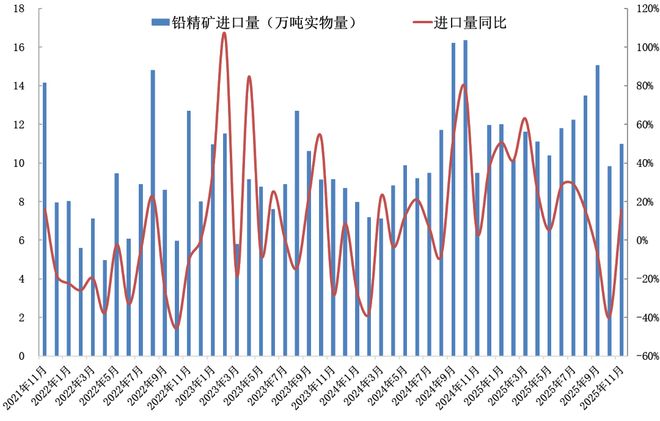
Group 1: Lead Concentrate Import - In November 2025, China's lead concentrate imports reached 110,000 tons, a year-on-year increase of 15.8% and a month-on-month increase of 11.7% [1] - From January to November 2025, cumulative imports of lead concentrate totaled 1.27 million tons, reflecting a year-on-year growth of 12.1%, with the growth rate expanding by 0.4 percentage points compared to the previous period [1] Group 2: Silver Concentrate Import - In November 2025, China imported 18,100 tons of silver concentrate, marking a year-on-year increase of 26.5% and a month-on-month increase of 21.1% [2] - Cumulative imports of silver concentrate from January to November 2025 reached 167,700 tons, with a year-on-year growth of 8.4%, an increase of 1.8 percentage points compared to the previous period [2] Group 3: Refined Lead Import and Export - In November 2025, the import volume of refined lead was 8,656 tons, a significant year-on-year increase of 961.5% and a month-on-month increase of 127.0% [3] - The export volume of refined lead in November 2025 was 1,148 tons, a year-on-year decrease of 45.6% and a month-on-month decrease of 45.3% [3] Group 4: Lead Alloy Import - In November 2025, net imports of lead alloy were 16,000 tons, an increase of 7,800 tons year-on-year [4] - Cumulative net imports of lead alloy from January to November 2025 reached 114,000 tons, reflecting a year-on-year increase of 18,000 tons [4] Group 5: Lead-Acid Battery Export - In November 2025, China exported 15.8 million lead-acid batteries, a year-on-year decrease of 21.3% and a month-on-month decrease of 5.1% [5] - Cumulative exports of lead-acid batteries from January to November 2025 totaled 201.96 million units, a year-on-year decline of 10.3% [5] Group 6: Lead-Acid Battery Parts Export - In November 2025, net exports of lead-acid battery parts were 8,237.2 tons, a year-on-year increase of 27.8% [6] - Cumulative net exports of lead-acid battery parts from January to November 2025 reached 85,000 tons, reflecting a year-on-year increase of 88.2% [6]
2026年铅期货年度行情展望:供需双弱,上下有限
Guo Tai Jun An Qi Huo· 2025-12-19 09:59
Report Industry Investment Rating No relevant information provided. Core Viewpoints of the Report - Based on the judgment that the lead market will maintain a situation of strong supply and weak demand in 2026, prices are expected to fluctuate within a range. The main operating range for Shanghai lead is 16,000 - 18,000 yuan/ton, and for London lead, it is 1,900 - 2,100 US dollars/ton [1][67]. - In 2026, the domestic market may have a slight surplus. The supply of lead ore is expected to improve, the supply of waste batteries may increase slightly, and the production of refined lead will continue to grow. The demand side may be supported by the continued replacement consumption and the positive growth of two - wheeled electric vehicles. The energy storage demand is growing explosively, and the incremental space for lead - carbon batteries is broad. However, the export of lead - acid batteries may face pressure, and the overall supply - demand situation is weak, with prices remaining range - bound. The price - holding intention in the waste battery recycling sector is strengthening year by year, which is expected to continuously lift the bottom of the lead price [1][67]. - It is recommended to pay attention to seasonal fluctuation opportunities. After the small spring of consumption at the beginning of the year, consumption weakens marginally, and prices may fall under pressure. In the middle of the year, battery manufacturers replenish stocks in advance for the consumption peak season, while the supply of waste batteries does not increase significantly during the replacement consumption peak season, which may bring a temporary supply - demand gap and inject upward momentum into prices [2][67]. Summary by Directory 1. 2025 Review: First Decline then Rise, with a Slow Uptrend in the Center of Gravity - In January 2025, the lead price declined due to the end of downstream inventory preparation, high finished - product inventory, and a potentially longer Spring Festival holiday. In February, the price rose initially but then fluctuated after factoring in the expected production increase of large downstream manufacturers. In March, the price increased as consumption recovered and downstream battery companies increased inventory. In April, it declined due to macro - tariff impacts and the entry into the consumption off - season. In May and June, prices fluctuated in a weak supply - demand situation [7]. - From July to December, the lead price showed a complex trend. In July, it first rose and then fell due to changes in supply and demand. In August, it fluctuated weakly. In September, it rose after a period of fluctuation. In October, it trended strongly with obvious supply pressure on primary lead and incremental demand. In November, it climbed and then declined as primary lead production increased and secondary lead production grew rapidly [8][9]. 2. Supply - Demand Weakness, with Dull Fundamental Contradictions 2.1 Lead Ore Supply is Rigid, but There Will Be Increment in the Next Year - In the long - term, overseas mining enterprises' capital expenditure in lead ore has been low, resulting in relatively rigid global lead ore production. The supply cycle of lead ore is more closely related to that of zinc ore. In 2025, global lead ore supply disturbances increased, and overseas production increments were limited. For 2026, there is an expected increment of 100,000 tons, with a year - on - year growth rate of 2.2% [10][13][14]. 2.2 Domestic Mines Increased Production This Year, but Realistic Contradictions Still Exist - In 2025, from January to November, China's lead concentrate production increased by 10.4% year - on - year, mainly due to the production increase of mines such as Xinjiang Huoshaoyun. It is expected to contribute an increment of 100,000 tons in 2026. The continuous tight supply of lead concentrate has squeezed the profit margin of primary lead smelting. China's lead raw material import structure is becoming more diversified, but the import profit of lead concentrate is meager [20][26]. 2.3 Insufficient Endogenous Power, Driven by By - Product Profits - Since March 2025, the thickening of primary lead plant profits has driven high - level production. By - product profits such as silver and sulfuric acid have become the main factors driving the supply elasticity of primary lead plants. Assuming that the prices of by - products remain high in 2026, primary lead supply is expected to continue to grow slightly, and supply elasticity may increase [33][34]. 2.4 Problems in Secondary Lead Supply Still Exist, Forming a Strong Constraint - China's secondary lead production capacity is severely over - supplied, and the shortage of raw materials has led to low - level production. Since the second quarter, secondary lead enterprises have suffered losses, and it is expected that the production of secondary lead will continue to decline in 2026. Although there will be more incremental supply in the long - term, the growth rate of capacity expansion may slow down, and some enterprises are transforming to a multi - raw material production mode [36][37]. 3. Is the Demand Really Collapsing: A Flash in the Pan or a Steady Stream? 3.1 Policy Boosts Consumption, Electric Bicycles Return to Positive Growth, and Automobile Exports Contribute Significantly - In 2025, new national standards and national subsidy policies have stimulated the growth of the electric bicycle industry. Automobile consumption policies have also continuously increased, and the trade - in policy has effectively boosted consumption. It is expected that the trade - in subsidy scale will continue to be maintained at 300 billion yuan in 2026 [46][52][53]. 3.2 Explosive Growth in Energy Storage Demand, Vast Incremental Space in the Future - The energy storage demand for lead - acid/lead - carbon batteries is growing explosively. Lead - acid batteries have cost, safety, recycling, and low - temperature performance advantages, but also have performance shortcomings. In 2025, the lead consumption of lead - carbon batteries was 27,300 tons in the first three quarters, and it is expected to increase by 28,300 tons in 2026, with a marginal contribution to consumption of 0.4% [60][61]. 3.3 High Domestic - Foreign Price Ratio and Tariff Impacts Weigh on Lead - Acid Battery Exports - In 2025, the export volume of lead - acid batteries declined rapidly due to the expansion of the domestic - foreign price ratio and tariff impacts. The anti - dumping tariff imposed by the GCC on Chinese lead - acid batteries will take effect in 2026, which may significantly reduce the export volume [64]. 4. Conclusion and Investment Outlook - In 2026, the lead market will maintain a situation of weak supply and demand, with prices fluctuating within a range. The main operating range for Shanghai lead is 16,000 - 18,000 yuan/ton, and for London lead, it is 1,900 - 2,100 US dollars/ton. It is recommended to pay attention to seasonal fluctuation opportunities [67].
铅周报:资金离场持仓下行,沪铅重回运行中枢-20251129
Wu Kuang Qi Huo· 2025-11-29 11:56
Report Investment Rating - No investment rating for the industry is provided in the report. Core Viewpoint - From the perspective of industrial data, the visible inventory of lead ore has increased, but the smelting start - up rate of primary lead has declined, while that of secondary lead has continued to rise. The weekly start - up rate of downstream battery enterprises has increased marginally, and the visible inventory of domestic lead ingots has decreased marginally. In terms of funds, after two consecutive weeks of decline, the lead price has returned to the oscillation center of 17,000 yuan. Considering the Fed's interest - rate cut cycle, the sentiment in the non - ferrous metals industry is relatively positive, and the short - term lead price is expected to be strong [11]. Summary by Directory 1. Weekly Assessment - **Price Review**: On Friday, the Shanghai Lead Index closed up 0.77% at 17,087 yuan/ton with a total unilateral trading position of 73,500 lots. As of 15:00 on Friday, LME Lead 3S rose 13 to $1,990/ton with a total position of 166,200 lots. The average price of SMM 1 lead ingots and secondary refined lead was 16,975 yuan/ton, with a flat price difference between refined and scrap. The average price of waste electric vehicle batteries was 9,900 yuan/ton [11]. - **Domestic Structure**: According to Steel Union data, the domestic social inventory of lead ingots decreased slightly to 35,300 tons. The futures inventory of lead ingots on the Shanghai Futures Exchange was 26,300 tons, with an internal primary basis of - 65 yuan/ton and a spread of - 35 yuan/ton between consecutive contracts. **Overseas Structure**: The LME lead ingot inventory was 264,200 tons, and the LME lead ingot cancelled warrants were 140,400 tons. The external cash - 3S contract basis was - $38.94/ton, and the 3 - 15 spread was - $82.8/ton. **Cross - Market Structure**: After excluding exchange rates, the Shanghai - London ratio was 1.215, and the import profit and loss of lead ingots was 143.13 yuan/ton [11]. - **Industrial Data**: At the primary end, the port inventory of lead concentrate was 32,000 tons, and the factory inventory was 474,000 tons, equivalent to 30.7 days. The import TC of lead concentrate was - $135/dry ton, and the domestic TC was 300 yuan/metal ton. The primary smelting start - up rate was 65.32%, and the primary ingot factory inventory was 9,000 tons. At the secondary end, the waste lead inventory was 102,000 tons, the weekly output of secondary lead ingots was 46,000 tons, and the secondary ingot factory inventory was 7,000 tons. At the demand end, the start - up rate of lead - acid battery enterprises was 73.39% [11]. 2. Primary Supply - **Import and Production**: In October 2025, the net import of lead concentrate was 98,300 physical tons, a year - on - year change of - 39.7% and a month - on - month change of - 34.6%. From January to October, the cumulative net import was 1,167,300 physical tons, a cumulative year - on - year change of 14.0%. The net import of silver concentrate in October was 149,400 physical tons, a year - on - year change of 11.4% and a month - on - month change of - 7.0%. From January to October, the cumulative net import was 1,507,900 physical tons, a cumulative year - on - year change of 5.4%. In October, China's lead concentrate production was 146,200 metal tons, a year - on - year change of 10.6% and a month - on - month change of - 3.4%. From January to October, the total production was 1,395,300 metal tons, a cumulative year - on - year change of 11.4%. The net import of lead - containing ore in October was 118,700 metal tons, a year - on - year change of - 21.6% and a month - on - month change of - 23.2%. From January to October, the cumulative net import was 1,303,500 metal tons, a cumulative year - on - year change of 9.9% [15][17]. - **Total Supply**: In October 2025, China's total supply of lead concentrate was 264,900 metal tons, a year - on - year change of - 6.6% and a month - on - month change of - 13.4%. From January to October, the cumulative supply was 2,698,800 metal tons, a cumulative year - on - year change of 10.7%. In August 2025, the global lead ore production was 383,300 tons, a year - on - year change of - 1.2% and a month - on - month change of 0.5%. From January to August, the total production was 3,008,800 tons, a cumulative year - on - year change of 3.1% [19]. - **Inventory and Processing Fees**: At the primary end, the port inventory of lead concentrate was 32,000 tons, and the factory inventory was 474,000 tons, equivalent to 30.7 days. The import TC of lead concentrate was - $135/dry ton, and the domestic TC was 300 yuan/metal ton [21][23]. - **Smelting and Production**: The primary smelting start - up rate was 65.32%, and the primary ingot factory inventory was 9,000 tons. In October 2025, China's primary lead production was 326,000 tons, a year - on - year change of 2.7% and a month - on - month change of - 0.5%. From January to October, the total production of primary lead ingots was 3,186,900 tons, a cumulative year - on - year change of 7.7% [26]. 3. Secondary Supply - **Raw Materials and Weekly Output**: At the secondary end, the waste lead inventory was 102,000 tons. The weekly output of secondary lead ingots was 46,000 tons, and the secondary ingot factory inventory was 7,000 tons. In October 2025, China's secondary lead production was 346,300 tons, a year - on - year change of 11.9% and a month - on - month change of 9.2%. From January to October, the total production of secondary lead ingots was 3,235,100 tons, a cumulative year - on - year change of 2.7% [31][33]. - **Net Export and Total Supply**: In October 2025, the net export of lead ingots was - 15,100 tons, a year - on - year change of 92.6% and a month - on - month change of 21.9%. From January to October, the cumulative net export of lead ingots was - 95,200 tons, a cumulative year - on - year change of - 43.5%. In October, the total domestic supply of lead ingots was 687,400 tons, a year - on - year change of 8.3% and a month - on - month change of 4.6%. From January to October, the cumulative domestic supply of lead ingots was 6,517,200 tons, a cumulative year - on - year change of 3.8% [35]. 4. Demand Analysis - **Battery Start - up Rate and Apparent Demand**: At the demand end, the start - up rate of lead - acid battery enterprises was 73.39%. In October 2025, the apparent domestic demand for lead ingots was 689,700 tons, a year - on - year change of 5.9% and a month - on - month change of - 4.1%. From January to October, the cumulative apparent domestic demand for lead ingots was 6,526,400 tons, a cumulative year - on - year change of 3.9% [40]. - **Battery Export**: In October 2025, the net export quantity of batteries was 1,614,520 units, and the net export weight was 84,600 tons. It was estimated that the net export of lead in batteries was 52,900 tons, a year - on - year change of - 15.1% and a month - on - month change of - 12.8%. From January to October, the total net export of lead in batteries was 607,600 tons, and the cumulative net export of lead in batteries had a year - on - year change of - 5.0% [43]. - **Inventory Days**: In October 2025, the finished product inventory days of lead - acid battery factories increased from 19.7 days to 24.5 days, and the inventory days of lead - acid batteries for dealers increased from 39.7 days to 41 days [45]. - **Terminal Demand**: In the two - wheeled vehicle sector, although the production decline of electric bicycles directly dragged down the new installation demand, the continuous growth of delivery scenarios such as express delivery and takeaway drove the improvement of the new installation consumption of electric two - and three - wheeled vehicles. In the automotive sector, the contribution of lead demand is expected to maintain stable growth. Although new energy vehicles are gradually replacing lead - acid start - up batteries, the high stock of existing vehicles still provides support for lead consumption. In the base station sector, the increasing number of communication base stations and 5G base stations driven by the development of communication technology has led to a steady increase in the demand for lead - acid batteries [49][51][54]. 5. Supply - Demand and Inventory - **Domestic Supply - Demand Gap**: In October 2025, the domestic supply - demand gap of lead ingots was a shortage of - 2,400 tons. From January to October, the cumulative domestic supply - demand gap of lead ingots was a shortage of - 9,200 tons [63]. - **Overseas Supply - Demand Gap**: In August 2025, the overseas supply - demand gap of refined lead was a shortage of - 19,400 tons. From January to August, the cumulative overseas supply - demand gap of refined lead was a shortage of - 46,900 tons [66]. 6. Price Outlook - **Domestic Basis and Spread**: According to Steel Union data, the domestic social inventory of lead ingots decreased slightly to 35,300 tons. The futures inventory of lead ingots on the Shanghai Futures Exchange was 26,300 tons, with an internal primary basis of - 65 yuan/ton and a spread of - 35 yuan/ton between consecutive contracts [71]. - **Overseas Basis and Spread**: The LME lead ingot inventory was 264,200 tons, and the LME lead ingot cancelled warrants were 140,400 tons. The external cash - 3S contract basis was - $38.94/ton, and the 3 - 15 spread was - $82.8/ton [74]. - **Internal - External Spread**: After excluding exchange rates, the Shanghai - London ratio was 1.215, and the import profit and loss of lead ingots was 143.13 yuan/ton [77]. - **Position Analysis**: The net short position of the top 20 holders of Shanghai Lead decreased significantly, the net long position of investment funds in LME Lead decreased, and the net short position of commercial enterprises decreased. From the perspective of positions, the short - term guidance is bullish [80].
国城矿业跌2.03%,成交额9128.48万元,主力资金净流出928.51万元
Xin Lang Cai Jing· 2025-10-16 05:35
Core Viewpoint - Guocheng Mining's stock price has shown volatility, with a year-to-date increase of 21.61% but a recent decline of 7.31% over the past five trading days, indicating potential market fluctuations and investor sentiment changes [2]. Company Overview - Guocheng Mining Co., Ltd. is located in Fengtai District, Beijing, and was established on November 10, 1978, with its stock listed on January 20, 1997. The company primarily engages in lead-zinc mining and related businesses [2]. - The revenue composition of Guocheng Mining includes: titanium dioxide (53.55%), zinc concentrate (21.05%), iron concentrate (8.37%), lead concentrate (4.38%), copper concentrate (3.87%), silver concentrate (2.92%), sulfuric acid (2.91%), sulfur concentrate (1.81%), others (1.04%), and sulfur iron powder (0.09%) [2]. Stock Performance - As of October 16, Guocheng Mining's stock price was 14.46 CNY per share, with a market capitalization of 16.273 billion CNY. The stock experienced a trading volume of 91.2848 million CNY and a turnover rate of 0.55% [1]. - The net outflow of main funds was 9.2851 million CNY, with significant selling pressure observed [1]. Financial Performance - For the period from January to June 2025, Guocheng Mining achieved a revenue of 1.085 billion CNY, representing a year-on-year growth of 39.74%. The net profit attributable to shareholders was 521 million CNY, showing a remarkable increase of 1111.34% [2]. Shareholder Information - As of September 19, the number of shareholders for Guocheng Mining was 25,800, a decrease of 2.35% from the previous period. The average circulating shares per person increased by 2.40% to 43,643 shares [2]. - The company has distributed a total of 235 million CNY in dividends since its A-share listing, with 59.2363 million CNY distributed over the past three years [3]. Institutional Holdings - As of June 30, 2025, Hong Kong Central Clearing Limited was the eighth largest circulating shareholder, holding 6.641 million shares, a decrease of 571,200 shares compared to the previous period [3].

罗平锌电控制权拟转移给曲靖发投
Zheng Quan Shi Bao Wang· 2025-05-27 12:35
Group 1 - The controlling shareholder of Luoping Zinc & Electricity is planning to transfer control of the company to a municipal state-owned asset management entity, which would elevate the control from county-level to city-level [1] - The transfer involves the agreement to transfer 72.4276 million shares, accounting for 22.3960% of the total share capital, to Qujing Development Investment Group [1] - The stock of Luoping Zinc & Electricity will be suspended from trading starting May 28, with an expected suspension period of no more than two trading days [1] Group 2 - Luoping Zinc & Electricity has faced operational challenges in recent years due to environmental pollution and litigation issues, resulting in a lack of performance highlights [2] - In Q1 2025, the company reported a revenue of 185 million yuan, a year-on-year decrease of 53.55%, and a loss of 45.0088 million yuan compared to a loss of 29.526 million yuan in the same period last year [2] - The company aims to produce 80,000 tons of zinc ingots and achieve a revenue of 1.918 billion yuan in 2025 [2] Group 3 - In the 2024 annual performance meeting, the company indicated a significant improvement in profitability, with a gross margin turning positive, reflecting effective cost control and production efficiency [2] - The net cash flow from operating activities for 2024 was 103 million yuan, indicating sustained net inflow from operations [2] - The zinc industry is characterized by "tight supply, weak recovery, and high volatility," with long-term trends pointing towards green transformation and new technology applications reshaping the industry landscape [2]

国城矿业: 国城矿业股份有限公司公开发行可转换公司债券2025年跟踪评级报告
Zheng Quan Zhi Xing· 2025-05-21 13:25
Company Overview - Guocheng Mining Co., Ltd. has been downgraded to a long-term credit rating of A+ by Lianhe Credit Rating Co., Ltd. with a stable outlook for both the company and its convertible bonds [1][3] - The company primarily engages in non-ferrous metal mining and selection, with a focus on zinc, lead, and sulfur iron resources [10][12] Financial Performance - As of the end of 2024, the company reported total assets of 9.272 billion yuan and total equity of 3.431 billion yuan, with an operating revenue of 1.918 billion yuan and a net profit of -55 million yuan [10][12] - The company experienced a decline in profitability, with total capital return rate and net asset return rate at 0.12% and -3.40% respectively in 2024 [5][9] - The company’s cash flow from operating activities decreased, resulting in a net cash outflow of 338 million yuan in the first quarter of 2025 [9] Operational Developments - The company’s subsidiary, Inner Mongolia Dongshengmiao Mining Co., Ltd., maintains good resource endowment and is gradually expanding production, with a sulfur-titanium iron resource recycling project having completed trial production [3][6] - The company plans to acquire at least 60% of the equity of Inner Mongolia Guocheng Industrial Co., Ltd., which is a large molybdenum metal mine, enhancing its resource base [6][12] Management and Governance - The company has a relatively stable corporate governance structure, but frequent changes in board members and senior management have been noted [5][12] - The company has faced administrative penalties due to safety production incidents, indicating areas for improvement in management capabilities [7][16] Industry Context - The non-ferrous metal industry is characterized by significant cyclicality and is influenced by international supply-demand dynamics and geopolitical factors [11] - The industry has seen a rise in demand for traditional industrial metals like copper and aluminum, while new energy metals face price pressures due to supply-demand imbalances [11]
铅锌日评:原料不足引发炼厂减产,铅价下方支撑较强,沪锌区间整理-20250513
Hong Yuan Qi Huo· 2025-05-13 06:36
Report Investment Rating - No investment rating for the industry is provided in the report. Core Viewpoints - For lead, the raw material shortage problem remains unsolved, with some secondary lead smelters reducing production due to insufficient raw materials. The demand is in the off - season. Cost support and weak demand are in a tug - of - war. Short - term lead prices are expected to be in a wide - range consolidation, and subsequent macro uncertainties should be continuously monitored [1]. - For zinc, the macro sentiment is stable and positive, but the fundamentals of SHFE zinc are weak. Short - term zinc prices are expected to be in a wide - range consolidation. In the medium - to - long - term, TC still has room to rise, and the center of zinc prices may move down. Subsequent macro sentiment disturbances should be continuously monitored [1]. Summary According to Related Catalogs Lead Price and Market Data - The average price of SMM1 lead ingots was 16,750 yuan/ton, up 0.75% from the previous day. The closing price of the main SHFE lead futures contract was 16,995 yuan/ton, up 1.13% [1]. - The SHFE lead basis was - 245 yuan/ton, a decrease of 65 yuan/ton. The trading volume of the active futures contract was 42,622 lots, up 47.20%, and the open interest was 33,309 lots, down 0.43% [1]. - The LME lead inventory was 251,800 tons, with no change. The SHFE - LME lead price ratio was 8.58, up 1.13% [1]. Industry News - As of May 12, a large lead smelter in Central China will conduct a one - week regular maintenance on its waste battery disassembly production line, and the procurement of waste lead - acid batteries will remain normal [1]. - On May 9, Australian mining company South32 announced that its Hermosa mine project in Arizona reached a key approval node, and the US Forest Service (USFS) officially released the environmental impact assessment draft of the project. The construction of Hermosa has been 40% completed [1]. Fundamental Analysis - The production of primary lead is stable with a slight increase. For secondary lead, the price of waste lead - acid batteries has been rising, and recyclers have limited supplies. Some secondary lead smelters have reduced or stopped production due to cost inversion, and the operating rate has significantly declined [1]. - The demand is in the off - season, and downstream purchasing is weak, providing limited support for lead prices [1]. Zinc Price and Market Data - The average price of SMM1 zinc ingots was 22,650 yuan/ton, down 0.22% from the previous day. The closing price of the main SHFE zinc futures contract was 22,490 yuan/ton, up 1.35% [1]. - The trading volume of the active SHFE zinc futures contract was 229,910 lots, up 64.20%, and the open interest was 118,030 lots, down 0.96% [1]. - The LME zinc inventory was 169,850 tons, with no change. The SHFE - LME zinc price ratio was 8.48, up 1.35% [1]. Industry News - As of May 12, the total inventory of SMM zinc ingots in seven regions was 8.55 million tons, an increase of 0.14 million tons compared with May 6 and an increase of 0.22 million tons compared with May 8 [1]. - On May 11, Pan American announced a final agreement to acquire all the issued common shares of MAG Silver through an arrangement plan with a total consideration of approximately $2.1 billion. After the transaction, MAG shareholders will hold about 14% of Pan American. MAG Silver holds a 44% stake in the Juanicipio silver - lead - zinc mine [1]. Fundamental Analysis - Zinc smelters have sufficient raw material stocks, and zinc concentrate processing fees are continuously rising. The limitation of raw material shortage on smelter production has weakened, and the cost - side support has decreased. The profit and production enthusiasm of smelters have improved, and the production increase trend is obvious [1]. - After the May Day holiday, production - cut enterprises have actively resumed production, but the terminal demand has not improved. In different sectors, the operating rate of galvanizing enterprises has significantly increased, but downstream purchasing is mainly for rigid demand; the electronic orders of the die - casting zinc alloy sector are good, but the demand for traditional hardware accessories is weak; the export orders of zinc oxide are uncertain due to the EU's anti - dumping investigation on Chinese tires [1].