可获得性悖论

Search documents
从MOLLY到星星人,这个河南老板的IP“换代速度”比迪士尼还快
3 6 Ke· 2026-02-11 01:12
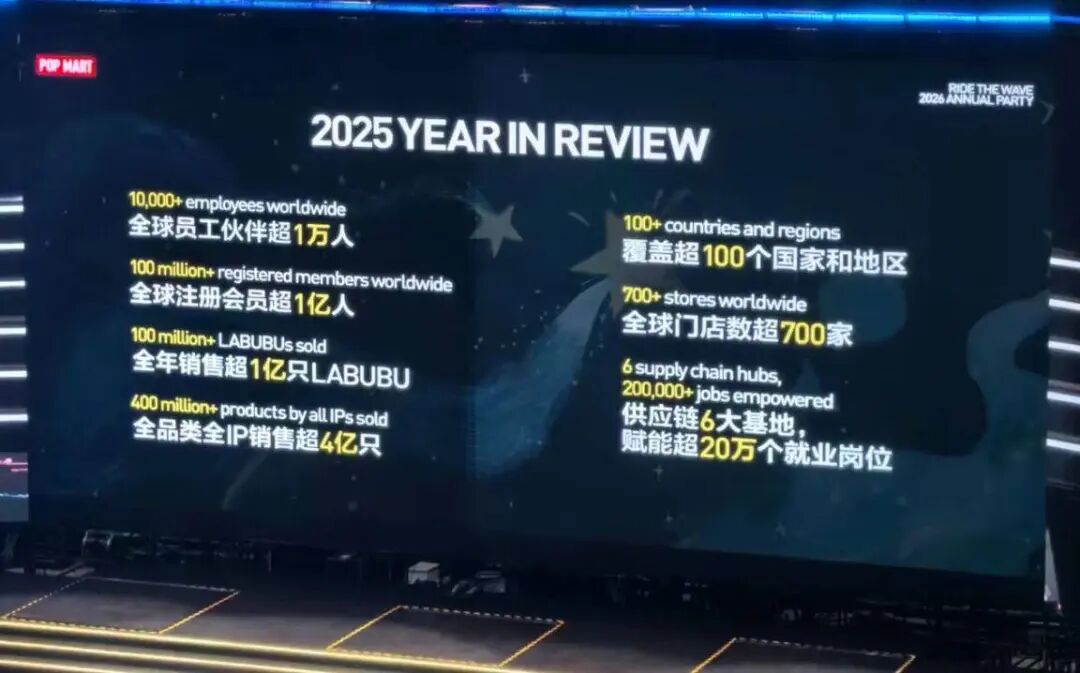
Core Insights - The annual meeting of Pop Mart has significantly impacted its stock price, with a notable increase of 4.90% to HKD 269.8 per share, resulting in a market capitalization of HKD 361.95 billion since the event [1] - Key data revealed during the annual meeting includes over 10,000 global employees, more than 100 million registered members, and sales figures indicating strong growth in various product categories [1] Group 1: Performance and Market Reaction - Following the annual meeting, Pop Mart's stock price experienced a substantial rise, with a two-day increase of nearly 5% [1] - Despite strong performance in 2025, the stock faced pressure in the latter half of the year, dropping from HKD 339 in August to around HKD 170 by December [3] - The company initiated a share buyback plan in January 2026, which contributed to a rebound in stock price [3] Group 2: LABUBU's Impact - LABUBU, a key product for Pop Mart, sold over 100 million units in 2025, driving significant sales growth [11] - The product gained international popularity, with sales in the Americas increasing by 1,142.3% to HKD 2.265 billion, and European sales rising by 729.2% to HKD 478 million [6] - LABUBU's peak pricing on secondary markets reached HKD 4,522, reflecting a 44.7 times premium over its original price [6] Group 3: IP Development and Future Strategy - Pop Mart is actively developing new IPs, with "Star People" emerging as a potential successor to LABUBU, showcasing the company's ability to innovate and adapt [12][14] - The company has established a robust pipeline of over 350 artists contributing to its IP portfolio, ensuring a continuous flow of new ideas [17] - Pop Mart is expanding its business model beyond toys, launching a jewelry brand and a bakery that incorporates its IPs into consumable products, aiming to enhance brand visibility and consumer engagement [18][24]

泡泡玛特没变,资本先变脸了
3 6 Ke· 2025-12-23 00:33
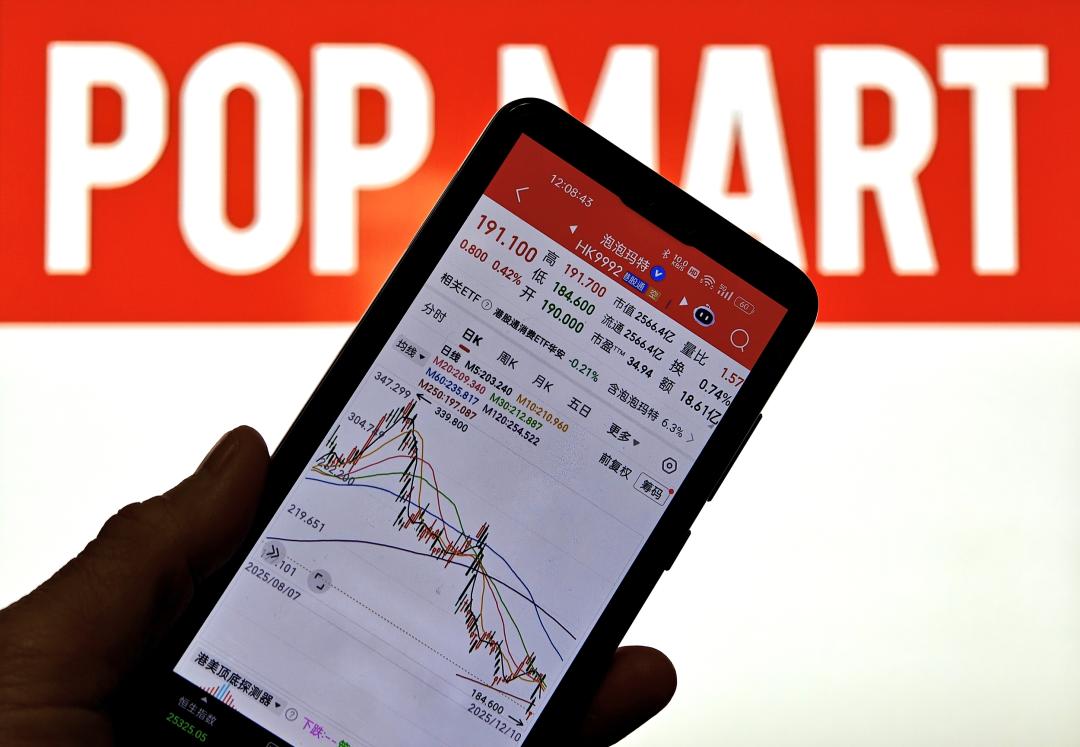
Core Viewpoint - The scarcity of Pop Mart has diminished significantly due to a substantial increase in production capacity, leading to a wave of short-selling by institutions and a collective sell-off by previously profitable investors, resulting in a market value loss of HKD 197.2 billion since the stock peaked in late August [1][4]. Group 1: Stock Performance - As of December 19, Pop Mart's stock closed at HKD 192.9, down 0.16%, with a cumulative decline of 43.23% from its historical high of HKD 339.8 four months prior, equating to a market value evaporation of HKD 197.2 billion [1][4]. - On December 22, the stock rebounded by 4.61%, reaching HKD 200, with a total market value of HKD 271 billion [1]. - The stock's volatility has been accompanied by heightened emotional and controversial discussions among investors, contrasting with the more stable declines of other companies in the same sector [1][2]. Group 2: Investor Sentiment - Following the stock's decline, discussions among investors have surged, with debates centering on whether Pop Mart represents a bubble or a rational market correction [2]. - Investors have been actively assessing foot traffic and restocking in physical stores to determine whether to buy more shares or cut losses [2]. Group 3: Company Actions - Despite the stock's downturn, Pop Mart has not issued any statements or conducted buybacks, focusing instead on operational strategies, including the appointment of LVMH's former president for Greater China to its board [4]. - On December 19, Pop Mart announced the launch of a new product series priced at 79 yuan each, marking its second price increase since 2021 [4]. Group 4: Fund Activity - Data shows that the number of public funds holding Pop Mart shares peaked at 311 in Q2, with a total of 72.3 million shares, but dropped to 197 funds and 51.7 million shares by Q3, indicating a significant sell-off of 2.06 million shares and a 28.52% decrease in holding ratio [5]. Group 5: Short Selling - As the stock price fell, short-selling activities intensified, with Pop Mart leading the home appliance and goods sector in short-selling amounts, reaching HKD 341 million and a short-selling ratio of 21.47% on December 19 [7]. Group 6: Market Dynamics - The recent stock decline is attributed to a combination of "overdrawn expectations" and "reality gaps," with analysts noting that the stock's rise was based on high expectations that are now being corrected [8]. - The stock experienced a 17.25% drop in September, with market confidence in the scarcity premium of Pop Mart's IP beginning to wane [10]. - Despite a strong Q3 earnings report, the stock continued to decline by 16.94% in October, as the market adjusted its expectations [10]. Group 7: Future Outlook - Analysts predict a slowdown in sales growth for Pop Mart, with expectations for Q4 sales growth in the U.S. to drop below 500%, down from over 1200% in Q3 [11]. - Concerns have been raised about the sustainability of Pop Mart's business model as it transitions from explosive growth to a phase of sustainable growth, with warnings about the diminishing scarcity of its products [11][12]. - The company is taking steps to address these challenges by ceasing point redemption for discounts and focusing on content production to enhance its IP [16].

泡泡玛特如何逃离“LABUBU悖论”?
财富FORTUNE· 2025-12-12 13:02
Core Viewpoint - The stock price of Pop Mart has been on a continuous decline for nearly four months, dropping over 40% from its mid-year peak, raising concerns among multiple institutions about the company's future prospects [1][4]. Group 1: Stock Performance and Market Sentiment - As of December 12, Pop Mart's market capitalization has evaporated by nearly 200 billion HKD since its high in August [1]. - Despite a significant increase in stock price earlier this year, the company is now facing skepticism from various foreign institutions, which have issued bearish reports [4]. - The stock price fell over 8% on the day the company announced a 245% year-on-year revenue growth for Q3 2025, indicating a disconnect between performance and market perception [4][5]. Group 2: Product Supply and Demand Dynamics - The stock price decline coincided with a supply increase of the LABUBU product, which led to a decrease in its market value and a cooling of consumer demand [3][6]. - The company increased LABUBU's production capacity from an average of 10 million units per month in the first half of the year to 50 million units by year-end, impacting its scarcity premium [6]. Group 3: Strategic Changes and Future Outlook - A recent appointment of a former LVMH executive as a non-executive director suggests a potential shift towards exploring higher-end collaborations [7]. - Pop Mart has not engaged in stock buybacks during the recent downturn, contrasting with its previous actions during past low points, indicating a different approach to market confidence and capital allocation [7][9]. - The company is at a crossroads, with analysts providing two valuation scenarios: a bearish outlook if LABUBU's popularity declines without new IPs, and a bullish scenario if existing IPs maintain their appeal and new ones emerge [9].
泡泡玛特与LV再连接:一场彼此需要的结盟
Hua Er Jie Jian Wen· 2025-12-11 15:53
Core Viewpoint - Pop Mart's trendy toy business is increasingly connecting with the luxury goods sector, as evidenced by the appointment of LVMH's Greater China President, Wu Yue, to its board of directors [2][5]. Group 1: Strategic Developments - Wu Yue's appointment may indicate Pop Mart's further exploration into the core circle of international fashion trends [3]. - The company has been compared to luxury brands like Hermes due to its high gross margin of nearly 70% since its performance explosion [3]. - Pop Mart's collaboration with LVMH and its luxury brands could signify a shift from mere marketing to deeper strategic interactions [13]. Group 2: Market Dynamics - The demand for scarcity is a common pursuit in both the trendy toy and luxury goods industries, where exclusivity enhances social status and identity recognition [6]. - Pop Mart's products, particularly in the secondary market, have seen a decline in premium pricing, indicating a cooling of consumer interest compared to previous "one toy hard to find" scenarios [4][11]. - The company aims to balance IP value, scarcity, and revenue scalability, which remains a long-term challenge [15]. Group 3: Financial Performance and Challenges - In the first half of 2025, the MEGA series generated nearly 1 billion yuan, accounting for 7% of total revenue [10]. - Pop Mart's stock price has dropped over 45% since its peak, with a market capitalization loss exceeding 200 billion HKD, reflecting investor concerns over declining resale prices and market sentiment [16][17]. - The company is facing a "availability paradox," where increased production capacity is transforming its core IP LABUBU from a scarce trend symbol to a mass-market product, potentially signaling a decline in popularity [19]. Group 4: Future Prospects - Pop Mart is expanding its international presence, with plans to open 200 new stores by the end of the year, maintaining a pace of approximately three new stores per week [14]. - The company is also diversifying its IP portfolio, with notable growth from new IPs like CRYBABY and Star People, which are expected to contribute significantly to revenue [14]. - Collaborations with major brands and the development of immersive experiences are part of Pop Mart's strategy to deepen emotional connections with consumers [27].
泡泡玛特市值跌没了一个海天味业:挤泡沫还是被做空?
Xin Lang Cai Jing· 2025-12-10 07:18
Core Viewpoint - Pop Mart's stock price has significantly declined, dropping 44% from its August peak, leading to a market value loss of over 200 billion HKD, comparable to a major company like Haitian Flavoring and Food [1][2] Stock Performance - In the last seven trading days, Pop Mart's stock has only seen two days of gains, with significant declines on other days, reflecting a market capitalization reduction of over 40% since the peak on August 29 [1][2] - The stock was initially listed at 80 HKD per share in late 2020, fell below 10 HKD in late 2022, and reached a high of 339.8 HKD on August 29, 2025 [1] Market Concerns - Concerns have arisen regarding Pop Mart's sales performance during the upcoming Black Friday promotions in the U.S., with expectations that the market interest in new products may not meet previous levels [2][4] - The premium on hidden versions of products has decreased by over 50%, and regular versions are selling below official retail prices on secondary markets [4] Growth and Revenue Projections - Deutsche Bank's report indicates that while there is a strong growth driven by the Labubu IP, there are significant risks related to supply and demand imbalances [5] - Two contrasting scenarios for future growth have been proposed: one predicting a 20% decline in domestic revenue and a 10% decline in overseas revenue by 2026, and another forecasting a 30% increase in domestic revenue and a 50% increase in overseas revenue [5] Business Model and Strategy - Pop Mart has successfully transitioned from a retail company to an IP incubation operation, creating a matrix of popular IPs, including Labubu and Crybaby [8][10] - The company has increased its production capacity from an average of 10 million units per month to 50 million units by the end of the year, significantly boosting revenue and profit [9][10] Challenges of Mass Production - The rapid expansion of production capacity may dilute the brand's appeal, as products that were once scarce become widely available, potentially transforming them into mass-market items [10][11] - The company is advised to shift from explosive growth to sustainable growth, emphasizing the importance of maintaining the "cool" and "scarcity" attributes of its products [12][13] Comparison with Disney - Pop Mart's business model is still in its early stages compared to Disney, which has diversified into entertainment, sports, and experiential sectors, generating substantial revenue [15][18] - Disney's success is attributed to its ability to create emotional connections through IP and monetize them across various platforms, a strategy that Pop Mart has yet to fully adopt [19][20] Future Directions - To evolve into a "emotional consumption ecosystem," Pop Mart needs to explore new markets and develop business areas closely related to its core IPs, moving beyond just selling toys [20][21][22]

德银:月产5000万只!当Labubu不再稀缺,泡泡玛特拿什么接棒?
美股IPO· 2025-12-01 10:38
Group 1: Availability Paradox and Market Dynamics - Deutsche Bank warns that Pop Mart is facing an "Availability Paradox" as its production capacity aggressively expands to 50 million units per month by year-end, leading to Labubu transitioning from a scarce trendy IP to a mass consumer product, which may signal a decline in popularity for trend-driven toys [1] - If Labubu's popularity peaks in 2026 without new hit products, valuation pressure on Pop Mart will increase significantly [1] Group 2: Copper Market Supply and Price Forecast - Deutsche Bank indicates that the global copper market is experiencing a supply squeeze, with severe supply disruptions pushing copper prices close to historical highs [3] - The report predicts a decline in mine supply by 2025, with only a 1% rebound expected the following year, resulting in a "clear deficit" in the market [3] - As a result, Deutsche Bank raises its copper price forecast for 2026 to $10,600 per ton, with potential peaks exceeding $11,000 per ton in the first half of 2026 [3][6] Group 3: Key Company Updates and Investment Focus - Glencore is set to hold its first Capital Markets Day (CMD) in two years, aiming to restore market confidence in its operational capabilities, while Rio Tinto focuses on business simplification and capital discipline [4][9] - Deutsche Bank lists Anglo Teck, Glencore, and Freeport as preferred stocks, adjusting ratings for Boliden to "Buy" and First Quantum to "Hold" [7] - Glencore's CMD on December 3 is highly anticipated, with expectations that it will provide guidance on copper production and capital expenditures, while also addressing potential M&A discussions [8] Group 4: Rio Tinto's Strategic Focus - Rio Tinto's CMD on December 4 is expected to emphasize capital discipline, business simplification, and divestment of non-core assets, with a projected annual capital expenditure guidance of $10-11 billion [10] - The market will closely monitor production guidance for the Simandou project, amid concerns of potential oversupply [10]

月产5000万只!当Labubu不再稀缺,泡泡玛特拿什么接棒?
华尔街见闻· 2025-12-01 09:56
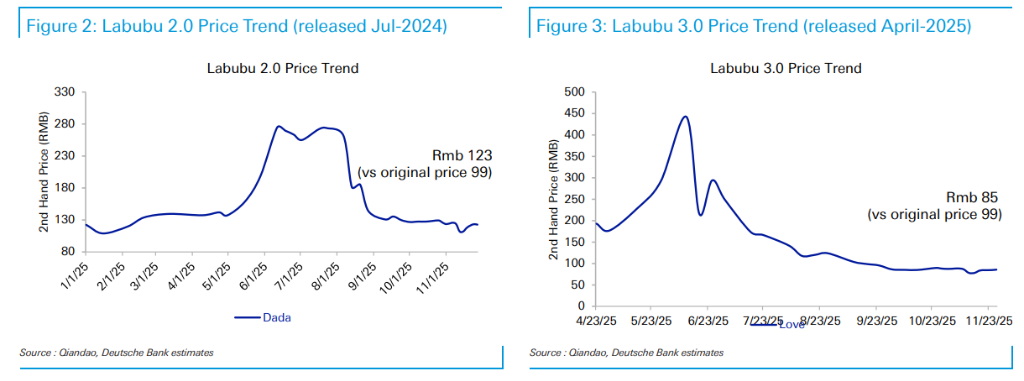
Core Viewpoint - Deutsche Bank warns that Pop Mart is facing an "Availability Paradox," where the rapid expansion of production capacity is leading to Labubu transitioning from a scarce trendy IP to a mass consumer product, which will diminish its fashion appeal and secondary market prices [1][2]. Group 1: Production Capacity and Market Dynamics - Pop Mart's production capacity has surged from an average of 10 million units per month in the first half of the year to 50 million units per month by the end of the year, trading scarcity for short-term revenue growth [1][2]. - The strong growth driven by Labubu is masking significant risks of supply-demand reversal, with potential valuation pressures if Labubu's popularity peaks in 2026 without new hits [1][3]. Group 2: Market Performance and Pricing Trends - Since August 2025, the premium for Labubu and other popular IPs has halved, with the price of Labubu's "hidden" variants dropping over 50% [6]. - Specific examples show that Labubu 1.0 "Exciting Macaron" hidden variant prices have fallen by 50%, while Labubu 3.0 "Love" variant prices have dropped by 81% [7]. Group 3: Consumer Sentiment and Product Reception - The secondary market has seen immediate discounts on newly released products, indicating a slowdown in sales and a potential "fashion fatigue" among consumers [11][12][14]. - Negative feedback regarding design and quality has increased on social media, suggesting a decline in consumer interest in the Labubu IP [13][14]. Group 4: Valuation Scenarios - Deutsche Bank maintains a "Hold" rating for Pop Mart with a target price of 228 HKD, presenting two contrasting valuation scenarios based on Labubu's popularity trajectory [15]. - In a bearish scenario, if Labubu's popularity peaks in 2026, net profit could drop to 10.6 billion RMB, leading to a significant increase in implied P/E ratio to 23x [15]. - Conversely, in a bullish scenario with sustained growth and new IP launches, net profit could exceed 23.1 billion RMB, reducing the implied P/E ratio to 13x [16].

月产5000万只!当Labubu不再稀缺,泡泡玛特拿什么接棒?
Hua Er Jie Jian Wen· 2025-12-01 06:26
Core Viewpoint - Deutsche Bank warns that Pop Mart is facing an "Availability Paradox," as the rapid expansion of production capacity is transforming the once-scarce Labubu IP into a mass consumer product, which will diminish its fashion appeal and secondary market prices [1][2]. Production Capacity and Market Dynamics - Pop Mart's production capacity has surged from an average of 10 million units per month in the first half of the year to 50 million units per month by the end of the year [1]. - This aggressive capacity expansion is seen as a risky gamble, trading scarcity for short-term revenue growth [1]. Financial Projections - Deutsche Bank estimates that this strategy will yield an adjusted net profit of approximately RMB 14.5 billion in 2025 [2]. - The bank maintains a "Hold" rating for Pop Mart with a target price of HKD 228, based on a projected P/E ratio of 18x to 20x for 2025 [1][11]. Market Sentiment and Pricing Trends - Since August 2025, the premium prices for Labubu and other popular IPs have significantly declined, with some hidden variants losing over 50% of their peak value [5]. - The secondary market has shown alarming signs, with regular versions of Labubu dropping below official retail prices on platforms like "Qian Dao" and "Xian Yu" [5]. Consumer Behavior and Product Reception - The popularity of Labubu has shifted from a "must-have" to a readily available product, leading to a decrease in consumer interest and a drop in search trends on Google since mid-2025 [7]. - Recent product launches, such as "Labubu Mini" and "The Monsters 1 a.m.," have not sold out as quickly as previous releases, indicating potential consumer fatigue [10]. Valuation Scenarios - Deutsche Bank presents two contrasting valuation scenarios for Pop Mart: - Bear Case: If Labubu's popularity peaks in 2026 without new IPs, net profit could drop to RMB 10.6 billion, leading to a P/E ratio of 23x [11]. - Bull Case: If growth continues and new IPs emerge, net profit could exceed RMB 23.1 billion, resulting in a P/E ratio of 13x [11].