上汽集团

Search documents
三大千亿级产业跃马扬鞭 上海嘉定擘画“新质”未来
Zhong Guo Jin Rong Xin Xi Wang· 2026-02-13 05:46
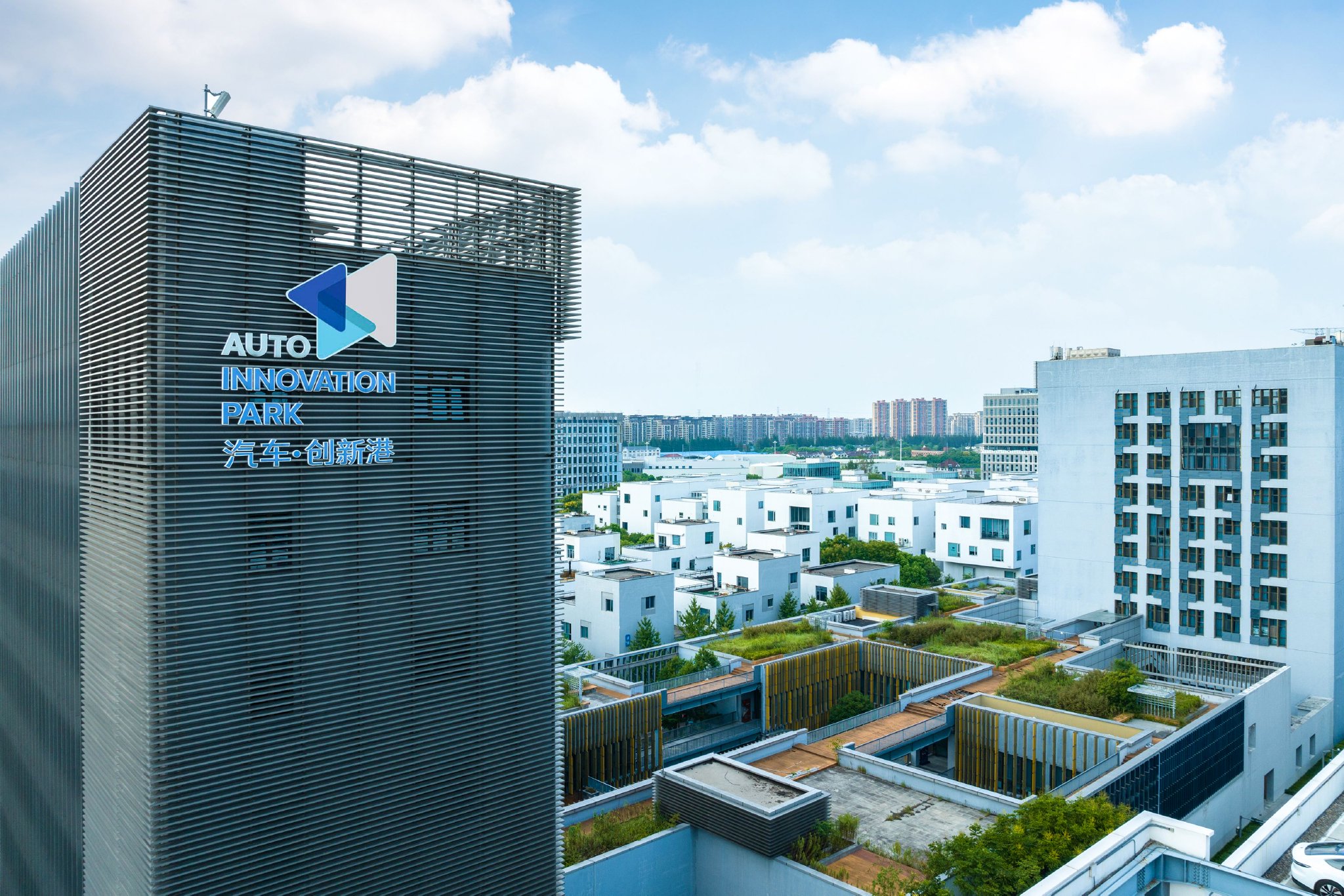
Core Insights - The automotive industry in Jiading is undergoing a significant transformation, with a focus on smart and connected vehicles, aiming to exceed a scale of 300 billion yuan by 2025 [2] - Jiading's integrated circuit industry is projected to achieve a total output of 105.8 billion yuan by 2025, reflecting a 3.8% year-on-year growth [3] - The biopharmaceutical sector is rapidly developing, with initiatives aimed at establishing Jiading as a leading hub for high-end medical devices and innovative therapies [8] Automotive Industry - Jiading's automotive sector is transitioning from testing and demonstration to large-scale commercial applications, with the Shanghai International Automobile City collaborating with 18 major car manufacturers to create a transparent supply chain management platform [2] - The government plans to accelerate the development of a world-class smart connected new energy vehicle innovation hub by 2026, with a focus on high-value and new energy models [2] - The evolution of vehicles into intelligent terminals is supported by advancements in high-performance automotive chips and solid-state battery production [2] Integrated Circuit Industry - Jiading is positioned as a key player in Shanghai's integrated circuit strategy, with a focus on domestic production capabilities and a complete industry chain [5] - The establishment of innovation centers and collaborative platforms is aimed at enhancing the local semiconductor manufacturing ecosystem [5] - The development of specialized companies, such as Liyang Chip, demonstrates the effectiveness of the regional industrial cluster strategy [3] Biopharmaceutical Industry - The biopharmaceutical sector is characterized by rapid growth, with significant projects like the establishment of high-end medical device clusters and innovative treatment centers [8] - Jiading aims to create a comprehensive ecosystem for precision medicine, integrating clinical research and application [8] - The collaboration with institutions like Ruijin Hospital and Fudan University is expected to foster advancements in biotechnologies and medical devices [8] Social and Cultural Development - Jiading's development strategy includes social initiatives such as the provision of affordable housing and community services, enhancing the quality of life for residents [10] - Cultural events like the Shanghai Auto Culture Festival are expected to boost tourism and local consumption [2][10] - The integration of industry and community development reflects Jiading's commitment to a balanced approach to urban growth [10]

李迅雷:中国出口份额提升空间还有多大?| 立方大家谈
Sou Hu Cai Jing· 2026-02-13 04:14
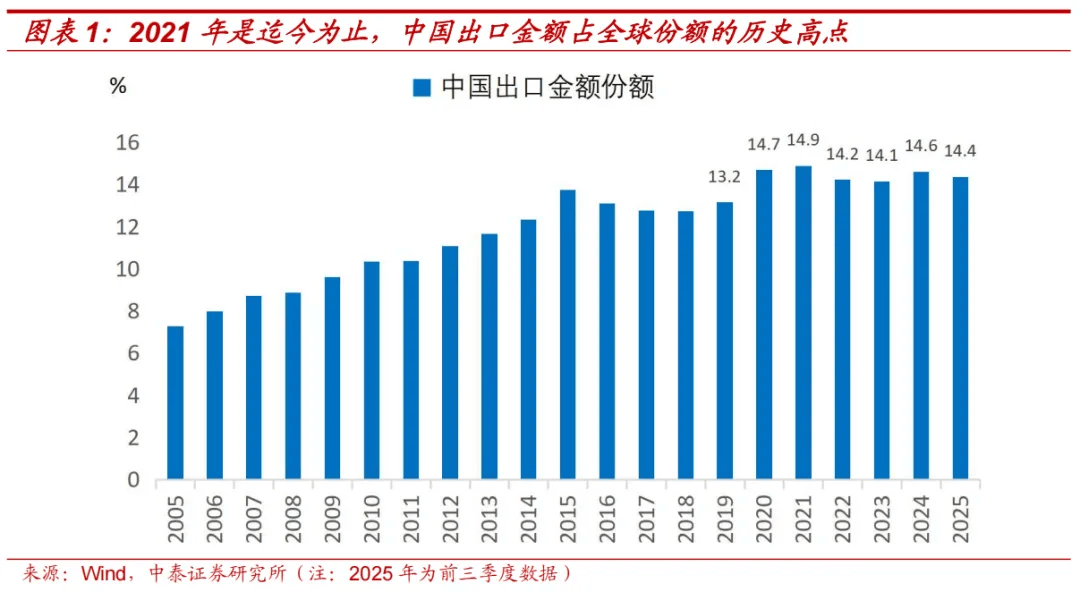
Core Viewpoint - The depreciation of the RMB and low export prices have hindered the increase of China's export value share in the global market, despite exports being a crucial driver of China's economic growth. After reaching a historical high of 14.9% in 2021, China's export share is expected to remain below this level from 2022 to 2025. However, when excluding the impacts of price and exchange rate, the quantity of China's exports continues to increase, indicating its importance as a driver of GDP growth [1][4][7]. Group 1: Export Quantity Share - China's export quantity share is projected to rise from 13.2% in 2019 to 17.0% by the third quarter of 2025, driven by the accelerated upgrade of industries and an increase in high-value-added product exports [13][16]. - The analysis of Japan and Germany's export share decline suggests that China will maintain strong competitiveness in exports, leading to an increase in export order share [38][25]. Group 2: Price Factors - The potential for trade friction risks will limit the price reduction of certain Chinese export products, while optimizing export tax policies may increase export prices. The expected decline in China's export price will narrow, with a possibility of a temporary increase due to a low base [2][44][51]. - The export price index for Chinese goods has been in negative territory for three consecutive years, with a cumulative decline of 10.1% from 2023 to 2025, indicating a strategy of "price for volume" to enhance competitiveness [16][21]. Group 3: RMB Exchange Rate - Since 2022, there has been a divergence between China's trade surplus and the actual effective exchange rate of the RMB, with expectations of a gradual appreciation of the RMB due to strong export resilience and the goal of achieving a per capita GDP comparable to that of developed countries by 2035 [2][63][67]. - The RMB is expected to appreciate against the USD, with a projected increase of 4.4% by 2025, supported by a stable economic environment and increased use of RMB in international trade [70][77]. Group 4: Future Projections - Quantitative assessments indicate that China's export value share in the global market is expected to begin a sustained recovery starting in 2026, stabilizing around 17% by 2030, suggesting that there is still room for growth in China's export share [3][89][91]. - The analysis predicts that the factors supporting China's export growth will not reverse in the short term, indicating continued resilience in exports [20][21].
中国出口份额提升空间还有多大?
李迅雷金融与投资· 2026-02-13 03:53
Core Viewpoint - The article emphasizes that despite the perception of strong export performance, China's export growth has lagged behind the global average in recent years, with only 2024 expected to exceed global growth rates in dollar terms [3][4][6]. Export Performance Analysis - Over the past four years, only in 2024 did China's dollar-denominated exports grow faster than the global average, while in 2022 and 2023, China's export growth was lower than the global average [3][4]. - China's share of global exports remained stable at around 13% from 2015 to 2019, with a slight increase to 14%-15% from 2020 to the first three quarters of 2025, but still below the historical high of 14.9% reached in 2021 [3][4][6]. - The decline in China's export share is attributed to weak export prices and currency depreciation, which have hindered the growth of export value [3][6][11]. Factors Influencing Export Growth - Analyzing the components of China's export share reveals that the decline is primarily due to export prices and exchange rates, while the quantity of exports has been increasing [6][7][8]. - China's export quantity share is projected to rise from 13.2% in 2019 to 17.0% by the first three quarters of 2025, driven by a shift towards higher value-added products [12][14]. - The article identifies three main reasons for the increase in export quantity: accelerated industrial upgrading, persistent price declines due to supply-demand imbalances, and the diversification of markets through the Belt and Road Initiative [12][14][17]. Future Projections - The article forecasts that China's export share will begin to recover in 2026 and stabilize around 17% by 2030, indicating that there is still room for growth in China's global export share [3][82]. - The expected recovery is supported by a projected appreciation of the renminbi, a narrowing of export price declines, and the competitive advantages of Chinese exporters [76][82]. Price and Currency Factors - The article suggests that the downward pressure on export prices is expected to weaken, with potential for price increases due to trade friction risks and government policy adjustments [40][41][47]. - The renminbi is anticipated to appreciate against the dollar, supported by China's resilient export performance and the government's long-term economic goals [58][61][76].

观察|1月车市三把“王座”全部易主
Guang Zhou Ri Bao· 2026-02-13 03:15
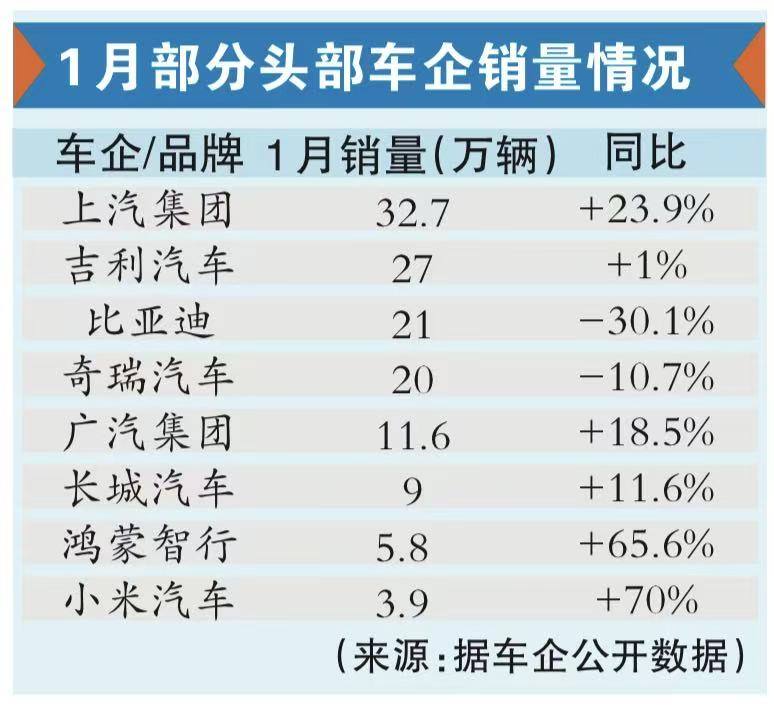
Core Insights - The January sales figures indicate a significant shift in the competitive landscape of the Chinese automotive market, with traditional giants like SAIC and Geely reclaiming leadership positions, while BYD's dominance is challenged [1][3][4] Group 1: Sales Performance - SAIC Group achieved sales of 327,000 vehicles in January, marking a year-on-year increase of 23.9% [2][4] - Geely Automotive sold 270,100 vehicles, a year-on-year growth of 1%, surpassing BYD to become the top-selling domestic brand [2][4] - BYD's sales fell to 210,000 vehicles, experiencing a significant year-on-year decline of 30.1% [2][4] - New energy vehicle sales for SAIC reached 85,000 units, growing by 39.7% [4] - The overall automotive production and sales in January were 2.45 million and 2.346 million units, respectively, with a slight year-on-year production increase of 0.01% [7] Group 2: New Players and Market Dynamics - The new energy vehicle segment saw a reshuffling, with Hongmeng Zhixing leading the new force with 57,915 units sold, a remarkable year-on-year increase of 65.6% [6] - Xiaomi Automotive followed closely with over 39,000 units sold, achieving a year-on-year growth of approximately 70% [6] - The previous leaders in the new force segment, such as Leap Motor, have seen a decline, with their sales dropping to 32,059 units [6] Group 3: International Market Growth - The overseas market is identified as a key growth area for automotive companies, with January exports reaching 681,000 vehicles, a year-on-year increase of 44.9% [7] - Exports of new energy vehicles doubled to 302,000 units, highlighting the importance of global expansion for competitive advantage [7]



人形机器人产业化进程明显提速,机器人ETF嘉实(159526)聚焦机器人全产业链
Xin Lang Cai Jing· 2026-02-13 02:29
Group 1 - The humanoid robot industry is experiencing accelerated commercialization, with significant product launches and financing activities indicating a shift towards mass production and market readiness [1] - Recent product announcements include the full-size humanoid robot Bolt by Jingzhi Technology, which has a peak speed of 10m/s, and the launch of three series of EAI robots by Faraday Future [1] - The global humanoid robot market is expected to enter a mass production phase in 2025, driven by Tesla's Optimus V3 and increased investment activity in the industry [1] Group 2 - As of January 30, 2026, the top ten weighted stocks in the China Securities Robot Index account for 54.66% of the index, including companies like iFlytek and Huichuan Technology [2] - The Robot ETF by Harvest (159526) closely tracks the China Securities Robot Index, focusing on companies involved in system solutions, digital workshops, automation equipment manufacturing, and other related sectors [2] - Investors without stock accounts can access the robot industry development opportunities through the Robot ETF Harvest Connect Fund (024620) [3]

中国汽车:市场反馈及行业预期下调 -1 月季节性表现弱于往常,且物料成本通胀加剧-China Automobiles_ Marketing feedback & lowering estimates for the sector on weaker-than-usual Jan seasonality with BOM cost inflation
2026-02-13 02:18
Summary of Conference Call Notes on the Automotive Industry Industry Overview - **Industry**: Automotive, specifically focusing on electric vehicles (EVs) and new energy vehicles (NEVs) in China - **Current Market Sentiment**: Investor positioning in the automotive sector is underweight as of early 2026, with concerns about demand and cost inflation impacting outlooks [1][2] Key Points 1. Industry Volume Trajectory - **January 2026 Performance**: Domestic passenger vehicle retail volume decreased by 20% month-over-month (mom), compared to a 14% decrease in January 2024 [3] - **Market Expectations**: Anticipation of continued volume decline into February 2026, attributed to the Chinese New Year holiday and reduced stimulus effects [3] - **Future Outlook**: Expected recovery in consumer demand starting March 2026, coinciding with new product launches from BYD and the Beijing Auto Show [3] 2. Raw Material and Memory Cost Inflation - **Cost Increases**: Year-to-date increases in commodity prices (lithium, copper, aluminum) range from 27% to 85% year-over-year [4][18] - **Impact on BOM Costs**: Estimated average increase in Bill of Materials (BOM) costs for EVs is approximately Rmb4,000, leading to a gross margin decline of 2.0% and a net margin decline of 1.7% [4][11] - **OEM Negotiations**: OEMs are negotiating cost-sharing with suppliers, but are expected to absorb 100% of memory cost increases [4] 3. Potential Policy Stimulus - **Government Support Expectations**: Investors anticipate additional government support if demand remains weak, including subsidies for Level 3 vehicles and domestic chip usage [7] - **Economic Contribution**: Passenger vehicles accounted for about 5% of GDP in 2025, indicating the sector's significance to the economy [7] 4. Sensitivity Analysis on Costs - **Margin Concerns**: Rising raw material and memory costs are raising concerns about potential margin impacts for OEMs [8] - **Cost Pass-Through Assumptions**: Analysis assumes a 50/50 cost pass-through ratio for battery and metals, while memory costs are fully absorbed by OEMs [9][12] 5. Target Price Adjustments - **Price Target Reductions**: Target prices for covered OEMs and suppliers have been cut by up to 12% due to weaker demand and higher costs, with average estimates lowered by approximately 16% [2][24] - **Specific Company Adjustments**: - **BYD**: Target price reduced from Rmb144 to Rmb137 due to weaker delivery volumes and higher BOM costs [25] - **Li Auto**: Target price reduced from US$27 to US$24, reflecting lower sales and higher costs [25] - **XPeng**: Target price reduced from US$25 to US$22, driven by weaker sales and pricing pressures [25] - **NIO**: Target price reduced from US$7.0 to US$6.6, impacted by BOM cost inflation [25] 6. Long-term Projections - **Revenue and Net Income Changes**: Projections for revenue and net income have been adjusted downward for several companies, reflecting anticipated market conditions through 2030 [24][30] Additional Insights - **Investor Concerns**: There is a growing concern among investors regarding the sustainability of margins in light of rising costs and competitive pressures [8] - **Market Dynamics**: The automotive sector is facing significant challenges from both internal cost pressures and external market conditions, necessitating close monitoring of policy developments and consumer demand trends [7][8] This summary encapsulates the critical insights from the conference call, highlighting the automotive industry's current challenges and future outlook.




中国汽车:2026 年 1 月十大数据与十大趋势总结-China Auto Manufacturers 10 Figures 10 Trends Jan-26 Summary
2026-02-13 02:18
Summary of the Conference Call on China Auto Manufacturers Industry Overview - The conference call focused on the **China Auto Manufacturers** industry, particularly the performance of **New Energy Vehicles (NEVs)** and **Internal Combustion Engine (ICE)** vehicles in January 2026. Key Points and Arguments NEV Market Performance - **NEV Sales Decline**: In January 2026, domestically produced NEV passenger vehicle (PV) sales decreased by **58% month-over-month (MoM)** and **20% year-over-year (YoY)**, slightly missing the previous expectation of **-55% MoM** [1][6] - **Market Share Gains**: Companies like **Xiaomi, Seres, Nio, and Li Auto** gained NEV market shares MoM, while traditional brands like **BYD** saw significant declines [1][2] ICE Vehicle Trends - **ICE Sales Surge**: The penetration of ICE vehicles increased to **62.6%**, a rise of **21.3 percentage points (ppt) MoM**, attributed to seasonal sales before the Chinese New Year [2][6] - **Market Share Changes**: Chinese brands' ICE market share rose by **1.4ppt MoM** to **35.7%**, while foreign brands showed mixed results [4][6] Brand-Specific Insights - **Tesla's Performance**: Tesla's domestic insurance retail sales fell by **78% MoM** and **41% YoY**, with wholesales at **69,129 units** (down **29% MoM**, up **9% YoY**) [5][22] - **BYD's Decline**: BYD's NEV sales were **104,623 units**, down **49% YoY** and **68% MoM**, resulting in a market share drop of **10.4ppt** [9][22] - **Gains by Competitors**: **Xiaomi** and **Nio** reported increases in market share, with Xiaomi gaining **4.9ppt** and Nio **2.9ppt** MoM in the BEV segment [2][3] Inventory Levels - **Inventory Increase**: The inventory of PVs increased by **1.0 month MoM** to **3.1 months**, while NEV inventory rose by **2.0 months MoM** to **3.4 months** [6][23] Market Share by Segment - **BEV Market Share**: Local Chinese brands maintained a high NEV market share of **87.1%**, while US brands dropped to **8.2%** [6][10] - **PHEV Market Dynamics**: BYD lost PHEV market share by **5.1ppt** to **43.3%**, while local competitors gained [3][6] Additional Important Insights - **Sales Recovery Expectations**: There are expectations for a sales recovery starting in March 2026, as the market adjusts post-holiday season [1][6] - **Overall Market Trends**: The data suggests a challenging environment for NEV manufacturers, with significant month-over-month declines indicating potential volatility in the market [1][6] This summary encapsulates the critical insights from the conference call regarding the current state and trends within the China auto manufacturing industry, particularly focusing on NEVs and ICE vehicles.
800现金流ETF汇添富(563680)开盘跌1.42%
Xin Lang Cai Jing· 2026-02-13 01:41
Group 1 - The 800 Cash Flow ETF managed by Huatai-PineBridge opened at 1.317 yuan, experiencing a decline of 1.42% [1] - Major holdings in the ETF include China National Offshore Oil Corporation (CNOOC) down 2.93%, SAIC Motor Corporation down 0.14%, and China Aluminum Corporation down 1.82% [1] - The ETF's performance benchmark is the CSI 800 Free Cash Flow Index, with a return of 33.50% since its inception on April 30, 2025, and a return of 5.17% over the past month [1]





上汽集团取得无级变速器速比控制方法及装置专利
Jin Rong Jie· 2026-02-13 00:27
上海汽车工业(集团)有限公司,成立于1996年,位于上海市,是一家以从事汽车制造业为主的企业。 企业注册资本2174917.5737万人民币。通过天眼查大数据分析,上海汽车工业(集团)有限公司共对外 投资了43家企业,参与招投标项目16次,财产线索方面有商标信息10条,专利信息750条,此外企业还 拥有行政许可19个。 声明:市场有风险,投资需谨慎。本文为AI基于第三方数据生成,仅供参考,不构成个人投资建议。 财经频道更多独家策划、专家专栏,免费查阅>> 天眼查资料显示,上海汽车集团股份有限公司,成立于1984年,位于上海市,是一家以从事汽车制造业 为主的企业。企业注册资本1149527.7504万人民币。通过天眼查大数据分析,上海汽车集团股份有限公 司共对外投资了56家企业,参与招投标项目5000次,财产线索方面有商标信息1456条,专利信息5000 条,此外企业还拥有行政许可588个。 国家知识产权局信息显示,上海汽车集团股份有限公司、上海汽车工业(集团)有限公司取得一项名 为"一种无级变速器的速比控制方法及装置"的专利,授权公告号CN117167475B,申请日期为2022年5 月。 ...
财经观察:中国车企出海加拿大,机遇还是险滩?
Huan Qiu Shi Bao· 2026-02-12 22:56
Core Viewpoint - Canada is actively pursuing a joint venture with Chinese automakers to establish an electric vehicle (EV) manufacturing plant aimed at global exports, reflecting a significant policy shift to reduce reliance on the U.S. automotive market and strengthen its domestic industry [1][4][5]. Group 1: Joint Venture and Collaboration - The Canadian government is in "active dialogue" with Chinese automakers to explore the establishment of an EV assembly plant in Canada, leveraging a joint venture model that combines Chinese vehicle platforms with Canadian labor and technology [2][4]. - Canadian companies like Magna International and Linamar are already engaged in business in China and are expected to participate in the joint venture, enhancing collaboration between local and Chinese firms [2][4]. Group 2: Policy Changes and Market Dynamics - The Canadian government has made significant adjustments to its EV import policy, allowing for an annual quota of 49,000 Chinese electric vehicles with a reduced tariff of 6.1%, a major shift from the previous 100% tariff [5][9]. - A recent survey indicates that 78% of Canadians support the new EV agreement with China, highlighting a broad public backing for diversifying trade away from the U.S. [5][6]. Group 3: Market Opportunities and Consumer Sentiment - The agreement is expected to lead to over 50% of imported Chinese EVs being priced below CAD 35,000, making them more accessible to Canadian consumers [7]. - Despite concerns about the impact on domestic industries and geopolitical implications, 62% of Canadians support allowing more Chinese EVs into the market, with many believing it will increase competition and lower prices [6][7]. Group 4: Infrastructure and Challenges - Current charging infrastructure in Canada, with 14,500 stations and 38,700 charging points, is deemed sufficient for the anticipated increase in EVs, but expansion is necessary to meet future demand [8]. - Concerns remain regarding after-sales service and the adequacy of infrastructure in remote areas, which could hinder the adoption of electric vehicles [7][8]. Group 5: Strategic Implications - The collaboration with Chinese automakers is seen as a pragmatic step for Canada to diversify its trade relationships and reduce dependency on the U.S. market, with experts suggesting that about 10% of Canada's EV sales could shift to Chinese manufacturers [9][10]. - The investment environment in Canada is under scrutiny, with experts advising caution regarding the sustainability of policies and the real market response to these changes [10].