
恒力石化

Search documents
恒力石化(600346.SH):实际控制人陈建华首次增持1344.74万股公司股份
Ge Long Hui A P P· 2026-02-03 08:36
格隆汇2月3日丨恒力石化(600346.SH)公布,2026年2月3日,公司实际控制人之一陈建华先生以自有资 金,采取集中竞价交易方式首次增持公司股份1344.74万股,占公司总股本的0.19%,累计增持金额为 3.30亿元(不含佣金、过户费等交易费用)。本次增持计划尚未实施完毕,陈建华先生后续将按照相关 增持计划继续增持公司股份。 ...

恒力石化:实控人陈建华首次增持3.30亿元股份
Ge Long Hui· 2026-02-03 08:22
格隆汇2月3日|恒力石化公告称,公司实控人之一陈建华计划2025年4月9日起12个月内,以5亿 - 10亿 元自有或自筹资金增持公司股份。2026年2月3日,他首次增持13,447,369股,占总股本0.19%,累计增 持32,997.02万元。增持计划未实施完毕,后续将按计划继续增持。本次增持或因资本市场变化、资金未 及时到位等因素延期或无法实施,公司将及时披露。 ...
收盘速递 | 石化ETF(159731)上涨2.87%,近19天获得连续资金净流入
Xin Lang Cai Jing· 2026-02-03 08:20
Core Viewpoint - The petrochemical sector is experiencing significant growth, as evidenced by the strong performance of the China Petrochemical Industry Index and related ETFs, indicating a positive market sentiment and investment opportunities in this industry [1][2]. Group 1: Index Performance - As of February 3, 2026, the China Petrochemical Industry Index (H11057) rose by 2.89%, with notable increases in constituent stocks such as Cangge Mining (+6.76%), Hualu Hengsheng (+6.17%), and Guangwei Composites (+5.94%) [1]. - The Petrochemical ETF (159731) increased by 2.87%, reaching a latest price of 1 yuan, and has accumulated a 6.21% rise over the past month [1]. Group 2: Liquidity and Trading Activity - The Petrochemical ETF recorded a turnover rate of 12.19% during the trading session, with a transaction volume of 200 million yuan, indicating active market participation [1]. - Over the past week, the average daily trading volume of the Petrochemical ETF was 329 million yuan [1]. Group 3: Fund Flows and Share Performance - The latest share count of the Petrochemical ETF reached 1.656 billion, marking a one-year high [2]. - The ETF has seen continuous net inflows for 19 days, with a peak single-day net inflow of 348 million yuan, totaling 1.413 billion yuan in net inflows [2]. Group 4: Return Metrics - Since its inception, the Petrochemical ETF has achieved a maximum monthly return of 15.86%, with the longest streak of consecutive monthly gains being 9 months and a total increase of 60.75% during that period [2]. - The average return during the months of increase is 5.59% [2]. Group 5: Index Composition - As of January 30, 2026, the top ten weighted stocks in the China Petrochemical Industry Index include Wanhua Chemical, China Petroleum, and Yilong Co., among others, collectively accounting for 55.71% of the index [2].
化工行业ETF易方达(516570)上涨3.32%,近12天获得连续资金净流入
Xin Lang Cai Jing· 2026-02-03 07:05
Core Viewpoint - The chemical industry ETF managed by E Fund has shown strong performance, with significant increases in both stock prices and fund inflows, indicating a positive market sentiment towards the chemical sector [1][2]. Group 1: Index Performance - As of February 3, 2026, the China Petroleum Industry Index (H11057) rose by 2.92%, with notable gains from stocks such as Cangge Mining (+6.53%) and Hualu Hengsheng (+6.38%) [1]. - The E Fund Chemical Industry ETF (516570) increased by 3.32%, reaching a latest price of 1.09 yuan [1]. - Over the past month, the E Fund Chemical Industry ETF has accumulated a total increase of 6.14% [1]. Group 2: Trading Volume and Liquidity - The E Fund Chemical Industry ETF had a turnover rate of 2.72% during the trading session, with a transaction volume of 42.92 million yuan [1]. - The average daily trading volume over the past week for the ETF was 162 million yuan [1]. Group 3: Fund Size and Shares - The latest size of the E Fund Chemical Industry ETF reached 1.537 billion yuan, marking a one-year high [1]. - The total number of shares for the ETF is now 1.453 billion, also a one-year high [1]. Group 4: Fund Inflows - The E Fund Chemical Industry ETF has seen continuous net inflows over the past 12 days, with a peak single-day inflow of 391 million yuan, totaling 1.357 billion yuan in net inflows [1]. - The average daily net inflow for the ETF is 113 million yuan [1]. Group 5: Top Holdings - As of January 30, 2026, the top ten weighted stocks in the China Petroleum Industry Index account for 55.71% of the index, including major companies like Wanhua Chemical and China Petroleum [2].
化工板块持续走强,化工行业ETF易方达(516570)近一周“吸金”约10亿元
Mei Ri Jing Ji Xin Wen· 2026-02-03 06:57
【免责声明】本文仅代表作者本人观点,与和讯网无关。和讯网站对文中陈述、观点判断保持中立,不对所包含内容 的准确性、可靠性或完整性提供任何明示或暗示的保证。请读者仅作参考,并请自行承担全部责任。邮箱: news_center@staff.hexun.com 中证石化产业指数既覆盖"三桶油"等炼化龙头,也包括万华化学、恒力石化等细分化工领军企业, 其PX-PTA-长丝产业链含量高,受益于产品涨价预期与行业估值修复。化工行业ETF易方达(516570) 的管理费率仅为0.15%/年,处于全市场ETF中最低一档,为投资者布局石油化工产业龙头提供了低成本 工具。 每日经济新闻 (责任编辑:董萍萍 ) 2月3日早盘,化工板块高开高走,截至10:14,中证石化产业指数上涨1.6%,成分股中,浙江龙盛 涨超6%,和邦生物涨超4%,桐昆股份、新凤鸣等涨超3%。根据Wind数据统计,跟踪该指数的化工行 业ETF易方达(516570)近一周净流入约10亿元。 中金公司认为,欧洲产能加速退出将促使全球供给格局改善,行业中长期景气度好转趋势确定。叠 加国内稳增长政策与出口竞争力增强,看好估值偏低的化工龙头以及产能增速放缓的细分领域。 ...
化工ETF(159870)涨近4%,盘中净申购7.37亿份
Xin Lang Cai Jing· 2026-02-03 06:39
Group 1 - The chemical sector experienced a strong rally with significant capital inflow, as evidenced by the net subscription of 737 million units in the chemical ETF (159870) [1] - The primary driver for the recent price increase in disperse dyes is the surge in the price of upstream key intermediates, which rose from 25,000 yuan/ton to 38,000 yuan/ton, an increase of over 50% [1] - The price of intermediates accounts for 20%-30% of the production cost of dyes, and the rigid price increase is directly transmitted to downstream dye products [1] Group 2 - The China Securities Sub-Industry Chemical Theme Index (000813) rose by 3.68%, with significant gains in constituent stocks such as Hongda Co., which increased by 9.02%, and Zhejiang Longsheng, which rose by 5.91% [1] - The top ten weighted stocks in the China Securities Sub-Industry Chemical Theme Index account for 44.82% of the index, including companies like Wanhua Chemical and Salt Lake Co. [2] - The chemical ETF (159870) increased by 3.98%, with the latest price reported at 0.89 yuan [1][2]
欧洲部分装置有望加速退出,中国化工行业推行反内卷,石化ETF(159731)涨超2.4%
Sou Hu Cai Jing· 2026-02-03 06:04
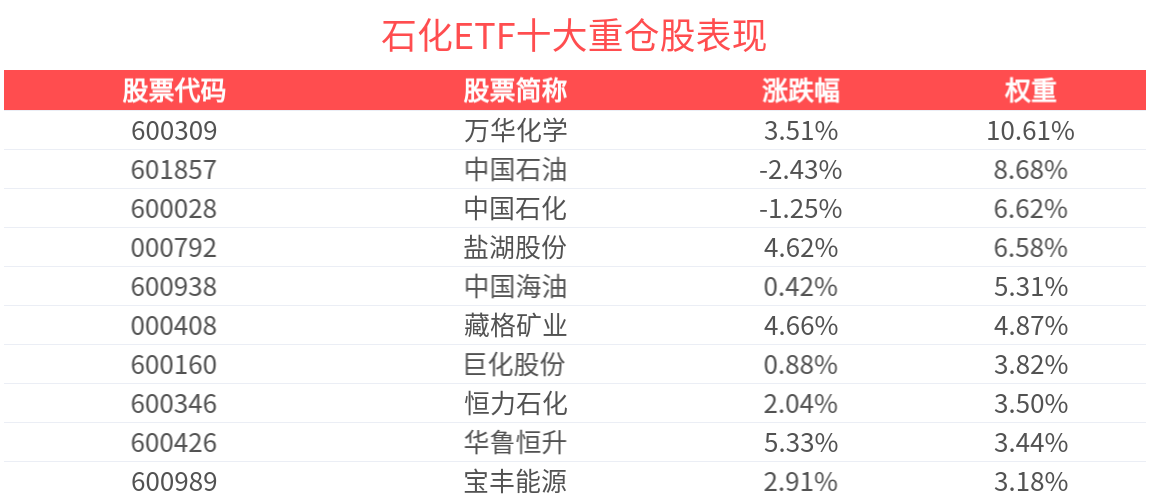
Group 1 - The core viewpoint of the news highlights the strong performance of the petrochemical sector, with the China Petrochemical Industry Index rising by 2.41% and significant gains in individual stocks such as Zhejiang Longsheng and Guangwei Composites [1][2] - The Petrochemical ETF (159731) has seen a price increase of 2.46%, with a trading volume of 1.78 billion yuan and a turnover rate of 10.87%, indicating active market participation [1] - Over the past 19 days, the Petrochemical ETF has experienced continuous net inflows, totaling 14.13 billion yuan, with a peak single-day inflow of 3.48 billion yuan [1][2] Group 2 - The severe winter storm affecting the Gulf Coast of the United States has led to production disruptions among major chemical companies, resulting in a 3.1% increase in PVC prices and signs of supply tightness in some regions [2] - The outlook for the chemical industry in 2026 suggests a potential upward cycle due to supply constraints and recovering demand, with a recommendation to maintain a positive rating for the sector [2] - The top ten weighted stocks in the China Petrochemical Industry Index account for 55.71% of the index, with companies like Wanhua Chemical and China Petroleum being significant contributors [2][4]





化学制品、化纤行业等震荡走强,化工ETF嘉实(159129)聚焦行业“反内卷”背景下新一轮景气周期
Xin Lang Cai Jing· 2026-02-03 05:29
2026年2月3日午后,化学制品、化纤行业等震荡走强,截至13:14,中证细分化工产业主题指数强势上 涨2.18%,成分股浙江龙盛上涨5.99%,宏达股份上涨5.74%,光威复材上涨5.50%,博源化工,和邦生 物等个股跟涨。 数据显示,截至2026年1月30日,中证细分化工产业主题指数(000813)前十大权重股分别为万华化学、 盐湖股份、藏格矿业、天赐材料、华鲁恒升、恒力石化、巨化股份、宝丰能源、云天化、荣盛石化,前 十大权重股合计占比44.82%。 化工ETF嘉实(159129)紧密跟踪中证细分化工产业主题指数,聚焦行业"反内卷"背景下新一轮景气周 期。 场外投资者还可以通过化工ETF联接基金(013527)关注化工板块投资机遇。 消息面方面,天赐材料2025年Q4业绩超预期,单季净利润达9.3亿元,同比增长536%,环比增长 507%,主要受益于六氟磷酸锂价格从年初6.3万元/吨大幅上涨至年末16.7万元/吨(涨幅164%),叠加 电解液年度销量突破70万吨、满产运行及与瑞浦兰钧、中创新航等头部电池企业签订多项大额订单。 近期,化工行业迎来政策与产业双重催化。广发证券指出,新型储能作为电力系统关键调节 ...

化工行业2025年信用回顾与2026年展望
新世纪资信评估· 2026-02-03 02:35
Investment Rating - The chemical industry is rated as "Weak" and stable for 2025, with expectations of continued low economic prosperity and pressure on profitability [1]. Core Insights - The chemical industry is expected to remain in a low prosperity phase in 2025, with most raw material and product prices at historical lows. The decline in oil, coal, and gas prices has eased raw material cost pressures for chemical companies, but has weakened support for product prices [1][7]. - The overall profitability of the chemical industry is under pressure, with different segments experiencing varying levels of impact. The supply side shows a slowdown in fixed asset investment, while certain petrochemical raw materials like ethylene and propylene are expected to see significant new capacity released [1][4]. - Demand from downstream sectors is expected to remain weak, with notable differences across industries. Real estate demand continues to be sluggish, while automotive production is growing rapidly, and the demand for chemical raw materials in the new energy and new materials sectors remains high [1][27][32]. Summary by Sections Industry Overview - The chemical industry is categorized into basic chemicals and fine chemicals, with basic chemicals including acids, alkalis, and plastics, while fine chemicals encompass pesticides, fuels, and specialty chemicals [6]. Supply and Demand Dynamics - The supply of basic chemical raw materials is expected to grow moderately, while demand is anticipated to improve slightly. However, issues of overcapacity and homogenized competition are expected to persist in the short term [4][18]. - Fixed asset investment in the chemical industry has shown a general slowdown, with significant growth in the petrochemical and chemical fiber sectors, while investment in chemical raw materials and products has decreased [20][21]. Financial Performance - In the first three quarters of 2025, the overall operating income of sample companies in the chemical sector showed a slight decline, with profitability remaining at historical lows. However, cash flow from operations has improved [2][3]. - The credit quality of the chemical industry has weakened, with a concentration of credit ratings in the AAA and AA+ categories. The financing environment is stable, with a focus on leading companies [3][4]. Price Trends - The CCPI index for chemical products has shown a downward trend, with an average decline of 12.69% compared to 2023. Prices for many chemical products have reached historical lows due to weak demand and oversupply [9][17]. Sector-Specific Insights - In the agricultural chemicals sector, prices for key products like urea and glyphosate have fluctuated, influenced by global price trends and domestic demand [31]. - The new energy sector continues to drive demand for chemical raw materials, with significant growth in lithium battery production and renewable energy installations [32]. Future Outlook - The chemical industry is expected to face challenges in 2026, including continued overcapacity and competition issues. However, the fine chemicals sector is projected to develop towards high-end, green, and intelligent growth [4][5].
新官将上任,能化是福是祸?
Bao Cheng Qi Huo· 2026-02-03 02:20
Group 1: Report's Investment Rating - No information about the industry investment rating is provided in the report. Group 2: Core Viewpoints - Trump's nomination of Kevin Warsh as the next Fed Chair has triggered a significant game between macro - policy expectation reconstruction and industrial fundamentals in the domestic energy - chemical commodity futures market. Warsh's "tight liquidity + low - interest - rate" policy combination has broken the traditional impact logic of monetary policy on commodities, leading to an "upstream pressured, downstream differentiated" market structure [4][5][40]. - In the short term, the market will focus on Warsh's policy implementation rhythm, the trend of the US dollar index, and geopolitical dynamics, with intensified volatility. In the long - term, energy - chemical prices will return to industrial fundamentals, and domestic demand recovery, industrial structure upgrading, and cost advantages will be the core factors determining the trends of each sector [5][40]. Group 3: Summaries of Each Chapter Chapter 1: Domestic Energy - Chemical Sector Experiences a Collective Decline - On February 2, 2026, affected by the cooling of Middle - East geopolitical risks and the nomination of Kevin Warsh, the domestic energy - chemical sector declined collectively. The crude oil futures 2603 contract dropped 7.02% to 449 yuan/barrel, the fuel oil futures 2605 contract fell 6.51% to 2669 yuan/ton, the asphalt futures 2603 contract decreased 4.87% to 3299 yuan/ton, and the methanol futures 2605 contract declined 3.92% to 2252 yuan/ton. The rubber futures sector generally fell 3.5% - 5%, the polyester industry chain sector averaged a 5% decline, and the polyolefin sector averaged a 2.5% decline [10]. Chapter 2: Kevin Warsh's Policy Proposals and Transmission Mechanisms - Warsh's policy stance is a mix of "hawkish and dovish". He advocates active balance - sheet reduction to shrink excess liquidity and supports Trump's call for interest - rate cuts, creating a "tight financial liquidity + loose real - economy financing environment" combination. This makes the traditional "interest - rate cut = easing" logic ineffective, and the commodity market faces a dual game of "US - dollar strengthening suppression" and "economic recovery support" [23]. - The impact of Warsh's nomination on domestic energy - chemical futures is transmitted through three paths: the US - dollar exchange - rate channel (the expected balance - sheet reduction pushes up the US - dollar index, pressuring the prices of international crude oil and other basic energy sources), the capital - flow channel (tightening financial - market liquidity leads to speculative - capital withdrawal and concentrated closing of high - leverage positions), and the demand - expectation channel (the expected economic recovery from interest - rate cuts and the global demand suppression from balance - sheet reduction offset each other) [25]. Chapter 3: Oil - Chemical Futures Sector: Full - Chain Pressure under Crude Oil Dominance - The oil - chemical sector is directly affected by international crude oil price fluctuations. Under the dual impact of the strengthening of the US dollar and the cooling of geopolitical risks, it shows a "full - chain pressured" weak market. The crude oil and fuel oil futures hit the daily limit down, while the asphalt futures are relatively resistant to decline [26]. - The expected balance - sheet reduction by Warsh pushes up the US - dollar index, increasing the procurement cost for non - US - currency buyers of crude oil and suppressing global demand. The cooling of geopolitical risks leads to a rapid return of the previously accumulated geopolitical premium. The global crude oil market has a loose supply - demand fundamental, with an expected daily surplus of 385,000 barrels in 2026 and a 0.3 - percentage - point reduction in the global crude oil demand growth rate forecast [26]. - The fuel oil futures are closely linked to crude oil. The sharp decline in crude oil prices leads to a collapse in the cost side, and the weak demand in the shipping market further suppresses prices. The asphalt futures are relatively resistant due to infrastructure demand support, but the overall demand is expected to decline year - on - year, and the industry is experiencing capacity reduction and increasing concentration [27][29]. Chapter 4: Coal - Chemical Futures Sector: Game Balance between Policy Impact and Cost Advantage - The coal - chemical sector is less directly affected by Warsh's policy. The prices of domestic coal - chemical products are mainly determined by policy regulation and the supply - demand fundamental of coal, and the demand for products like methanol and urea is relatively rigid. The coal - to - olefin route has a significant cost advantage when the international oil price is above 60 US dollars/barrel [30]. - It is expected that the stable coal cost and domestic rigid demand will support the prices of the coal - chemical sector. The methanol futures will maintain a range - bound trend, the urea futures may stabilize and rebound with the start of spring - plowing demand, and the price fluctuations of coal - based ethylene glycol will be limited [30]. Chapter 5: Rubber Futures Sector: Double Pressure from Import Dependence and Weak Overseas Demand - The rubber sector, which is import - dependent and sensitive to overseas demand, shows a "domestic - overseas resonance decline" under Warsh's policy impact. The strengthening of the US dollar increases import costs, and the continuous shrinkage of overseas terminal demand reduces the rubber procurement demand of domestic tire enterprises [31]. - In the short term, the double pressure of the strengthening US dollar and weak overseas demand will suppress rubber prices. In the long term, the incremental demand from the domestic new - energy vehicle industry and the supply contraction in Southeast Asia's main producing areas may support rubber prices [33]. Chapter 6: Polyester Futures Sector: Game Balance between Blocked Cost Transmission and Domestic Demand - The polyester sector shows characteristics of "pressured cost side, differentiated demand side". The decline in crude oil prices drags down raw - material costs, but the cost reduction is not fully transmitted to terminal products, and the profit margins of polyester enterprises improve marginally. The recovery of domestic consumption offsets the pressure from overseas demand [34]. - The polyester futures sector may present a pattern of "weak cost - side fluctuations, demand - side dominance" in the future. In the short term, the prices of PTA and ethylene glycol are under limited cost pressure, and the demand for polyester filament is expected to remain high. In the long term, the recovery of the global economy and domestic textile exports need to be monitored [35]. Chapter 7: Polyolefin Futures Sector: Resonant Decline due to Loose Supply - Demand and Policy Impact - The polyolefin sector is affected by both the loose supply - demand pattern and policy impact. On the supply side, the release of domestic production capacity and the pressure of imports intensify the supply - demand imbalance. On the demand side, the weak recovery of industrial demand fails to support price increases, and the pricing logic has shifted from "cost - side dominated" to "supply - demand - side dominated" [36][38]. - In the short term, the polyolefin sector will be suppressed by the loose supply - demand and policy uncertainties. In the long term, the supply - demand pattern may improve marginally, and the demand growth from emerging fields will be the core driving force for structural opportunities [39]. Chapter 8: Summary - The domestic energy - chemical commodity futures market situation triggered by Trump's nomination of Kevin Warsh is the result of the game between macro - policy expectation reconstruction and industrial fundamentals. The "tight liquidity + low - interest - rate" policy combination leads to a market structure of "upstream pressured, downstream differentiated" [40]. - Investors should focus on the supply - demand fundamentals and policy transmission logic of each sector, seize structural opportunities, and do a good job in risk prevention [40].