油化工

Search documents
中东局势拉锯,TACO交易放大市场波动
Hua Tai Qi Huo· 2026-03-24 07:00
1. Report Industry Investment Rating No information provided. 2. Core Viewpoints - The situation in the Middle East is tense, with the Iran - Israel conflict escalating and then cooling down. The Iran situation mainly affects crude oil, LPG, and shipping sectors, and rising oil prices have a driving effect on oil - chemical and oil - seed sectors, also causing concerns about inflation and economic recession [1]. - Global interest rate hike expectations are rising. The Fed, BoE, BoJ, and ECB have different stances on interest rates, and the rise in oil prices and interest rate hike expectations form a copper - oil seesaw pattern [2]. - China's domestic policies are pro - active, with economic growth targeted at 4.5% - 5%, and various fiscal measures are in place. The economic structure shows differentiation, with different performance in manufacturing, trade, consumption, and real estate [3]. - In the short term, the Iran situation and oil prices dominate commodity fluctuations. There are anti - correlations between the non - energy and energy sectors, and different commodity sectors have different focuses [4]. - For commodities and stock index futures, it is recommended to go long on stock indices, precious metals, and some chemical products [5]. 3. Summary by Related Catalogs Market Analysis - The Iran - Israel conflict has led to damage to Qatar's LNG facilities. The US may lift sanctions on Iranian oil, and the situation has some uncertainties. The Iran situation mainly impacts crude oil, LPG, and shipping sectors, and rising oil prices drive oil - chemical and oil - seed sectors, also causing inflation and recession concerns. If the Strait of Hormuz is blocked for a long time, oil prices and related sectors may rise further. Disruptions in Middle East natural gas supply may have a far - reaching impact on Asia - Pacific countries [1]. Global Interest Rate Situation - The Fed maintains the interest rate at 3.5% - 3.75%, and Powell will not leave the council before the investigation ends and won't cut interest rates until inflation improves. The BoE maintains the interest rate, removes the "rate cut" wording, and is ready to act on inflation. The BoJ keeps the policy unchanged, and the ECB maintains the interest rate at 2% but has a tougher stance. The rise in oil prices and interest rate hike expectations form a copper - oil seesaw pattern [2]. Domestic Policy and Economic Situation - China's 2026 government work report sets the economic growth target at 4.5% - 5%, with a deficit rate of about 4% and a deficit scale of 5.89 trillion yuan. The general public budget expenditure will reach 30 trillion yuan. Special treasury bonds of 1.3 trillion yuan will be issued, and 2500 billion yuan will be used for consumer goods replacement. In February, China's official manufacturing PMI was 49, non - manufacturing PMI was 49.5. Exports and imports increased significantly. Consumption and industrial added value showed growth, while real estate investment and sales declined [3]. Commodity Market - In the short term, the Iran situation and oil prices dominate commodity fluctuations. There is an anti - correlation between the non - energy and energy sectors. The IEA releases a record - high 4 billion barrels of crude oil reserves, and the US plans to release 1.72 billion barrels of strategic oil reserves. Oil price increases drive oil - chemical products. The EU simplifies gas import rules, Russia may cut off gas supply to Europe, and South Korea starts a resource security crisis warning. Black commodities focus on domestic policy expectations and low - valuation repair [4]. Strategy - For commodities and stock index futures, it is recommended to go long on stock indices, precious metals, and some chemical products [5]. Key News - Trump claims to be negotiating with Iran, but all related information is released by the US. Iran has control over the Strait of Hormuz and will take retaliatory measures if its power system is attacked. The US allows the sale of Iranian oil in transit. Fed officials have different views on interest rate hikes and cuts [6].
FICC日报:中国1-2月经济开局良好,滞涨叙事打压金价-20260317
Hua Tai Qi Huo· 2026-03-17 08:18
Report Industry Investment Rating - No information provided Core Viewpoints - China's economy had a good start in January - February 2026, and the stagflation narrative suppressed the gold price [1] - Pay attention to the tail - risk of the Iran situation, which mainly affects crude oil, LPG, and shipping sectors, and may drive up oil - related industries and cause inflation concerns [1] - Focus on China's Two Sessions. During the Two Sessions, the stock and commodity markets face pressure, but the stock index recovers after the sessions. The US February non - farm payrolls decreased unexpectedly, and China's economic data shows mixed performance [2] - In the short term, the Iran situation and oil prices dominate commodity fluctuations. It is recommended to go long on stock index, precious metals, and some chemical products at low prices [2][3] Summary by Directory Market Analysis - The Iran conflict has exceeded the initial 4 - 5 - day "end - of - war" expectation of the US and Israel. The tail - risk has increased sharply, affecting energy and shipping sectors. The continuous rise in oil prices has driven oil - chemical and oil - and - fat sectors and raised concerns about inflation and economic recession [1] - The US will launch a 301 investigation against 16 trading partners. The geopolitical situation remains volatile. There are also events related to Powell's case and the nomination of Wash [1] Attention to China's Two Sessions - The 2026 government work report sets the economic growth target at 4.5% - 5%, with a deficit rate of about 4% and a deficit scale of 5.89 trillion yuan. An ultra - long - term special treasury bond of 1.3 trillion yuan will be issued [2] - During the Two Sessions, the A - share market has pressure but the decline is limited. After the sessions, the stock index strengthens, especially the CSI 500 and CSI 1000 [2] - China's economic data in February shows that the official manufacturing PMI is 49, non - manufacturing PMI is 49.5. Exports and imports in US dollars have double - digit growth. The growth rate of catering and upgraded products leads. The added value of industrial enterprises above designated size in January - February increases by 6.3%, while real estate investment and sales decline [2] Commodity Market - Short - term commodity fluctuations are mainly dominated by the Iran situation and oil prices. The non - positive correlation between the non - ferrous metal sector, precious metals, and oil prices is worthy of attention. The IEA has approved the release of a record - high 400 million barrels of crude oil reserves, but there may still be a supply gap [2] - The rise in oil prices drives oil - chemical products such as pure benzene, EB, PVC, PTA, ethylene glycol, and methanol. Agricultural products' oil - and - fat sector is also affected by the spill - over effect of oil prices. The black - metal sector should focus on domestic policy expectations and the possibility of low - valuation repair [2] Strategy - Go long on stock index, precious metals, and some chemical products at low prices [3] Important News - Trump said the US may quickly reach an agreement with Cuba after resolving the Iran issue [5] - The average urban surveyed unemployment rate in January - February is 5.3%, the same as the previous year. In February, the rate is 5.3%, up 0.1 percentage point from the previous month [5] - In January - February, the sales area of newly - built commercial housing decreases by 13.5% year - on - year, and the sales volume decreases by 20.2% [5] - In February, the year - on - year decline in the sales price of newly - built commercial housing in first - tier cities is 2.2%, and the month - on - month decline in first - tier cities turns flat. The decline in second - and third - tier cities narrows [5] - The US plans to announce the establishment of a "convoy alliance" for the Strait of Hormuz. Iran says it will continue to defend and is willing to talk about the safety of ships passing through the strait [5] - On March 15, China and the US started economic and trade consultations in Paris [2][5]
关注今日美伊日内瓦谈判结果-20260226
Tian Fu Qi Huo· 2026-02-26 11:33
1. Report's industry investment rating - Not provided in the given content 2. Core view of the report - The report focuses on the Geneva negotiation between the US and Iran, with a particular emphasis on the impact of the geopolitical situation on the oil and chemical industries. It analyzes the current market situation, price trends, and investment strategies for various products, highlighting the importance of the US - Iran negotiation results in determining market trends [2][3] 3. Summary according to relevant directories (1) Crude oil - **Logic**: There is a divergence between geopolitical factors and fundamentals. Short - term logic is centered on the Iran issue. Geopolitical sentiment drives up prices, but the probability of a US strike on Iran before the end of February is low. The market has priced in geopolitical premiums, and the short - term trend depends on the resolution of the Iran issue. Key lies in whether Iran can accept the US demands. It is advisable to wait for the situation to cool down and look for short - selling opportunities [2][5] - **Technical analysis**: The daily - level shows a medium - term downward structure, and the hourly - level shows a short - term upward structure. There was an increase in positions and a decline today. The short - term support is at 484 (15 - minute). The strategy is to wait and see in the hourly cycle, and hold the 04P440 options with a small position if available [5] (2) Styrene - **Logic**: Domestic production is increasing due to high profits, and supply may return more than expected. The cost is driven up by the geopolitical sentiment transmitted from crude oil to butadiene. There is an increase in exports, providing support for demand. Attention should be paid to the development of the Iran issue [7][10] - **Technical analysis**: The hourly - level shows a short - term downward structure, with intraday fluctuations today. The short - term pressure is at 7850. If there were short positions yesterday, exit at break - even and wait and see [10] (3) Pure benzene - **Logic**: Port inventory is high, domestic production rate is rising, and downstream production is fair. The cost is driven up by the geopolitical sentiment transmitted from crude oil to butadiene. It is likely that imports will increase this year due to the reduction of overseas styrene plants. A hedging strategy of going long on EB and short on BZ can be considered [11] - **Technical analysis**: The hourly - level shows a short - term downward structure, with an increase in positions and a decline today. The short - term pressure is at 6295. If not participated, wait and see; if entered yesterday, set the stop - loss at 6295 [13] (4) Rubber - **Logic**: There is no significant short - term supply - demand contradiction. Due to the seasonal factors of the Southeast Asian rubber - cutting season and domestic inventory reduction, the price of natural rubber is driven up by the substitution effect of synthetic rubber. However, the medium - term upward logic is not strong. It is advisable to hold a short - term long or long - allocation view, but the medium - term view is bearish [15][17] - **Technical analysis**: The daily - level shows a medium - term upward structure, and the hourly - level shows an upward structure. There was a decrease in positions and a decline today. The short - term support is at 16250. Wait and see in the hourly cycle [17] (5) Synthetic rubber - **Logic**: The downstream tire profit is poor, and the fundamental pressure is expected to increase. The cost is driven up by the geopolitical sentiment transmitted from crude oil to butadiene, showing a divergence between fundamentals and geopolitics. It has a relatively high correlation with crude oil in the short term [18][21] - **Technical analysis**: The daily - level shows a medium - term upward structure, and the hourly - level shows a short - term downward structure. There was a decrease in positions and a long - negative line today. The short - term pressure is at 13220 (04 contract). If not participated, wait and see; if entered yesterday, close half of the positions for profit - taking, and set the stop - loss at 13350 for the remaining positions [21] (6) PX - **Logic**: The fundamentals changed little during the holiday. Supply is stable, and the polyester terminal production is at a low level. The slow resumption of work before the Lantern Festival suppresses short - term demand. The cost is driven up by the Iran issue [22][25] - **Technical analysis**: The daily - level shows a medium - term upward structure, and the hourly - level shows a short - term oscillating structure. There was an increase in positions and a decline today, still within the wide range of 7050 - 7500. Wait and see for single - side trading in the hourly level [25] (7) PTA - **Logic**: Similar to PX, the fundamentals changed little during the holiday. Supply is stable, and the terminal production is at a low level. The slow resumption of work before the Lantern Festival suppresses short - term demand. The cost is driven up by the Iran issue [26] - **Technical analysis**: The daily - level shows a medium - term upward structure, and the hourly - level shows a short - term upward structure. There was an increase in positions and a decline today. The short - term support is at 5160. Wait and see for single - side trading in the hourly cycle [26] (8) PP - **Logic**: The downstream terminals have not fully recovered. The olefin has high supply pressure. The cost disturbance from crude oil is the short - term trading focus. Once the geopolitical situation cools down, olefins will face real - world pressure [29] - **Technical analysis**: The hourly - level short - term downward structure is being tested. There was an increase in positions and a decline today. The short - term pressure is at 6730 - 6770. If not participated, wait and see; if entered yesterday, close half of the positions for profit - taking, and set the stop - loss at 6770 for the remaining positions [29] (9) Methanol - **Logic**: Similar to crude oil, there is a divergence between fundamentals and geopolitics. After the restart of Iranian methanol plants in spring, there is an expected high import pressure. Geopolitical sentiment and seasonal inventory reduction drive up the price, and the upward space depends on the resolution of the Iran issue [32] - **Technical analysis**: The daily - level shows a medium - term downward structure, and the short - term downward structure is being tested. There was an increase in positions and a long - negative line today. The short - term pressure is at 2285. If not participated, wait and see; if entered yesterday, close half of the positions for profit - taking, and set the stop - loss at 2265 for the remaining positions [32] (10) Ethylene glycol - **Logic**: Supply is at a high level, and downstream production has decreased. There was a significant inventory build - up during the Spring Festival. The slow resumption of work before the Lantern Festival suppresses short - term demand. The 05 contract is under high inventory and high premium pressure, and the probability of a downward trend is greater after the delivery regression logic starts [35] - **Technical analysis**: The daily - level shows a medium - term downward structure, and the hourly - level shows a short - term downward structure. There were intraday fluctuations today. The short - term pressure is at 3780 - 3800. There is a technical signal for short - selling in the hourly cycle, with a stop - loss at 3800, but be cautious due to geopolitical uncertainties [35] (11) Plastic - **Logic**: Similar to PP, the downstream terminals have not fully recovered. The olefin has high supply pressure. The cost disturbance from crude oil is the short - term trading focus. Once the geopolitical situation cools down, olefins will face real - world pressure [38] - **Technical analysis**: The daily - level shows a medium - term downward structure, and the hourly - level shows a downward structure. There was an increase in positions and a decline today. The short - term pressure is at 6830 - 6860. If not participated, wait and see; if entered yesterday, close half of the positions for profit - taking, and set the stop - loss at 6860 for the remaining positions [38] (12) Soda ash - **Logic**: Soda ash is in a situation of oversupply. New production capacity is being released, and demand is weak. The 05 contract is likely to see a downward correction of the premium. After the short - term positive news is exhausted, maintain a bearish view [39][41] - **Technical analysis**: The hourly - level shows a short - term downward structure, with intraday fluctuations today. The short - term pressure is in the range of 1180 - 1190. Hold short positions and set the profit - taking at 1190 [41] (13) PVC - **Logic**: PVC is in a situation of oversupply with high inventory. The export - related positive factors have ended, and the market will return to the medium - term oversupply situation. The 05 contract is likely to see a downward correction of the premium. After the short - term positive news is exhausted, maintain a bearish view [42][44] - **Technical analysis**: The daily - level shows a medium - term upward structure, and the hourly - level shows a short - term downward structure. There was an increase in positions and a long - negative line today. The short - term pressure is at 5010. Hold short positions and set the stop - loss at 5010 [44]
国泰君安期货:节后归来,一文理清马年开市新变量
Xin Lang Cai Jing· 2026-02-24 03:00
Core Viewpoint - The article discusses the macroeconomic changes during the Chinese New Year holiday and their potential impact on the domestic futures market as trading resumes after the break [2]. Group 1: Key Events - The U.S. Supreme Court ruled some tariffs invalid, leading to a temporary 10% global tariff, which was quickly raised to 15%. This creates a short "policy window" before new tariffs take effect on February 24, potentially boosting export risk appetite, but does not alleviate trade pressure on China [3][16]. - Tensions between the U.S. and Iran escalated, with the U.S. increasing troop presence and Iran conducting military exercises. This "tense but controlled" situation supports international oil prices and may affect domestic chemical products linked to crude oil costs [4][17]. - There are rumors of a potential visit by the U.S. President to China at the end of March, which could lead to increased pressure in trade negotiations. Market participants should monitor developments in trade and technology that may introduce uncertainty into global trade dynamics [6][18]. - Key revisions in U.S. economic data showed a significant downward adjustment in non-farm employment for 2025 and that Q4 GDP growth did not outpace inflation. This may temper concerns about an overheating economy and influence expectations regarding Federal Reserve policy [7][19]. Group 2: Focused Sectors - The non-ferrous metals sector is experiencing renewed demand due to the rise of humanoid robots, which is expected to increase the long-term demand for copper, aluminum, and rare earth materials. The overall environment is supportive, with strong international precious metals and tight supply-demand dynamics [8][20][21]. - The oil and chemical sector is benefiting from rising crude oil prices due to geopolitical tensions, which directly supports downstream chemical products. Potential changes in domestic naphtha consumption tax and seasonal industry maintenance may also affect supply [9][22]. - The photovoltaic sector is seeing positive policy changes, with efforts to eliminate low-price competition and promote quality over quantity. The expiration of the "201 tariffs" on solar components may lower market entry costs for U.S. exports, providing a marginal benefit [10][11][23][24].


新官将上任,能化是福是祸?
Bao Cheng Qi Huo· 2026-02-03 02:20
Group 1: Report's Investment Rating - No information about the industry investment rating is provided in the report. Group 2: Core Viewpoints - Trump's nomination of Kevin Warsh as the next Fed Chair has triggered a significant game between macro - policy expectation reconstruction and industrial fundamentals in the domestic energy - chemical commodity futures market. Warsh's "tight liquidity + low - interest - rate" policy combination has broken the traditional impact logic of monetary policy on commodities, leading to an "upstream pressured, downstream differentiated" market structure [4][5][40]. - In the short term, the market will focus on Warsh's policy implementation rhythm, the trend of the US dollar index, and geopolitical dynamics, with intensified volatility. In the long - term, energy - chemical prices will return to industrial fundamentals, and domestic demand recovery, industrial structure upgrading, and cost advantages will be the core factors determining the trends of each sector [5][40]. Group 3: Summaries of Each Chapter Chapter 1: Domestic Energy - Chemical Sector Experiences a Collective Decline - On February 2, 2026, affected by the cooling of Middle - East geopolitical risks and the nomination of Kevin Warsh, the domestic energy - chemical sector declined collectively. The crude oil futures 2603 contract dropped 7.02% to 449 yuan/barrel, the fuel oil futures 2605 contract fell 6.51% to 2669 yuan/ton, the asphalt futures 2603 contract decreased 4.87% to 3299 yuan/ton, and the methanol futures 2605 contract declined 3.92% to 2252 yuan/ton. The rubber futures sector generally fell 3.5% - 5%, the polyester industry chain sector averaged a 5% decline, and the polyolefin sector averaged a 2.5% decline [10]. Chapter 2: Kevin Warsh's Policy Proposals and Transmission Mechanisms - Warsh's policy stance is a mix of "hawkish and dovish". He advocates active balance - sheet reduction to shrink excess liquidity and supports Trump's call for interest - rate cuts, creating a "tight financial liquidity + loose real - economy financing environment" combination. This makes the traditional "interest - rate cut = easing" logic ineffective, and the commodity market faces a dual game of "US - dollar strengthening suppression" and "economic recovery support" [23]. - The impact of Warsh's nomination on domestic energy - chemical futures is transmitted through three paths: the US - dollar exchange - rate channel (the expected balance - sheet reduction pushes up the US - dollar index, pressuring the prices of international crude oil and other basic energy sources), the capital - flow channel (tightening financial - market liquidity leads to speculative - capital withdrawal and concentrated closing of high - leverage positions), and the demand - expectation channel (the expected economic recovery from interest - rate cuts and the global demand suppression from balance - sheet reduction offset each other) [25]. Chapter 3: Oil - Chemical Futures Sector: Full - Chain Pressure under Crude Oil Dominance - The oil - chemical sector is directly affected by international crude oil price fluctuations. Under the dual impact of the strengthening of the US dollar and the cooling of geopolitical risks, it shows a "full - chain pressured" weak market. The crude oil and fuel oil futures hit the daily limit down, while the asphalt futures are relatively resistant to decline [26]. - The expected balance - sheet reduction by Warsh pushes up the US - dollar index, increasing the procurement cost for non - US - currency buyers of crude oil and suppressing global demand. The cooling of geopolitical risks leads to a rapid return of the previously accumulated geopolitical premium. The global crude oil market has a loose supply - demand fundamental, with an expected daily surplus of 385,000 barrels in 2026 and a 0.3 - percentage - point reduction in the global crude oil demand growth rate forecast [26]. - The fuel oil futures are closely linked to crude oil. The sharp decline in crude oil prices leads to a collapse in the cost side, and the weak demand in the shipping market further suppresses prices. The asphalt futures are relatively resistant due to infrastructure demand support, but the overall demand is expected to decline year - on - year, and the industry is experiencing capacity reduction and increasing concentration [27][29]. Chapter 4: Coal - Chemical Futures Sector: Game Balance between Policy Impact and Cost Advantage - The coal - chemical sector is less directly affected by Warsh's policy. The prices of domestic coal - chemical products are mainly determined by policy regulation and the supply - demand fundamental of coal, and the demand for products like methanol and urea is relatively rigid. The coal - to - olefin route has a significant cost advantage when the international oil price is above 60 US dollars/barrel [30]. - It is expected that the stable coal cost and domestic rigid demand will support the prices of the coal - chemical sector. The methanol futures will maintain a range - bound trend, the urea futures may stabilize and rebound with the start of spring - plowing demand, and the price fluctuations of coal - based ethylene glycol will be limited [30]. Chapter 5: Rubber Futures Sector: Double Pressure from Import Dependence and Weak Overseas Demand - The rubber sector, which is import - dependent and sensitive to overseas demand, shows a "domestic - overseas resonance decline" under Warsh's policy impact. The strengthening of the US dollar increases import costs, and the continuous shrinkage of overseas terminal demand reduces the rubber procurement demand of domestic tire enterprises [31]. - In the short term, the double pressure of the strengthening US dollar and weak overseas demand will suppress rubber prices. In the long term, the incremental demand from the domestic new - energy vehicle industry and the supply contraction in Southeast Asia's main producing areas may support rubber prices [33]. Chapter 6: Polyester Futures Sector: Game Balance between Blocked Cost Transmission and Domestic Demand - The polyester sector shows characteristics of "pressured cost side, differentiated demand side". The decline in crude oil prices drags down raw - material costs, but the cost reduction is not fully transmitted to terminal products, and the profit margins of polyester enterprises improve marginally. The recovery of domestic consumption offsets the pressure from overseas demand [34]. - The polyester futures sector may present a pattern of "weak cost - side fluctuations, demand - side dominance" in the future. In the short term, the prices of PTA and ethylene glycol are under limited cost pressure, and the demand for polyester filament is expected to remain high. In the long term, the recovery of the global economy and domestic textile exports need to be monitored [35]. Chapter 7: Polyolefin Futures Sector: Resonant Decline due to Loose Supply - Demand and Policy Impact - The polyolefin sector is affected by both the loose supply - demand pattern and policy impact. On the supply side, the release of domestic production capacity and the pressure of imports intensify the supply - demand imbalance. On the demand side, the weak recovery of industrial demand fails to support price increases, and the pricing logic has shifted from "cost - side dominated" to "supply - demand - side dominated" [36][38]. - In the short term, the polyolefin sector will be suppressed by the loose supply - demand and policy uncertainties. In the long term, the supply - demand pattern may improve marginally, and the demand growth from emerging fields will be the core driving force for structural opportunities [39]. Chapter 8: Summary - The domestic energy - chemical commodity futures market situation triggered by Trump's nomination of Kevin Warsh is the result of the game between macro - policy expectation reconstruction and industrial fundamentals. The "tight liquidity + low - interest - rate" policy combination leads to a market structure of "upstream pressured, downstream differentiated" [40]. - Investors should focus on the supply - demand fundamentals and policy transmission logic of each sector, seize structural opportunities, and do a good job in risk prevention [40].
价格低到令人难以置信!煤制烯烃成本低至“三千出头”?
Xin Lang Cai Jing· 2025-12-12 14:13
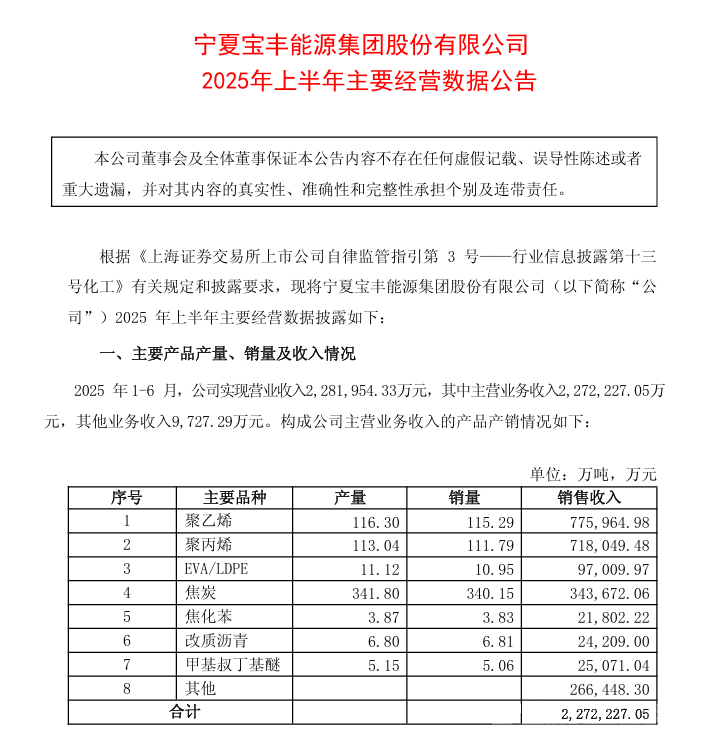
Core Viewpoint - Baofeng Energy's financial report for the first half of 2025 indicates strong performance in the production and sales of polyethylene and polypropylene, with a significant gross margin in its coal-to-olefins segment [1][7]. Group 1: Financial Performance - The company sold a total of 2.2708 million tons of polyethylene and polypropylene products, generating revenue of 14.94 billion yuan [1][7]. - The average selling price of olefin products is approximately 6,579.18 yuan per ton [1][7]. - The gross margin for the coal-to-olefins segment reached 42.84%, suggesting a production cost of about 3,760.66 yuan per ton [1][10]. Group 2: Cost Analysis - Some analysts believe that considering hydrogen subsidies and carbon tax exemptions, the actual production cost could be "just over three thousand," significantly lower than traditional industry perceptions [10][11]. - The cost of producing ethylene via traditional naphtha cracking is around 550 USD per ton, equivalent to approximately 3,894.99 yuan, indicating that Baofeng could earn nearly 3,000 yuan per ton when market prices are at 6,700 yuan [5][10]. Group 3: Industry Comparison - The coal chemical industry, exemplified by Baofeng Energy, excels in producing cost-sensitive bulk chemicals through integrated and large-scale production, creating a competitive cost advantage [12]. - In contrast, the oil chemical industry offers a wider range of products, including high-end materials, and often views olefin production as a byproduct of its refining processes [12].