太平鸟

Search documents
Forever 21重返中国市场 但快时尚江湖已变
Sou Hu Cai Jing· 2025-08-30 02:37
Core Insights - Forever 21 is making its fourth attempt to enter the Chinese market, highlighting the brand's persistent interest in this significant consumer market despite previous failures [1][5] - The collaboration with Shanghai Chengdi, backed by Vipshop, aims to leverage both brands' strengths to enhance Forever 21's market presence in China [3][4] - The fast fashion landscape in China has drastically changed, with local brands rising and consumer preferences evolving, posing challenges for foreign brands like Forever 21 [10][11] Company Strategy - Forever 21's partnership with Vipshop is intended to overcome digital challenges and enhance its online and offline marketing strategies [4] - The brand plans to offer trendy apparel at affordable prices while revitalizing its online presence and expanding its physical retail footprint [4][9] - The previous failures of Forever 21 in China were attributed to poor market positioning and a lack of adaptation to local consumer trends [7][10] Market Dynamics - The fast fashion market in China is now characterized by intense competition and a shift towards local brands, which are better aligned with consumer preferences [11] - International brands, including H&M and ZARA, are also facing challenges, with some closing stores or exiting the market entirely [10][11] - The rise of domestic brands like UR and Taiping Bird indicates a significant shift in consumer loyalty and market dynamics [11] Consumer Trends - The changing landscape of Chinese consumer behavior necessitates that foreign brands like Forever 21 adapt their product designs and marketing strategies to resonate with local tastes [6][10] - The emergence of "Guochao" (national trend) reflects a growing preference for local culture and aesthetics, which poses a challenge for foreign fast fashion brands [11]

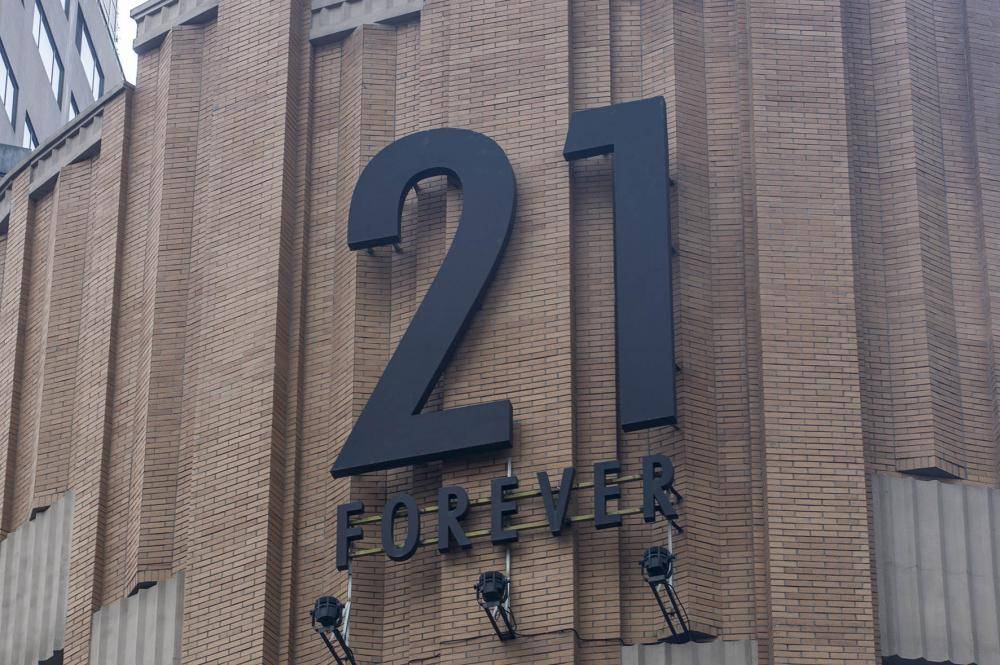
Forever 21第四次入华 但快时尚江湖已变
2 1 Shi Ji Jing Ji Bao Dao· 2025-08-29 10:29
Core Insights - Forever 21 is making its fourth attempt to enter the Chinese market, highlighting the brand's persistent interest in this significant consumer market despite previous failures [1][4] - The collaboration with Shanghai Chengdi, backed by Vipshop, aims to leverage digital capabilities and enhance market presence through a combination of brand and platform advantages [2][3] - The fast fashion landscape in China has evolved significantly, with local brands gaining traction and international brands facing challenges in adapting to consumer trends and preferences [9][10] Group 1: Company Strategy - Forever 21's new strategy includes a focus on digital marketing and e-commerce, with plans to revamp its online store and expand offline retail channels [3][2] - The brand's previous attempts in China were hindered by a lack of effective localization and failure to adapt to the rapid changes in the market [8][7] - The partnership with Vipshop is seen as a way to overcome past digital shortcomings and enhance overall channel capabilities [2][3] Group 2: Market Dynamics - The Chinese fast fashion market has shifted, with local brands like UR and Taiping Bird rapidly filling market gaps, while international brands struggle to maintain relevance [9][10] - The competitive landscape is characterized by a growing divide among consumer segments, making it difficult for any single fast fashion brand to dominate [9][10] - International brands, including H&M and Zara, are increasingly focusing on localization and optimizing their supply chains to better compete in the Chinese market [10]
Forever 21第四次入华,但快时尚江湖已变
2 1 Shi Ji Jing Ji Bao Dao· 2025-08-29 10:04
Core Insights - Forever 21 is making its fourth attempt to enter the Chinese market, highlighting the brand's persistent interest in this significant consumer market despite previous failures [1][4][8] - The collaboration with Shanghai Chengdi, a subsidiary of Vipshop, aims to leverage digital capabilities and enhance market presence through both online and offline channels [2][3] - The fast fashion landscape in China has evolved significantly, with local brands gaining traction and international brands facing challenges in adapting to consumer preferences and market dynamics [7][8] Group 1: Company Strategy - Forever 21's new strategy includes a focus on digital marketing and partnerships, particularly with platforms like Xiaohongshu and Vipshop, to overcome previous digital shortcomings [2][3] - The brand plans to revamp its online store and expand its offline retail presence, aiming to attract consumers with affordable fashion [3] - The collaboration with Vipshop is seen as a way to combine Forever 21's brand strength with Vipshop's platform advantages, potentially leading to innovative channel strategies [2][3] Group 2: Market Challenges - The fast fashion market in China has become increasingly competitive, with local brands like UR and Taiping Bird rapidly filling market gaps [8] - Forever 21's previous attempts in China were hindered by a lack of clear brand positioning and failure to adapt to local consumer trends, leading to its exit from the market in 2019 [5][6][7] - Analysts express skepticism about Forever 21's ability to succeed this time, citing the need for a more localized approach in product design and marketing strategies [3][7] Group 3: Industry Trends - The fast fashion industry is undergoing a transformation, with many international brands struggling to maintain relevance amid changing consumer behaviors and preferences [7][8] - The rise of digital commerce and the shift towards local cultural integration are critical factors that foreign brands must address to thrive in the Chinese market [7][8] - The competitive landscape is characterized by a growing divide among consumer segments, making it challenging for any single brand to dominate the market [8]
服装家纺板块8月29日跌0.35%,日播时尚领跌,主力资金净流出9018.48万元
Zheng Xing Xing Ye Ri Bao· 2025-08-29 08:41
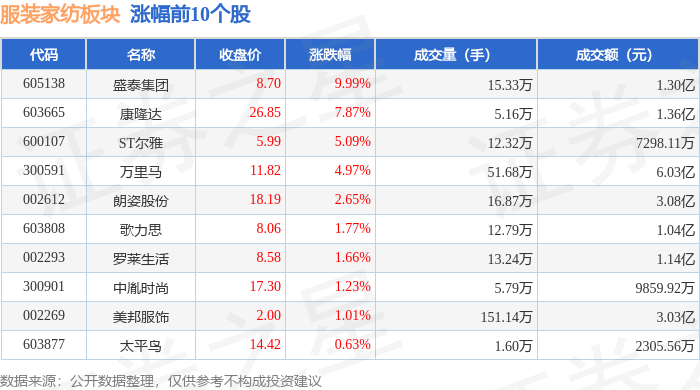
Market Overview - The apparel and home textile sector experienced a decline of 0.35% on August 29, with Daybo Fashion leading the drop [1] - The Shanghai Composite Index closed at 3857.93, up 0.37%, while the Shenzhen Component Index closed at 12696.15, up 0.99% [1] Stock Performance - Notable gainers in the apparel and home textile sector included: - Shengtai Group (605138) with a closing price of 8.70, up 9.99% and a trading volume of 153,300 shares, totaling 130 million yuan [1] - Kanglongda (603665) closed at 26.85, up 7.87% with a trading volume of 51,600 shares, totaling 136 million yuan [1] - ST Erya (600107) closed at 5.99, up 5.09% with a trading volume of 123,200 shares, totaling 72.98 million yuan [1] - Conversely, Daybo Fashion (603196) saw a decline of 3.50%, closing at 20.14 with a trading volume of 54,400 shares, totaling 112 million yuan [2] - Other notable decliners included: - Kute Intelligent (300840) down 3.12% to 21.77 [2] - Ru Yi Zhi Tuan (002193) down 3.06% to 5.70 [2] Capital Flow - The apparel and home textile sector saw a net outflow of 90.18 million yuan from institutional investors, while retail investors contributed a net inflow of 49.69 million yuan [2] - The capital flow for key stocks included: - Shengtai Group with a net inflow of 65.88 million yuan from institutional investors [3] - Wanlima (300591) with a net inflow of 47.55 million yuan [3] - Kanglongda with a net inflow of 15.41 million yuan [3]

太平鸟(603877):渠道、折扣调整下业绩短期承压,期待后续高质量增长
Changjiang Securities· 2025-08-26 23:30
Investment Rating - The report maintains a "Buy" rating for the company [7]. Core Views - In the short term, the company is expected to face pressure on performance due to channel adjustments, gradual retail improvement, and the recovery of franchise gross margins. However, with enhanced cost control, profit growth is anticipated to rebound in the future. In the long term, structural adjustments within the company are expected to significantly improve operational quality and profit elasticity. The company is shifting from profit elasticity driven by high retail growth to a more sustainable and robust profit elasticity driven by internal capabilities. The projected net profits for 2025, 2026, and 2027 are estimated at 200 million, 250 million, and 280 million yuan, respectively, with corresponding PE ratios of 35, 28, and 25 times [2][11]. Financial Performance Summary - For the first half of 2025, the company achieved revenue of 2.9 billion yuan, a year-on-year decrease of 7.9%. The net profit attributable to the parent company was 78 million yuan, down 54.6% year-on-year, while the net profit after deducting non-recurring gains and losses was 14 million yuan, a decline of 78.9% year-on-year. In Q2 alone, revenue was 1.23 billion yuan, a decrease of 8.2% year-on-year, and the net profit turned to a loss of 46 million yuan, a decline of 471.5% year-on-year [5][11]. Brand and Channel Performance - In Q2, most brands experienced revenue declines, with PB women's wear, men's wear, and Le Town down by 7.5%, 8.5%, and 13.8% respectively, while children's wear saw a slight increase of 0.2%. However, gross margins improved for most brands due to discount control. The revenue from franchise and online channels continued to decline year-on-year, while direct sales returned to positive growth with a 5.2% increase year-on-year in Q2 [11]. Cost and Profitability Analysis - The gross margin improved by 2.1 percentage points year-on-year in Q2 due to strict discount control. However, the net profit margin decreased by 4.7 percentage points to -3.8% due to negative operating leverage. The company’s operating cash flow for H1 was -260 million yuan, indicating tight cash flow but an improvement compared to Q1 [11][14].

本土时尚巨头转型样本:太平鸟的自我革命
Jing Ji Guan Cha Wang· 2025-08-26 09:24
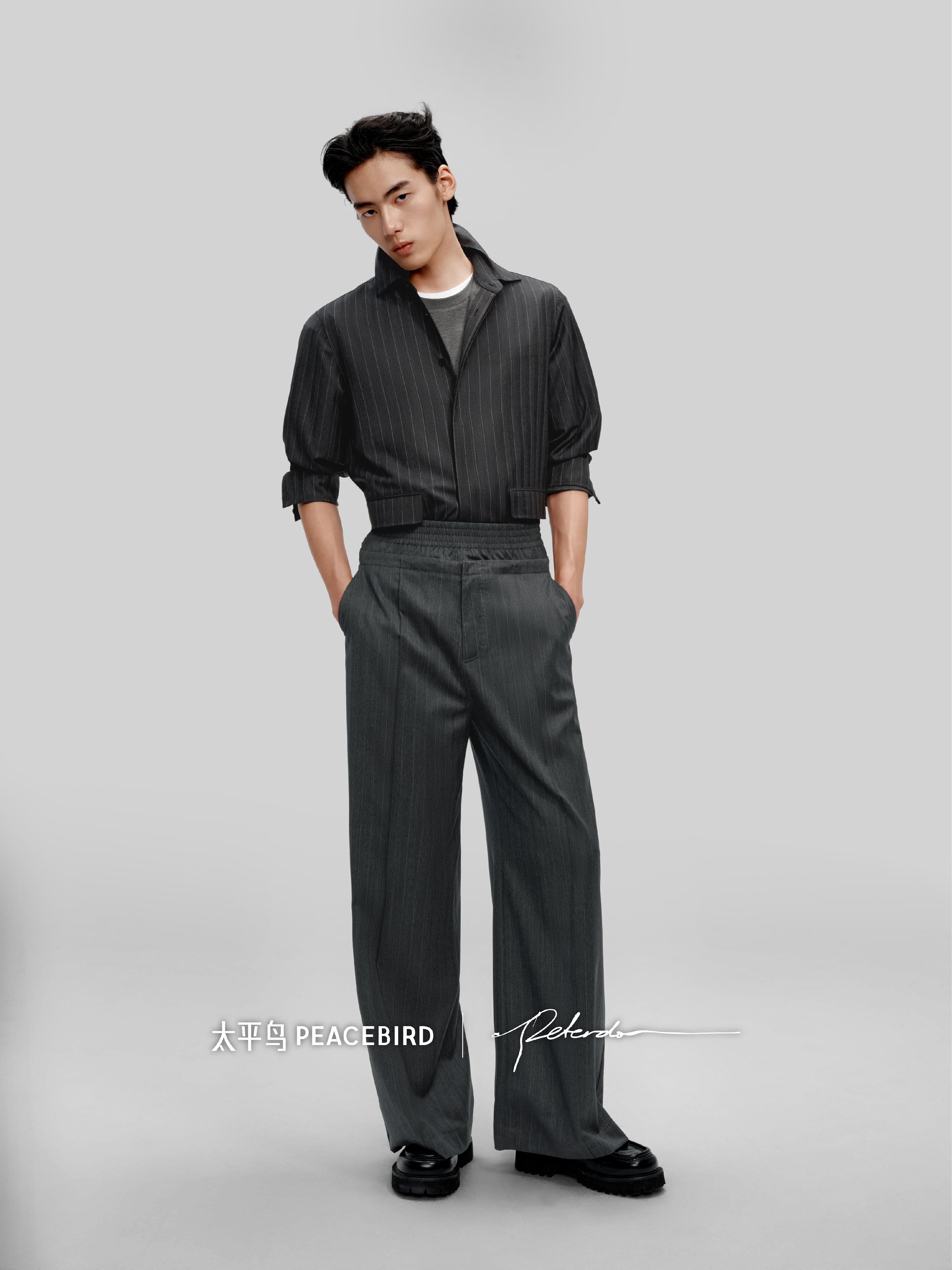
Core Insights - The article discusses the transformation of Peacebird (太平鸟) as it shifts from a fast fashion model to a focus on quality and sustainable growth, recognizing the limitations of its previous strategies [1][3][15] - The company aims to redefine its brand positioning to target the "emerging middle class" aged 25-35, emphasizing a more refined understanding of consumer needs [6][9][10] Group 1: Company Transformation - Peacebird has experienced revenue growth from 7.712 billion yuan in 2018 to 10.92 billion yuan in 2021, entering the "100 billion revenue club," but faced a 4.99% decline in net profit, indicating unsustainable growth risks [1] - In 2022, the company initiated significant organizational changes, merging its women's and men's clothing divisions into a unified "Peacebird main brand" to enhance brand cohesion and operational efficiency [3][4] - The establishment of a centralized organizational structure aims to improve internal collaboration and resource allocation, leading to better product quality and operational efficiency [4][15] Group 2: Market Positioning - Peacebird's new brand positioning targets the "25-35 years old emerging middle class," focusing on their lifestyle aspirations and evolving needs [6][9] - The company is not abandoning its younger consumer base but is instead refining its approach to meet the dynamic preferences of its target demographic [9][10] - Peacebird's strategy includes a "multi-scenario development" approach, creating clothing suitable for various social contexts, thus addressing the diverse needs of its consumers [13] Group 3: Future Development - The company plans to solidify its transformation results over the next two years and aims to become a leading brand in the Chinese fashion apparel sector within five years [19] - Peacebird is investing in infrastructure, including a new fashion research center and a digital sampling center, to support its quality upgrade initiatives [9][10]
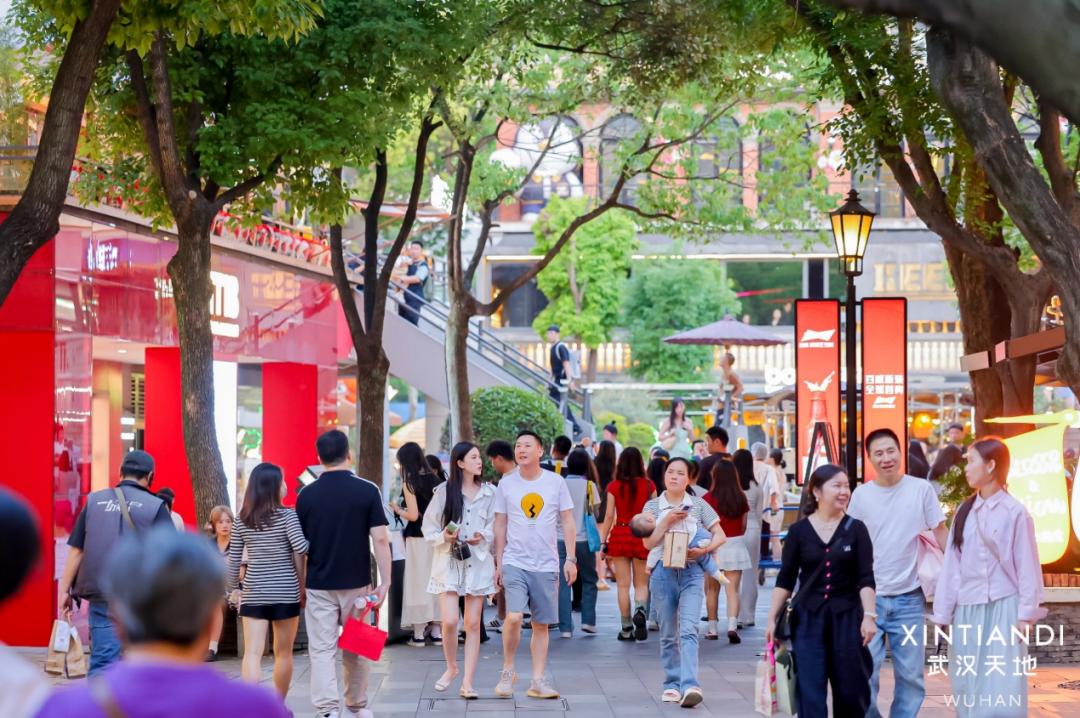
174家首店冲入武汉:武汉天地、咸安坊抢下冠亚军
3 6 Ke· 2025-08-25 01:52
Core Insights - The "first store economy" and "first launch economy" are gaining significant attention in Wuhan, driven by government support and consumer demand, leading to a boost in consumption quality and new consumption growth [1] Group 1: First Store Statistics - Wuhan has opened a total of 174 new first stores in key commercial areas, marking a 20% increase from 145 stores in the same period last year, achieving a historical high [1] - The quality and tier of brands have improved, with 5 national first stores, 46 first stores in Central China, 22 in Hubei, and 101 in Wuhan [1] Group 2: Concentration of First Stores - The first stores are increasingly concentrated in leading commercial projects, with 8 projects hosting over 10 new stores each, accounting for 57.5% of the total [2] - Wuhan Tiandi has introduced 18 first stores across various sectors, enhancing consumer choices with both international and local brands [2] Group 3: Notable Commercial Projects - Wuhan Xian'an Fang has become a "first store harvesting machine," with 74 first stores, representing over 78% of its total, focusing on trendy retail and nightlife consumption [4] - Wuhan Wushang Mall has introduced 12 first stores, including international and domestic brands, contributing to the high-quality development of the first store economy [6] - Wuhan Wuchang Vanke City has also attracted 12 first stores, showcasing a variety of new brands and high-profile exhibitions [6] Group 4: Market Composition - The market is primarily dominated by the restaurant and retail sectors, with 81 new restaurant stores (46.6% of total) and 63 retail stores introduced [8] - Beverage stores lead the restaurant category with 17 new entries, while bakery and dessert stores have 6 new brands [9][10] - The lifestyle service sector is growing, focusing on personal image and health-related services, reflecting consumer demand for quality [12]
杰克逊霍尔:不止放鸽,还有政策框架修订
GOLDEN SUN SECURITIES· 2025-08-25 00:53
Group 1: Macro Insights - The export performance remains strong, with August exports expected to exceed expectations, while second-hand housing sales show slight improvement but remain weak overall [5][6] - The Jackson Hole meeting indicated a dovish stance from Powell, with a high probability of interest rate cuts in September and two cuts expected within the year [6][7] - The food and beverage sector has finally seen a daily-level increase, while the oil and petrochemical sectors have also reversed previous downtrends [7][11] Group 2: Company-Specific Insights - Jackson Hole's policy framework revisions suggest a shift away from the "average inflation target," which may limit long-term rate cuts if inflation remains high [6] - Xiaomi Group reported record revenue and profit in Q2 2025, driven by high-end product offerings and growth in IoT and automotive sectors [32][33] - The construction company Lianjian Technology is expected to see significant growth due to successful mergers and acquisitions, with projected net profits increasing substantially from 0.70 billion to 1.66 billion from 2025 to 2027 [20] - Angel Yeast is anticipated to enter a multi-year upward cycle, with projected net profits of 16.4 billion to 21.9 billion from 2025 to 2027, reflecting a strong recovery [21] - Weilai Transmission, a leader in wind power precision transmission, is expected to turn profitable in 2025, with significant growth in net profits projected for the following years [22] - Muyu Group's pig production volume increased by 44.8% in H1 2025, with a focus on cost reduction, aiming to lower costs to 11 yuan/kg by year-end [41][42]
太平鸟(603877):折扣管理优化 费用投入致使利润承压
Xin Lang Cai Jing· 2025-08-24 06:31
Core Viewpoint - The company experienced a decline in revenue and net profit in the first half of 2025, with a focus on improving profitability through cost management and brand strategy [1][2][5]. Financial Performance - In 2025H1, the company's revenue was 2.9 billion yuan, down 8% year-on-year, and the net profit attributable to shareholders was 80 million yuan, down 55% year-on-year [1]. - For 2025Q2, revenue was 1.23 billion yuan, also down 8% year-on-year, with a net loss of 50 million yuan [2]. - The gross profit margin improved in both periods, with 2025H1 at 59.8% (+3.7 percentage points) and 2025Q2 at 59.5% (+2.1 percentage points) [1][2]. Profitability Quality - Despite the improvement in gross profit margin, the net profit margin decreased due to rising expense ratios, with 2025H1 net profit margin at 2.6% (-2.8 percentage points) and 2025Q2 at -3.8% (-4.7 percentage points) [1][2]. - The company recorded asset impairment losses of 77 million yuan in 2025H1 and 45 million yuan in 2025Q2, both higher than the previous year [1][2]. Brand Performance - Revenue from various brands declined, with PB women's wear down 10.45%, PB men's wear down 7.42%, and other brands also showing decreases [3]. - The company is focusing on its "one brand" strategy to enhance product development and improve brand image, despite facing short-term profit pressures due to increased expenses [3]. Channel Performance - Online sales in 2025Q1 decreased by 12.71% to 450 million yuan, while offline direct sales were relatively stable, down only 0.13% [4]. - The company has seen a reduction in the number of direct and franchise stores, indicating that channel adjustments are nearing completion [4]. Inventory and Cash Flow - Inventory increased by 9.8% year-on-year to 1.52 billion yuan, with inventory turnover days rising by 62.7 days to 251.2 days [5]. - The operating cash flow for 2025H1 was a net outflow of 260 million yuan, but there is an expectation for cash flow management to normalize in the future [5]. Investment Outlook - The company is recognized as a leading mass fashion brand group in China, with a clear long-term strategic goal despite short-term performance fluctuations [5]. - Profit forecasts for 2025 to 2027 are adjusted to 220 million, 290 million, and 370 million yuan respectively, with a corresponding PE ratio of 32 times for 2025 [5].
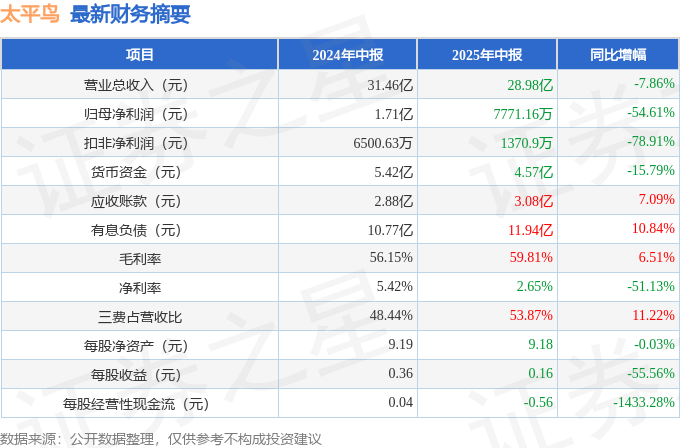
太平鸟2025年中报简析:净利润同比下降54.61%,公司应收账款体量较大
Zheng Quan Zhi Xing· 2025-08-22 22:42
Core Viewpoint - The financial performance of Taiping Bird (603877) for the first half of 2025 shows significant declines in revenue and net profit, indicating challenges in the retail sector and potential issues with cash flow management [1][9]. Financial Performance Summary - Total revenue for the first half of 2025 was 2.898 billion yuan, a decrease of 7.86% compared to 3.146 billion yuan in the same period of 2024 [1]. - Net profit attributable to shareholders was 77.71 million yuan, down 54.61% from 171 million yuan in the previous year [1]. - The gross profit margin improved to 59.81%, an increase of 6.51% year-on-year, while the net profit margin fell to 2.65%, a decrease of 51.13% [1]. - Total expenses (selling, administrative, and financial) reached 1.561 billion yuan, accounting for 53.87% of revenue, which is an increase of 11.22% year-on-year [1]. - Earnings per share dropped to 0.16 yuan, down 55.56% from 0.36 yuan in the previous year [1]. Cash Flow and Receivables - The company reported a significant increase in accounts receivable, which reached 308 million yuan, representing 119.18% of the latest annual net profit [1][10]. - Operating cash flow per share was -0.56 yuan, a drastic decline of 1433.28% compared to 0.04 yuan in the previous year [1]. Changes in Financial Items - Cash and cash equivalents decreased by 54.0% due to lower sales from spring and summer collections [3]. - Accounts receivable increased by 7.09%, attributed to lower unit values and decreased revenue [3]. - Prepayments surged by 222.71%, driven by higher-value autumn and winter collections [3]. - Short-term borrowings increased due to higher bill discounts [3]. - Accounts payable decreased by 69.3%, reflecting lower unit values in spring and summer collections [3]. Operational Insights - The company's return on invested capital (ROIC) was 5.27%, indicating average capital returns, with a historical median ROIC of 14.6% since its listing [9]. - The business model relies heavily on marketing-driven strategies, necessitating further investigation into the underlying factors affecting performance [9].