今世缘

Search documents
省外收入微增0.06%,今世缘千亿扩张梦碎?
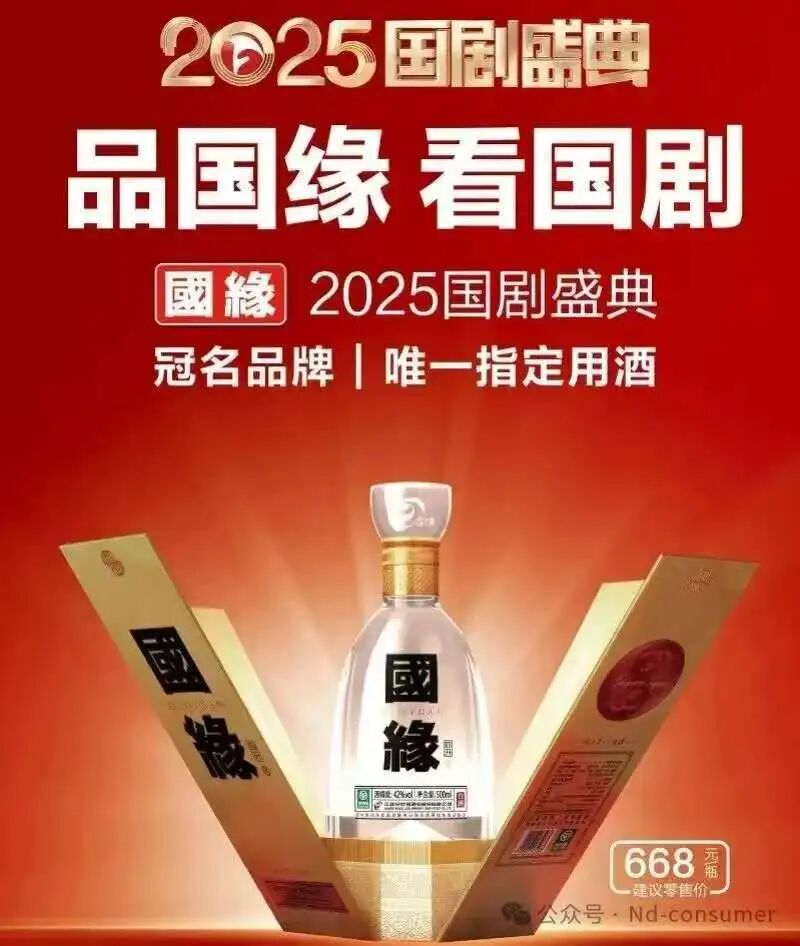
Xin Lang Cai Jing· 2025-12-30 03:38
Core Insights - The company is facing a "high investment, low output" dilemma, with both revenue and net profit declining while external market growth stagnates [2][4][10] Group 1: Marketing Strategies - The company has accelerated its brand expansion efforts, engaging in intensive marketing activities across sports and cultural events, including becoming the official strategic partner of the Jiangsu Super League [2][8] - A strategic partnership with Anhui Satellite TV was established, securing the naming rights for the 2025 "National Drama Festival," aiming to enhance brand exposure and cultural recognition [3][8] Group 2: Financial Performance - For the first three quarters, the company reported a revenue of 8.88 billion yuan, a year-on-year decline of 10.7%, and a net profit of 2.55 billion yuan, down 17.4% [4][9] - In Q3 alone, revenue plummeted to 1.93 billion yuan, a staggering drop of 26.8%, with net profit nearly halving to 320 million yuan, a decrease of 48.7% [4][9] Group 3: Market Challenges - The company's revenue heavily relies on the domestic market, with 7.955 billion yuan from the province, accounting for 90% of total revenue, which saw a decline of 12.4% [4][9] - The external market growth is minimal, with only 804 million yuan in revenue, reflecting a mere 0.06% increase, indicating challenges in the company's national expansion strategy [4][10] Group 4: Industry Context - The broader industry is experiencing a "slight revenue increase, profit pressure" trend, with intense competition in the domestic market, prompting local companies to seek expansion into surrounding provinces [5][10] - The white liquor industry is characterized by strong regionality and channel dependency, making cross-regional expansion challenging and requiring significant long-term investment [10]


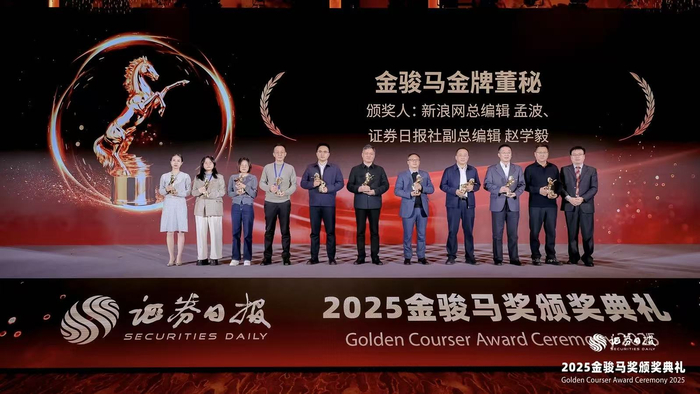
今世缘王卫东荣获“金骏马金牌董秘”奖
Zheng Quan Ri Bao Zhi Sheng· 2025-12-29 08:12
Group 1 - The "2025 Securities Market Annual Conference" was successfully held in Beijing, focusing on the theme of "Reform and Innovation in Capital Markets" [1] - The conference awarded the "Golden Horse Award," recognizing outstanding contributions to the healthy development of the capital market, with 11 significant awards presented [1] - Wang Weidong, Secretary of the Board of Jiangsu Jinshiyuan Liquor Co., Ltd., received the "Golden Horse Gold Medal Secretary" award for his exceptional professional capabilities and performance [1] Group 2 - Wang Weidong has been instrumental in optimizing governance structures, enhancing ESG initiatives, and building capital brand value, which has effectively maintained and increased the company's market value [2] - Under his leadership, Jinshiyuan's governance and information disclosure levels have significantly improved, earning the highest A-level rating for information disclosure from the Shanghai Stock Exchange for two consecutive years [2] - Wang Weidong has established a robust investor communication platform, organizing frequent performance briefings and roadshows, achieving a 100% response rate to inquiries [2]
平衡终端价格与销量 白酒旺季临近酒企再掀涨价潮
Bei Jing Shang Bao· 2025-12-29 07:10
针对以上涨价一事,北京商报记者分别致电湖南武陵酒有限公司、广西丹泉酒业营销有限公司营销公司 总部,但截至记者发稿前,暂未收到回复。 从头部名酒蔓延至区域酒企的涨价热浪,"市场占位"、"价格对标"成为下半年竞技赛道的关键字眼。程 万松告诉北京商报记者,不同于名酒涨价,区域酒企的涨价还需慎重。对于高端产品而言,该品类多为 满足商务社交需求,价格的变动会反作用于供需关系;而对于低端产品,涨价或许意味着部分消费者的 流失。可见,当消费者追求性价比时,供需关系直接决定产品价格。 面对即将到来的中秋、国庆双节,从头部酒企到区域酒企也纷纷坐不住了,在市场接连上演"调价""新 品"的戏码。泸州老窖在历经大张旗鼓的涨价后,也暂时进入平静期。进入8月以来,"涨价"似乎已成为 区域酒企的主场。 在不同的价格带,各区域酒企也分别进行了不同程度的涨价。北京商报记者梳理发现,湖南武陵酒销售 有限公司将旗下匠心、琥珀1000、琥珀509等多款高端产品价格分别上调至4299元/瓶、1699元/瓶和899 元/瓶,"三酱"系列的上酱、中酱、武陵王价格分别上调至2680元/瓶、880元/瓶和1680元/瓶,涨价幅度 100元-1000元不等。同 ...
白酒板块逆市上涨 酒企双节价格仍坚挺
Zheng Quan Ri Bao Wang· 2025-12-29 07:10
Group 1 - The liquor sector experienced a counter-market rise on September 22, with Kweichow Moutai leading the gains by over 1%, along with other liquor stocks like Shui Jing Fang and Shanxi Fenjiu, which also saw increases of over 1% [1] - Tianfeng Securities maintains a strong recommendation for the liquor sector, noting that prices remain firm ahead of the Mid-Autumn Festival, with major liquor companies actively preparing stock and increasing promotional efforts [1] - Northeast Securities shares a similar outlook, indicating that high-end liquor demand is strong, with Moutai's batch price rising to 2860 yuan and Wuliangye maintaining around 960 yuan, suggesting a recovery in dining and banquet consumption [1] Group 2 - The liquor sector is expected to reach last year's sales levels during the Mid-Autumn and National Day holidays, with high-end liquor potentially evolving towards a luxury goods market [1] - Despite the current high valuations compared to historical averages, the industry's improving structure and increasing concentration justify these valuations, with a long-term positive outlook for the sector [1] - Recommendations include preferential allocation to Kweichow Moutai, Wuliangye, Luzhou Laojiao, and Shanxi Fenjiu, with additional emphasis on Gujing Gongjiu, Jianshiyuan, and Yanghe Distillery [1]


白酒调整期最惨成绩单?白云边暴跌20.8%,百亿目标差38亿
Sou Hu Cai Jing· 2025-12-29 05:12
Core Viewpoint - The performance decline of Baiyunbian Distillery reflects broader challenges faced by regional liquor companies in the context of a deep adjustment period in the liquor industry, with its 2025 revenue dropping to 6.2 billion yuan, a 20.8% decrease from 7.83 billion yuan in 2024, reverting to 2021 levels [2][3]. Group 1: Company Performance - Baiyunbian's revenue for 2025 is reported at 6.2 billion yuan, significantly lower than the previously stated 8.72 billion yuan in the "2025 Hubei Top 100 Enterprises" list, indicating a discrepancy in data reporting [3]. - The company's ambitious goal of reaching 10 billion yuan in sales by the end of the 14th Five-Year Plan has been shattered, highlighting deep-rooted issues in market expansion, product structure, and brand protection [2][6]. Group 2: External and Internal Challenges - The liquor industry has entered a deep adjustment phase since 2024, compounded by the strict implementation of the "drinking ban" in 2025, leading to a significant contraction in key consumption scenarios such as government and business banquets [3][4]. - Baiyunbian's internal issues, particularly its heavy reliance on the local market, have exacerbated its performance decline, as over 70% of its sales come from Hubei, limiting its ability to counteract regional market fluctuations [4][6]. Group 3: Market Position and Competition - The competitive landscape in Hubei's liquor market is intense, with national brands like Wuliangye and Yanghe dominating the high-end segment, while brands like Jiangxiaobai and Jinjiu are capturing market share in the mass consumption segment [4]. - Baiyunbian's product structure is heavily focused on the 100-500 yuan price range, leaving it vulnerable in the high-end market and underrepresented in the low-end market, which is critical for capturing consumer demand during economic downturns [5][6]. Group 4: Brand and Product Strategy - The proliferation of counterfeit products has severely impacted Baiyunbian's brand integrity, with imitations flooding the market across various price points, undermining consumer trust [4][5]. - Despite recognizing the need for strategic adjustments, such as maintaining price stability and exploring new product flavors, the company's initiatives have largely remained theoretical without effective implementation [5][6]. Group 5: Future Outlook - The current performance decline serves as a warning for Baiyunbian, emphasizing the need for a strategic overhaul to escape its comfort zone in the local market and to diversify its product offerings [6][7]. - The liquor industry's adjustment period presents both challenges and opportunities for Baiyunbian, which must address its regional limitations, product pricing constraints, and brand protection to remain competitive [7].
2025年度金骏马金牌董秘奖



Zheng Quan Ri Bao Zhi Sheng· 2025-12-26 14:43
Group 1 - Key point 1: The article lists various executives from different companies, indicating a focus on leadership within the industry [2][3] - Key point 2: The companies mentioned span multiple sectors, including transportation, energy, and technology, highlighting a diverse range of industries [2][3] - Key point 3: The presence of executives from both state-owned and private enterprises suggests a mixed economic landscape in China [2][3] Group 2 - Key point 1: The mention of specific individuals such as Wang Jian from CRRC and Li Yan from Fuanna indicates their significance in their respective companies [2] - Key point 2: The inclusion of companies like BYD and Tianqi Lithium reflects the growing importance of electric vehicles and battery materials in the current market [2] - Key point 3: The diversity of sectors represented, from environmental technology to traditional manufacturing, points to a broad spectrum of investment opportunities [2][3]
白酒板块12月26日跌0.34%,*ST岩石领跌,主力资金净流出4.94亿元
Zheng Xing Xing Ye Ri Bao· 2025-12-26 09:07
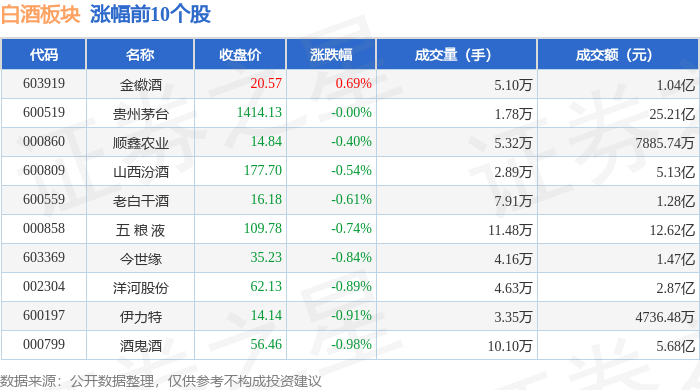
Group 1 - The liquor sector experienced a decline of 0.34% on December 26, with *ST Rock leading the drop [1] - The Shanghai Composite Index closed at 3963.68, up 0.1%, while the Shenzhen Component Index closed at 13603.89, up 0.54% [1] - Major liquor stocks showed varied performance, with Kweichow Moutai closing at 1414.13, unchanged, while Wuliangye fell by 0.74% to 109.78 [1] Group 2 - The liquor sector saw a net outflow of 494 million yuan from institutional investors, while retail investors contributed a net inflow of 446 million yuan [2] - The trading volume for major liquor stocks varied, with Kweichow Moutai having a transaction amount of 2.52 billion yuan [2] - The net inflow from retail investors was significant, indicating a potential shift in market sentiment towards retail participation [2] Group 3 - Kweichow Moutai had a net inflow of 74.04 million yuan from institutional investors, while *ST Rock experienced a net outflow of 2.24 million yuan [3] - The data indicates that institutional investors are cautious, with several stocks like *ST Rock and Jinzhongzi Wine showing negative net inflows [3] - Retail investors showed a positive net inflow in several stocks, suggesting a divergence in investment strategies between institutional and retail investors [3]


食品饮料行业 2026 年度投资策略报告(二):白酒:底部信号夯实,重视优质酒企配置机会-20251225
Guoxin Securities· 2025-12-25 13:59
Group 1 - The report indicates that the liquor industry is currently facing supply-demand imbalances, with companies reducing growth expectations and releasing channel pressures. The white liquor index has dropped by 12% since the beginning of 2025, underperforming the CSI 300 index by 33% [1][11] - The report highlights that the overall market demand for white liquor has shown slight recovery, but actual demand remains weak, with mainstream product prices in a downward trend. Companies like Wuliangye and Gujing Gongjiu are reducing growth expectations, leading to significant declines in Q3 performance [1][22] - The report suggests that the white liquor sector is entering a configuration phase, with leading companies like Kweichow Moutai improving their price-volume relationship and showcasing dividend asset attributes, with a projected dividend yield of 4% in 2026 [3][4] Group 2 - Looking ahead to 2026, the report anticipates that supply-side optimization and channel clearing will occur, with a focus on quality company configurations. The industry is expected to see gradual recovery in demand, particularly during the Spring Festival sales period [2][29] - The report notes that channel inventory has decreased since Q3 2025, and companies are focusing on maintaining dynamic profits for distributors. Leading companies are gradually relaxing channel policies, indicating a stabilization trend in product prices post-holiday [2][42] - The competitive landscape is shifting from price differentiation to brand and organizational capabilities, with companies that can establish pricing power in specific regions or demographics likely to emerge from the adjustment cycle first [2][29] Group 3 - Investment recommendations suggest that the white liquor sector is now in a configuration zone, with a focus on brands that can navigate through cycles, such as Kweichow Moutai and Shanxi Fenjiu, which are expected to see valuation improvements as market liquidity increases [3][4] - The report emphasizes the importance of companies that have established advantages in pricing and regional market share during the adjustment phase, such as Luzhou Laojiao, Gujing Gongjiu, and Jinhui Liquor [3][4] - The report also highlights companies with strong shareholder returns and cash flow safety margins, such as Wuliangye, as potential investment opportunities [3][4]



白酒浮华消散,行业寻找新主场|2025中国经济年报
Hua Xia Shi Bao· 2025-12-25 12:57
Core Insights - The Chinese liquor industry is still in a deep adjustment phase as of the end of 2025, shifting from volume growth to a focus on market share redistribution due to declining demand pressures [2][3] - The high-end market is losing its appeal, leading to a downward adjustment in mainstream price ranges, with distributors adopting a cautious outlook for the upcoming Spring Festival sales [2][3] - Key issues facing the industry include overcapacity, high inventory levels, price inversions, and a lack of consumption scenarios, as highlighted by industry leaders [2][3] Market Dynamics - The price of Moutai liquor has become a significant indicator of industry adjustments, with its wholesale price dropping to 1500 yuan per bottle in December 2025, reflecting broader market challenges [3][4] - Among 20 A-share listed liquor companies, only Guizhou Moutai and Shanxi Fenjiu reported positive growth in the first three quarters of the year, while the remaining 18 experienced negative growth [3][4] - The new regulations on government consumption and changing preferences among younger consumers are contributing to the industry's downturn [3][4] Industry Adjustments - The current adjustment is characterized by a proactive approach from leading companies, focusing on quality improvement and channel optimization rather than aggressive price cuts [4][5] - There is a significant market differentiation occurring, with top brands managing to maintain their positions while smaller and less established brands face existential threats [4][5] - The industry is expected to enter a "U-shaped" recovery phase in 2026, driven by structural differentiation and improvements in actual sales and inventory levels [5][6] Strategic Shifts - The industry is undergoing a transformation in response to new consumer behaviors, with a consensus on the need for lower-alcohol products to cater to younger demographics [6][7] - Companies are increasingly embracing e-commerce and new retail models to adapt to changing market dynamics [6][7] - Internationalization is becoming a necessary strategy, with companies like Luzhou Laojiao expanding into over 70 countries, although challenges such as trade barriers and cultural differences remain [7][8] Future Outlook - The industry is expected to realign its value propositions to connect more closely with consumers' daily lives, marking a significant shift in survival logic [8]
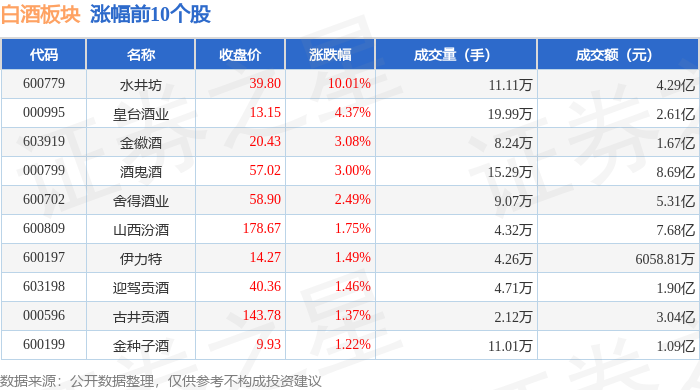
白酒板块12月25日涨1.13%,水井坊领涨,主力资金净流入8.74亿元
Zheng Xing Xing Ye Ri Bao· 2025-12-25 09:07
Core Viewpoint - The liquor sector experienced a rise of 1.13% on December 25, with Shui Jing Fang leading the gains, while the Shanghai Composite Index rose by 0.47% and the Shenzhen Component Index increased by 0.33% [1] Group 1: Liquor Sector Performance - Shui Jing Fang (600779) closed at 39.80, up 10.01% with a trading volume of 111,100 shares [1] - Other notable performers include Sanlong Jibei (000995) with a 4.37% increase, and Quan Wei Jiu (616809) rising by 3.08% [1] - The total net inflow of funds into the liquor sector was 874 million yuan, while retail investors saw a net outflow of 325 million yuan [1] Group 2: Fund Flow Analysis - Major net inflows were observed in Kweichow Moutai (600519) with 319 million yuan, accounting for 9.67% of the total [2] - Shui Jing Fang (600779) had a net inflow of 154 million yuan, representing 35.78% of its trading volume [2] - The retail investor net outflow for Shui Jing Fang was 93.49 million yuan, indicating a significant withdrawal from this stock [2]