壁仞科技

Search documents
350余家排队,国产大模型和算力企业扎堆港交所
3 6 Ke· 2026-01-26 12:04
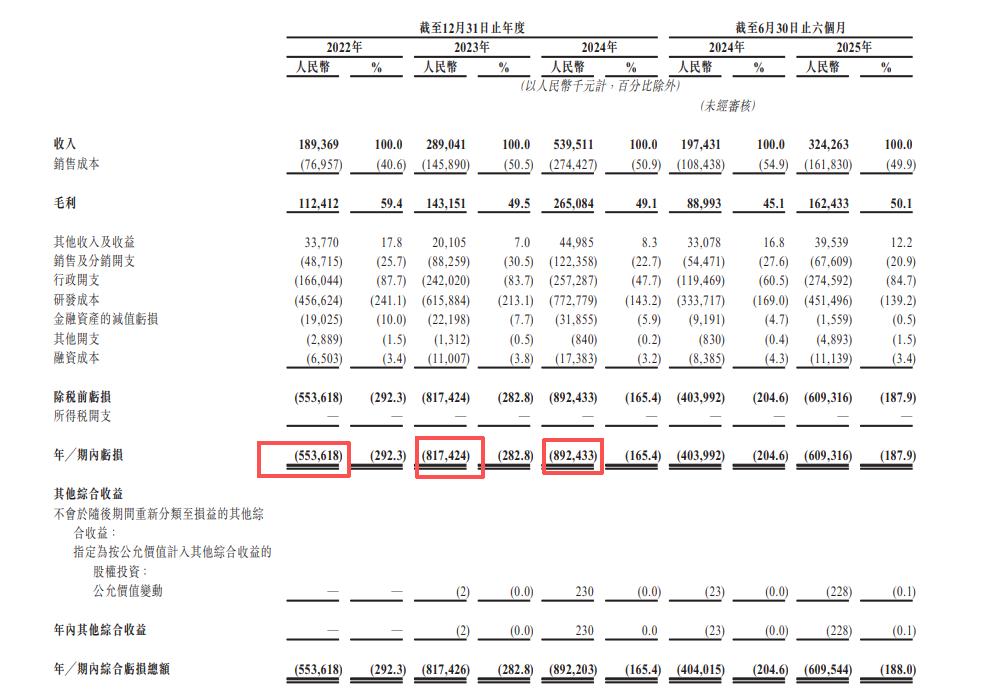
Core Viewpoint - The recent surge in IPOs on the Hong Kong Stock Exchange (HKEX) reflects a favorable market environment for technology companies, particularly in the semiconductor and AI sectors, driven by a more flexible registration system and financing mechanisms [1][12]. Group 1: Recent IPO Activity - Shanghai Birun Technology Co., Ltd. became the first domestic GPU company to list on HKEX on January 2, followed by TianShu ZhiXin and Beijing ZhiPu HuaZhang Technology Co., Ltd. on January 8, and MiniMax, the world's first AI company with a market value exceeding 100 billion, on January 9 [1]. - As of January 13, 11 companies had completed IPOs on HKEX, raising a total of HKD 33.1 billion, with sectors including semiconductors, AI, pharmaceuticals, and non-ferrous metals [1]. Group 2: Financial Performance of Listed Companies - Birun Technology reported revenues of RMB 0.499 million in 2022, RMB 62.03 million in 2023, RMB 337 million in 2024, and RMB 58.903 million in the first half of 2025, but has not yet achieved profitability [3]. - TianShu ZhiXin's net losses from 2022 to 2024 were RMB 5.54 billion, RMB 8.17 billion, and RMB 8.92 billion, totaling over RMB 22 billion in losses [4]. Group 3: Market Dynamics and Listing Preferences - The HKEX offers a quicker IPO process compared to A-shares, with an average listing cycle of approximately 393 days in 2024, compared to A-shares which can take up to 719.3 days [8][9]. - Companies prefer HKEX for its more lenient listing requirements and faster access to capital, which is crucial for survival in capital-intensive sectors like AI and semiconductors [11][12]. Group 4: Future Trends and Market Outlook - The HKEX is expected to continue attracting IPOs, with projections indicating that 2025 will see significant activity, particularly from semiconductor and biopharmaceutical companies [16]. - The trend of A+H listings is likely to persist, although the proportion may decrease, and international capital is expected to play a larger role in the market [16].

上海大模型企业阶跃星辰完成超50亿元B+轮融资
Guo Ji Jin Rong Bao· 2026-01-26 11:35
Group 1 - StepFun, a Shanghai-based AI startup, completed over 5 billion yuan in B+ round financing, setting a record for the largest single financing in China's large model sector in the past 12 months [1] - The financing utilized a diverse model of "state-owned capital guidance + industrial capital + leading venture capital," with significant participation from major state-owned enterprises and existing investors like Tencent [1] - The funds will focus on upgrading foundational models, accelerating the development of top-tier base models globally, and promoting the "AI + terminal" strategy in automotive and mobile phone applications [1] Group 2 - The financing coincides with the critical phase of the national "AI +" strategy, aiming for over 70% application penetration of new intelligent terminals and agents by 2027, and 90% by 2030 [2] - Shanghai's action plan targets a 300 billion yuan industry scale by 2027, with a goal of producing millions of AI smartphones [2] Group 3 - StepFun's API call volume for terminal intelligent agents has grown nearly 170% over three consecutive quarters, with over 60% of leading domestic smartphone brands collaborating with the company [3] - The company has partnered with Qianli Technology and Geely to launch the first end-to-end voice model in the automotive sector, with the Geely Galaxy M9 selling nearly 40,000 units in three months [3] - StepFun is building an industrial ecosystem by forming the "MoCore Ecological Innovation Alliance" and collaborating with chip manufacturers to create solutions for various applications, enhancing its competitive edge [3]
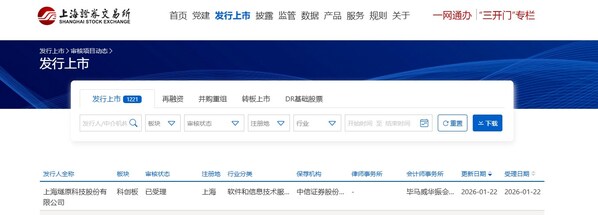
燧原科技科创板IPO获受理 "国产GPU四小龙"齐聚资本市场
Sou Hu Wang· 2026-01-26 03:32
2025年末,随着摩尔线程、沐曦股份在科创板上市后股价表现强劲,及2026年初壁仞科技成功登陆港 股,国产高端GPU领军企业集群加速对接资本市场。如今,"国产GPU四小龙"阵营的最后一块关键拼图 即将就位 —— 上海燧原科技股份有限公司的科创板IPO申请已于1月22日获证监会受理,标志着其上市 进程进入冲刺阶段,这家估值达205亿元的独角兽企业有望在二级市场再引关注。 公司的核心竞争力植根于其核心团队的深厚产业背景。创始人、董事长兼CEO赵立东毕业于清华大学无 线通信系,曾在硅谷的半导体芯片行业工作超过二十年,2007年至2014年就职于AMD(美国超威半导体 公司),负责CPU/APU产品规划和多个相关核心IP的研发,并参与成立中国研发中心。2014年12月加入 紫光集团担任副总裁,主管半导体投资相关工作。联合创始人兼COO张亚林也曾在AMD工作11年,带 领AMD上海研发中心成功开发并量产多颗旗舰处理器。可以说,从核心团队来看,燧原科技具有纯正 的"硅谷基因",这也为公司奠定了坚实的技术与工程基础。 在技术路径选择上,燧原科技采取了差异化竞争策略。燧原科技的最大亮点之一是其技术路线,公司避 开与英伟达通用 ...
上海:龙腾虎跃闹“芯”春
Xin Hua Wang· 2026-01-26 02:13
Core Insights - Shanghai is emerging as a leading hub for the semiconductor and artificial intelligence industries in China, with significant growth projections for both sectors by 2025 [1][7][13] - The rapid expansion of the general GPU market in China is driven by the increasing demand for computing power, particularly due to the rise of AI models [3][6] - A number of innovative AI companies have recently gone public, highlighting the vibrant "Shanghai tech sector" [6][11] Industry Overview - The integrated circuit industry in Shanghai is expected to achieve a revenue scale exceeding 488 billion yuan by 2025, doubling in five years [1] - The artificial intelligence industry in Shanghai is projected to exceed 550 billion yuan, with a growth rate surpassing 30% [1] - Shanghai ranks fourth globally and first in China in the latest global integrated circuit industry competitiveness ranking [8] Company Developments - Wallen Technology, the first GPU company listed on the Hong Kong stock market, has set a record for the largest IPO since the implementation of the special technology company listing mechanism [3] - TianShu Intelligent Chip is expected to deliver approximately 15,000 general GPU units in the first half of 2025, covering various sectors including finance and healthcare [3] - MiniMax, a rapidly growing AI company, has achieved significant milestones in video model development, generating over 590 million videos [4][5] Investment and Ecosystem - Shanghai has established a comprehensive investment ecosystem, including a fund matrix with a scale of 105 billion yuan to support core technology breakthroughs and industry chain organization [11][12] - The city is fostering a collaborative environment for AI companies, with over 200 AI enterprises having settled in the "Mosu Space" innovation community [9][10] - The government is actively supporting innovation by facilitating pilot projects for new products, which is crucial for early-stage product iteration [12]
AI迈入“技术+资本”驱动成长期
Ke Ji Ri Bao· 2026-01-26 00:57
Core Viewpoint - The recent wave of IPOs by domestic AI companies in China signifies a transition from a technology-driven exploration phase to a capital-driven industrialization phase, characterized by rapid revenue growth, significant R&D investment, and ongoing losses [1][2]. Group 1: Transition from Exploration to Growth Phase - The current IPO wave indicates that China's AI industry has surpassed the foundational development phase and is entering a growth phase marked by large-scale investment, industry chain collaboration, and accelerated application penetration [1][2]. - AI development inherently features high fixed costs and low marginal costs, with substantial initial investments in computing power, data management, and talent, but decreasing unit costs as scale increases [1]. Group 2: Role of Capital Markets - The IPOs suggest that capital markets are increasingly taking over the role of major internet companies in allocating computing power and R&D resources, shifting from short-term funding to long-term financing [2]. - The listed companies cover critical areas of AI development, including computing power, foundational models, and vertical applications, indicating a shift from isolated innovations to a collaborative ecosystem [2]. Group 3: Market Challenges Post-IPO - Post-IPO, AI companies face stricter public scrutiny and immediate profitability pressures, necessitating a balance between long-term R&D investments and short-term market expectations [3]. - Companies are advised to establish verifiable R&D milestones and present measurable indicators of success to align with market expectations and reduce the impact of short-term fluctuations on R&D [3]. Group 4: Commercialization Strategies - Companies should develop a layered cash flow strategy to secure funding for long-term R&D, diversifying revenue streams through subscriptions, API calls, and service deployments [4]. - The goal is to use more stable revenue sources to buffer against the uncertainties of cutting-edge R&D, ensuring that innovation does not compromise profitability [4]. Group 5: New Competitive Landscape - Continuous R&D investment and capital expenditure are essential for both model and chip layers, with many companies planning to allocate IPO proceeds towards foundational model development and platform capabilities [5]. - The financing boom is expected to accelerate innovation cycles and shift the focus from isolated breakthroughs to project-based and product-oriented developments, raising industry entry barriers [5]. Group 6: Macro Trends in AI - The global AI market is projected to reach $900 billion by 2026, with China expected to see a growth rate exceeding 30% during the same period, highlighting its position as a rapidly growing market [6]. - The effectiveness of this financing wave in fostering sustainable innovation will depend on directing capital towards long-term research and maintaining a balance between efficiency, ecosystem boundaries, and compliance [6].
“国产GPU四小龙”拥抱资本市场意味着什么
Zheng Quan Ri Bao· 2026-01-25 17:10
Core Viewpoint - The recent IPO activities of domestic GPU companies such as Moore Threads, Muxi Technology, and others signify a pivotal moment for China's GPU industry, driven by the demand for AI and the need for self-sufficiency in computing power [1][4]. Group 1: Market Dynamics - The embrace of the capital market by domestic GPU companies is a result of both technological breakthroughs and surging market demand, particularly in the context of AI and computing power needs [2][3]. - The "Four Little Dragons" of domestic GPUs have transitioned from being labeled as "laboratory products" to achieving large-scale commercialization in key areas such as AI model training and financial risk control [2][3]. Group 2: Capital Market Impact - The capital market is expected to provide crucial momentum for the domestic GPU industry to overcome development bottlenecks, addressing the high R&D costs and long return cycles typical of the GPU sector [3]. - The listing of these companies will enhance funding for advanced process research, software ecosystem development, and industry chain collaboration, facilitating a shift from "catching up" to "running alongside" or even "leading" in certain areas [3]. Group 3: Collaborative Ecosystem - The future development of the "Four Little Dragons" is anticipated to foster a collaborative growth model within the domestic GPU industry, leveraging their unique strengths to cover core application scenarios [3]. - The essence of GPU competition lies in the ecosystem, necessitating collaboration with universities, research institutions, independent developers, and international open-source communities to cultivate a thriving application ecosystem [3]. Group 4: Strategic Importance - Computing power is identified as the core productivity of the digital economy, with GPUs serving as the "heart" of this infrastructure, marking the collective move of the "Four Little Dragons" into the capital market as a significant milestone for China's computing power industry [4]. - The combination of technological, capital, and market forces is expected to enable the domestic GPU industry to break through ecological barriers and establish a self-sufficient computing foundation, supporting the advancement of AI applications across various sectors [4].
“A+H赴港上市需300亿市值门槛”?一线调查拨开传闻迷雾
财联社· 2026-01-25 07:36
本周五, 有关"赴港上市门槛收紧"的传闻引发市场广泛讨论。 该传闻不仅覆盖直接赴港上市的内地企业,还涉及寻求港股双重上市的A股公 司,一度被解读为赴港上市通道"降温"的信号。真实情况如何? 针对传闻中"已有券商收到指导,要求拟赴港上市的双重企业满足300亿元的市值门槛",财联社记者向部分券商求证,得到答复均为未收到此类指导 或通知。 同时记者获悉,联交所目前也并未接到"提高赴港上市门槛"的相关通知。 某头部券商投行高管告诉记者, 300亿元的市值标准对于赴港上市企业而言门槛过高,远超当前港股市场多数拟上市主体的规模水平, 设置这一 门槛背后必然有可追溯的潜在考量,但当前落地可能性较低。 另一位头部投行人士也向记者给出了相似结论,原因有二。 一是从监管逻辑来看,突然叫停或实质性收紧赴港上市门槛的可能性存在,但当前概率较低。这是因为,香港资本市场的核心优势在于高度 市场化,本质上只要企业股票能获得市场认可、成功配售,且不存在信息披露造假等违规行为,监管层通常不会刻意设限,通过高门槛"一 刀切"或无必要。 二是港股作为中资企业境外融资的核心平台,在内地上市审核以"质量"为导向的严监管态势下,若同步抬高市值门槛,可能 ...

英伟达H200相关PCB组件被传已暂停生产
Zhong Guo Jing Ying Bao· 2026-01-25 03:41
Group 1 - Nvidia's founder and CEO Jensen Huang visited China in January 2026, engaging with employees and attending New Year events in Shanghai, Beijing, and Shenzhen [1] - The H200 chip, launched in November 2023, features a groundbreaking 141GB HBM3e memory system, significantly enhancing the capability to process large models [2] - The U.S. government approved Nvidia's export of the H200 chip to China under certain conditions, including a 25% sales revenue fee, despite opposition from hawkish lawmakers [2] Group 2 - The production of key components for the H200 chip, such as printed circuit boards (PCBs), has been halted due to uncertainties surrounding U.S. export controls [2] - PCBs are essential for GPU/AI chips, providing physical support, signal transmission, and power distribution [3] - Different GPU models may require specific PCB designs based on their pin configurations and intended applications, leading to multiple differentiated PCB versions for the same GPU [3] Group 3 - Domestic GPU companies, including Moer Technology, Muxi Co., Biran Technology, and Tianshu Zhixin, rely on PCBs as a crucial raw material [4] - Shenghong Technology is identified as a core PCB supplier for domestic GPU manufacturers, holding over 50% of the global graphics card PCB market share [5] - Huadian Co. is another significant supplier, focusing on high-layer boards for UBB motherboards and data center computing boards [5]

韧性、勇气、眼界,三个关键词回望上海“十四五” | 大江东:开局看上海①
Sou Hu Cai Jing· 2026-01-24 15:14
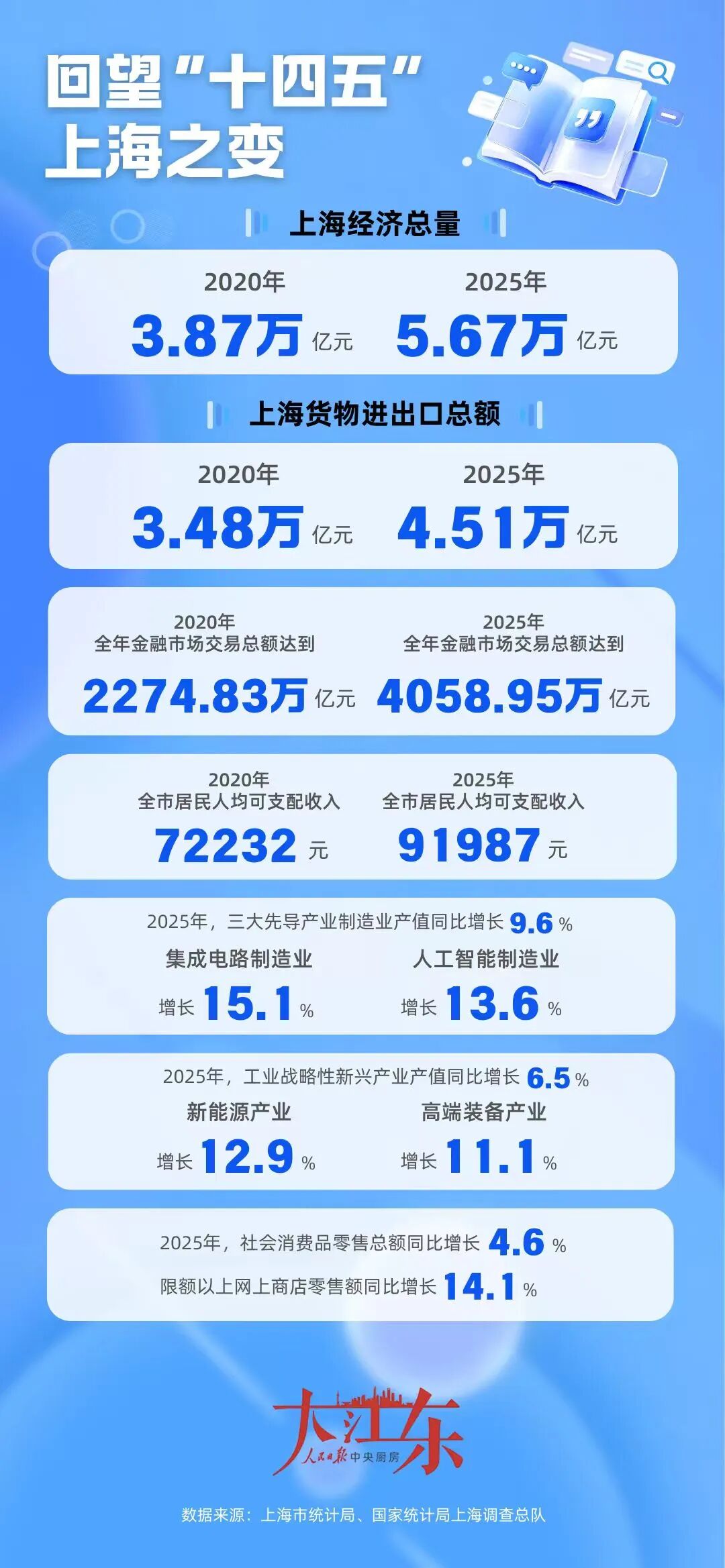
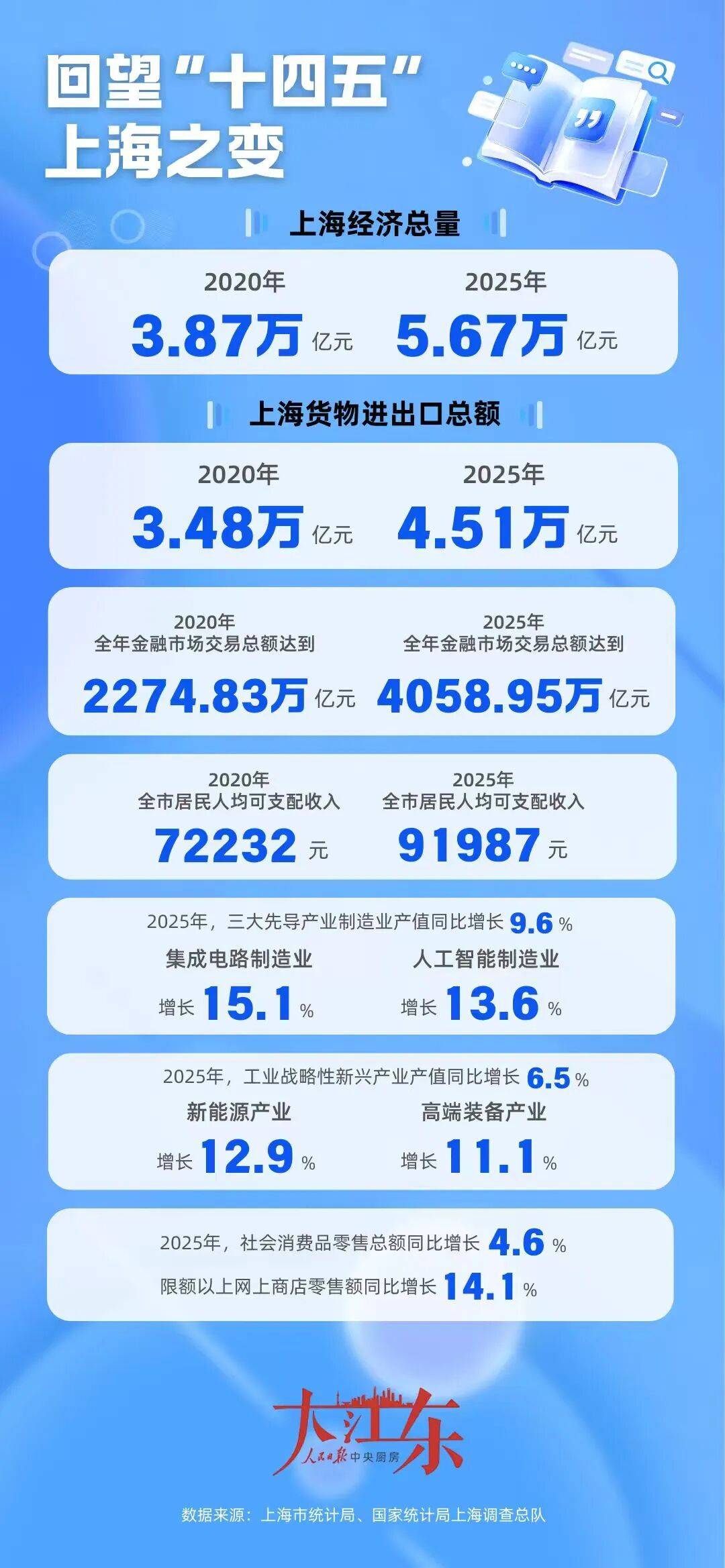
Economic Performance - In 2025, Shanghai's GDP is projected to reach 56,708.71 billion yuan, with a year-on-year growth of 5.4%, surpassing the national average by 0.4 percentage points [1] - Shanghai's economic scale has risen to the fifth largest globally, surpassing London, with significant growth from 3.87 trillion yuan in 2020 to over 5 trillion yuan [3] Industry Development - Shanghai has identified artificial intelligence, integrated circuits, and biomedicine as its three leading industries, with over 30 domestically produced innovative drugs approved for listing [3] - The integrated circuit industry in Shanghai is expected to generate over 480 billion yuan in revenue by 2025, more than doubling its scale compared to five years ago [19] Infrastructure and Urban Development - Major urban renovation projects have been completed, including the transformation of old housing and the initiation of 70 projects in urban villages [3] - Significant investments in infrastructure, totaling 195.75 billion yuan, have been made to support long-term urban development [6] Innovation and Research - Shanghai has seen a substantial increase in R&D spending, with a projected 85% growth in basic research investment during the "14th Five-Year Plan" period [21] - The number of papers published by Shanghai scientists in top international journals has increased from 124 in 2020 to 181 in 2025 [21] Policy and Reform - The "one industry, one certificate" reform has streamlined business operations, allowing for quicker establishment of new stores, with over 1,7000 comprehensive licenses issued [14] - Shanghai has implemented 24 local regulations to support innovative practices and address regulatory gaps [14]
韧性、勇气、眼界 三个关键词回望上海“十四五” | 大江东:开局看上海①
Guo Ji Jin Rong Bao· 2026-01-24 14:51
Economic Performance - In 2025, Shanghai's GDP is projected to reach 56,708.71 billion yuan, with a year-on-year growth of 5.4%, surpassing the national average by 0.4 percentage points [1] - Shanghai's economic scale has risen to the fifth largest globally, surpassing London, with significant growth from 3.87 trillion yuan in 2020 to over 5 trillion yuan [3] - The city's economic recovery is evident, with a steady increase in growth rates, projected to align with the national average of 5% in 2024 [11] Industrial Development - Shanghai has identified artificial intelligence, integrated circuits, and biomedicine as its three leading industries, with substantial advancements in these sectors over the past five years [3] - The integrated circuit industry in Shanghai is expected to generate over 480 billion yuan in revenue by 2025, more than doubling its scale compared to five years ago [19] - The city has established a comprehensive industrial chain in chip design, manufacturing, packaging, and materials, with 35 companies listed on the Sci-Tech Innovation Board, the highest in the country [20] Innovation and Research - Shanghai's R&D expenditure reached approximately 160 billion yuan in 2020, accounting for about 4.1% of its GDP, with a significant increase in basic research funding by 85% during the "14th Five-Year Plan" [22][23] - The number of papers published by Shanghai scientists in top international journals has increased from 124 in 2020 to 181 in 2025, reflecting the city's growing emphasis on scientific research [23] - The city aims to focus on six key areas for future development, including quantum technology and biomanufacturing, to enhance its innovation capabilities [24]