
中国卫星

Search documents
商业航天为何会成为2026年的主线?
Soochow Securities· 2026-01-29 00:20
Investment Rating - The report maintains an "Overweight" rating for the commercial aerospace industry, indicating a positive outlook for the sector in the coming months [1]. Core Insights - The commercial aerospace industry is expected to undergo a significant transformation by 2026, driven by advancements in launch capabilities and the successful deployment of domestic rockets, which will remove previous constraints on industry growth [8][9]. - The competition in commercial aerospace is fundamentally a "land grab" for space sovereignty and resource allocation, emphasizing the need for increased launch frequency to secure China's position in low Earth orbit [10]. - The report highlights the strategic importance of commercial aerospace in national defense and resource acquisition, particularly in the context of lunar resources like Helium-3, which could reshape global energy dynamics [12]. - Key catalysts for the industry include domestic policy support and capital market developments, with significant IPOs expected from leading aerospace companies in 2026 [13][15]. Summary by Sections 1. Why has the domestic commercial aerospace industry reached a qualitative change? - The industry has transitioned from a limited payload capacity to a robust launch capability, marked by the successful launch of the Zhuque-3 rocket, which signifies a shift from speculative themes to a narrative driven by operational capacity [8]. 2. How to understand the importance of commercial aerospace? - The scarcity of low Earth orbit resources has made the commercial aerospace race a critical national strategy, with the need to enhance launch frequency to secure space assets and maintain competitive advantages [10][11]. 3. What subsequent catalysts are worth paying attention to in commercial aerospace? 3.1. Domestic: Accelerated release of policy and capital dividends - The report anticipates significant policy support and capital market activity, with major aerospace companies expected to enter the IPO market in 2026, reflecting the strategic importance of the sector [13]. 3.2. International: Clear policy framework and tight planning timeline - The U.S. has shifted from a public to a private ownership model for space resources, establishing a legal framework that encourages commercial investment in space resource development [15][16]. 4. Investment Recommendations 4.1. SpaceX Concept - Companies that could potentially enter the SpaceX supply chain are highlighted, indicating a strong future in commercial aerospace [17]. 4.2. Rocket Sector: "Many Stars, Few Rockets" Expected to Breakthrough - The report suggests that advancements in large-capacity reusable rocket technology will lead to significant changes and valuation adjustments in the sector [19]. 4.3. Satellite Sector: Certainty in Implementation - The urgency to secure low Earth orbit resources is driving domestic satellite constellations from planning to large-scale deployment [20]. 4.4. Space Computing and Space Photovoltaics: Next-Generation Core Tracks - The report identifies space computing and space photovoltaics as critical future sectors, emphasizing their role in supporting lunar economies and global intelligence ecosystems [22].



东吴证券晨会纪要2026-01-29-20260129
Soochow Securities· 2026-01-29 00:02
Macro Strategy - The core viewpoint is that the reform of the public housing fund can release significant consumption potential by lowering housing costs, thereby saving more funds for consumption. Three specific paths are proposed to reduce housing costs: expanding rental withdrawals, broadening the usage scope of the fund, and further lowering loan interest rates. The total potential release of funds is estimated at approximately 515.1 billion yuan, which could theoretically stimulate consumption by about 360.6 billion yuan, increasing the growth rate of resident consumption by 0.7 percentage points [1][15]. Fixed Income Strategy - The report discusses the "see-saw" relationship between stocks and bonds, emphasizing that this relationship is not stable or universal. The direction of stock and bond pricing is determined by the interplay between the numerator (earnings) and the denominator (interest rates). When the economy performs well, stock prices may rise due to improved earnings, but rising interest rates can suppress bond prices and increase stock discount rates, leading to uncertain stock index directions. Conversely, in a weak economic environment, stock prices may decline even if bond prices rise [2][18]. Industry Insights - The commercial aerospace sector is highlighted as a key investment area for 2026, driven by the successful launch of domestic rockets, which has removed previous operational bottlenecks. The report suggests focusing on four main areas: SpaceX-related stocks, rocket and satellite sectors, and space computing/solar power. Specific companies to watch include Maimai Co., Anhui Helit, and others in the rocket and satellite sectors [3][21]. Water Conservancy Investment - The report indicates that the "northward shift of the rain belt" since 2021 has led to increased rainfall and flooding in northern China, prompting a focus on enhancing water conservancy infrastructure. It is projected that water-related investments in 2026 could see significant growth, contributing to a recovery in overall fixed asset investments by approximately 1.1 percentage points [2][16][17]. Electric Power Equipment - The report emphasizes the potential for rapid development in space solar power due to the acceleration of commercial aerospace and low-orbit satellite advancements. Companies involved in space power supply and equipment are recommended for investment, including Jun Da Co. and Ming Yang Smart Energy [6][21]. Food and Beverage Industry - The report discusses the potential of AKK bacteria as a beneficial symbiotic organism in gut health, with applications in obesity and diabetes management. The market for AKK is expected to grow significantly, with a focus on leading companies in the probiotic sector [3][23].
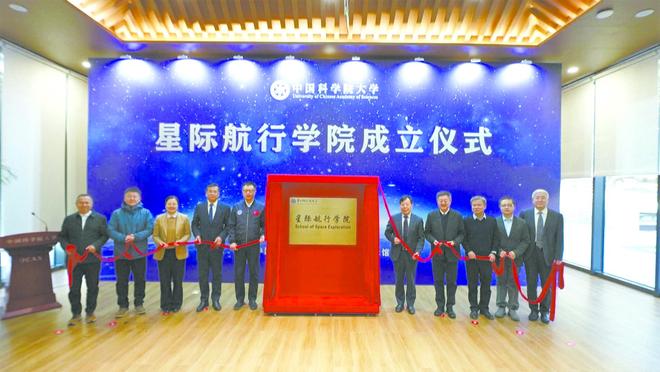
中国首个星际航行学院院长接受《环球时报》采访:星际航行距离我们有多远?
Huan Qiu Wang Zi Xun· 2026-01-28 23:05
Core Viewpoint - The establishment of the Interstellar Navigation College at the University of Chinese Academy of Sciences marks a significant step in talent cultivation for interstellar exploration, aiming to develop interdisciplinary talents with both scientific and engineering perspectives [1][4]. Group 1: College Establishment and Curriculum - The Interstellar Navigation College will offer over 100 courses, including 22 new core courses focused on cutting-edge topics such as interstellar propulsion and planetary dynamics [6]. - The college's primary discipline is aerospace science and technology, with a focus on areas like spacecraft design and propulsion engineering [6][7]. - The college aims to serve as an innovation hub and talent cultivation base for the long-term development of interstellar navigation in China [7]. Group 2: Research and Technological Significance - The research into interstellar navigation is increasingly important due to rapid advancements in space technology, which are bringing interstellar travel closer to reality [4]. - The next 10 to 20 years are identified as a critical window for breakthroughs in interstellar navigation, which will reshape deep space exploration and impact national competitiveness [4]. Group 3: Challenges and Future Directions - Key challenges for interstellar travel include propulsion technology, fuel efficiency, and long-term life support systems for humans in space [8][9]. - Future plans include launching a series of scientific satellites to explore fundamental questions about the universe, with China aiming to lead in addressing these space science issues [9][10]. - The development of Hall thrusters is highlighted as a crucial technology for deep space exploration, with ongoing advancements expected to enhance their application in future missions [10].


商业航天全景产业链图谱:结构解构、价值分布与生态趋势
材料汇· 2026-01-28 16:00
Core Viewpoint - The article provides a comprehensive analysis of the commercial aerospace industry, focusing on the value chain, key segments, and investment opportunities within the sector [3][4]. Group 1: Industry Structure and Value Distribution - The commercial aerospace industry is characterized as technology and capital-intensive, aiming to utilize and monetize space resources through market mechanisms [3]. - The value chain can be dissected into four core segments, with ground equipment manufacturing and satellite operation services accounting for approximately 92% of the total satellite industry scale [8]. - Upstream satellite manufacturing and launch services, while representing only about 9% of the value, are crucial due to their high technical barriers and are currently hotspots for capital investment [8]. Group 2: Upstream Manufacturing - Satellite manufacturing is identified as the foundational segment of the industry, with a focus on high technology and value creation [13]. - The value distribution in satellite manufacturing shows that payloads account for about 50% of costs, with antenna subsystems representing 53% of the value in mass-produced communication satellites [16][17]. - The satellite platform also constitutes about 50% of costs, with the attitude control system being a key component [18]. - Major players in satellite manufacturing include state-owned enterprises like China Aerospace Science and Technology Corporation and private companies like Galaxy Space [19]. Group 3: Rocket Manufacturing - Rocket manufacturing is described as the only channel for large-scale deployment and a significant cost bottleneck [20]. - The propulsion system constitutes 70% of the total cost of liquid rockets, making it a critical area for cost management [21]. - Technologies such as "one rocket multiple satellites" and reusable rocket technology are pivotal for reducing launch costs [23]. - The competitive landscape includes both state-owned enterprises and emerging private companies focused on innovation in reusability [24]. Group 4: Ground Equipment and Operations - Ground equipment manufacturing is the largest revenue contributor in the satellite industry, accounting for approximately 51.6% of total revenue [31]. - Consumer devices, particularly satellite navigation equipment, dominate the ground equipment market, with a projected value of $111.9 billion [32]. - The operational segment, which includes satellite operation management and data services, is crucial for value realization, contributing about 40.3% of the industry's value [36][38]. Group 5: Investment Trends and Future Outlook - The investment focus is currently on upstream segments, particularly satellite manufacturing and reusable rocket launches driven by low Earth orbit constellation demands [41]. - As constellations are established, the industry value is expected to shift towards ground terminals and diversified downstream applications, particularly in consumer satellite internet [41].


航天装备板块1月28日跌3.58%,航天电子领跌,主力资金净流出28.46亿元
Zheng Xing Xing Ye Ri Bao· 2026-01-28 09:04
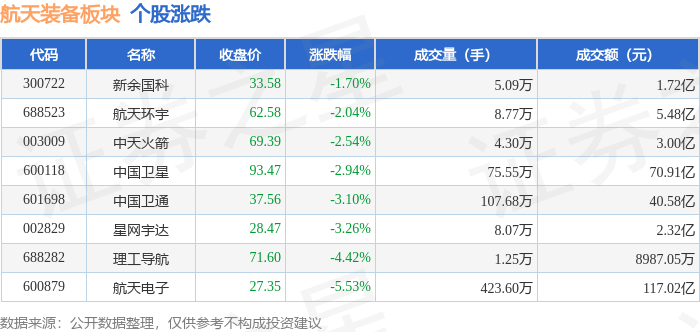
Market Performance - The aerospace equipment sector declined by 3.58% on January 28, with Aerospace Electronics leading the drop [1] - The Shanghai Composite Index closed at 4151.24, up 0.27%, while the Shenzhen Component Index closed at 14342.9, up 0.09% [1] Individual Stock Performance - Notable declines in individual stocks include: - Xinyu Guoke (300722) down 1.70% to 33.58 with a trading volume of 50,900 shares and a turnover of 172 million yuan - Hangda HuanYu (688523) down 2.04% to 62.58 with a trading volume of 87,700 shares and a turnover of 548 million yuan - Aerospace Electronics (600879) down 5.53% to 27.35 with a trading volume of 4.236 million shares and a turnover of 11.702 billion yuan [1] Capital Flow Analysis - The aerospace equipment sector experienced a net outflow of 2.846 billion yuan from institutional investors, while retail investors saw a net inflow of 2.701 billion yuan [1] - Specific stock capital flows indicate: - Aerospace Electronics (600879) had a net outflow of 1.257 billion yuan from institutional investors, with a retail net inflow of 1.226 billion yuan [1] ETF Performance - The Aerospace ETF (product code: 159227) tracked the National Aerospace Industry Index and saw a decline of 2.64% over the past five days, with a net subscription of 85.379 million yuan [5] - The General Aviation ETF (product code: 159230) tracked the National General Aviation Industry Index and experienced a decline of 2.52%, with a net redemption of 39.406 million yuan [6]

多重利好催化,商业航天板块继续横盘蓄势,航空航天ETF(159227)迎回调布局机会
Mei Ri Jing Ji Xin Wen· 2026-01-28 06:41
东兴证券指出,"十五五"时期,商业航天将成为国内推动新质生产力和科技高质量发展的重要引擎。为 了抢占宝贵的轨道和频谱资源,2026年我国星座卫星发射数量有望进一步加速增长;民营商业火箭公司 有望深入参与,成为国家队的有效补充,共同支撑起高频发射需求。看好2026年我国卫星互联网产业链 投资机会。 航空航天ETF(159227):紧密跟踪国证航天指数,成分股覆盖战斗机、航空发动机、火箭、导弹、卫 星、雷达等全产业链龙头,完美契合"空天一体"的战略方向,涵盖大飞机、商业航天、低空经济等新兴 领域,商业航天含量高达70.19%。前十大重仓股中包含了航天发展、中国卫星、航天电子、中航机 载、中航高科等行业龙头。 (文章来源:每日经济新闻) 1月28日,A股三大指数涨跌不一,商业航天板块近日呈现横盘震荡走势,昨日大涨后,今日再度回 调,截止14点25分,航空航天ETF(159227)跌幅2.25%,成交额达4.05亿元,稳居同类第一,持仓股 中仅振芯科技、长盈通、洪都航空、中兵红箭上涨,广联航空、航天电子、航天发展等股跌幅居前。 商业航天板块近期迎来密集催化,资本市场上,马斯克正积极推进SpaceX的IPO计划,目标在 ...
SpaceX星舰V3六周后首次发射测试,航空航天ETF(159227)日均成交7.4亿
Xin Lang Cai Jing· 2026-01-28 05:16
Group 1 - The core index of the aerospace industry, CN5082, shows mixed performance among its constituent stocks, with Zhenxin Technology leading at a 3.82% increase, followed by Changyingtong at 2.83%, and Hongdu Aviation at 1.90%, while Guolian Aviation experienced the largest decline [1] - The Aerospace ETF (159227) is currently priced at 1.48 yuan, with a turnover rate of 9.46% and a transaction volume of 297 million yuan during the trading session [1] - Over the past month, the average daily transaction volume of the Aerospace ETF reached 740 million yuan, and its scale increased by 213 million yuan in the past week [1] Group 2 - SpaceX CEO Elon Musk announced that the first flight test of the Starship V3 version is scheduled to take place in six weeks at the Boca Chica Starbase in Texas, aiming to launch the next-generation Starlink V3 satellites and validate key technological capabilities [1] - CITIC Construction Investment Securities believes that the booming commercial aerospace industry, particularly driven by companies like SpaceX, is reducing launch costs through reusable rocket technology and large-scale satellite constellation deployment, enabling the possibility of deploying thousands of satellites [1] - The commercial aerospace industry's growth is expected to create a vast market for satellite internet, IoT, and future space computing, with leading companies actively exploring new technologies and products for inter-satellite and ground communication applications [1][2] Group 3 - The Aerospace ETF closely tracks the National Aerospace Index and covers key industry chain segments such as aerospace equipment, space equipment, satellite navigation, and new materials, with a high weight of 70% in commercial aerospace concepts [2] - The top ten holdings of the ETF include industry leaders such as Aerospace Development, China Satellite, Aerospace Electronics, AVIC Aircraft, and AVIC High-Tech [2]
未知机构:华西计算机刘泽晶团队欧盟开启卫星通信自主化新篇章德国军工巨头联手打造本土版-20260128
未知机构· 2026-01-28 01:55
【华西计算机刘泽晶团队】欧盟开启卫星通信自主化新篇章,德国军工巨头联手打造本土版"星链" 欧盟启动政府卫星通信计划,以确保安全通信能力:据财联社报道,欧盟已正式启动政府卫星通信计划,旨在 汇集27个成员国的现有卫星资源,以摆脱对外国供应商的依赖,确保应急服务、警务和军事行动等关键业务的通 信安全。 作为未来欧盟第三个卫星通信星座项目IRIS²的关键先导,该计划目前已覆盖5国8颗卫星,预计将于2029年推出I 【华西计算机刘泽晶团队】欧盟开启卫星通信自主化新篇章,德国军工巨头联手打造本土版"星链" 欧盟启动政府卫星通信计划,以确保安全通信能力:据财联社报道,欧盟已正式启动政府卫星通信计划,旨在 汇集27个成员国的现有卫星资源,以摆脱对外国供应商的依赖,确保应急服务、警务和军事行动等关键业务的通 信安全。 产业映射与关注: 欧洲卫星通信星座(IRIS²)与德国军用版"星链"计划相继启动,旨在自主研发安全的卫星互 联通信网络,卫星互联网已正式成为国家关键基础设施。 作为未来欧盟第三个卫星通信星座项目IRIS²的关键先导,该计划目前已覆盖5国8颗卫星,预计将于2029年推出 IRIS²的首批服务并将覆盖范围逐步拓展至 ...
航天装备板块1月27日涨0.66%,理工导航领涨,主力资金净流出10.25亿元
Zheng Xing Xing Ye Ri Bao· 2026-01-27 08:56
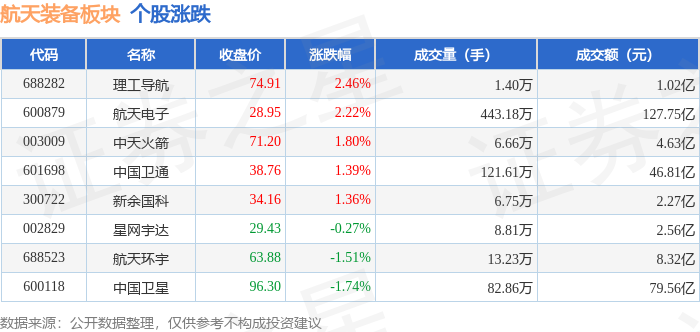
Group 1 - The aerospace equipment sector increased by 0.66% on January 27, with LIGONG Navigation leading the gains [1] - The Shanghai Composite Index closed at 4139.9, up 0.18%, while the Shenzhen Component Index closed at 14329.91, up 0.09% [1] - Key stocks in the aerospace equipment sector showed varied performance, with LIGONG Navigation at 74.91 (+2.46%), Aerospace Electronics at 28.95 (+2.22%), and China Satellite at 38.76 (+1.39%) [1] Group 2 - The net outflow of main funds in the aerospace equipment sector was 1.025 billion yuan, while retail investors saw a net inflow of 790 million yuan [1] - Specific stock fund flows indicated significant outflows for stocks like Aerospace Electronics (-605 million yuan) and China Satellite (-657 million yuan), while retail inflows were notable for LIGONG Navigation (+775 million yuan) [1] Group 3 - The Aerospace ETF (product code: 159227) tracked the National Aerospace Industry Index and saw a 6.64% increase over the past five days, with a net subscription of 190 million yuan [5] - The General Aviation ETF (product code: 159230) tracked the National General Aviation Industry Index, experiencing a 5.15% increase, but had a net redemption of 14.27 million yuan [6] - The Machine Tool ETF (product code: 159663) tracked the China Machine Tool Index, with a 3.98% increase and a net subscription of 1.78 million yuan [6]




首个星际航行学院成立,航空航天ETF(159227)涨幅1.63%,航发科技涨停
Mei Ri Jing Ji Xin Wen· 2026-01-27 05:44
Group 1 - The A-share market showed mixed performance on January 27, with the aerospace ETF (159227) experiencing a strong rally, rising by 1.63% and achieving a trading volume of 339 million yuan, leading its category [1] - The establishment of China's first Interstellar Navigation College by the University of Chinese Academy of Sciences focuses on advanced fields such as interstellar propulsion, deep space communication and navigation, and space science, aiming to cultivate versatile talents with solid foundations and strategic vision [1] - Dongxing Securities highlighted that during the 14th Five-Year Plan period, commercial aerospace will become a key driver for high-quality development in China's new productive forces and technology [1] Group 2 - The aerospace ETF (159227) closely tracks the National Securities Aerospace Index, covering leading companies across the entire industry chain, including fighter jets, aircraft engines, rockets, missiles, satellites, and radars, aligning perfectly with the "aerospace integration" strategic direction [2] - The ETF has a high commercial aerospace content of 70.19%, with top ten holdings including Aerospace Development, China Satellite, Aerospace Electronics, AVIC Aircraft, and AVIC High-Tech [2]


