农业银行

Search documents
凌晨突发,全线大跌,14万人爆仓,23万亿巨头砸盘,金银到底咋了
Sou Hu Cai Jing· 2026-02-15 16:29
Core Viewpoint - The article discusses a significant market crash in precious metals, particularly gold and silver, which resulted in massive losses for traders due to high leverage and sudden market shifts [3][11]. Group 1: Market Dynamics - On February 13-14, 2026, over 144,691 trading accounts experienced forced liquidations, totaling approximately $458 million (about 3.2 billion RMB) in losses [3]. - The price of gold peaked at $5,100 per ounce before experiencing a sharp decline, while silver saw a nearly 6% increase prior to the crash [3][4]. - The volatility in silver is notably higher than that of gold, with silver's price fluctuations being nearly double that of gold [7]. Group 2: Contributing Factors - A major asset management firm, managing $23 trillion in assets, initiated a concentrated sell-off, significantly impacting market prices [4]. - The Federal Reserve's signals indicated that interest rate cuts were not imminent, which contributed to a stronger dollar and negatively affected gold and silver prices [4]. - The rapid price increases in gold (67% from late 2025 to January 2026) and silver (120% in the same period) led to profit-taking, which further exacerbated the market decline [5]. Group 3: Market Reactions - Following the crash, the market saw a "V-shaped" recovery on February 14, driven by a lower-than-expected Consumer Price Index (CPI) report, which reignited expectations for potential interest rate cuts [7][8]. - Domestic gold prices fell by 160 to 215 RMB per gram, leading to increased consumer inquiries about returns on recently purchased gold jewelry [10]. - Financial institutions, including major state-owned banks, responded by tightening risk controls and adjusting policies related to gold investments [10]. Group 4: Lessons Learned - The market crash serves as a reminder that when assets are perceived as "risk-free," it often indicates a peak in risk accumulation [11]. - The article emphasizes the dangers of excessive leverage in trading, particularly in volatile markets like precious metals [11].

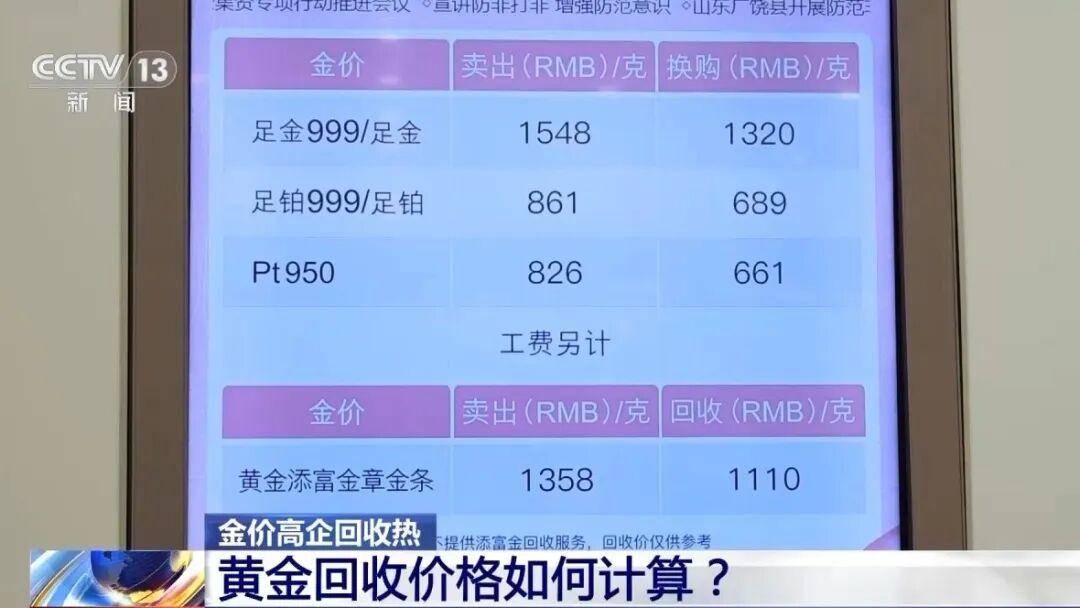
央视曝光黄金回收套路:不良商家在足金涂抹洗洁精等让其变黑而压价;业内人士:最终到手价应为上海黄金交易所实时金价×纯度×克重-手续费
Sou Hu Cai Jing· 2026-02-15 10:51
Core Viewpoint - Recent surges in international and domestic gold prices have led to increased consumer interest in gold buyback and "old-for-new" exchange services, prompting a rise in inquiries across various regions [1] Group 1: Main Buyback Channels - The primary channels for gold buyback include banks, brand-authorized stores, and companies with precious metal recovery qualifications [1] - Banks typically only repurchase gold bars sold by them, requiring original packaging and certificates, and generally do not buy back jewelry [1] - Brand-authorized stores mainly accept their own brand's gold products for buyback [2] Group 2: Pricing Calculation - The buyback price is calculated using the formula: current Shanghai Gold Exchange price × purity × weight - handling fees [4] - Consumers should be cautious of inflated quotes and reduced settlement amounts during the buyback process [4][10] Group 3: Consumer Precautions - Consumers are advised to choose reputable channels, understand the current gold prices, supervise the weighing and testing process, and retain transaction receipts to protect their rights [10][11] - Common pitfalls include merchants using deceptive practices such as altering the appearance of gold to claim lower purity [6][8] Group 4: New Regulations - A new standard titled "Gold Old-for-New Business Service Specification" has been released, which regulates the qualifications of businesses and personnel involved in gold buyback and exchange [11] - The new regulations mandate that businesses must have legal qualifications and that the gold testing process must be monitored with the consumer present [11][13]
天南海北新年味|守护春节“菜篮子”,“金融活水”托起年味烟火气
Zhong Guo Jin Rong Xin Xi Wang· 2026-02-15 08:05
Core Viewpoint - As the Spring Festival approaches, the supply and pricing of essential food items in Shanghai are being closely monitored, with financial support from Agricultural Bank of China (ABC) playing a crucial role in ensuring stability and availability of agricultural products [2][8]. Group 1: Agricultural Supply and Technology - Yongda Mushroom Industry, located in Shanghai's Baoshan District, is a leading agricultural enterprise that supplies over 20 types of edible mushrooms year-round to major retailers like Hema, JD, and Meituan [3]. - The company utilizes factory cultivation technology to achieve large-scale production, moving away from traditional production methods [3][4]. - Yongda has developed patented mushroom varieties and has received organic product certification, indicating a commitment to sustainable agricultural practices [4]. Group 2: Financial Support and Growth - Yongda Mushroom Industry plans to invest over 30 million yuan in a new cold chain processing facility post-Spring Festival, supported by a 20 million yuan credit line from ABC [5]. - ABC's "Agricultural Science Loan" product has been instrumental in providing financial support to agricultural technology enterprises, with a loan balance exceeding 120 million yuan as of January 2026 [5]. Group 3: Market Dynamics and Demand - Shanghai's Jiangyang Market serves as a key supply base for the city, with companies like Shanghai Muke International Trade Co., Ltd. actively involved in the import and distribution of frozen beef, expecting sales to exceed 500 million yuan by 2025 [6]. - The demand for high-quality agricultural products has surged, with Yongda's order volume during the Spring Festival expected to double compared to regular periods [4]. Group 4: Financial Products for Small Businesses - ABC has expanded its "Merchant e-loan" product to individual businesses in Jiangyang Market, facilitating access to credit based on purchase contracts, with over 1 billion yuan disbursed in 2025 [8]. - The bank's support has been crucial for small and micro enterprises, helping them manage cash flow and operational costs effectively [8].


金价真的是一夜变天了,2月15日最新报价,全国金价竟然差这么多?
Sou Hu Cai Jing· 2026-02-15 07:54
International Gold Market - The latest spot gold price in London is around $5038.50 per ounce, showing signs of fluctuation after a recent high [2] - COMEX New York gold futures are trading at $5064.38 per ounce, indicating a high-level consolidation with selling pressure evident [2] Domestic Market Trends - The domestic gold price on the Shanghai Gold Exchange is hovering around 1110 CNY per gram, with Au99.99 priced at approximately 1108.50 CNY per gram, reflecting a daily decline of about 1% [3] - The overall market is in a correction phase after a recent surge, with the fundamental gold price at 1125.00 CNY per gram, showing some weakening compared to previous highs [4] Brand Jewelry Prices - Major brand jewelry prices range from 1300 to 1548 CNY per gram, with specific prices as follows: - Chow Tai Fook: 1529 CNY per gram [5] - Chow Sang Sang: approximately 1529 CNY per gram [6] - Lao Feng Xiang: 1548 CNY per gram [7] - Chow Sang Sang: 1534 CNY per gram [8] - Caibai Jewelry: 1528 CNY per gram [9] - Liufeng Jewelry: 1529 CNY per gram [10] - China Gold: 1528 CNY per gram [11] - Compared to the fundamental gold price of 1125 CNY per gram, the brand premium is around 400 CNY, reflecting the value of craftsmanship and brand [12] Bank Investment Gold Bar Prices - Bank gold bars, which are more investment-oriented, are priced lower: - ICBC gold bar: approximately 1144 CNY per gram [13] - ABC gold bar: approximately 1145 CNY per gram [14] - SPD Bank: approximately 1132 CNY per gram [15] - Bank gold bars are close to the fundamental price with minimal additional fees, making them suitable for asset allocation [16] Regional Price Differences - In major cities like Beijing, Shanghai, Guangzhou, and Shenzhen, gold store prices range from 1520 to 1550 CNY per gram [17] - In Shenzhen's wholesale market, the price for gold is around 1130 to 1160 CNY per gram (including processing fees) [17] - Prices in third and fourth-tier cities fluctuate around 1500 CNY per gram, with regional differences potentially reaching 300 to 400 CNY per gram [17] Recycling Market Trends - The current gold recycling price is around 1115 CNY per gram, with gold bars recycling at approximately 1114 CNY per gram [20] - The recycling prices for 18K gold range from 777 to 813 CNY per gram, while palladium and silver recycling prices are approximately 310 to 339 CNY per gram and 18.20 CNY per gram, respectively [20] - Compared to retail prices, recycling prices are typically lower by 300 to 400 CNY per gram, influenced by purity testing and weight discrepancies [20]
平安人寿再举牌,疯狂扫货港股金融圈
Xin Lang Cai Jing· 2026-02-15 07:47
Core Viewpoint - Ping An Life has increased its stake in China Life's H-shares, surpassing the 10% threshold, triggering a mandatory disclosure under Hong Kong market rules [2][11]. Group 1: Investment Activities - Ping An Life's investment in China Life's H-shares reached 10% on February 3, 2026, following a series of acquisitions that began in August 2025 [4][14]. - The initial stake in China Life was 5.04% after purchasing 9.5 million shares at an average price of HKD 32.0655 per share [4][13]. - The stake has been incrementally increased through multiple purchases, including 1.0895 million shares at approximately HKD 33.2588 per share, resulting in a current holding of about 10.12% [5][14]. Group 2: Broader Investment Strategy - Ping An is building a substantial high-dividend financial asset pool in the Hong Kong market, acquiring stakes in various banks, including Agricultural Bank of China and China Merchants Bank [6][17]. - The company has made 16 purchases of Agricultural Bank H-shares, increasing its stake from 5% to 20.10%, with holdings reaching approximately 4.618 billion shares [8][17]. - The investment strategy emphasizes asset-liability matching, with a focus on reliable operations, growth potential, and sustainable dividends [9][19]. Group 3: Market Implications - Analysts suggest that the trend of insurance capital investing in other insurance companies reflects a demand for stable returns and may lead to a revaluation of undervalued insurance stocks [6][16]. - The investment behavior indicates a preference for companies with clear governance, stable business models, and improving dividend levels, which are seen as essential for long-term returns [6][19].



平安人寿再举牌,疯狂扫货港股金融圈
21世纪经济报道· 2026-02-15 07:44
Core Viewpoint - Ping An Life has increased its stake in China Life H-shares, surpassing the 10% threshold, indicating a strategic move to build a substantial high-dividend financial asset pool in the Hong Kong market [1][5][6]. Group 1: Investment Activities - Ping An Life's recent acquisition of China Life H-shares reached 10.12% of the total share capital, following a series of incremental purchases [1][5]. - The company has previously made similar moves, acquiring stakes in China Pacific Insurance and China Life in August 2025, triggering regulatory notifications due to crossing the 5% threshold [3][5]. - The continuous buying pattern reflects a broader strategy of acquiring undervalued insurance stocks, which are seen as stable long-term investments [5][6]. Group 2: Market Context - The current low-interest-rate environment and asset scarcity have prompted insurance companies to seek high-yield investments, leading to the phenomenon of "insurance capital buying insurance capital" [1][5]. - Ping An Life's strategy includes a focus on asset-liability matching, ensuring that investments align with the company's liability business [11]. Group 3: Broader Investment Strategy - Ping An Life has also engaged in significant purchases of H-shares from major state-owned banks, including Agricultural Bank and China Merchants Bank, further diversifying its high-dividend asset portfolio [8][9]. - The company has executed multiple transactions to increase its holdings in these banks, with Agricultural Bank's stake rising from 5% to 20.10% [8][9]. - The investment approach is guided by a "three criteria" principle, focusing on reliable operations, growth potential, and sustainable dividends [11].

黄金跌价,金条降价,2026年02月10日,国内黄金,足金、金条最新价格
Sou Hu Cai Jing· 2026-02-15 06:32
Core Insights - The recent fluctuations in the gold market have led to a decline in gold prices, prompting adjustments in gold bar prices, which are crucial for both investment and consumption [1] Group 1: Gold Purity Differences - The key indicators of gold value are purity levels, with common types being 999 (thousand-foot gold) and 9999 (ten-thousand-foot gold), where 999 has a gold content of 99.9% and 9999 has a higher content of 99.99% [2] - Higher purity gold, such as 9999, is generally softer than 999 gold due to its composition [3] - The price of 9999 gold is typically higher than that of 999 gold due to its greater gold content [4] Group 2: Latest Gold Prices - As of February 10, 2026, the domestic gold prices are as follows: - 999 gold: approximately RMB 1125.86 per gram - 9995 gold: approximately RMB 1123.50 per gram - 9999 gold: approximately RMB 1119.00 per gram [6] - The latest bank gold bar prices include: - Minsheng Bank: approximately RMB 1131.50 per gram - China Construction Bank: approximately RMB 1136.00 per gram - Agricultural Bank of China: approximately RMB 1147.05 per gram [7]
银行行业2026年1月金融数据点评:政府债发力明显,股市活跃推动存款搬家
Zhong Guo Yin He Zheng Quan· 2026-02-15 06:24
Investment Rating - The report maintains a "Recommended" rating for the banking sector, highlighting its high dividend and low valuation attributes that continue to attract long-term capital [5]. Core Insights - The banking sector is experiencing a significant contribution from government bonds to social financing growth, with a notable increase in government bond issuance in January 2026 [5]. - The report indicates that while social financing has increased year-on-year, the growth rate has decreased compared to the previous month, primarily due to weaker RMB loans and fluctuating demand from the real economy [5]. - The capital market's activity is driving a "deposit migration" process, as increased market engagement leads to higher liquidity in the banking sector [5]. Summary by Sections Banking Industry - In January 2026, new social financing reached 7.22 trillion yuan, an increase of 165.4 billion yuan year-on-year, with government bonds being the main contributor [5]. - RMB loans increased by 4.9 trillion yuan, which is a decrease of 319.4 billion yuan year-on-year, influenced by demand fluctuations and debt restructuring [5]. - The report notes that short-term loans in the real sector have increased, while medium and long-term loans remain weak, particularly in the real estate sector, which saw a 28.5% decline in sales for major developers [5]. Market Activity - The report highlights that M1 and M2 growth rates are at 4.9% and 9% respectively, indicating an increase in liquidity [5]. - Financial institutions' RMB deposits increased by 9.9% year-on-year, with a monthly increase of 8.09 trillion yuan, driven by both household and corporate deposits [5]. - The report emphasizes the role of an active capital market in attracting deposits, with a 58% increase in average daily trading volume in January [5].





银行业周报:央行关注存款搬家,2025Q4银行业净利增速回正
Zhong Guo Yin He Zheng Quan· 2026-02-15 06:24
Investment Rating - The report maintains a "Recommended" rating for the banking sector, highlighting the continued attractiveness of high dividend yields and low valuations for long-term investors [5]. Core Insights - The banking sector is expected to benefit from a stable growth in scale and a recovery in net profit growth, with a year-on-year increase of 2.33% in net profit for 2025 [9][11]. - The central bank's monetary policy will continue to be moderately accommodative, focusing on structural optimization and financial support for key areas such as domestic demand and small and medium enterprises [7][8]. - The phenomenon of "deposit migration" is impacting the liability structure of banks, but overall liquidity remains stable [8][9]. Summary by Sections Latest Research Insights - The central bank's 2025Q4 monetary policy report emphasizes maintaining ample liquidity and optimizing financial resource allocation through fiscal and monetary policy coordination [7]. - The report indicates that the average weighted interest rate for new loans in 2025 was 3.15%, a decrease of 9 basis points compared to the previous year [7]. Weekly Market Performance - The banking sector underperformed the market, with a decline of 1.31% compared to a 0.36% increase in the CSI 300 index [5]. - The current price-to-book ratio for the banking sector is 0.64, with a dividend yield of 4.64% [5]. Regulatory and Policy Updates - The banking sector's key regulatory indicators for 2025Q4 show a net profit growth recovery, with total assets increasing by 9% year-on-year [9][10]. - The non-performing loan ratio decreased to 1.5%, indicating an improvement in asset quality across various types of banks [10][11]. Investment Recommendations - The report suggests focusing on banks with low valuations and high dividend yields, recommending specific banks such as ICBC, Agricultural Bank of China, and Postal Savings Bank [5][39]. - The anticipated continuation of accommodative monetary policy and structural financial support is expected to enhance the effectiveness of policies aimed at boosting domestic demand [5][7].
今日金价:大家要有心理准备了,2月15日,金价或将重现15年历史
Sou Hu Cai Jing· 2026-02-15 05:06
Group 1 - The current gold price is experiencing high volatility, with the London gold price at $5038.52 per ounce, up $117.71 from the previous day, indicating a "rise followed by consolidation" trend [1] - The Shanghai gold price (AU9999) is at 1108.5 yuan per gram, down 15.1 yuan, showing a "same high level, different rhythm" phenomenon compared to the international market, reflecting intense short-term capital speculation [1] - The price of gold jewelry in stores ranges from 1300 to 1548 yuan per gram, with significant brand premium differences [2] Group 2 - The highest price for 999 pure gold from Lao Feng Xiang is 1548 yuan per gram, while other brands like Chow Sang Sang and Xie Rui Lin are priced at 1534 yuan and 1529 yuan per gram respectively [2] - The more affordable options from Cai Bai and China Gold are priced at 1528 yuan per gram, with price differences of 10 to 20 yuan per gram for 99.9% pure gold being common [3] Group 3 - Bank gold bars are priced between 1130 to 1145 yuan per gram, with various banks like ICBC, ABC, CCB, and BOC offering products within this range [5][6] - Craft gold bars from brands like Chow Tai Fook and Lao Feng Xiang have more noticeable premiums and lower buyback prices [7] Group 4 - The average buyback price for national 999 gold is 1067 yuan per gram, with recent fluctuations between 1030 to 1090 yuan per gram [8] - Buyback prices can vary by region, with brand store official buyback prices typically 15 to 40 yuan lower than market averages [9] Group 5 - Online platforms generally offer buyback prices between 1050 to 1073 yuan per gram, with actual received prices subject to deductions for testing [12] - Price differences exist between cities, with first-tier cities having faster updates and more transparent buyback processes compared to third and fourth-tier cities, which may be lower by 10 to 25 yuan per gram [14] Group 6 - Recommendations for consumers include comparing prices at multiple stores for jewelry purchases, prioritizing bank investment gold bars for investment, and comparing prices across different platforms for selling gold to maximize returns [15]