江西铜业

Search documents
包钢板材厂爆炸事故已造成6死4失联;万科被执行约10.9亿元;知名大V被罚没超8300万元丨每经早参
Mei Ri Jing Ji Xin Wen· 2026-01-19 22:16
Group 1 - The People's Bank of China will announce the one-year and five-year Loan Prime Rates (LPR) on January 20 [2] - The National Development and Reform Commission will hold a press conference on January 20 to discuss the implementation of the central economic work conference and the "14th Five-Year Plan" [2] - The central bank has released the "Management Measures for the Identification of Beneficial Owners of Financial Institutions," effective from January 20, 2026 [2] Group 2 - The U.S. stock market will be closed on January 19 for Martin Luther King Jr. Day and will resume normal trading on January 20 [3] - On January 19, U.S. stock index futures fell, with the S&P 500 down 0.88%, Dow Jones down 0.80%, and Nasdaq 100 down 1.11% [4] Group 3 - The ICE U.S. Dollar Index fell by 0.33% to 99.065 points, while COMEX gold futures rose by 1.77% to $4,676.70 per ounce [5] - The onshore RMB closed at 6.9640 against the U.S. dollar, appreciating by 80 basis points from the previous trading day [5] Group 4 - The Hang Seng Index rose by 0.20% to 26,640 points, and the Hang Seng Tech Index increased by 0.23% to 5,768 points [6] - European stock indices closed lower, with Germany's DAX down 1.34%, France's CAC40 down 1.78%, and the UK's FTSE 100 down 0.39% [6] Group 5 - China's GDP is projected to exceed 140 trillion yuan in 2025, with a year-on-year growth rate of 5% [7] - The industrial added value for the year increased by 5.9%, while the service sector's added value grew by 5.4% [8] Group 6 - The U.S. plans to impose a 10% tariff on goods from eight European countries starting February 1, with the rate increasing to 25% by June 1 [9] - The Chinese Ministry of Foreign Affairs has reiterated its stance on the Greenland issue in response to U.S. tariffs [10] Group 7 - The Supreme People's Procuratorate of China has emphasized the need to maintain economic and financial security and to punish serious economic crimes [11] - A satellite internet low-orbit launch of 19 satellites was successfully completed on January 19 [11] Group 8 - Tesla will restart the development of its Dojo 3 supercomputer project, indicating a commitment to AI technology [17] - Ford is reportedly in talks with BYD for battery procurement for hybrid vehicles, reflecting traditional automakers' engagement with China's EV supply chain [18] Group 9 - Vanke has been executed for approximately 1.09 billion yuan, raising concerns about risks in the real estate sector [19][20] - Porsche's sales in China for 2025 are projected to decline by 26.28%, with the company focusing on maintaining a healthy supply-demand relationship [21] Group 10 - ByteDance's AI platform "Kouzi" has announced a 2.0 brand upgrade, integrating new capabilities to enhance user experience [22] - Honor has launched a limited edition smartphone in collaboration with Pop Mart, showcasing cross-industry innovation [24]






特朗普拒绝说明是否会以武力夺取格陵兰;包钢板材厂爆炸事故已造成6死4失联;万科被执行约10.9亿元;知名大V被罚没超8300万元丨每经早参
Mei Ri Jing Ji Xin Wen· 2026-01-19 22:06
Group 1 - The People's Bank of China will announce the one-year and five-year Loan Prime Rate (LPR) on January 20 [2] - The National Bureau of Statistics reported that China's GDP for 2025 is projected to reach 140,187.9 billion yuan, with a year-on-year growth of 5% [8] - The total retail sales of consumer goods in 2025 are expected to be 501,202 billion yuan, reflecting a year-on-year increase of 3.7% [8] Group 2 - The U.S. stock market will be closed on January 19 for Martin Luther King Jr. Day and will resume normal trading on January 20 [3] - The S&P 500 futures fell by 0.88%, while the Dow futures dropped by 0.80% and the Nasdaq 100 futures decreased by 1.11% on January 19 [4] - The ICE U.S. Dollar Index decreased by 0.33%, closing at 99.065 points [5] Group 3 - The Hang Seng Index rose by 0.20% to close at 26,640 points, while the Hang Seng Tech Index increased by 0.23% to 5,768 points [6] - European stock indices closed lower, with Germany's DAX down 1.34%, France's CAC40 down 1.78%, and the UK's FTSE 100 down 0.39% [6] Group 4 - Tesla announced the restart of its Dojo 3 supercomputer project, indicating a commitment to AI technology development [17] - Ford is reportedly in talks with BYD for a battery supply partnership for its hybrid models, reflecting traditional automakers' efforts to engage with China's EV supply chain [18][19] - Vanke has been executed for approximately 1.09 billion yuan, highlighting financial pressures in the real estate sector [20][21] Group 5 - Porsche's sales in China for 2025 are projected to be 41,900 units, a decline of 26.28% year-on-year, attributed to market challenges [22] - ByteDance announced a 2.0 brand upgrade for its AI platform "Kouzi," integrating new features to enhance user experience [22] - Honor launched a limited edition smartphone in collaboration with Pop Mart, showcasing cross-industry innovation [23]

江西铜业股份有限公司关于与中国兵工物资集团有限公司签订《合作框架协议》的公告
Shang Hai Zheng Quan Bao· 2026-01-19 19:27
Core Viewpoint - Jiangxi Copper Co., Ltd. has signed a cooperation framework agreement with China Ordnance Material Group Co., Ltd. to engage in the purchase and sale of products such as cathode copper, crude copper, and electrolytic nickel, which is classified as a related party transaction due to the ownership structure [2][6]. Group 1: Agreement Overview - The agreement primarily involves the purchase and sale of cathode copper, crude copper, and electrolytic nickel [2][31]. - China Ordnance Material Group holds a 29.52% stake in Jiangxi Copper's subsidiary, Jiangxi Copper International Trade Co., Ltd., making it a related party under the Hong Kong Stock Exchange rules [2][6]. - The board of directors approved the related party transaction, with related directors abstaining from voting, and it does not require shareholder approval [2][6]. Group 2: Financial and Operational Details - As of the end of 2024, China Ordnance Material Group reported total assets of 2,205,946 thousand RMB and net assets of 446,882 thousand RMB, with a revenue of 4,727,253 thousand RMB and a net profit of 29,085 thousand RMB for the year [4]. - The agreement is set to be effective from January 1, 2026, to December 31, 2028, allowing for the procurement of cathode copper and electrolytic nickel from both domestic and international sources [16][30]. Group 3: Impact on the Company - The collaboration with China Ordnance Material Group is expected to enhance Jiangxi Copper's market competitiveness and brand influence, facilitating efficient integration of resources within the non-ferrous metal industry [31].
每天三分钟公告很轻松 | 301218拟易主 复牌!
Shang Hai Zheng Quan Bao· 2026-01-19 16:08
Group 1: 华是科技 - The controlling shareholder of 华是科技 is set to change to 杭州巨准, with a share transfer agreement signed for 12.912 million shares, representing 11.32% of the total share capital [1] - After the transfer, the actual controller will change to 郑剑波, and the existing shareholders will relinquish voting rights on their remaining shares [1] - The company will resume trading on January 20, 2026 [2] Group 2: 盈方微 - 盈方微 plans to acquire 100% of 上海肖克利 and 富士德中国 through a combination of share issuance and cash payment, with the transaction not being contingent on each other [3][4] - The acquisition is expected to meet the criteria for a major asset restructuring as per the regulations [3] - The company will also resume trading on January 20, 2026 [4] Group 3: 江化微 - 江化微's controlling shareholder will change to 上海福迅科技, with a transfer of 9.238 million shares at a price of 20 yuan per share, totaling 1.848 billion yuan, which is 23.96% of the total share capital [5][6] - The company will resume trading on January 20, 2026 [6] Group 4: 沃华医药 - 沃华医药 reported a revenue of 817 million yuan for 2025, a year-on-year increase of 6.96%, and a net profit of 95.7153 million yuan, up 162.93% [7] - The company plans to distribute a cash dividend of 1.46 yuan per 10 shares [7] Group 5: 南网能源 - 南网能源 expects a net profit of 300 million to 360 million yuan for 2025, recovering from a loss of 58.1258 million yuan in the previous year [7] Group 6: 其他公司业绩预告 - Several companies, including 翔鹭钨业, 飞沃科技, and 桂林旅游, have reported significant improvements in their expected net profits for 2025, with increases ranging from 93.75% to over 500% compared to the previous year [8][9][10][11][12][13][14][15]


股票异动停牌核查完毕 400亿AI概念股明起复牌|盘后公告集锦
Sou Hu Cai Jing· 2026-01-19 13:46
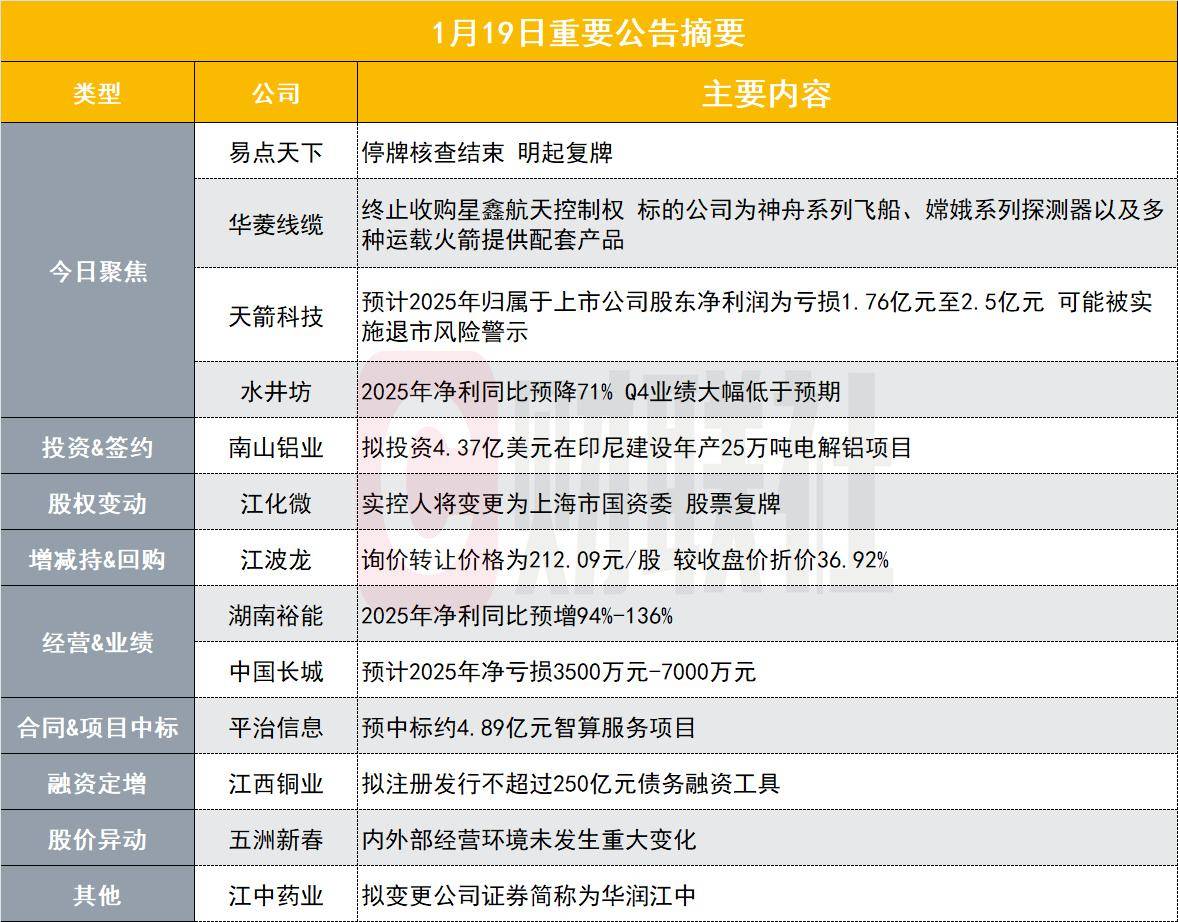
Company Announcements - Yidian Tianxia has completed its suspension review and will resume trading from tomorrow [2] - Hualing Cable has terminated the acquisition of control over Xingxin Aerospace due to failure to reach agreement on specific terms, which will not adversely affect its operations or financial status [2] - Tianjian Technology expects a net loss attributable to shareholders of 176 million to 250 million yuan for 2025, potentially facing delisting risk warnings [3] - Shuijingfang anticipates a 71% year-on-year decline in net profit for 2025, with Q4 performance significantly below expectations [4] Investments & Contracts - Nanshan Aluminum plans to invest 437 million USD in Indonesia to establish a 250,000-ton annual electrolytic aluminum project [8] - Donghua Software intends to invest 300 million yuan to establish a wholly-owned subsidiary focused on AI and big data [8] Shareholder Changes - Jianghuai Microelectronics will have its actual controller changed to the Shanghai State-owned Assets Supervision and Administration Commission, with stock resuming trading [9] Performance & Earnings - Hunan Yuneng expects a year-on-year net profit increase of 94% to 136% for 2025, driven by a rebound in lithium carbonate prices [10] - China Great Wall anticipates a net loss of 35 million to 70 million yuan for 2025, although it expects significant improvement compared to the previous year [10] - Dinglong Co. expects a year-on-year net profit increase of 34.44% to 40.20% for 2025 [10] Project Bids - Pingzhi Information is expected to win a smart computing service project worth approximately 489 million yuan [11] Financing & Capital Increase - Jiangxi Copper plans to register and issue debt financing instruments not exceeding 25 billion yuan [11]

股票异动停牌核查完毕 400亿AI概念股明起复牌||盘后公告集锦
Sou Hu Cai Jing· 2026-01-19 13:29
Company Announcements - Yidian Tianxia's stock will resume trading on January 20, 2026, after a suspension due to a significant price increase of over 100% during the previous trading days [2] - Hualing Cable has terminated its acquisition of Hunan Xingxin Aerospace, stating that the decision was mutual and will not adversely affect its operations or financial status [3] - Tianjian Technology expects a net loss of 176 million to 250 million yuan for 2025, which may lead to a delisting risk warning [4] - Shuijingfang anticipates a 71% decline in net profit for 2025, with Q4 performance significantly below expectations [5] Investment & Contracts - Nanshan Aluminum plans to invest approximately 4.37 billion USD to establish a 250,000-ton electrolytic aluminum project in Indonesia [13] Shareholding Changes - Jianghuai Microelectronics will have its actual controller changed to the Shanghai State-owned Assets Supervision and Administration Commission, with stock resuming trading on January 20, 2026 [16] Performance & Earnings - Hunan YN expects a net profit increase of 94% to 136% for 2025, driven by rising demand in the lithium battery sector [23] - China Great Wall anticipates a net loss of 35 million to 70 million yuan for 2025, although it expects to significantly reduce its losses compared to the previous year [24] - Dinglong Co. forecasts a net profit increase of 34.44% to 40.20% for 2025, supported by strong growth in semiconductor and display materials [26] Project Bids - Pingzhi Information is a candidate for a smart computing service project worth approximately 489 million yuan [41] Financing & Capital Increase - Jiangxi Copper plans to register and issue debt financing instruments not exceeding 250 billion yuan [44]


今日晚间重要公告抢先看——华菱线缆称终止收购星鑫航天控制权;翔鹭钨业发布年度业绩预告,同比扭亏为盈!




Jin Rong Jie· 2026-01-19 13:26
Major Events - Hualing Cable announced the termination of the acquisition of control over Xingxin Aerospace due to failure to reach consensus on specific agreement terms, stating that this decision will not adversely affect its operations or financial status [1] - Xianglu Tungsten Industry expects a net profit of 125 million to 180 million yuan for 2025, driven by continuous price increases in tungsten raw materials and improved market conditions [1] Company Announcements - Zhongwei Semiconductor is set to launch its first non-volatile memory chip, a low-power SPI NOR Flash with a capacity of 4M bits, filling a product gap in the Flash sector [2] - Nanshan Aluminum plans to invest approximately 437 million USD in a 250,000-ton electrolytic aluminum project in Indonesia [4] - Xinfengming intends to acquire a 35% stake in Dushan Port Development to enhance its supply chain capabilities [5] - Jiangxi Copper signed a cooperation framework agreement with China Ordnance Material Group for the purchase and sale of copper and nickel products [6] Performance Forecasts - Wan Tong Development expects a net loss of 500 million to 750 million yuan for 2025, attributed to strategic shifts and increased impairment losses [12] - Hunan YN anticipates a net profit of 1.15 billion to 1.4 billion yuan for 2025, driven by growth in lithium battery materials [13] - Tianjian Technology forecasts a net loss of 176 million to 250 million yuan for 2025, with potential delisting risk due to financial performance [14] - Leading companies like Guotou Securities and Xiangcai Securities project significant profit growth for 2025, with Guotou expecting 3.42 billion yuan, a 35.18% increase [27][28] Industry Trends - The tungsten market is experiencing improved supply-demand dynamics, benefiting companies like Xianglu Tungsten [1] - The photovoltaic industry continues to face challenges, with companies like Trina Solar projecting substantial losses due to market pressures [19] - The aluminum sector is seeing investment growth, particularly in overseas projects, as indicated by Nanshan Aluminum's plans [4] Stock Movements - Hualing Cable's stock will not be adversely affected by the termination of the acquisition [1] - Companies like Hunan YN and Guotou Securities are expected to see positive stock performance due to favorable profit forecasts [13][27]
江西铜业:第十届董事会第十五次会议决议公告
Zheng Quan Ri Bao· 2026-01-19 13:13
Core Viewpoint - Jiangxi Copper announced the approval of several key proposals during its 15th meeting of the 10th Board of Directors, including applications for membership in the China Interbank Market Dealers Association and the issuance of non-financial corporate debt financing instruments [1] Group 1 - The company approved the proposal to apply for membership in the China Interbank Market Dealers Association [1] - The company also approved the proposal for its subsidiaries, Zhejiang Jiangxi Copper Fuyue and Ding Copper Industry Co., Ltd., to provide external guarantees [1] - Additionally, the company signed a cooperation framework agreement with China Ordnance Material Group Co., Ltd. [1]
福事特(301446) - 301446福事特投资者关系管理信息20260119
2026-01-19 12:38
Group 1: Company Overview - The company specializes in the research, production, and sales of hydraulic pipeline systems, with key products including hard pipe assemblies, soft pipe assemblies, fire extinguishing systems, pipe joints, and oil tanks [3] - Hydraulic pipelines are essential components in various machinery manufacturing sectors, including construction, mining, port, agricultural, logistics, metallurgy, and wind power equipment, as well as emerging fields like new energy vehicles and semiconductor equipment [3][4] - The company has established a strong customer base, including industry leaders such as SANY, Zoomlion, Jiangxi Copper, State Power, and Schwing [3] Group 2: Market Segmentation - The company's product applications are divided into two main markets: the front-mounted market and the post-mining maintenance market [3] - The front-mounted market includes clients like SANY and Zoomlion, with a steady recovery in the construction machinery market and accelerated overseas exports [4] - The post-mining maintenance market benefits from the company's first-mover advantage and a commitment to 24-hour close service, with established service points in major domestic mines [4] Group 3: Future Development Plans - The company aims to focus on two major markets: the front-mounted market and the post-mining maintenance market, with plans to explore sectors like metallurgy and shipbuilding, as well as new areas such as new energy vehicle pipeline systems and liquid cooling [5] - The international mining market is a key focus, with the company expanding its overseas service points in countries like Suriname, Serbia, Mongolia, and Namibia [5][7] Group 4: Mining Maintenance Business - The company has over 20 years of experience in the post-mining maintenance market, establishing stable partnerships with companies like Jiangxi Copper, State Power, and China Coal [6] - Continuous growth in fixed asset investment in the mining industry has led to an increasing demand for maintenance and repair services, providing a solid foundation for the post-mining market [6] Group 5: International Business Expansion - Since the end of 2024, the company has partnered with large mining enterprises like Zijin Mining and China General Nuclear Power, establishing overseas subsidiaries for maintenance services [7] - The number of overseas service points is continuously increasing, contributing to the gradual growth of the business scale [7] Group 6: AI Liquid Cooling Development - The company has developed products for the liquid cooling market, leveraging its existing pipeline system advantages in cleanliness, sealing, and pressure resistance [7] - The demand for pipeline systems in the liquid cooling market is expected to grow with the acceleration of data center construction [7]
江西铜业与兵工物资三年合作官宣:将就阴极铜、粗铜、电解镍等产品建立购销关系
Mei Ri Jing Ji Xin Wen· 2026-01-19 12:33
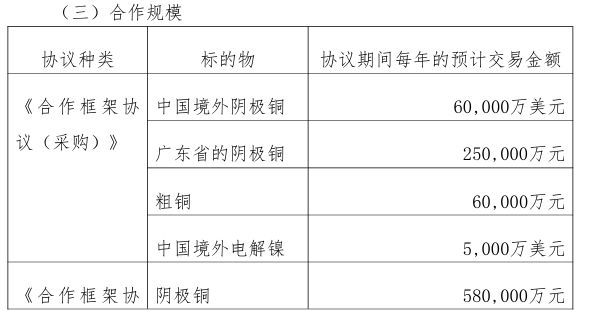
Core Viewpoint - Jiangxi Copper has signed a three-year cooperation framework agreement with China Ordnance Material Group, focusing on the purchase and sale of cathode copper, crude copper, and electrolytic nickel, while also pursuing a cash acquisition of SolGold to enhance its global copper resource layout [1][3]. Group 1: Cooperation Agreement - The cooperation agreement will be effective from January 1, 2026, to December 31, 2028, covering transactions in cathode copper, crude copper, and electrolytic nickel [1]. - Expected annual transaction amounts include $600 million for overseas cathode copper, 2.5 billion RMB for Guangdong cathode copper, 600 million RMB for crude copper, and $50 million for overseas electrolytic nickel [1]. - Sales projections include 5.8 billion RMB for cathode copper, 500 million RMB for copper rods, 700 million RMB for aluminum ingots, 1.5 billion RMB for electrolytic nickel, 700 million RMB for zinc ingots, 30 million RMB for tin ingots, and 500 million RMB for precious and rare metals [1]. Group 2: Acquisition of SolGold - Jiangxi Copper announced a formal offer to acquire all issued shares of SolGold at 28 pence per share, valuing the target company at approximately £867 million [3]. - The board of SolGold has deemed the acquisition terms fair and is recommending shareholders support the deal [3]. - Jiangxi Copper has received irrevocable commitments from major shareholders, including BHP, Newmont, and Maxit Capital LP, representing about 25.7% of SolGold's shares [3]. Group 3: Industry Context - The copper industry is experiencing a shift towards consolidation among leading enterprises, with a significant reduction in processing fees for copper concentrate, impacting smelter profit margins [4]. - Jiangxi Copper's revenue figures for 2022 to 2024 are projected at 479.94 billion RMB, 521.89 billion RMB, and 520.93 billion RMB, with net profit expected to reach 6.962 billion RMB in 2024 [5]. - The company is enhancing its resource control and industry influence through strategic acquisitions and partnerships, particularly during a period of overall capacity adjustment in the industry [5].