
沐曦

Search documents
寒武纪、海光信息领涨,多家AI芯片厂商已适配DeepSeek模型
Di Yi Cai Jing· 2025-08-22 04:45
Group 1 - DeepSeek released DeepSeek-V3.1, utilizing UE8M0 FP8 Scale parameter precision, designed for the upcoming domestic chip [1][3] - Multiple stocks in the computing sector surged, with notable increases such as 6.29% for SMIC and 17.19% for Haiguang Information [1] - Cambrian Technology, a major domestic AI chip company, reported significant revenue growth, achieving 11.11 billion yuan in Q1 2024, up from 0.26 billion yuan year-on-year [3] Group 2 - Several AI chip manufacturers, including Moer Technology and Suiyuan Technology, support FP8 precision computing, enhancing performance by 20%-30% in large model training [4] - The domestic computing power industry is seeing increased utilization of domestic chips, with companies like iFlytek using fully domestic computing power for large model training [4][5] - Recent reports from securities firms indicate a stable growth in the semiconductor supply chain, with rising wafer foundry capacity and a positive outlook for the semiconductor market [5]


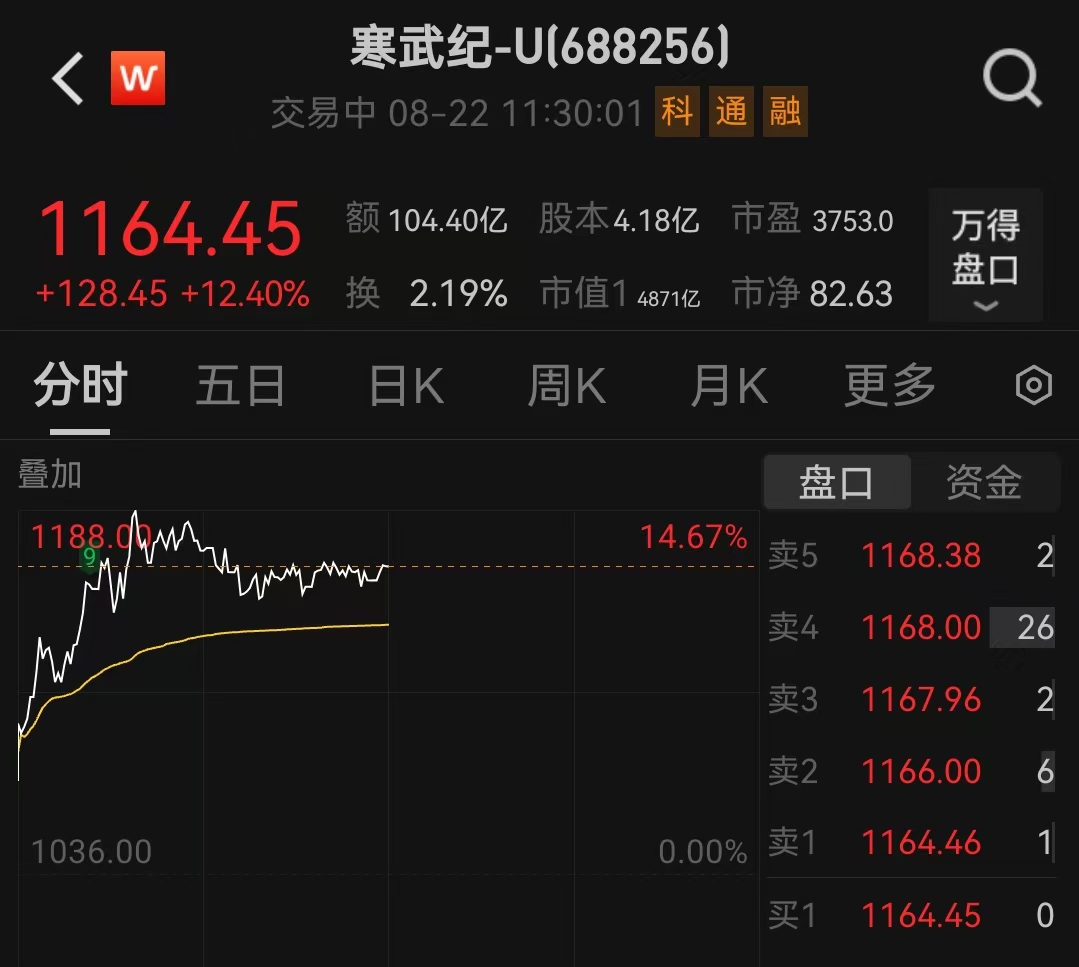
DeepSeek-V3.1正式发布,科创芯片ETF基金(588290)涨超7%,寒武纪-U涨超10%,机构:高端AI芯片国产化势在必行
2 1 Shi Ji Jing Ji Bao Dao· 2025-08-22 03:36
Group 1 - The STAR Market chip index showed strong performance with an intraday increase of 7.33%, and the related ETF, the STAR Chip ETF (588290), surged by 7.15% with a trading volume exceeding 200 million yuan, reflecting a year-to-date increase of over 26% [1] - Key component stocks such as Shengmei Shanghai hit the daily limit, while Haiguang Information and Cambricon Technologies rose over 10% [1] - The DeepSeek-V3.1 was officially released, featuring significant adjustments in tokenizer and chat templates, and is designed for the upcoming generation of domestic chips [1] Group 2 - Zhongyuan Securities predicts that by the first half of 2025, technological innovation will drive the rise of domestic large models, with widespread AI applications and the launch of AI glasses, marking the beginning of an era of universal intelligent driving [2] - The semiconductor industry is expected to continue its recovery, with increasing demand for self-controlled solutions and robust growth in AI computing power on the cloud side [2] - The storage market is rebounding, with customized storage becoming a trend, enhancing the competitive advantage of domestic storage module manufacturers and accelerating the growth of domestic production [2] Group 3 - Huaxin Securities emphasizes the necessity of domestic high-end AI chip localization, with companies like Cambricon, Haiguang Information, and Huawei leading the charge, while other domestic AI chip manufacturers are also accelerating their market penetration [3] - Moore Threads provides AI training and inference cards, with its latest GPU architecture significantly enhancing AI computing power, supporting advanced model pre-training solutions [3] - Muxi offers a series of GPUs with strong parallel computing capabilities, already applied at scale in multiple intelligent computing centers, and also provides inference-focused GPUs for cloud AI scenarios [3]

DeepSeek正式发布新模型,还透露国产AI芯片关键信息
Xuan Gu Bao· 2025-08-21 23:22
Group 1 - DeepSeek's latest V3.1 version utilizes UE8M0 FP8 Scale parameter precision, designed for the upcoming domestic chip release [1] - FP8 is a cutting-edge low-precision format for AI computing, significantly enhancing GPU performance and reducing memory usage for large language model training [1] - Domestic GPUs are rapidly developing, transitioning from "usable" to "user-friendly" stages, although they have not yet matched international products [1] Group 2 - Companies like Cambrian, Haiguang Information, and Huawei are leading the A-share computing chip market [3] - Moer Thread provides AI training and inference cards, with its latest GPU supporting FP8 precision, significantly boosting AI computing power [1] - Muxi offers C series GPUs for integrated training and inference, and N series GPUs focused on cloud AI inference, showcasing strong mixed-precision computing capabilities [2] Group 3 - The global GPU market is projected to reach 36,119.74 billion yuan by 2029, with China's GPU market expected to reach 13,635.78 billion yuan, increasing its global market share from 30.8% in 2024 to 37.8% in 2029 [2] - DeepSeek is driving the shift of AI applications from centralized cloud services to mass terminals, necessitating high-cost performance dedicated chips [2] - The domestic chip manufacturers and application enterprises are accelerating their integration with DeepSeek, anticipating a significant increase in domestic computing power by 2025 [2] Group 4 - Huawei's Ascend ecosystem includes companies like Tuo Wei Information, Digital China, and Huafeng Technology, enhancing mixed inference architecture and agent capabilities [4] - The upgraded model shows significant improvements in tool usage and intelligent agent tasks through Post-Training optimization [4] Group 5 - Related companies include Dingjie Zhizhi, Fanwei Network, and Kute Intelligent [5]

淡水泉投资解读WAIC:AI产业竞争格局加速重构
Xin Lang Ji Jin· 2025-08-15 07:42
Group 1 - The 2025 World Artificial Intelligence Conference (WAIC) showcased a shift from homogeneous competition among large model vendors to differentiated strategies, with companies focusing on long text processing, multimodal capabilities, and vertical scene development [2] - The boundaries between models and applications are becoming increasingly blurred, with leading vendors transitioning from pure model providers to comprehensive platforms that integrate generation, retrieval, and tool invocation capabilities [2] - The industry is exploring a hybrid model of open-source and closed-source, with some companies like OpenAI and Zhipu releasing open-source models, while others like Meta are developing advanced closed-source products [2] Group 2 - Internet cloud vendors are building model-centric full-stack capabilities, offering "Model as a Service" (MaaS) platforms that may change the logic of enterprises moving to the cloud, especially for small and medium-sized enterprises facing challenges with private AI cloud setups [3] - The progress of domestic computing power is highlighted by Huawei's Ascend 384 super node cluster, which boasts double the computing power of NVIDIA's GB200 NVL72 system, although domestic GPUs still lag in key inference performance metrics [4] - The demand for private deployment is reflected in the popularity of AI integrated machines, with domestic GPU manufacturers seeking breakthroughs through collaborative innovation [4] Group 3 - Despite high interest in smart robots and AR glasses, edge AI is still in a preparatory stage, facing challenges in multimodal perception, interaction, and autonomous decision-making capabilities [5] - The smartphone is seen as a potential primary carrier for AI agents due to its advantages in computing power, interaction, and application scenarios, with a cautious approach from manufacturers indicating the need for further technological maturity [5] - Continuous investment in the industry chain is laying the groundwork for future developments in edge AI, suggesting a positive outlook despite the current limitations [5]
国产算力迎来大航海时代
2 1 Shi Ji Jing Ji Bao Dao· 2025-08-14 13:20
Core Insights - The computing power industry in China has shown remarkable growth, becoming the second largest globally, with significant increases in 5G base stations and gigabit broadband users [1][3] - Chinese computing companies are accelerating their international expansion, leveraging cost advantages and technical expertise, while facing challenges from established Western competitors [2][7] Industry Development - China's computing power infrastructure is expanding rapidly, with major telecom operators increasing their server capacities and investments in computing power [3][4] - By mid-2025, the number of 5G base stations is expected to reach 4.55 million, a fivefold increase since 2020, and gigabit broadband users are projected to grow 34 times to 226 million [3][4] Technological Advancements - Significant breakthroughs in key technologies such as integrated circuits and artificial intelligence have been achieved, with China holding 60% of global AI patents [4][6] - Domestic companies are showcasing advanced products and technologies, indicating a shift towards self-sufficiency in high-end chips and related technologies [4][5] International Expansion - Chinese companies are capitalizing on their technological advancements and cost advantages to penetrate overseas markets, particularly in Southeast Asia [2][8] - The government is supporting this international push through policies that encourage technology sharing and infrastructure development for computing power exports [8][9] Market Opportunities and Challenges - The demand for computing power in international markets remains strong, particularly in AI and cloud computing sectors, with expectations of continued growth in capital expenditures from overseas cloud service providers [6][9] - However, competition from established Western firms poses a significant challenge, as they continue to invest heavily in the computing power sector [9]
WAIC 2025见闻:中国AI产业走到哪一步了?
淡水泉投资· 2025-08-12 08:03
Core Insights - The 2025 World Artificial Intelligence Conference (WAIC) in Shanghai showcased the growing interest in the AI industry from academia, industry, and investors, reflecting a significant shift in focus since the first conference in 2018 [3][4] - The AI landscape is evolving with a shift from homogeneous models to differentiated products, as companies face increasing competition and seek to maintain core advantages [6][7] - Traditional internet giants like Alibaba and Tencent are promoting full-stack AI capabilities, integrating AI models into comprehensive solutions to lower barriers for enterprises [10] Group 1: AI Model Development - The competition among large model companies has intensified, leading to a focus on differentiated product strategies, such as long text processing and multi-modal capabilities [6] - The boundaries between "model" and "application" are blurring, with model companies transitioning to comprehensive AI platforms that integrate various technologies [7] - The emergence of open-source models like DeepSeek R1 is reshaping the competitive landscape, prompting companies to explore new business models [6][7] Group 2: Cloud and AI Integration - Established cloud providers are building AI ecosystems around their models, offering one-stop AI solutions that enhance the accessibility of AI capabilities for enterprises [10] - The shift towards public cloud platforms for AI capabilities is driven by the challenges of private cloud deployment, particularly for small and medium-sized enterprises [10] - The integration of AI modules into existing cloud infrastructures is expected to reshape asset valuation logic in the long term [10] Group 3: Domestic Computing Power - Domestic computing power was prominently featured at the conference, with Huawei showcasing its Ascend 384 super node, which boasts double the computing power of NVIDIA's GB200 NVL72 system [13] - Domestic GPUs are increasingly competitive, although challenges remain in memory bandwidth and interconnect capabilities [14] - The demand for private AI deployment is driving innovation in AI integrated machines, reflecting a strong market need [15] Group 4: Edge AI Development - The WAIC highlighted the innovative potential of edge AI, though the commercialization paths for these products remain limited [18] - Key areas for improvement in edge AI include multi-modal perception and decision-making capabilities, which are critical for applications like robotics and AR [18] - The smartphone is positioned as a likely platform for AI agents due to its proximity to users and strong computational capabilities, although industry caution regarding technology maturity persists [18][19]

21专访|曦智科技沈亦晨:两年前预见的超节点未来,正在兑现
2 1 Shi Ji Jing Ji Bao Dao· 2025-08-12 06:17
Core Insights - The article discusses the emergence of "supernodes" in the computing industry, particularly focusing on the advancements in optical interconnect technology by Xizhi Technology, which has positioned itself as a leader in this field [1][2][3] - Xizhi's innovative "LightSphere X" solution aims to break traditional limitations of physical cabinets, allowing for larger-scale, cross-cabinet networks, which is a significant shift in the industry [1][9] Company Strategy - Xizhi Technology recognized the potential of the supernode concept as early as 2023, aligning its product line with this emerging trend [2][4] - The company is pursuing an open ecosystem strategy, differentiating itself from competitors like NVIDIA and Huawei by focusing on core technologies related to optical interconnects and chips [2][23] Technological Innovations - Xizhi's "LightSphere X" solution utilizes optical interconnect technology, which allows for faster data transmission and lower costs compared to traditional electrical interconnects [7][8] - The company has developed two supernode solutions: one based on optical interconnect electrical switching and another on optical interconnect optical switching, with the latter being a novel approach [5][6] Market Position - Xizhi has established a favorable position in the optical interconnect market, with a team comprising over 80% researchers, including top scientists from MIT [1][24] - The company aims to deploy a ten-thousand-card cluster by the end of the year, indicating its ambition to scale rapidly in the supernode space [11] Competitive Landscape - The article highlights the competitive dynamics in the GPU market, where various manufacturers are exploring different interconnect technologies, with some opting for electrical interconnects while others are inclined towards innovative solutions like Xizhi's [12][22] - Xizhi's open approach may pose a challenge to established players like NVIDIA and Huawei, as it aims to lower the technical barriers for adoption [22][23]
第二届 “兴智杯” 全国人工智能创新应用大赛专题活动明天开启,技术解析 + 资源对接一站式平台重磅来袭!
机器之心· 2025-08-11 04:27
为深入贯彻落实党中央、国务院关于加快人工智能产业创新发展的决策部署,工业和信息化部、科学技术部、深圳市人民政府共同主办了首届 "兴智杯" 全国人工 智能创新应用大赛,以需求为牵引,推动了一批关键技术突破,加快人工智能与重点行业融合赋能,成为了目前国内规模最大、参赛主体最丰富的人工智能专业 赛事。 为进一步发挥 "以赛促研、以赛促用、以赛育人" 的作用,第二届 "兴智杯" 全国人工智能创新应用大赛(以下简称 "大赛")由中国信息通信研究院、深圳市人工智 能产业办公室、深圳市前海深港现代服务业合作区管理局、深圳市宝安区人民政府共同主办,自 2025 年 5 月 8 日大赛正式启动以来,已吸引千余支团队、超万名 选手报名参赛。 大赛定于 8 月 12-13 日以线上直播形式举办专题活动,邀请近 20 家人工智能及重点行业应用领域头部单位的领军学者及企业专家,进行赛题解析、场景探讨及趋 势分享,聚焦人工智能技术突破与产业落地的重点、热点议题,以赛促产,推动培育一批亮点技术与应用成果。 活动还特别设置答疑与交流环节(添加官方小助手微信:AIAC_WX 实时提问交流),有机会与各领域大牛直接交流、解疑答惑,大赛组委会精心 ...
怎么看华为超节点和国产卡26年的竞争格局
2025-08-05 03:20
Summary of Conference Call on Huawei's Super Node and Domestic AI Chip Market Industry Overview - The conference call discusses the domestic AI chip market, focusing on Huawei's 384 Super Node and its competitive landscape against international players like NVIDIA [1][2][8]. Key Points and Arguments - **Huawei 384 Super Node**: - Utilizes high-speed interconnect and optical module technology, enhancing cost-effectiveness and deployment certainty in inference scenarios, serving as a domestic alternative to NVIDIA's Nvlink bottleneck [1][2]. - Supports SP8, providing superior performance in inference tasks compared to many domestic cards lacking this feature [2]. - **Domestic AI Chip Companies**: - Companies like Moer, Muxi, and Suiyuan are narrowing the gap with international leaders through technological advancements, with expectations to increase market share by 2026 [1][4]. - New products from these companies, such as Moer S5000 and Muxi C600, are expected to meet the demands of major internet companies, enhancing their competitive position [4]. - **Market Demand and Supply**: - The demand for domestic computing cards is not limited to internet companies but extends to telecom operators, financial institutions, and state-owned enterprises, indicating a supply-demand imbalance [3][16]. - The market is projected to focus on 2026 valuations, with optimism surrounding the growth of domestic graphics cards [3][13]. - **High-Density Super Point Solutions**: - Companies like Haiguang are developing high-density, high-performance super point solutions, such as a silent liquid cooling solution supporting up to 660 cards, to improve overall computing efficiency [5][6]. - **GPGPU Architecture Development**: - Domestic GPGPU architecture is evolving, with companies like Huawei Ascend transitioning to GPGPU to reduce interconnect development risks [7]. - The integration of DSA functions into GPUs by manufacturers like Moer indicates a trend towards technological convergence [7]. - **Future Market Dynamics**: - The competitive landscape is expected to become more complex by 2026, with new product launches and testing processes for internet companies [10][12]. - Despite the anticipated changes, the overall market structure is expected to remain stable, with Huawei leading, followed by Cambricon and Haiguang [10]. Additional Important Insights - **Inference Demand Growth**: - The increasing demand for inference capabilities, especially in the context of the multi-modal era, is driving the need for domestic computing cards [9][12]. - **AI Application Revenue**: - Significant growth in AI application revenues is anticipated, with estimates for companies like Keling reaching $200 million in 2025 [10]. - **Comparison with U.S. Market**: - The U.S. market is dominated by a few major clients, while China's demand is diversified across numerous long-tail customers, indicating a robust growth potential for domestic computing cards [16]. This summary encapsulates the critical insights from the conference call, highlighting the competitive landscape, technological advancements, and market dynamics within the domestic AI chip industry.
《关于深入实施人工智能+行动的意见》快评:走深走实以应用促创新的AI产业发展之路
Yin He Zheng Quan· 2025-08-04 13:29
Group 1: AI Industry Development - China's AI industry is currently in the "scale-up" phase, with a market size expected to exceed 1 trillion yuan by 2030, contributing approximately 10% to GDP over the next decade[2][46] - The AI+ industry is projected to achieve a compound annual growth rate (CAGR) of over 15%[2][46] - By the end of 2024, the AI industry in China is expected to surpass 700 billion yuan, maintaining a growth rate of over 20% annually[11] Group 2: Industrial and Consumer Integration - China's industrial base provides rich scenarios for AI applications, with the country expected to account for 45% of global industrial output by 2030[28][33] - The AI consumer hardware market is projected to exceed 1.17 trillion yuan in 2024, with a growth rate of approximately 10%, significantly outpacing the overall consumption growth rate of 3.4%[39] - AI applications are expected to expand from traditional industrial and consumer sectors to deeper integration across various industries[46][50] Group 3: Key Growth Areas - The digital native sector, represented by large internet companies, is poised for rapid growth due to its established data infrastructure and user base[51] - High-penetration industries such as finance, healthcare, and transportation are expected to see accelerated AI adoption, with 88% of financial institutions in the U.S. already deploying AI[51] - Industrial AI tools and platforms are anticipated to evolve, requiring deep integration of algorithms with industry knowledge to achieve comprehensive autonomy[52] Group 4: Risks and Challenges - Potential risks include slower-than-expected policy implementation, volatility in financial markets, and uncertainties in AI technology iterations[2][53]