精达股份

Search documents
精达股份:股东李光荣及特华投资拟合计减持不超3%公司股份
Xin Lang Cai Jing· 2025-10-28 10:01
Core Viewpoint - The actual controller of Jingda Co., Ltd. (600577.SH), Li Guangrong, along with his concerted party, Tehua Investment Holdings Co., Ltd., plans to reduce their holdings by a total of up to 64.3 million shares, representing no more than 3% of the company's total share capital [1] Summary by Categories Shareholding Reduction - Li Guangrong intends to reduce his holdings by up to 20.8 million shares, accounting for 0.97% of the total shares [1] - Tehua Investment plans to reduce its holdings by up to 43.5 million shares, representing 2.02% of the total shares [1] Reduction Method and Timeline - The reduction will be executed through centralized bidding and block trading [1] - The reduction period is set from November 19, 2025, to February 18, 2026 [1] Reason for Reduction - The reason for the shareholding reduction is stated as the shareholders' own funding needs [1]

大幅拉升,A股刷屏
Zheng Quan Shi Bao· 2025-10-28 05:24
Core Viewpoint - The A-share market has shown significant activity, with the Shanghai Composite Index surpassing 4000 points for the first time since August 2015, driven by sectors such as controllable nuclear fusion, domestic software, PCB, and commercial aerospace [1][3]. Controllable Nuclear Fusion Sector - The controllable nuclear fusion concept stocks have been on a continuous rise, with companies like Dongfang Tantalum and Antai Technology seeing multiple trading gains. Recent reports indicate that key materials for "artificial sun" technology have achieved domestic industrialization [1][7]. - The research team at the Chinese Academy of Sciences has successfully industrialized high-purity ton-level Hastelloy C276 metal substrates, which are crucial for the production of second-generation high-temperature superconducting tapes used in controllable nuclear fusion [7][8]. - Controllable nuclear fusion is recognized as a vital future energy direction, with advantages over nuclear fission, including minimal radioactive pollution and abundant raw materials sourced from seawater [9]. PCB Sector - PCB concept stocks have collectively strengthened, with companies like Aisen Co. and Meilian New Materials seeing gains exceeding 11%. Shengyi Technology has also reported a significant increase in revenue and profit forecasts, projecting a revenue increase of 108% to 121% year-on-year for the first three quarters of 2025 [4]. Domestic Software Sector - Domestic software stocks have shown active performance, with several companies reaching their daily price limits. The recent policy support from the government is expected to accelerate demand for domestic software and hardware companies, particularly as some leading firms enter a phase of performance realization [4]. Commercial Aerospace Sector - The commercial aerospace sector has rebounded, with companies like Aerospace Development reaching their price limits. A recent successful test of a large liquid rocket by Tianbing Technology marks a significant milestone in China's commercial aerospace capabilities [4]. Financial Sector - The financial sector has also seen notable movements, with companies like Ruida Futures and Huijin Co. experiencing sharp increases in stock prices [5]. Market Overview - The A-share market's three major indices opened lower but rose throughout the day, with the Shanghai Composite Index closing at 4005.44 points, up 0.21%. The onshore RMB also appreciated against the USD, reaching its highest level since November 2024, which may enhance foreign investment in RMB assets [3]. - The China Securities Regulatory Commission has introduced measures to optimize the Qualified Foreign Institutional Investor (QFII) system, aiming to create a more transparent and efficient investment environment for foreign investors [3].
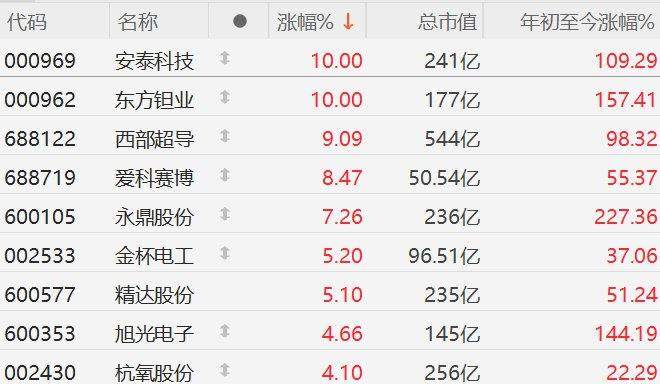
A股可控核聚变概念股强势,为中央定调6大未来产业,机构称看好产业趋势向上!安泰科技、东方钽业涨停,西部超导涨9%,爱科赛博涨8%
Ge Long Hui· 2025-10-28 03:36
Core Viewpoint - The A-share market is experiencing a collective rise in controllable nuclear fusion concept stocks, driven by recent policy announcements that highlight the importance of quantum technology and nuclear fusion as new economic growth points [1][2]. Group 1: Stock Performance - An Tai Technology (000969) and Dongfang Tantalum (000962) both reached the daily limit up of 10% [1]. - Western Superconducting (688122) increased by 9.09%, while Aikosebo rose by 8.47% [1][2]. - Yongding Co. (600105) saw a rise of 7.26%, and Jinbei Electric (002533) increased by 5.20% [1][2]. - Other notable performers include Jingda Co. (600577) with a 5.10% increase and Xuguang Electronics (600353) with a 4.66% rise [1][2]. Group 2: Market Context - On October 24, the Central Committee proposed the 15th Five-Year Plan, emphasizing the development of future industries, including quantum technology and nuclear fusion [2]. - The report from Guojin Securities indicates that these sectors are expected to receive top-level policy support and funding, enhancing their growth potential [2].


精达股份涨2.12%,成交额2.43亿元,主力资金净流出2182.33万元
Xin Lang Cai Jing· 2025-10-28 02:12
Core Viewpoint - Jingda Co., Ltd. has shown significant stock performance with a year-to-date increase of 47.16%, reflecting strong market interest and financial growth [1][2]. Financial Performance - For the first half of 2025, Jingda Co., Ltd. achieved operating revenue of 11.856 billion yuan, representing a year-on-year growth of 14.28% [2]. - The net profit attributable to shareholders for the same period was 306 million yuan, marking a 6.03% increase compared to the previous year [2]. Stock Market Activity - As of October 28, the stock price of Jingda Co., Ltd. was 10.61 yuan per share, with a trading volume of 2.43 billion yuan and a turnover rate of 1.08% [1]. - The company experienced a net outflow of main funds amounting to 21.8233 million yuan, while large orders accounted for 24.23% of total buying [1]. Shareholder Information - As of June 30, the number of shareholders for Jingda Co., Ltd. was approximately 109,600, a decrease of 2.86% from the previous period [2]. - The average number of circulating shares per shareholder increased by 2.95% to 19,613 shares [2]. Dividend Distribution - Since its A-share listing, Jingda Co., Ltd. has distributed a total of 1.971 billion yuan in dividends, with 776 million yuan distributed over the last three years [3]. Shareholding Structure - As of June 30, 2025, the eighth largest circulating shareholder was XINGQUAN Trend Investment Mixed Fund, holding 20 million shares as a new shareholder [3]. - Hong Kong Central Clearing Limited was the ninth largest shareholder, increasing its holdings by 2.4356 million shares to 19.8724 million shares [3].
转债缩量上涨,涨幅较权益偏低
Jianghai Securities· 2025-10-27 09:28
- The weekly performance of the convertible bond market indices: Shanghai Convertible Bond Index, Shenzhen Convertible Bond Index, and China Convertible Bond Index had weekly changes of 1.557%, 1.396%, and 1.473% respectively[7] - The weekly performance of the equity market indices: Shanghai Composite Index and China Securities Index had weekly changes of 2.879% and 3.363% respectively[7] - The trading volume and value of the convertible bond market for the week were 184,327.64 million units and 30,011,742.91 million yuan, with week-on-week changes of -12.58% and -15.40% respectively[7] - The trading volume and value of the corresponding stocks for the week were 3,999,054.08 million shares and 63,737,365.90 million yuan, with week-on-week changes of -23.41% and -26.84% respectively[7] - As of October 24, 2025, the number of outstanding convertible bonds was 414, with an issuance scale of approximately 686.345 billion yuan and a remaining scale of approximately 538.707 billion yuan[10] - The median and arithmetic average conversion premium rates of the convertible bond market were approximately 27.15% and 41.72%, with week-on-week changes of -4.77% and -3.04% respectively[10] - The top five convertible bonds with the highest weekly gains were Yingliu Convertible Bond, Chenfeng Convertible Bond, Jingda Convertible Bond, Montai Convertible Bond, and Chunqiu Convertible Bond, with weekly changes of 73.08%, 27.32%, 25.11%, 24.41%, and 15.88% respectively[19][20] - The top five convertible bonds with the highest weekly losses were Huiche Convertible Bond, Yitian Convertible Bond, Jiaze Convertible Bond, Huicheng Convertible Bond, and Hengbang Convertible Bond, with weekly changes of -18.82%, -14.62%, -10.85%, -10.63%, and -9.55% respectively[19][21] - As of October 24, 2025, the number of convertible bonds priced below 100, between 100-110, 110-120, 120-130, 130-140, and above 140 were 0 (0.00%), 5 (1.22%), 52 (12.71%), 124 (30.32%), 105 (25.67%), and 123 (30.07%) respectively[35] - The median conversion premium rates for these price ranges were 0.00%, 99.95%, 71.57%, 46.47%, 21.84%, and 13.00%, with week-on-week changes of 0.00%, -3.74%, 1.52%, 19.48%, -0.48%, and 1.29% respectively[35]
核聚变电源系列一聚焦FRC技术潜力与机遇
2025-10-27 00:31
Summary of Fusion Energy Conference Call Industry Overview - The fusion energy industry is experiencing significant growth in 2025, driven by policies, capital, and technological advancements, with a notable emphasis on domestic production characteristics and deep participation across the entire industry chain [1][2][3] - The Field-Reversed Configuration (FRC) technology is gaining attention due to its advantages in miniaturization and modularity, alongside substantial financing [1][3] - The mainstream technology remains the Tokamak device, with related components such as magnets and superconducting materials being key areas of focus [1][3] Key Developments - Internationally, devices like W7-X and ITER have made progress, with multiple countries releasing fusion innovation strategies [1][5] - In China, fusion has been identified as a future industry, with procurement budgets exceeding 100 million yuan [1][5] - Cumulatively, global fusion financing has approached 10 billion USD, with private capital accounting for over 90%, primarily concentrated in the US and Europe, while China is rapidly catching up [1][7] Policy Support - Strong policy support for fusion development is evident, with major countries like the US, Japan, the UK, and Germany releasing comprehensive innovation strategies [8] - In China, the 20th Central Committee has defined fusion as a key future industry, with significant procurement activities underway [8] Technological Insights - FRC devices exhibit high beta values and low energy consumption, with applications in both pulsed (e.g., Helion) and steady-state (e.g., TAE) configurations [1][10] - Hydrogen-boron fusion offers advantages over traditional deuterium-tritium fusion, including no neutron release, which eliminates the need for complex shielding and reduces radioactive waste [11] Company Highlights - Helion and TAE are leading private companies in the FRC space, with Helion planning to commercialize fusion power by 2028 [10][13] - TAE has raised 1.355 billion USD in funding, focusing on hydrogen-boron fuel [16] - Domestic companies like Hanhai Fusion and Nova Fusion are actively participating in the FRC field, with Nova Fusion recently securing 500 million yuan in angel funding [1][18] Emerging Technologies - The Shena Nova-1 device developed by the Sun Xuan team at the University of Science and Technology of China is designed for low-cost, small-scale fusion applications, with plans for a 200 MW fusion power station by 2035 [17] - The FRC system requires a high degree of precision in its pulse power supply, which constitutes over 50% of the system's components [12] Market Dynamics - The investment landscape shows a strong preference for FRC technology, with significant funding directed towards this area, indicating a shift in focus from traditional fusion methods [7][20] - Companies like Xuguang Electronics and Guoguang Electric are also involved in various fusion projects, contributing to the overall ecosystem [19] Conclusion - The fusion energy sector is poised for rapid advancement, supported by robust policy frameworks, significant capital inflows, and innovative technological developments, particularly in the FRC domain, which presents a promising alternative to traditional fusion approaches [1][2][8][20]
可转债周报(2025年10月20日至2025年10月24日):再次转涨-20251025
EBSCN· 2025-10-25 09:25
1. Report Industry Investment Rating - No relevant content provided 2. Core View of the Report - From January to October 24, 2025, the convertible bond market underperformed the equity market. In the long - term, convertible bonds remain relatively high - quality assets due to the persistent strong demand and weak supply. However, the current valuation is high, and investors need to focus on structure [1][4] 3. Summary by Relevant Catalogs Market行情 - From October 20 to October 24, 2025, the convertible bond and equity markets rose again. The CSI Convertible Bond Index increased by +1.5% (previous week: - 2.3%), and the CSI All - Share Index changed by +3.4% (previous week: - 3.5%). Since the beginning of 2025, the CSI Convertible Bond Index has risen by +16.1%, and the CSI All - Share Index has risen by +23.0% [1] - By rating, high - grade bonds (AA+ and above), medium - grade bonds (AA), and low - grade bonds (AA - and below) rose by +2.30%, +2.22%, and +2.53% respectively this week, with low - grade bonds having the highest increase [1] - By convertible bond size, large - scale convertible bonds (bond balance > 5 billion yuan), medium - scale convertible bonds (balance between 500 million and 5 billion yuan), and small - scale convertible bonds (balance < 500 million yuan) rose by +0.12%, +2.36%, and +2.66% respectively this week, with large - scale convertible bonds having the lowest increase [1] - By conversion parity, ultra - high - parity bonds (conversion value > 130 yuan), high - parity bonds (conversion value between 110 and 130 yuan), medium - parity bonds (conversion value between 90 and 110 yuan), low - parity bonds (conversion value between 70 and 90 yuan), and ultra - low - parity bonds (conversion value < 70 yuan) rose by +4.58%, +2.88%, +1.64%, +1.35%, and +1.16% respectively this week, with ultra - high - parity bonds having the highest increase [2] Current Convertible Bond Valuation Level - As of October 24, 2025, there were 410 outstanding convertible bonds (413 at the end of last week), with a balance of 556.823 billion yuan (566.693 billion yuan at the end of last week) [3] - The average convertible bond price was 131.06 yuan (130.61 yuan at the end of last week), with a percentile of 98.6%; the average convertible bond parity was 104.86 yuan (103.82 yuan at the end of last week), with a percentile of 94.8%; the average convertible bond conversion premium rate was 27.6% (27.7% at the end of last week), with a percentile of 56.0%. The conversion premium rate of medium - parity convertible bonds (conversion value between 90 and 110 yuan) was 29.3%, higher than the median of medium - parity convertible bonds since 2018 (20.4%) [3] Convertible Bond Increase Situation - The top 15 convertible bonds in terms of increase this week include Yingliu Convertible Bond, Chenfeng Convertible Bond, and Jingda Convertible Bond, with increases of 73.08%, 27.32%, and 25.11% respectively [22]
可控核聚变深度:核聚变产业进程加速,多技术路线并行发展
Western Securities· 2025-10-22 07:06
Investment Rating - The report maintains an "Overweight" rating for the nuclear fusion industry, indicating a positive outlook for investment opportunities in this sector [6]. Core Insights - Nuclear fusion is expected to become the ultimate energy source, with accelerated industrial progress driven by policy, capital support, and advancements in AI technology [1][6]. - The industry is optimistic about the feasibility of nuclear fusion power generation, with approximately 84% of surveyed companies believing it can be achieved by 2040 [1]. - Various technical routes for nuclear fusion are being explored, with the Tokamak being the most mature and widely applied technology [2][6]. Summary by Sections 1. Nuclear Fusion as the Ultimate Energy Source - Nuclear fusion combines light atomic nuclei under high temperature and pressure to release significant energy, offering high energy density and safety advantages [1][18]. - The industry is optimistic about the engineering feasibility of nuclear fusion, with AI developments accelerating the commercialization process [30][36]. - Current challenges include energy balance, material performance, and tritium self-sustainability, which are being addressed through increased industrial efforts [41][42]. 2. Diverse Technical Routes for Nuclear Fusion - Nuclear fusion can be categorized into gravitational, magnetic, and inertial confinement, with magnetic confinement being the most viable option [46]. - The Tokamak technology is highlighted as the most mature and widely used, with significant advancements in plasma stability and engineering feasibility [55]. 3. Cost Structure of Tokamak Components - Major cost components of Tokamak include magnets, vacuum chambers, and other supporting systems, with superconducting magnets being a key focus for enhancing plasma confinement [3][4]. - The report emphasizes the importance of high-temperature superconducting materials in improving fusion reaction rates and reducing cooling costs [3]. 4. Global Support for Nuclear Fusion Industry - Governments and capital markets worldwide are increasingly investing in nuclear fusion, with several demonstration projects planned for construction between 2035 and 2040 [36]. - Key companies to watch include those involved in superconducting magnets, vacuum chambers, and other critical components, such as Western Superconducting Technologies and Shanghai Electric [4]. 5. Related Companies - The report suggests monitoring companies like Western Superconducting Technologies, Lianchuang Optoelectronics, and others involved in various aspects of the nuclear fusion supply chain [4].
西部证券:核聚变产业进程加速 多技术路线并行发展
智通财经网· 2025-10-22 04:04
Core Insights - Nuclear fusion is expected to become the ultimate energy source due to its high energy density and safety advantages, with significant support from policies and capital accelerating the industrial process [2][5] - Major global economies are strategically focusing on the prospects of nuclear fusion, providing support in terms of policies and funding to expedite industrialization [2][5] Group 1: Industry Overview - Nuclear fusion involves the combination of two light atomic nuclei under high temperature and pressure, releasing a large amount of energy, and is seen as a potential ultimate energy source for humanity [2] - Despite existing technical challenges such as energy balance and material performance, strong policy and capital support will drive the acceleration of research and development in the industry [2] - The CFETR in China, EU-DEMO in Europe, and K-DEMO in South Korea are planned to begin construction between 2035 and 2040, with operations expected to start by 2050 [2] Group 2: Technological Developments - Various technological routes for nuclear fusion exist, with the Tokamak being the most mature, while other routes like Z-pinch also show potential [3] - The Tokamak technology, which uses magnetic fields to confine plasma, is the most widely applied and developed, with significant milestones such as the EAST achieving high-quality burning at 100 million degrees Celsius for 1000 seconds [3] Group 3: Cost Structure - The main cost components of Tokamak systems include the magnetic system, vacuum chamber, and other supporting systems, with the magnetic system accounting for 28% of costs, vacuum chamber 8%, and internal components 17% [4] - The industry is focusing on superconducting magnets to enhance plasma confinement time, with high-temperature superconductors expected to improve fusion reaction rates and reduce cooling costs as technology matures [4] Group 4: Investment Opportunities - With major fusion devices like BEST in planning or construction phases and large-scale bidding imminent, investment opportunities are emerging in related sectors [5] - Companies to watch include those involved in low-temperature superconductors, high-temperature superconductors, vacuum chambers, and power systems, such as Western Superconducting, Lianchuang Optoelectronics, and others [5]

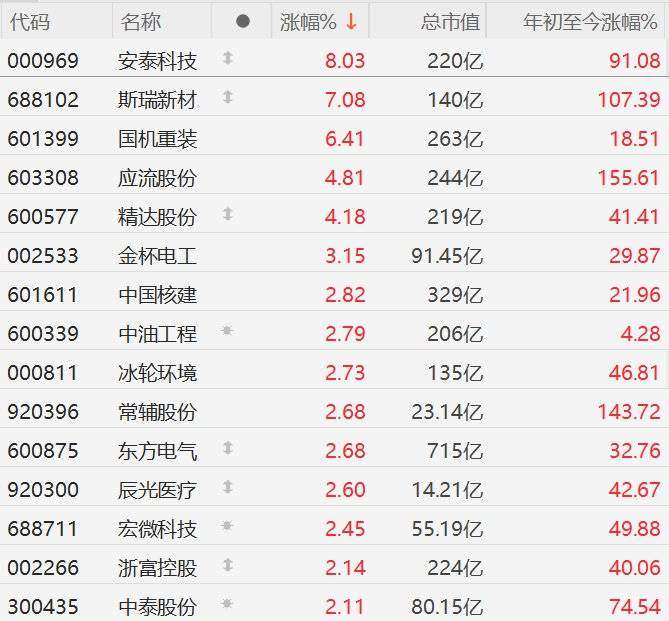
A股可控核聚变概念股上涨,安泰科技涨8%,斯瑞新材涨7%,国机重装涨6%,应流股份、精达股份涨4%,金杯电工、中国核建涨3%
Ge Long Hui· 2025-10-21 02:57
Group 1 - The A-share market saw a rise in controllable nuclear fusion concept stocks, with notable increases in share prices for several companies [1] - An Tai Technology (安泰科技) experienced an 8.03% increase, with a total market capitalization of 22 billion and a year-to-date increase of 91.08% [2] - Si Rui New Materials (斯瑞新材) rose by 7.08%, with a market cap of 14 billion and a year-to-date increase of 107.39% [2] - Guo Ji Heavy Industry (国机重装) increased by 6.41%, with a market cap of 26.3 billion and a year-to-date increase of 18.51% [2] - Ying Liu Co., Ltd. (应流股份) saw a 4.81% rise, with a market cap of 24.4 billion and a year-to-date increase of 155.61% [2] - Jing Da Co., Ltd. (精达股份) increased by 4.18%, with a market cap of 21.9 billion and a year-to-date increase of 41.41% [2] - Jin Bei Electric (金杯电工) rose by 3.15%, with a market cap of 9.145 billion and a year-to-date increase of 29.87% [2] - China Nuclear Engineering (中国核建) increased by 2.82%, with a market cap of 32.9 billion and a year-to-date increase of 21.96% [2]