
南钢股份

Search documents
浙江五洲新春集团股份有限公司关于召开2025年第六次临时股东会的通知
Shang Hai Zheng Quan Bao· 2025-12-10 19:08
Group 1 - The company will hold its sixth extraordinary general meeting of shareholders on December 26, 2025, at 13:30 in Shaoxing, Zhejiang Province [1][4] - Voting will be conducted through a combination of on-site and online methods, utilizing the Shanghai Stock Exchange's network voting system [2][5] - Shareholders must register to attend the meeting, with registration available on December 25, 2025 [10][11] Group 2 - The board of directors has approved the agenda for the upcoming shareholder meeting, which includes a proposal for the expected related party transactions for 2026 [15][19] - The expected total amount for related party transactions in 2026 is capped at 508.06 million yuan [24] - The company emphasizes that these transactions will not significantly impact its financial status or independence, ensuring no harm to minority shareholders [22][39]

2025年1-10月中国钢材产量为12.2亿吨 累计增长4.7%
Chan Ye Xin Xi Wang· 2025-12-10 03:47
上市企业:宝钢股份(600019),鞍钢股份(000898),马钢股份(600808),沙钢股份(002075),首钢股 份(000959),包钢股份(600010),太钢不锈(000825),华菱钢铁(000932),河钢股份(000709),南 钢股份(600282) 2020-2025年1-10月中国钢材产量统计图 数据来源:国家统计局,智研咨询整理 知前沿,问智研。智研咨询是中国一流产业咨询机构,十数年持续深耕产业研究领域,提供深度产业研 究报告、商业计划书、可行性研究报告及定制服务等一站式产业咨询服务。专业的角度、品质化的服 务、敏锐的市场洞察力,专注于提供完善的产业解决方案,为您的投资决策赋能。 根据国家统计局数据显示:2025年10月中国钢材产量为1.2亿吨,同比下降0.9%;2025年1-10月中国钢 材累计产量为12.2亿吨,累计增长4.7%。 相关报告:智研咨询发布的《2026-2032年中国钢材深加工行业竞争格局分析及投资发展研究报告》 ...


2025年1-10月中国生铁产量为7.1亿吨 累计下降1.8%
Chan Ye Xin Xi Wang· 2025-12-10 03:47
根据国家统计局数据显示:2025年10月中国生铁产量为0.7亿吨,同比下降7.9%;2025年1-10月中国生 铁累计产量为7.1亿吨,累计下降1.8%。 2020-2025年1-10月中国生铁产量统计图 上市企业:宝钢股份(600019),马钢股份(600808),鞍钢股份(000898),首钢股份(000959),河钢股 份(000709),凌钢股份(600231),重庆钢铁(601005),安阳钢铁(600569),八一钢铁(600581),南 钢股份(600282) 相关报告:智研咨询发布的《2026-2032年中国高纯生铁行业市场产销状况及投资战略研判报告》 数据来源:国家统计局,智研咨询整理 知前沿,问智研。智研咨询是中国一流产业咨询机构,十数年持续深耕产业研究领域,提供深度产业研 究报告、商业计划书、可行性研究报告及定制服务等一站式产业咨询服务。专业的角度、品质化的服 务、敏锐的市场洞察力,专注于提供完善的产业解决方案,为您的投资决策赋能。 ...

26家银行派息落地,险资有望加码红利板块,国企红利ETF(159515)调整蓄势
Xin Lang Cai Jing· 2025-12-10 02:42
Group 1 - The core viewpoint of the news is that the China Securities State-Owned Enterprises Dividend Index has experienced a slight decline, while the dividend distribution from major banks is expected to attract long-term capital into the market [1][2] - As of December 10, 2025, the China Securities State-Owned Enterprises Dividend Index fell by 0.15%, with Xiamen International Trade leading the gains and China Merchants Bank leading the losses [1] - The China Securities State-Owned Enterprises Dividend ETF (159515) saw a scale increase of 2.33 million yuan and a share increase of 2.7 million shares over the past week [1][2] Group 2 - On December 8, Industrial and Commercial Bank of China and Agricultural Bank of China announced their mid-term dividend distributions, totaling 50.396 billion yuan and 41.823 billion yuan, respectively [1] - By December 9, 2025, 26 A-share listed banks had disclosed mid-term or quarterly dividend plans, with a total proposed payout exceeding 260 billion yuan [1] - China Galaxy Securities noted that the mid-term dividend distribution from listed banks remains strong and is occurring earlier than expected, enhancing the attractiveness of dividend stocks [1][2] Group 3 - The China Insurance Regulatory Commission announced a reduction in stock risk factors, which lowers the capital requirements for insurance companies investing in high-quality equity assets [2] - Recent policies focus on capital markets and consumer policies, with a goal for large state-owned insurance companies to allocate 30% of new premiums to A-shares [2] - The China Securities State-Owned Enterprises Dividend Index includes 100 listed companies with high cash dividend yields, reflecting the overall performance of high-dividend securities among state-owned enterprises [2]







推动“双新”融合筑牢现代化产业体系根基
Zhong Guo Zheng Quan Bao· 2025-12-09 20:22
Core Insights - The article emphasizes the integration of technological innovation and industrial transformation, highlighting how companies are leveraging AI and automation to enhance production efficiency and reduce costs [1][2][3] Group 1: Smart Manufacturing - Companies like Nanjing Steel are utilizing digital twin technology to create interactive 3D models of production lines, leading to increased efficiency and reduced costs [1] - Langbo Technology is enhancing its profitability by investing in automation equipment, which improves production processes and product quality traceability [1] Group 2: Green Transformation - Haiyang Technology has implemented intelligent production lines to address high energy consumption and labor intensity issues, achieving a fully automated manufacturing process that reduces resource consumption and emissions [2] - GCL-Poly Energy's subsidiary, GCL Lithium, focuses on green manufacturing, achieving approximately 50% reductions in investment costs, energy consumption, and overall process costs through innovative production methods [2] Group 3: Technological Innovation - Aviation engine manufacturing is highlighted as a complex system requiring advanced materials and manufacturing techniques, with companies like Hangya Technology developing barriers in precision processing and special treatments [3] - The development of R5-grade mooring chains by Yaxing Anchor Chain demonstrates the importance of understanding downstream demands and collaborating with research institutions to meet industry needs [3] Group 4: Balancing Technology and Market Needs - Companies must adapt to customer application scenarios and maintain competitive costs while ensuring product efficiency and ease of use [4] - Successful technology firms need to excel not only in technical capabilities but also in commercializing their innovations into valuable products for customers [4]
钢铁行业资金流出榜:包钢股份、华菱钢铁等净流出资金居前
Zheng Quan Shi Bao Wang· 2025-12-09 09:32
Market Overview - The Shanghai Composite Index fell by 0.37% on December 9, with five industries experiencing gains, led by the comprehensive and communication sectors, which rose by 3.45% and 2.23% respectively [1] - The metal and steel industries faced the largest declines, with losses of 3.03% and 2.47% respectively, placing the steel industry second in terms of decline [1] Capital Flow - The main capital outflow from the two markets totaled 52.992 billion yuan, with only three industries seeing net inflows: retail trade (1.143 billion yuan), comprehensive (432 million yuan), and banking (70.578 million yuan) [1] - The non-ferrous metals industry had the highest net outflow, totaling 7.937 billion yuan, followed by the computer industry with a net outflow of 5.616 billion yuan [1] Steel Industry Performance - The steel industry saw a decline of 2.47%, with a total net outflow of 704 million yuan, and only one of the 44 stocks in this sector rose in value [2] - Among the steel stocks, Baosteel had the highest net inflow of 25.986 million yuan, followed by Shagang and Jiugang Hongxing with inflows of 8.877 million yuan and 5.087 million yuan respectively [2] - Six steel stocks experienced net outflows exceeding 30 million yuan, with Baogang, Hesteel, and Nanjing Steel leading the outflows at 190 million yuan, 64.883 million yuan, and 49.797 million yuan respectively [2] Steel Stock Flow Data - The following table summarizes the performance of key steel stocks: - Baogang: -1.63%, -189.6372 million yuan - Hesteel: -3.45%, -64.8827 million yuan - Nanjing Steel: -4.61%, -49.797 million yuan - Other notable declines include Fangda Carbon (-2.79%, -39.6426 million yuan) and Vanadium Titanium (-3.55%, -38.6316 million yuan) [2][3]


市领导在区、相关单位宣讲党的二十届四中全会精神
Nan Jing Ri Bao· 2025-12-09 02:27
Group 1 - The core message emphasizes the importance of implementing the spirit of the 20th National Congress of the Communist Party, focusing on grassroots governance and the integration of technology in administrative processes [1][2][3][4][5][6][7] - The "14th Five-Year Plan" is highlighted as a strategic framework for the next five years, addressing key areas such as social governance, public welfare, and safety, which directly impact the livelihoods of the people [2][4] - The role of private enterprises in driving high-quality development is underscored, with a call for innovation and social responsibility to enhance economic growth and employment [3][6] Group 2 - The emphasis on community engagement and the integration of various governance models, including party leadership and technology, is crucial for effective grassroots management [2][4][5] - The need for continuous improvement in public services and administrative efficiency is stressed to enhance citizen satisfaction and welfare [1][2][4][7] - The importance of aligning local governance with national strategies to ensure cohesive development and modernization is highlighted [3][6][7]
2025年中国钢铁行业绿电消费的进程、挑战与建议报告
Sou Hu Cai Jing· 2025-12-08 08:19
Core Insights - The report discusses the acceleration of green electricity consumption in China's steel industry, highlighting its significance in the sector's low-carbon transition and the challenges it faces [1][11]. Group 1: Acceleration of Green Electricity Consumption - The steel industry, being a high energy-consuming and high carbon-emitting sector, is focusing on green electricity consumption as a core pathway for low-carbon transformation [1]. - The acceleration is driven by multiple factors, including policy shifts from energy consumption control to carbon emission control, clear compliance directions for green electricity consumption, and increasing demand for low-carbon steel from downstream industries like automotive and construction [1][12]. - Major steel companies are integrating green electricity consumption into their long-term strategies, responding to both regulatory requirements and market demands [1][12]. Group 2: Consumption Models - Three mainstream models of green electricity consumption have emerged: green electricity trading, green certificate trading, and self-built/invested renewable energy projects [2][14]. - Green electricity trading requires no initial investment and can lock in power supply and environmental value, with companies like Baowu Steel and Hebei Steel engaging in large-scale transactions [2]. - Self-built renewable energy projects, while having higher initial costs, can optimize long-term energy costs, as seen with companies like Ansteel and Jiugang [2][14]. Group 3: Long-term Value and Challenges - Green electricity consumption brings multiple long-term benefits, including enhanced green competitiveness, compliance with domestic and international regulations, and the development of the green certificate market [2][12]. - Challenges include mismatches between steel industry locations and renewable energy-rich areas, unclear cost-sharing mechanisms for green electricity premiums, and the need for clearer policy connections and compliance details [2][12]. Group 4: Policy and Corporate Recommendations - To promote sustainable development in green electricity consumption, the report suggests improving incentive mechanisms, fostering industry collaboration, and enhancing energy management levels within companies [3][15]. - Companies are encouraged to set green electricity consumption targets, develop diversified consumption strategies, and advance technology integration with core production processes [3][15]. Group 5: Market Dynamics and Downstream Demand - The demand for low-carbon steel from key downstream sectors, such as construction and automotive, is increasing, influencing steel companies' energy consumption decisions [2][41]. - Major automotive manufacturers are setting carbon reduction targets that directly impact their steel suppliers, creating a supply chain responsibility that drives steel companies to enhance their green electricity consumption [2][41]. Group 6: Future Outlook - The report anticipates that the synergy between renewable energy development and the steel industry will expand, with green electricity consumption facilitating deeper decarbonization and structural transformation in the steel sector [1][17]. - The ongoing evolution of policies and market mechanisms will provide robust support for the steel industry's transition to green electricity consumption [20][31].

中长期经济高质量发展背景下,红利资产配置价值凸显,国企红利ETF(159515)盘中蓄势
Xin Lang Cai Jing· 2025-12-08 06:01
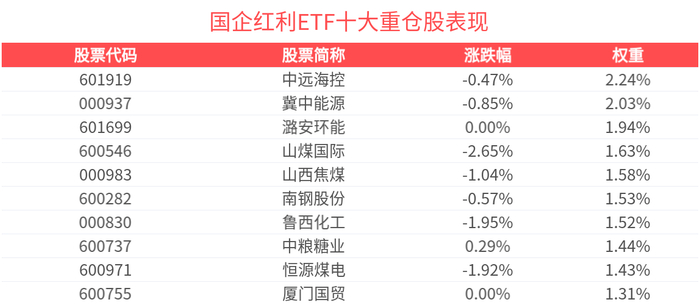
Group 1 - The core point of the news is the performance of the China Securities State-Owned Enterprises Dividend Index, which has seen a decline of 0.47% as of December 8, 2025, with Xiamen Bank leading the gains among constituent stocks [1] - The China Securities State-Owned Enterprises Dividend ETF (159515) has a latest scale of 47.8753 million yuan and a total of 41.1866 million shares, indicating a significant interest from investors with a net inflow of 3.4908 million yuan over the last three days [1] - The ETF closely tracks the China Securities State-Owned Enterprises Dividend Index, selecting 100 listed companies with high cash dividend yields and stable dividends from state-owned enterprises [2] Group 2 - According to Huachuang Securities, dividend assets show value across various sectors including transportation, finance, energy, food and beverage, home appliances, real estate, metals, and publishing [2] - In the transportation sector, long-duration assets such as highways, ports, and railways exhibit defensive stability, with a recommendation for high-quality highway assets with growth potential [2] - The coal industry is experiencing enhanced profitability stability due to unexpected anti-involution policies and supply constraints, indicating a positive outlook for dividend assets amid high-quality economic development [2] Group 3 - As of November 28, 2025, the top ten weighted stocks in the China Securities State-Owned Enterprises Dividend Index account for a total of 16.99%, with notable stocks including COSCO Shipping Holdings and Jizhong Energy [3] - The performance of the top ten stocks shows varied results, with COSCO Shipping Holdings declining by 0.47% and Jizhong Energy by 0.85%, while Lu'an Environmental Energy remained unchanged [3]


为何钢铁的需求侧具有韧性?
Changjiang Securities· 2025-12-08 04:33
行业研究丨行业周报丨钢铁 [Table_Title] 为何钢铁的需求侧具有韧性? 报告要点 [Table_Summary] 回顾 2025 年钢铁需求侧表现, 1~10 月粗钢、钢材产量同比分别-3.9%、+4.7%。钢材产量由 于涉及冷轧、钢管等二次材重复计算的问题,伴随钢铁产品结构升级和二次材占比的提升,或 对实际产量有所高估。粗钢产量由于系钢企自行上报,缺乏严格监督机制,不涉及流转税数据 的检验,导致实际的产量或有所低估。由此,实际钢铁产量或介于统计局粗钢产量和钢材产量 之间。结合钢材库存整体去化至低位,当前库存水平和年初库存水平差异也不大,表明 2025 年 钢铁总需求相对 2024 年是较为平稳的。为何钢铁的需求侧具有韧性? 丨证券研究报告丨 分析师及联系人 [Table_Author] 王鹤涛 赵超 易轰 吕士诚 SAC:S0490512070002 SAC:S0490519030001 SAC:S0490520080012 SAC:S0490525080005 SFC:BQT626 SFC:BUY139 SFC:BUZ394 请阅读最后评级说明和重要声明 %% %% %% %% research ...