
网易云音乐

Search documents
星巴克迎中国合伙人 能否撑起下沉市场的盈利预期?
Jing Ji Guan Cha Wang· 2025-11-04 11:53
Core Insights - Starbucks has entered a strategic partnership with Boyu Capital to form a joint venture for its retail operations in China, with Boyu holding up to 60% equity and Starbucks retaining 40% [2] - The estimated enterprise value of Starbucks' retail business in China exceeds $13 billion, which includes the value from the joint venture and ongoing brand licensing fees [2] - The partnership indicates a shift in control of Starbucks' operations in China to a local entity, reflecting a broader trend of foreign brands seeking local partnerships to enhance competitiveness [5][8] Financial Performance - In fiscal year 2024, Starbucks China reported revenues of $2.958 billion, a decline of 1.4% year-on-year, while fiscal year 2025 is expected to show a slight recovery with revenues projected at $3.105 billion, representing a 5% increase [3] Boyu Capital Overview - Boyu Capital is recognized as a top private equity firm in China, co-founded by former executives from China Ping An Group and TPG Capital, focusing on sectors like technology, consumer retail, and healthcare [4] - The firm has a diverse investment portfolio, including notable companies such as NetEase Cloud Music and Perfect Diary, and is known for its strategic investments in emerging markets [4] Market Dynamics - The Chinese consumer market is characterized by intense competition, with local brands employing aggressive pricing strategies to capture market share, posing challenges for foreign brands like Starbucks [5] - The partnership with Boyu Capital is seen as a necessary evolution for Starbucks to adapt to local market conditions and optimize its operations in lower-tier cities [6][7] Future Expansion Plans - The newly formed joint venture aims to expand Starbucks' store count in China from 8,000 to 20,000, indicating a significant growth strategy in the Chinese market [6] - The operational headquarters will remain in Shanghai, and the joint venture will focus on adapting to the unique challenges of the lower-tier market [6] Strategic Shift - Starbucks is transitioning from a direct operator to a brand licensor, which reduces operational risks and allows for a more flexible approach to market expansion [6][7] - This shift mirrors similar strategies employed by other foreign brands, such as McDonald's, which have sought local partnerships to enhance their market presence in China [8]



星巴克中国易主,未来将再开1.2万家店
Hua Er Jie Jian Wen· 2025-11-04 10:35
Core Insights - Starbucks has announced a strategic partnership with Chinese alternative asset management firm Boyu Capital to establish a joint venture for its retail operations in China, marking the first time in 26 years that Starbucks has relinquished control of its Chinese business [2][6] - Boyu Capital will hold up to 60% of the joint venture, investing approximately $2.4 billion (about 173 billion RMB), while Starbucks retains 40% ownership and continues to own the brand and intellectual property [2][3] - The joint venture aims to expand Starbucks' store count in China from 8,000 to 20,000, with a current valuation of over $13 billion for Starbucks' retail business in China [3][5] Company Strategy - The partnership is seen as a strategic adjustment for Starbucks in response to increasing competition from local brands like Luckin Coffee and CoCo [6][10] - Starbucks' CEO Brian Niccol emphasized the need for a fundamental change in strategy to restore growth, particularly in the face of declining global comparable store sales [4][6] - The collaboration allows Starbucks to gain significant cash flow while still benefiting from future growth in the Chinese market through retained equity and ongoing licensing fees [6][10] Market Performance - Starbucks China reported a revenue of $831.6 million for Q4 of fiscal year 2025, a 6% year-over-year increase, marking four consecutive quarters of growth [5] - For the full fiscal year 2025, Starbucks China achieved a total revenue of $3.105 billion, reflecting a 5% increase, which is higher than the global average growth rate [5] - The joint venture comes at a time when Starbucks is experiencing a divergence in performance between its global and Chinese markets [4][5] Competitive Landscape - The deal attracted interest from over 20 capital firms and business giants, indicating a competitive environment for Starbucks' Chinese operations [7][8] - Boyu Capital's expertise in local market operations is expected to accelerate Starbucks' expansion, particularly in lower-tier cities [8][9] - The historical performance of Boyu Capital, with a net internal rate of return exceeding 25%, positions it as a strong partner for Starbucks in navigating the competitive landscape [9] Historical Context - This partnership is part of a broader trend where foreign brands in China seek local partnerships to enhance market penetration, similar to past collaborations like McDonald's with CITIC and Coca-Cola with COFCO [10] - The establishment of the joint venture signifies a new phase for Starbucks in China, referred to as the "2.0 era," aiming to unlock significant market potential [10]

从SKP到星巴克:博裕的“高端消费闭环”野心
Tai Mei Ti A P P· 2025-11-04 09:36
图 片来源:网络 这场历时半年的资本招亲终于落下了帷幕,博裕资本在博弈中击败了凯雷、EOT和红杉中国,成为星巴 克中国的新合伙人。 2025年11月4日一大早, 星巴克正式官宣与博裕资本达成战略合作,双方将成立合资企业,共同运营星 巴克在中国市场的零售业务。这也是继2017年星巴克收回中国大陆全面运营权之后,再一次接受外部股 东入驻。 根据协议,博裕斥资约40亿美元持有合资企业至多60%股权,星巴克保留40%股权,并将继续作为星巴 克品牌与知识产权的所有者和授权方,向新成立的合资企业进行授权。星巴克预计其中国零售业务的总 价值将超过130亿美元,完成此次交易后,星巴克计划在中国扩张至多达2万家门店,这一数字将超过其 目前在北美的门店数量。 博裕投资合伙人黄宇铮表示:"我们既认同这一品牌的持久生命力,也看到了为中国顾客带来更创新、 更本土化体验的巨大机遇。基于这一共同的信念,我们将与星巴克协作,融合星巴克在全球咖啡行业的 领导力与博裕深度的本地市场洞察,致力于加速增长,为更广大的中国消费者缔造卓越的咖啡体验。" 星巴克咖啡公司董事长兼首席执行官倪睿安(Brian Niccol)表示:"博裕在本地市场的经验与专长 ...
网易云音乐(09899) - 截至2025年10月31日止月份股份发行人的证券变动月报表
2025-11-04 08:48
股份發行人及根據《上市規則》第十九B章上市的香港預託證券發行人的證券變動月報表 截至月份: 2025年10月31日 狀態: 新提交 致:香港交易及結算所有限公司 公司名稱: 網易雲音樂股份有限公司 呈交日期: 2025年11月4日 I. 法定/註冊股本變動 | 1. 股份分類 | 普通股 | 股份類別 | 不適用 | | | 於香港聯交所上市 (註1) | | 是 | | | --- | --- | --- | --- | --- | --- | --- | --- | --- | --- | | 證券代號 (如上市) | 09899 | 說明 | | | | | | | | | | | 法定/註冊股份數目 | | | 面值 | | | 法定/註冊股本 | | | 上月底結存 | | | 1,000,000,000 | USD | | 0.0001 | USD | | 100,000 | | 增加 / 減少 (-) | | | | | | | USD | | | | 本月底結存 | | | 1,000,000,000 | USD | | 0.0001 | USD | | 100,000 | 本月底法定/註冊股 ...
星巴克中国出售!博裕资本拿下60%股权,斥资40亿美元
Sou Hu Cai Jing· 2025-11-04 06:40
Core Insights - Starbucks has announced a joint venture with Chinese private equity firm Boyu Capital to operate its retail business in mainland China, marking the first time in 26 years that Starbucks has relinquished control of its Chinese operations [1][2] - Boyu Capital will hold up to 60% of the joint venture, while Starbucks retains 40% and continues to own and license its brand and intellectual property [1] - The enterprise value of the transaction is approximately $4 billion, excluding cash and debt, with Starbucks estimating the total value of its retail business in China to exceed $13 billion [2] Company Overview - The newly formed Starbucks China joint venture will be headquartered in Shanghai and will manage around 8,000 stores currently operated by Starbucks in mainland China [2] - Over 60% of Starbucks' stores are located in the U.S. and China, with China being its second-largest and fastest-growing market [3] - Starbucks CEO Brian Niccol emphasized that Boyu's local market expertise will significantly accelerate Starbucks' expansion in China, particularly in smaller cities and emerging regions [3] Investment Background - Boyu Capital, established in 2011, has become one of China's top local private equity firms, focusing on technology innovation, consumer retail, and healthcare [3] - Recent investments by Boyu include leading projects in the consumer and technology sectors, such as Mixue Ice Cream, Haitian Flavoring, and Perfect Diary [3] Financial Performance - For the fiscal year 2025, Starbucks reported revenue of $3.105 billion from the Chinese market, reflecting a 5% year-over-year growth [3] - By the end of fiscal year 2025, Starbucks had 8,011 stores in China, having entered 1,091 county-level markets, with 183 new stores opened in the fourth quarter alone [3]
星巴克中国“让贤”仅保留40%股权,借力博裕投资坐望2万家门店
Sou Hu Cai Jing· 2025-11-04 06:13
Core Insights - Starbucks has announced a strategic partnership with Boyu Capital to establish a joint venture for its retail operations in China, with Boyu holding up to 60% equity and Starbucks retaining 40% [1] - The estimated enterprise value of the joint venture is approximately $4 billion, and Starbucks anticipates the total value of its retail business in China to exceed $13 billion [1] - The new joint venture will be headquartered in Shanghai and aims to expand the number of Starbucks stores in China from 8,000 to 20,000 in the future [1] Company Strategy - Starbucks CEO Brian Niccol emphasized that Boyu's local market expertise will accelerate Starbucks' expansion in China, particularly in smaller cities and emerging regions [2] - The company reported significant growth in its retail presence, with 8,011 stores in 1,091 county-level cities by the end of fiscal year 2025 [2] - In response to market competition, Starbucks implemented its largest price adjustment in 26 years, reducing prices on key products by an average of 5 yuan, which contributed to revenue growth [2] Market Challenges - Despite the positive results from its expansion strategy, Starbucks faces challenges in penetrating the lower-tier markets, where competitors like Luckin Coffee have a significant presence [3][5] - Data indicates that the majority of coffee shop locations are concentrated in new first-tier and second-tier cities, while brands targeting lower-tier markets have a higher percentage of their stores in those areas [3] - The entry of various tea brands into the coffee market poses additional challenges for Starbucks as it seeks to establish a foothold in non-first and second-tier cities [5] Investment Landscape - The sale of Starbucks' equity in China has attracted interest from over 20 private equity firms, with potential valuations reaching $10 billion [6] - Boyu Capital, founded in 2011, has a strong investment track record in the consumer market, managing a fund size of $10 billion and holding stakes in over 200 companies [7] - Boyu's recent acquisition of a significant stake in Beijing SKP, a leading luxury department store, highlights its strategic investment approach in the evolving Chinese consumer market [8] Industry Transformation - The coffee market in China is undergoing significant changes, with high-end brands like Starbucks needing to adapt to the competitive landscape dominated by local brands [10] - The shift in consumer preferences and market dynamics necessitates a transformation for mid-to-high-end foreign brands, which must navigate the challenges of maintaining their brand identity while appealing to a broader audience [10]

2025中国播客行业现状与发展趋势报告-嘉世咨询
Sou Hu Cai Jing· 2025-10-31 03:15
Core Insights - The report indicates that the Chinese podcast industry is in a "revival period," with the audience size reaching 120-140 million in 2023 and expected to exceed 170 million by 2025, with a market size projected to surpass 5 billion RMB [11][12][13]. Group 1: Market Overview - The podcast market in China is characterized by a unique positioning within the "ear economy," capturing a high-value audience that is well-educated and affluent [11][12]. - The audience demographics show that over 80% are from Generation Z and Millennials, with more than 60% located in first-tier and new first-tier cities [11][12]. - The listening scenarios are primarily commuting (65.8%), household chores (48.2%), and before sleep (42.5%), with an average listening duration exceeding 30 minutes and a completion rate of 60%-80% [11][12]. Group 2: Industry Structure - The podcast ecosystem is thriving, with active podcast programs increasing from less than 10,000 in 2019 to over 50,000 in 2023, supported by MCNs like JustPod and PodFest China [11][12]. - The distribution platforms are characterized by a "one strong, many strong" model, with platforms like Ximalaya holding significant traffic advantages, while niche platforms like Xiaoyuzhou create high-engagement communities [11][12]. - The content categories have expanded from general culture and talk shows to include technology, finance, psychology, and podcast dramas, with talk shows accounting for 30.5% of listening time [11][12]. Group 3: Commercialization and Revenue - Advertising is the primary revenue model, accounting for over 70% of income, with host-read ads showing high conversion rates due to trust [11][12]. - The podcast market's total revenue was approximately 1-1.5 billion RMB in 2021, with expectations to exceed 5 billion RMB by 2025, driven mainly by advertising revenue [11][12]. - The industry faces challenges in monetization, including the "data black box" issue, balancing creator commercialization with content quality, and platform revenue-sharing disputes [11][12]. Group 4: Future Trends - The report predicts four major trends: AIGC technology will enhance content production and distribution; video podcasts will lower listening barriers; smart devices will create new listening scenarios; and improved data monitoring standards will accelerate commercialization [11][12][13].

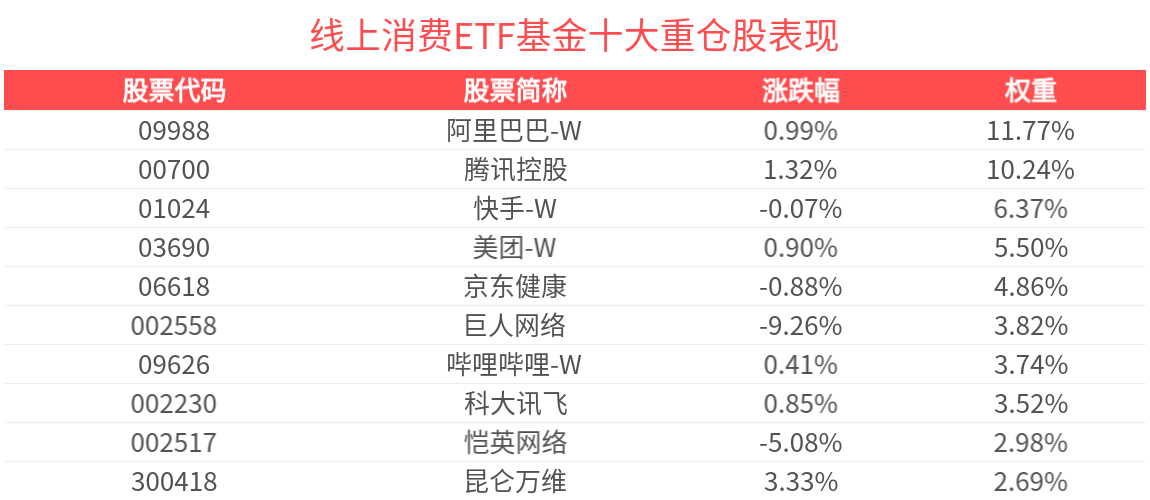
腾讯视频成立AI影视表达工作室,“AI应用ETF”——线上消费ETF基金(159793)创近1月规模新高
Xin Lang Cai Jing· 2025-10-30 02:26
Group 1 - Tencent Video has established an AI Film Expression Studio to enhance productions such as "The Three-Body Problem" and "Strange Stories from a Chinese Studio" through AI technology [1] - The domestic AI ecosystem is rapidly evolving, with significant acceleration observed in large models, computing power, and applications [1] - The online consumption ETF fund (159793) is positioned to benefit from the explosion of AI applications [1] Group 2 - The CSI Hong Kong-Shanghai Online Consumption Theme Index (931481) includes 50 listed companies involved in online shopping, digital entertainment, online education, and telemedicine, reflecting the overall performance of these sectors in the mainland and Hong Kong markets [2] - As of September 30, 2025, the top ten weighted stocks in the CSI Hong Kong-Shanghai Online Consumption Theme Index account for 55.76% of the index, with Alibaba-W (09988) and Tencent Holdings (00700) being the top two [2][4]
钟睒睒以5300亿元“四度登顶”中国首富;苹果市值首次升破4万亿美元;雷军带队,小米汽车成立架构部;中通快递回应被约谈 丨邦早报
创业邦· 2025-10-29 00:09
Group 1: Wealth Rankings - Zhong Shanshan has become the richest person in China for the fourth time with a wealth of 530 billion yuan, an increase of 190 billion yuan from the previous year, setting a new record for the wealth of a Chinese billionaire [1][2] - Zhang Yiming, founder of ByteDance, ranks second with a wealth of 470 billion yuan, increasing by 120 billion yuan [1][2] - Ma Huateng, founder of Tencent, ranks third with a wealth of 465 billion yuan, an increase of 150 billion yuan [1][2] - Lei Jun, founder of Xiaomi, saw the highest wealth increase among entrepreneurs this year, growing by 196 billion yuan (+151%) to reach 326 billion yuan, ranking fifth [1][2] Group 2: Corporate Developments - Xiaomi has established a new department focused on the architecture of next-generation smart electric vehicles, directly reporting to Lei Jun, which will influence the company's future product technology direction [3] - OpenAI has completed a capital restructuring, establishing a nonprofit organization to hold its for-profit business, with Microsoft supporting this restructuring [2] - Meituan has seen a return of a former executive to lead its operations in Brazil, indicating a strategic move to strengthen its international presence [3] Group 3: Market Movements - Apple has become the third company in the U.S. to surpass a market capitalization of 4 trillion dollars, although it closed at 3.99 trillion dollars [2] - Nvidia plans to invest 1 billion dollars in Nokia through a directed share issuance, acquiring a 2.9% stake in the company [7] - The AI sector continues to see significant investment, with companies like Deepexi and Fireworks AI raising substantial funds to expand their operations and capabilities [7][8]




人工智能周报(25年第43周):OpenAI 推出 AI 浏览器,DeepSeek 发布开源 DeepSeek-OCR 模型-20251028
Guoxin Securities· 2025-10-28 14:28
Investment Rating - The report maintains an "Outperform" rating for the AI industry, indicating expected performance above the market benchmark [3][4]. Core Insights - The AI sector has demonstrated significant impacts on the advertising business of internet giants, cloud computing scenarios, and corporate efficiency, as evidenced by Tencent's advertising growth of 20% in Q2 and Alibaba Cloud's acceleration to 26% [2][29]. - Recent developments include the launch of proprietary chips by companies like Baidu and Alibaba, which are expected to enhance market share through a complete chain layout of chips, models, and applications [2][29]. - Key companies recommended for investment include Tencent Holdings, Alibaba, Kuaishou, Baidu Group, Meitu, and Tencent Music, which is less correlated with macroeconomic fluctuations [2][29]. Company Dynamics - OpenAI launched the AI browser ChatGPT Atlas, integrating large models into web browsing processes, enhancing automation capabilities [15]. - Meta restructured its AI team, laying off 600 employees to focus on advanced model development while increasing its capital expenditure limit to $72 billion [17]. - Google upgraded its AI Studio with vibeCoding, streamlining the development process and enhancing its competitive edge in the AI ecosystem [18]. - Huawei released HarmonyOS 6, enabling cross-ecosystem data transfer and introducing AI capabilities for various applications [19]. - Alibaba's Quark launched a dialogue assistant, marking the first outcome of its internal "C Plan" aimed at enhancing AI capabilities for consumer applications [20]. - Tencent is set to release the ima2.0 version of its AI workbench, enhancing its productivity tools with new features [21]. Underlying Technologies - DeepSeek introduced the open-source DeepSeek-OCR model, achieving a 7-20 times increase in text token efficiency while maintaining over 97% accuracy [22]. - Tencent released the WorldMirror model, a unified 3D reconstruction model that significantly improves processing efficiency [23]. - Baichuan Intelligent launched the Baichuan-M2 Plus model, addressing the credibility of medical AI through a six-source evidence reasoning paradigm [24]. - The Hong Kong University of Science and Technology released the DreamOmni2 model, enhancing multi-modal creative capabilities [25]. Industry Policies - The 18th meeting of the 14th National People's Congress reviewed amendments to the cybersecurity law, proposing a framework for AI safety and development [27]. - The Ministry of Science and Technology outlined core directions for AI development during the 14th Five-Year Plan, focusing on foundational research and international cooperation [28].