
三生国健

Search documents
左手创新药、右手生发剂,“药二代”娄竞冲击第三个上市平台
Bei Jing Shang Bao· 2025-11-26 13:35
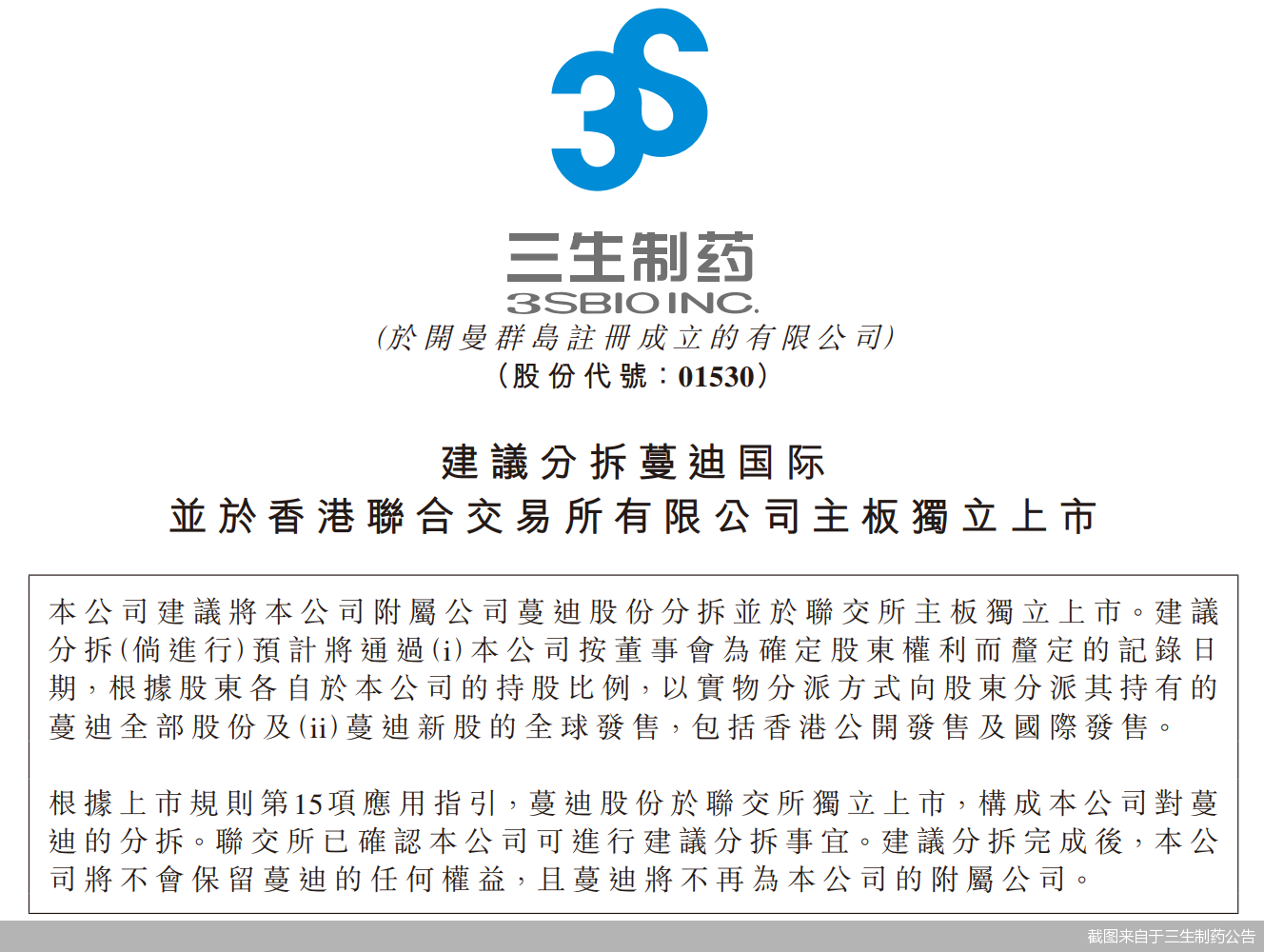
Core Viewpoint - Sanofi Pharmaceutical is set to become a star in the pharmaceutical sector by 2025, following its collaboration with Pfizer and the planned spin-off of its subsidiary, Mandi International, for independent listing, marking the potential emergence of a third listing platform within the "Sanofi System" [1][4]. Group 1: Company Developments - Mandi International, a Cayman Islands-registered company, focuses on consumer pharmaceuticals, particularly in skin health and weight management solutions, and is known for its flagship Minoxidil-based hair loss treatment products [5]. - The valuation of Mandi International has increased over nine times since its acquisition by Sanofi Pharmaceutical in 2015 for 528 million yuan [6][7]. - Mandi International's financial performance shows projected revenues of approximately 982 million yuan, 1.228 billion yuan, 1.455 billion yuan, and 743 million yuan for the years 2022 to 2025, with profit margins consistently above 80% [5]. Group 2: Market Strategy - The spin-off aims to allow for more accurate market valuation of Mandi International, isolating consumer healthcare market risks from Sanofi Pharmaceutical's core focus on innovative drugs and biopharmaceuticals [8]. - The spin-off will utilize a stock distribution and new global share issuance method, allowing existing shareholders to receive shares in Mandi International proportionate to their holdings [8]. Group 3: Historical Context - The "Sanofi System" has a clear capital structure, with Sanofi Pharmaceutical focusing on biopharmaceuticals, Sanofi Guojian on antibody drugs, and Mandi International on consumer healthcare, maximizing capital value across different market segments [11]. - The history of Sanofi Pharmaceutical includes its founding in 1993, its listing on NASDAQ in 2007, and its transition to the Hong Kong Stock Exchange in 2015, alongside strategic acquisitions that expanded its product offerings [9][10]. Group 4: Recent Performance - The stock prices of Sanofi Pharmaceutical and Sanofi Guojian have surged significantly this year, with Sanofi Pharmaceutical's stock increasing nearly fourfold, driven by a lucrative business development deal with Pfizer [13][15]. - The deal with Pfizer involves a $1.25 billion upfront payment for a dual-target antibody product, which has sparked a broader rally in the innovative drug sector [14][15].


11月26日重要资讯一览
Zheng Quan Shi Bao Wang· 2025-11-26 13:24
Group 1 - The Ministry of Industry and Information Technology and five other departments issued a plan to enhance the adaptability of supply and demand for consumer goods, aiming for a significant optimization of the supply structure by 2027, with the formation of three trillion-level consumption fields and ten hundred-billion-level consumption hotspots [2] - The State Council Information Office will hold a press conference on November 27, 2025, to discuss policies related to enhancing the adaptability of supply and demand for consumer goods [2] - The National Development and Reform Commission will hold a news conference on November 27, 2025, to provide updates on relevant policies [2] Group 2 - Guangdong issued a plan to support enterprises in conducting industrial chain integration and mergers, aiming to enhance the competitive advantages of industrial clusters in the Guangdong-Hong Kong-Macao Greater Bay Area by 2027 [3] - The China Insurance Industry Association issued a risk warning regarding "Anwo Stock Insurance," clarifying that it is not an approved insurance institution and that stock investment losses are not covered by insurance [3] Group 3 - Changguang Huaxin has achieved mass production of 100G EML in the optical communication field, and 200G EML has begun sampling [5] - Shida Group noted that it has not engaged in business cooperation with Alibaba Cloud despite market rumors [6] - Jindike will not issue new quadrivalent influenza virus split vaccines this year [7] - Zhongshui Fishery reported no significant changes in its operating conditions and external environment [8] - Maoye Commercial is currently operating normally [9] - Industrial Fulian raised the upper limit for share repurchase to no more than 75 yuan per share [10] - China Iron and Steel's controlling shareholder plans to increase its stake in the company by 65 million to 130 million yuan [11] - Boda Pharmaceutical has not organized the production and sale of related influenza drugs, and it is expected that there will be no impact on the company's operating performance for a considerable period [11] - Muxi Co., Ltd. announced that the subscription date for its issuance is December 5 [11] - Pinming Technology may apply for a trading suspension if its stock continues to experience abnormal fluctuations [12]



生物制品板块11月26日涨0.36%,金迪克领涨,主力资金净流入2093.84万元
Zheng Xing Xing Ye Ri Bao· 2025-11-26 09:05
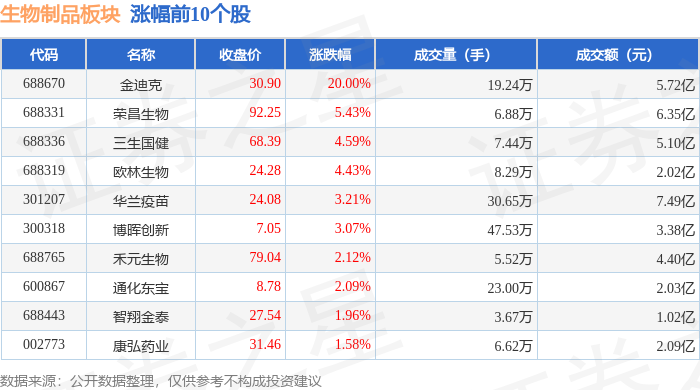
Market Overview - The biopharmaceutical sector increased by 0.36% compared to the previous trading day, with Jindike leading the gains [1] - The Shanghai Composite Index closed at 3864.18, down 0.15%, while the Shenzhen Component Index closed at 12907.83, up 1.02% [1] Stock Performance - Jindike (688670) saw a closing price of 30.90, with a significant increase of 20.00% and a trading volume of 192,400 shares, amounting to a transaction value of 572 million [1] - Rongchang Bio (688331) closed at 92.25, up 5.43%, with a trading volume of 68,800 shares and a transaction value of 635 million [1] - Sanofi (688336) closed at 68.39, up 4.59%, with a trading volume of 74,400 shares and a transaction value of 510 million [1] - Other notable performers include Olin Bio (616889) with a 4.43% increase and Hualan Bio (301207) with a 3.21% increase [1] Fund Flow Analysis - The biopharmaceutical sector experienced a net inflow of 20.94 million from institutional investors, while retail investors saw a net outflow of 57.02 million [2] - Jindike had a net inflow of 57.00 million from institutional investors, despite a net outflow of 19.76 million from retail investors [3] - Rongchang Bio also saw a net inflow of 32.94 million from institutional investors, with retail investors withdrawing 25.48 million [3]




国产创新药迎业绩兑现、出海双轮驱动,投资价值凸显,科创医药ETF嘉实(588700)聚焦生物医药产业机会
Xin Lang Cai Jing· 2025-11-26 05:46
Group 1 - The core viewpoint of the articles highlights the positive growth and potential of the innovative pharmaceutical sector in China, driven by policy support and increasing market presence of domestic innovative drugs [1][2]. - As of the end of Q3 2025, the innovative drug sector reported a revenue of 48.56 billion yuan, reflecting a year-on-year growth of 21.41% [1]. - The establishment of a commercial insurance directory for innovative drugs is expected to create a new payment channel, potentially adding around 20 billion yuan in annual funding for high-value innovative drugs [1]. Group 2 - The top ten weighted stocks in the Shanghai Stock Exchange Sci-Tech Innovation Board Biopharmaceutical Index account for 49.74% of the index, indicating a concentrated investment landscape [2]. - The innovative drug industry is experiencing breakthroughs in international markets, benefiting from policy dividends and the steady improvement of R&D capabilities among Chinese pharmaceutical companies [1]. - The Jiashi Sci-Tech Medicine ETF closely tracks the Shanghai Stock Exchange Sci-Tech Innovation Board Biopharmaceutical Index, providing an accessible investment option for those without stock accounts [3].
蔓迪国际冲刺港股IPO,三生系或添第三家上市公司
Sou Hu Cai Jing· 2025-11-26 03:01
Core Insights - The hair health management market in China is rapidly growing, driven by an increasing number of hair loss patients, which has reached approximately 340 million [4][5]. Market Overview - The number of hair loss patients in China is projected to grow from 271 million in 2018 to 339 million by 2024, with a compound annual growth rate (CAGR) of 3.8%, and is expected to reach 468 million by 2035 [5]. - The hair health management market size is anticipated to expand from 19.8 billion yuan in 2018 to 52.7 billion yuan by 2024, reflecting a CAGR of 17.7%, and is projected to further increase to 171.4 billion yuan by 2035 [5]. Treatment Options - There are primarily two treatment options for hair loss: medication and hair transplantation. The hair transplantation market has seen the emergence of the first listed company, Yonghe Medical, which has faced continuous losses since its IPO [5][6]. - Compared to the expensive and painful hair transplantation process, more individuals prefer medication for treatment [6]. Drug Market Growth - The market for anti-hair loss medications in China is expected to grow from 500 million yuan in 2018 to 3.5 billion yuan by 2024, with projections to soar to 19.7 billion yuan by 2035 [7]. Company Spotlight: Mandi International - Mandi International, a leading player in the hair health medication sector, is currently pursuing an IPO on the Hong Kong Stock Exchange [8]. - The company was the first to obtain approval for a 5% minoxidil solution in China in 2001, establishing a significant market presence [9]. - Mandi has developed various formulations of minoxidil and other hair care products, maintaining a leading market share of 57% in the hair loss medication market and 71% in the minoxidil segment by 2024 [10]. Financial Performance - Mandi International has demonstrated high profitability, with gross margins exceeding 80% and net margins over 20%. Revenue is projected to grow from 982 million yuan in 2022 to 1.455 billion yuan by 2024, representing a CAGR of 21.7% [11]. - The company completed a Series A financing round in November 2022, raising $50 million and achieving a valuation of approximately $752 million [11]. Parent Company: Sanofi Group - Mandi International was acquired by Sanofi Group in 2015 for 528 million yuan, highlighting the potential of the hair loss medication market [12]. - Sanofi Group has a history of successful drug development and capital operations, having previously listed on NASDAQ and later on the Hong Kong Stock Exchange [14][15]. Future Prospects - The IPO of Mandi International represents a strategic move by Sanofi Group to independently list its various business lines, potentially leading to the establishment of a third publicly traded company within the group [17].

“防脱第一股”核心产品收入缩水过亿,蔓迪到顶了?
阿尔法工场研究院· 2025-11-26 02:55
Core Insights - The article highlights that Mandi International is the leading player in the domestic hair loss treatment market, maintaining a dominant market share in minoxidil products for ten consecutive years, with a significant growth expected in the foam formulation by mid-2025 [1][2][5] - The company's revenue structure is heavily reliant on a single product, with over 90% of its income derived from the minoxidil series, raising concerns about long-term sustainability [5][11] - Recent financial maneuvers, including substantial dividends paid before the IPO, have led to a significant reduction in cash reserves, which may impact investor confidence and operational stability [9][23] Industry Leadership - Mandi International has established itself as a key brand in the hair loss treatment sector, with minoxidil products accounting for a substantial market share [5][6] - The company faces increasing competition as the minoxidil market is open to multiple players, which could threaten its pricing power and market position [6][11] Financial Performance - Revenue decreased from 9.82 billion to 7.43 billion from 2022 to the first half of 2025, with net profit also declining during the same period [5][11] - The sales of the core product, minoxidil solution, dropped significantly, while the foam variant saw a remarkable increase in sales, indicating a shift in consumer preference [11][12] Distribution and Supply Chain - Mandi's revenue is primarily generated through distributors, which accounted for over 90% of sales, but the number of distributors has decreased by approximately 39% [2][12] - The company relies heavily on a limited number of suppliers, with a single supplier providing the raw material for minoxidil, raising concerns about supply chain stability [13][14] Research and Development - The company's R&D expenditures have fluctuated significantly, raising questions about its ability to innovate and compete effectively in the market [15][16] - Mandi is attempting to diversify its product offerings by introducing new products, but faces stiff competition from established players in the market [15][16] Management and Governance - The ownership structure is highly concentrated, with significant control held by the founder and major shareholder, which may pose risks if the IPO does not succeed [20][23] - The recent stock incentive plan is closely tied to the success of the IPO, creating potential instability in management if the listing is delayed or fails [21][22] Conclusion - Mandi International's strong market position is counterbalanced by its reliance on a single product, high dividend payouts, and concentrated supply and distribution channels, which could pose risks to its future growth and stability [24][25]

趋势研判!2025年中国ITP药物治疗路径、产业链、市场规模、竞争格局及发展趋势分析:市场规模约28亿元,海曲泊帕探索空间广阔[图]
Chan Ye Xin Xi Wang· 2025-11-26 02:49
Core Insights - The ITP drug treatment market in China is projected to grow, reaching 2.4 billion yuan in 2024, an increase of 200 million yuan from 2023, and is expected to reach approximately 2.8 billion yuan in 2025 [1][3][4] - Eltrombopag, a novel oral small molecule TPO receptor agonist, has shown excellent efficacy in treating ITP, significantly expanding treatment options for patients [1][4][7] - The sales of Eltrombopag in hospitals reached 376 million yuan in 2023, with an estimated 430 million yuan for the entire year of 2024 [1][4] ITP Drug Treatment Industry Pathway - ITP, or Immune Thrombocytopenic Purpura, is primarily treated with corticosteroids as the first-line therapy, while second-line treatments include platelet-stimulating drugs [2][4] - The incidence of ITP in adults in China is estimated at 5 to 10 per 100,000, with a projected 130,400 patients in 2024 [2][3] ITP Drug Treatment Industry Development Status - The ITP drug treatment market has been expanding, with a notable increase in treatment options due to ongoing research into the disease's pathophysiology [4][6] - The market is characterized by a growing number of patients and an increasing demand for effective treatments [2][3] ITP Drug Treatment Industry Chain - The upstream of the ITP drug treatment industry includes active pharmaceutical ingredients (APIs), chemical raw materials, and related equipment, while the midstream focuses on drug manufacturing [4][6] ITP Drug Treatment Competitive Landscape - Major companies in the domestic ITP drug market include Jiangsu Aosaikang Pharmaceutical, Jiangsu Hengrui Medicine, and Shenyang Sanofi Pharmaceutical, among others [2][6] - Several companies have received approval for Eltrombopag, indicating a competitive environment for generic versions of the drug [6][7] ITP Drug Treatment Development Trends - The treatment of ITP is moving towards targeted and precision medicine, with new therapies showing potential in regulating key immune nodes [7] - Future research may explore the combination of Eltrombopag with existing therapies to enhance treatment outcomes and achieve long-term remission for patients [7]



方正证券:创新药出海已成趋势 新技术开发引领未来
Zhi Tong Cai Jing· 2025-11-26 02:29
Group 1: Core Insights - The current wave of innovative drugs is driven by China's participation in new technologies, with advancements in ADC, bispecific antibodies, second-generation IO, and GLP-1 [1] - The global pharmaceutical transaction volume has steadily increased, with total transaction amounts rising from $56.9 billion to $187.4 billion over the past decade, while China's transaction amounts surged from $3.1 billion to $57.1 billion [1] - By 2024, China's transaction volume is expected to account for approximately 30% of global pharmaceutical transactions [1] Group 2: Sector Analysis - In oncology, the combination of IO and ADC therapies remains strong, with significant transactions in the PD-1 bispecific antibody space; the sales of Pembrolizumab are projected to reach $29.482 billion in 2024 [2] - The autoimmune disease sector is witnessing a shift as older drugs face patent expirations, with new opportunities emerging in Th2 and Th17 pathways; Dupilumab is expected to lead with $14.1 billion in sales in 2024 [2] - The cardiovascular and metabolic disease market continues to grow, with GLP-1 receptor agonists projected to exceed $50 billion in global sales in 2024 [3] Group 3: Future Technologies - New technologies such as next-generation ADCs, TCE therapies, universal/in vivo CART technologies, gene therapy, and small nucleic acid technologies are anticipated to lead future disease treatments [4]

解密脱发药公司蔓迪IPO生意经:销售费用是研发的6倍
Hua Er Jie Jian Wen· 2025-11-25 17:45
Core Viewpoint - The investment made by the company in 2015 to acquire Mandi International has yielded nearly tenfold returns, with Mandi's valuation reaching HKD 58 billion in November 2025, compared to the original acquisition price of HKD 5.28 billion [1][24]. Group 1: Investment and Valuation - The acquisition of Mandi International in 2015 for HKD 5.28 billion has resulted in a valuation increase to HKD 58 billion by November 2025, representing a nearly tenfold increase [1][24]. - Mandi's revenue from its core product, Minoxidil solution, has surpassed HKD 1 billion, with projected revenues of HKD 14.55 billion and net profits of HKD 3.9 billion for 2024 [2]. Group 2: Market Position and Product Strategy - Mandi holds a 53.3% market share in the Minoxidil solution segment, which is a leading treatment for androgenetic alopecia [4]. - The company has emphasized marketing, with sales expenses projected to be six times that of R&D expenses in 2024 [2][8]. - Mandi's 5% Minoxidil solution is expected to generate approximately HKD 9.91 billion in revenue for 2024, accounting for nearly 70% of total revenue [5]. Group 3: Challenges and Future Prospects - Despite strong revenue, Mandi faces challenges as the growth of its main product, Minoxidil solution, has begun to decline, with projected revenue drops of 10% in 2024 and over 25% in the first half of 2025 [14]. - The company is actively seeking to diversify its product offerings, including new products for skin and weight management, with plans to submit applications for new drugs by 2027 [16][17]. - The introduction of a 5% Minoxidil foam product has shown promising growth, generating HKD 2.83 billion in the first half of 2025, indicating potential for continued revenue growth [19].
三生制药拟分拆脱发治疗领域附属公司蔓迪国际赴港上市
Xin Jing Bao· 2025-11-25 12:05
Core Viewpoint - Recently, 3SBio announced the proposal to spin off its subsidiary Mandi International for independent listing on the Hong Kong Stock Exchange, with 3SBio holding 87.16% of Mandi's shares, and after the spin-off, 3SBio will not retain any interests in Mandi [1][5] Group 1: Company Overview - Mandi International was established in 1997 as Zhejiang Wansheng Pharmaceutical Co., Ltd., and launched China's first 5% minoxidil product in 2001, filling a gap in the domestic hair loss treatment market [1][2] - Mandi International's revenue is primarily dependent on the Mandi product series, which includes 5% minoxidil solutions and shampoos, contributing over 90% of its revenue [3][4] Group 2: Market Potential - The hair health management market in China has expanded from 19.8 billion yuan in 2018 to an estimated 52.7 billion yuan in 2024, with a projected compound annual growth rate (CAGR) of 11.3% from 2024 to 2035 [2] - Over 339 million people in China are affected by hair loss, with more than 60% of them under the age of 35 [2] Group 3: Financial Performance - Mandi International's revenue from 2022 to 2024 is projected to grow from 982 million yuan to 1.455 billion yuan, with a CAGR of 21.7%, and net profits are expected to rise from 202 million yuan to 390 million yuan [3] - In the first half of 2025, Mandi International achieved revenue of 743 million yuan, a year-on-year increase of approximately 20.2% [3] Group 4: Product Development - Mandi International launched the second-generation minoxidil product, Mandi 5% minoxidil foam, which saw rapid sales growth, generating 307 million yuan in 2024 and 283 million yuan in the first half of 2025 [4] - The company has a pipeline of products under development, including treatments for acne, obesity, and vitiligo, although these contribute less to current revenue [4] Group 5: Strategic Rationale for Spin-off - The spin-off is expected to provide multiple commercial benefits, including enhanced value transparency, independent financing platforms, and optimized management responsibilities, which will improve decision-making and market responsiveness [5]