
特比澳

Search documents
每月金股二月研选:两会前奏开启,春季行情将步入验证期
BOCOM International· 2026-02-02 15:00
Market Overview - The market is transitioning from strong expectations to a "data verification" phase as the Spring Festival approaches, with a focus on marginal improvements in fundamental data[3] - Southbound capital continues to flow into the market, supporting Hong Kong stocks, which are expected to experience a "stock-heavy, index-light" structural market[3] Key Variables for February - Attention will be on post-Spring Festival consumption data, including tourism, dining, and real estate sales, which may reflect the effectiveness of the "resident income increase plan" and domestic demand expansion[4] - The upcoming "Two Sessions" will provide insights into fiscal policies, particularly regarding long-term special bonds and "new productivity," which could influence market sentiment towards infrastructure and technology sectors[4] - The market's confidence in the Fed's interest rate cuts may be affected by resilient U.S. inflation data, necessitating close monitoring of the dollar index's impact on Hong Kong stock liquidity[4] Sector Focus - Consumer and internet sectors are expected to benefit from positive Spring Festival data, with a focus on policy-driven areas like hospitality and food and beverage[5] - Hard technology and overseas manufacturing sectors are promising, particularly in semiconductors and consumer electronics, as well as leading companies in engineering machinery and home appliances[5] - Upstream resource products, such as copper and aluminum, are anticipated to perform well due to a recovering global manufacturing PMI and post-holiday inventory replenishment expectations[5] Stock Recommendations - **Cheung Kong Property Trust (778HK)**: Target price of HKD 5.92, potential upside of 15.9%, with a strong dividend yield over 7%[9] - **NVIDIA (NVDAUS)**: Target price of USD 245.00, potential upside of 27.3%, driven by sustainable AI demand[13] - **Hesai Technology (2525HK)**: Target price of HKD 269.66, potential upside of 35.0%, benefiting from L3 autonomous driving advancements[20] - **Sangfor Technologies (1530HK)**: Target price of HKD 39.50, potential upside of 65.1%, with strong growth prospects from core products[27] - **Midea Group (000333CH)**: Target price of HKD 96.20, potential upside of 23.5%, supported by robust market leadership and dividend policies[32] - **GCL-Poly Energy (3800HK)**: Target price of HKD 1.54, potential upside of 37.5%, benefiting from developments in perovskite technology and commercial aerospace[38]


三生制药(1530.HK):辉瑞全速推进707全球临床 ADC联用蓄势待发
Ge Long Hui· 2026-01-28 20:49
Core Viewpoint - Pfizer has unveiled a significant R&D plan for 707/PF'4404 (PD-1/VEGF) in collaboration with 3SBio, with an accelerated pace and breadth beyond expectations, aiming to initiate four global Phase III clinical trials by 2026 across five major first-line indications [1][2] Group 1: Clinical Development - Pfizer plans to launch four Phase III clinical trials in 2026 targeting first-line squamous/non-squamous NSCLC, mCRC, endometrial cancer, and urothelial carcinoma [2] - The company has already completed the first patient enrollment for Phase III trials targeting first-line NSCLC and mCRC, as well as Phase II/III trials for first-line ES-SCLC [2] - Pfizer will also initiate Phase III clinical studies combining 707 with various ADCs, such as Padcev for first-line treatment of urothelial carcinoma [2] Group 2: Competitive Landscape - Four multinational corporations (MNCs) are competing in the PD-(L)1/VEGF space, including Pfizer, BMS, Merck, and AbbVie, with Pfizer expected to stand out due to its "speed, breadth, and depth" advantages [2] - BMS and BioNTech have announced extensive clinical plans, but their progress in core indications like first-line NSCLC and mCRC lags behind Pfizer [2] Group 3: Pipeline and Financials - 3SBio is increasing R&D investments with multiple pipelines expected to yield clinical data, including 705 (PD-1/HER2) and 706 (PD-1/PD-L1) in Phase II trials in China [3] - The core business fundamentals of 3SBio remain robust, with projected revenue of approximately 4.2 billion yuan in 2025, including 2.89 billion yuan from the upfront payment for 707 licensing [3] - Excluding the upfront payment, the internal business revenue of 3SBio is estimated to grow by about 9% year-on-year [3] Group 4: Investment Rating - The company maintains a "Buy" rating with a target price of 37.43 HKD, supported by an estimated net cash position of approximately 13 billion yuan [4] - Confidence in 707 becoming a global blockbuster is reaffirmed due to Pfizer's unexpected clinical advancement [4]

招银国际每日投资策略-20260128
Zhao Yin Guo Ji· 2026-01-28 05:56
Group 1: Market Overview - The Hang Seng Index closed at 27,127, up 1.35% for the day and 5.84% year-to-date [1] - The Hang Seng Financial Index rose by 2.51% for the day and 5.88% year-to-date, indicating strong performance in the financial sector [2] - Southbound capital recorded a net sell of 635 million HKD, with notable sell-offs in China Mobile, Zijin Mining, and SMIC, while Tencent and Longi Green Energy saw significant net buying [3] Group 2: Company Analysis - Sanofi - Sanofi's collaboration with Pfizer on the 707/PF'4404 (PD-1/VEGF) has advanced rapidly, with plans to initiate four global Phase III clinical trials by 2026 covering five major indications [4] - The dual antibody PD-(L)1/VEGF is expected to become a cornerstone in next-generation tumor immunotherapy, with Sanofi leveraging its internal pipeline for competitive advantage [5] - Sanofi's robust pipeline includes multiple candidates, with the potential for early assets to be licensed out as clinical data matures [6] Group 3: Financial Projections - The target price for Sanofi is set at 37.43 HKD, based on a DCF model with a WACC of 10.11% and a perpetual growth rate of 2.0% [7] - The company is estimated to have net cash of approximately 13 billion HKD, supporting its growth and development initiatives [7]
三生制药(01530):辉瑞全速推进707全球临床,ADC联用蓄势待发
Zhao Yin Guo Ji· 2026-01-28 02:12
Investment Rating - The report maintains a "Buy" rating for the company with a target price of HKD 37.43, representing a potential upside of 55.5% from the current price of HKD 24.08 [2][8]. Core Insights - Pfizer is rapidly advancing the global clinical development of 707/PF'4404 (PD-1/VEGF), with plans to initiate four global Phase III trials in 2026 targeting five major indications. The combination of PD-(L)1/VEGF dual antibodies is expected to become a cornerstone of next-generation cancer immunotherapy, positioning Pfizer to leverage its internal pipeline synergy and strong clinical execution capabilities [1][8]. - The company is increasing its R&D investments, with several pipelines expected to yield clinical data soon. The core business fundamentals remain robust, providing a safety margin, and the company is projected to achieve significant revenue growth driven by its innovative pipeline [8][12]. Financial Summary - For FY23A, the company reported sales revenue of RMB 7,816 million, with a year-on-year growth of 13.8%. The projected sales revenue for FY25E is RMB 17,972 million, reflecting a substantial increase of 97.3% [2][15]. - The net profit attributable to shareholders for FY23A was RMB 1,549 million, with a year-on-year decline of 19.1%. However, the forecast for FY25E shows a significant increase to RMB 9,741 million, indicating a growth of 366.0% [2][15]. - The earnings per share (EPS) for FY23A was RMB 0.64, expected to rise to RMB 3.84 in FY25E [2][15]. Market Position and Shareholder Structure - The company's market capitalization is approximately HKD 61,115.2 million, with a 52-week stock price range of HKD 35.90 to HKD 6.01 [3][4]. - Major shareholders include TMF (Cayman) Ltd. with 22.8% and Decade Sunshine with 19.6% [4]. Clinical Development and Pipeline - The report highlights the competitive landscape for PD-(L)1/VEGF therapies, with Pfizer's strategy of combining IO with ADCs as a unique advantage. The company plans to conduct multiple Phase III trials for various indications, including NSCLC and mCRC, with a focus on rapid patient recruitment [1][8]. - The ongoing clinical trials for other innovative products, such as 705 (PD-1/HER2) and 706 (PD-1/PD-L1), are also expected to contribute to the company's growth and potential licensing opportunities [8][12].
2.03亿“90后”撑起脱发产品市场,这家龙头借力上市!
IPO日报· 2025-11-28 00:33
Core Viewpoint - The article highlights the growing market for men's grooming products, particularly focusing on the success of Minoxidil-based products from Mandi International, which is preparing for an IPO. The company has seen significant growth driven by the increasing demand from younger consumers, particularly those born in the 1990s [1][2][12]. Company Overview - Mandi International, established in 1997, is a leading consumer pharmaceutical company in China, focusing on skin health and weight management solutions, with a primary emphasis on hair health [6][13]. - The company was spun off from 3SBio, which was founded in 1993 and became the first Chinese biopharmaceutical company listed on NASDAQ in 2007 [7][8]. Financial Performance - Mandi International's revenue for the years 2022 to 2025 is projected to grow from 9.82 billion to 14.55 billion, with a compound annual growth rate (CAGR) of 21.7%. Net profit is expected to increase from 2.02 billion to 3.90 billion during the same period [14]. - Over 90% of the company's revenue comes from the Mandi series products, with the Minoxidil foam's revenue share rising from 10.6% in the first half of 2024 to 38.7% in the same period of 2025 [14]. Market Position - Mandi's flagship product, the Mandi 5% Minoxidil foam, is the only domestically approved Minoxidil foam in China and has maintained the top position in the hair loss treatment market for ten consecutive years, holding approximately 57% market share in the hair loss drug market and 71% in the Minoxidil category by 2024 [13]. - The hair health management market in China is expected to grow from 198 billion in 2018 to 527 billion by 2024, with a projected CAGR of 11.3% from 2024 to 2035 [13]. IPO and Valuation - Mandi International submitted its main board IPO application on November 20, with a post-investment valuation of 58 billion HKD following a recent financing round [3][9]. - The company is backed by significant shareholders, including 3SBio, which holds approximately 87.16% of the shares, and other investors like GLWecan and Alibaba Health [8][9]. Future Prospects - Mandi International is expanding its product pipeline beyond hair health, with ongoing clinical trials for innovative products in skin health and weight management, including a unique acne treatment and a long-acting GLP-1 receptor agonist for weight management [15].


蔓迪国际冲刺港股IPO,三生系或添第三家上市公司
Sou Hu Cai Jing· 2025-11-26 03:01
Core Insights - The hair health management market in China is rapidly growing, driven by an increasing number of hair loss patients, which has reached approximately 340 million [4][5]. Market Overview - The number of hair loss patients in China is projected to grow from 271 million in 2018 to 339 million by 2024, with a compound annual growth rate (CAGR) of 3.8%, and is expected to reach 468 million by 2035 [5]. - The hair health management market size is anticipated to expand from 19.8 billion yuan in 2018 to 52.7 billion yuan by 2024, reflecting a CAGR of 17.7%, and is projected to further increase to 171.4 billion yuan by 2035 [5]. Treatment Options - There are primarily two treatment options for hair loss: medication and hair transplantation. The hair transplantation market has seen the emergence of the first listed company, Yonghe Medical, which has faced continuous losses since its IPO [5][6]. - Compared to the expensive and painful hair transplantation process, more individuals prefer medication for treatment [6]. Drug Market Growth - The market for anti-hair loss medications in China is expected to grow from 500 million yuan in 2018 to 3.5 billion yuan by 2024, with projections to soar to 19.7 billion yuan by 2035 [7]. Company Spotlight: Mandi International - Mandi International, a leading player in the hair health medication sector, is currently pursuing an IPO on the Hong Kong Stock Exchange [8]. - The company was the first to obtain approval for a 5% minoxidil solution in China in 2001, establishing a significant market presence [9]. - Mandi has developed various formulations of minoxidil and other hair care products, maintaining a leading market share of 57% in the hair loss medication market and 71% in the minoxidil segment by 2024 [10]. Financial Performance - Mandi International has demonstrated high profitability, with gross margins exceeding 80% and net margins over 20%. Revenue is projected to grow from 982 million yuan in 2022 to 1.455 billion yuan by 2024, representing a CAGR of 21.7% [11]. - The company completed a Series A financing round in November 2022, raising $50 million and achieving a valuation of approximately $752 million [11]. Parent Company: Sanofi Group - Mandi International was acquired by Sanofi Group in 2015 for 528 million yuan, highlighting the potential of the hair loss medication market [12]. - Sanofi Group has a history of successful drug development and capital operations, having previously listed on NASDAQ and later on the Hong Kong Stock Exchange [14][15]. Future Prospects - The IPO of Mandi International represents a strategic move by Sanofi Group to independently list its various business lines, potentially leading to the establishment of a third publicly traded company within the group [17].

三生制药拟分拆脱发治疗领域附属公司蔓迪国际赴港上市
Xin Jing Bao· 2025-11-25 12:05
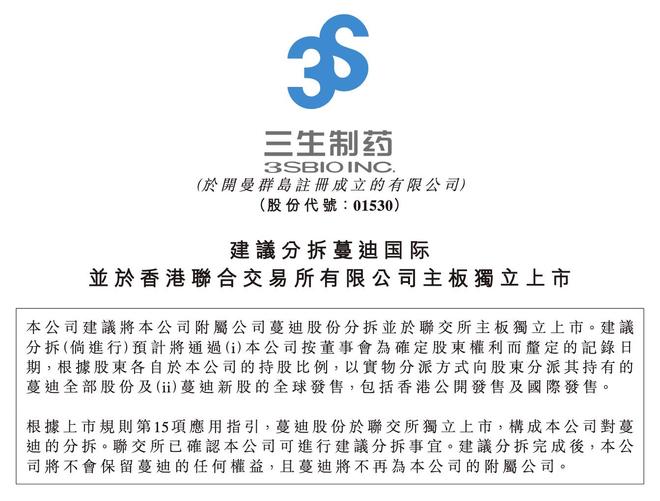
Core Viewpoint - Recently, 3SBio announced the proposal to spin off its subsidiary Mandi International for independent listing on the Hong Kong Stock Exchange, with 3SBio holding 87.16% of Mandi's shares, and after the spin-off, 3SBio will not retain any interests in Mandi [1][5] Group 1: Company Overview - Mandi International was established in 1997 as Zhejiang Wansheng Pharmaceutical Co., Ltd., and launched China's first 5% minoxidil product in 2001, filling a gap in the domestic hair loss treatment market [1][2] - Mandi International's revenue is primarily dependent on the Mandi product series, which includes 5% minoxidil solutions and shampoos, contributing over 90% of its revenue [3][4] Group 2: Market Potential - The hair health management market in China has expanded from 19.8 billion yuan in 2018 to an estimated 52.7 billion yuan in 2024, with a projected compound annual growth rate (CAGR) of 11.3% from 2024 to 2035 [2] - Over 339 million people in China are affected by hair loss, with more than 60% of them under the age of 35 [2] Group 3: Financial Performance - Mandi International's revenue from 2022 to 2024 is projected to grow from 982 million yuan to 1.455 billion yuan, with a CAGR of 21.7%, and net profits are expected to rise from 202 million yuan to 390 million yuan [3] - In the first half of 2025, Mandi International achieved revenue of 743 million yuan, a year-on-year increase of approximately 20.2% [3] Group 4: Product Development - Mandi International launched the second-generation minoxidil product, Mandi 5% minoxidil foam, which saw rapid sales growth, generating 307 million yuan in 2024 and 283 million yuan in the first half of 2025 [4] - The company has a pipeline of products under development, including treatments for acne, obesity, and vitiligo, although these contribute less to current revenue [4] Group 5: Strategic Rationale for Spin-off - The spin-off is expected to provide multiple commercial benefits, including enhanced value transparency, independent financing platforms, and optimized management responsibilities, which will improve decision-making and market responsiveness [5]
“防脱药水”生意单飞,蔓迪国际自立门户闯港股
Guan Cha Zhe Wang· 2025-11-25 08:57
Core Viewpoint - The announcement of the spin-off of the consumer pharmaceutical business, Mandi International, from Sangfor Pharmaceutical marks a significant move towards independent listing on the Hong Kong Stock Exchange, highlighting the company's strategy to unlock value and navigate market challenges [1][3][9]. Company Overview - Mandi International, a subsidiary of Sangfor Pharmaceutical, has dominated the Chinese hair loss treatment market for over a decade with its Minoxidil products, holding approximately 57% market share in 2024 [4][6]. - The company was founded by Lou Dan in 1993, with Lou Jing taking over management in 1995, and has since expanded through acquisitions, including the full acquisition of Zhejiang Wansheng Pharmaceutical in 2015 [3]. Financial Performance - Mandi International's revenue is heavily reliant on its Minoxidil product line, contributing over 90% of total revenue from 2022 to 2024, with projected revenues of 982 million yuan in 2022, 1.228 billion yuan in 2023, and 1.455 billion yuan in 2024, reflecting a compound annual growth rate of approximately 21.7% [6][7]. - The company experienced a revenue growth of 25.05% in 2023, but this is expected to slow to 18.49% in 2024, with net profit growth also declining from 68.81% in 2023 to 14.37% in 2024 [6][8]. Market Challenges - The company faces significant challenges due to policy changes, with a reported 52% price drop for its core Minoxidil liquid products following collective procurement initiatives, impacting its high-margin business model [8]. - Increased competition from brands like Zhendong Pharmaceutical and new entrants in the hair loss treatment market adds pressure on Mandi International to diversify its product offerings and maintain growth [8][11]. Spin-off Implications - The spin-off is seen as a strategic asset restructuring for Sangfor Pharmaceutical, allowing it to focus on its core biopharmaceutical business while Mandi International seeks to establish its own market identity [9][10]. - Post-spin-off, Mandi International will not retain any equity in Sangfor, indicating a complete separation that may pose risks as it loses the backing of its parent company [10]. Future Growth Prospects - Mandi International is exploring new growth avenues beyond hair loss treatments, including dermatology and weight management, with potential new products expected to enter the market by 2026 [11]. - The company’s ability to navigate the challenges of high customer and supplier concentration, alongside rising sales expenses, will be critical for its success as an independent entity [10][11].
“头秃” 焦虑撑起一个IPO,沈阳“药二代”的第三家上市公司来了
Xin Lang Cai Jing· 2025-11-25 03:02
Core Insights - The article highlights the significant growth potential in the hair loss treatment market, particularly through the upcoming IPO of Mandi International, a subsidiary of Sangfor Pharmaceutical, which is set to capitalize on the booming demand for hair restoration products [1][20]. Market Overview - The hair loss market in China is experiencing explosive growth, with the number of affected individuals exceeding 339 million by 2024, translating to one in four people suffering from hair loss, predominantly among the younger demographic [4]. - The hair health management market is projected to grow from 52.7 billion RMB in 2024 to 171.4 billion RMB by 2035, with a compound annual growth rate (CAGR) of 11.3% [4]. Company Performance - Mandi International holds a 57% market share in the hair loss medication sector, with revenue expected to grow from 982 million RMB in 2022 to 1.455 billion RMB in 2024, reflecting a CAGR of 21.7% [1][12]. - The company's flagship product, Minoxidil, has seen a decline in sales, while the newly launched Minoxidil foam is driving growth, achieving sales of 283 million RMB in the first half of 2025, a 338% increase year-on-year [6][8]. Financial Metrics - Mandi's gross profit margin remains high, consistently above 80%, with net profits rising from 202 million RMB in 2022 to 390 million RMB in 2024 [9][12]. - The company has distributed 1.42 billion RMB in dividends to shareholders from 2022 to mid-2025, indicating strong cash flow management despite a decrease in asset value [20]. Competitive Landscape - Mandi International is facing increasing competition in the hair loss treatment market, with a need to diversify its product offerings beyond hair restoration to maintain growth [8][9]. - The company is also exploring new markets in skin health and weight management, although these segments are still in early development stages [9]. Family Business Background - The Lou family, founders of Sangfor Pharmaceutical, have established a significant presence in the capital markets with three listed companies, including Mandi International, which represents a strategic shift towards consumer healthcare [20][21]. - The family's wealth has been recognized, ranking them among the top in the biopharmaceutical sector, with a net worth of 15 billion RMB as of October 2025 [22][23].


招商证券:首予三生制药“强烈推荐”评级 PD-1/VEGF双抗引领价值重估
Zhi Tong Cai Jing· 2025-11-20 09:12
Company Background - Founded in 1993, the company is a leading biopharmaceutical firm in China with extensive experience in R&D, production, and sales of biological drugs. It has developed a rich product portfolio and pipeline in various therapeutic areas including nephrology, hematology, oncology, autoimmune diseases, and dermatology [1] - The company has strong domestic commercialization capabilities, with core products such as TPIAO, EPO, Yisaipu, and Mandi holding high market shares, driving continuous revenue growth [1] Oncology Focus - The SSGJ-707 molecule is expected to become a cornerstone therapy in global cancer immunotherapy, with multiple first-in-class (FIC) molecules entering clinical stages. A significant licensing agreement with Pfizer was established in May-July 2025, where Pfizer will pay $1.4 billion upfront and up to $4.8 billion in milestone payments, setting a record for domestic PD-(L)1/VEGF dual antibodies [1][2] - The PD-(L)1 inhibitors face challenges in cold tumors and efficacy improvements, but the dual antibody approach has shown potential in head-to-head trials against existing therapies, indicating a market potential exceeding $100 billion [1] Clinical Development Plans - Pfizer's strategy for SSGJ-707 includes launching seven global clinical trials, positioning it as a foundational therapy across various cancers. Upcoming trials include 1L NSCLC Phase III, 1L mCRC Phase III, and others, with plans to explore over 10 additional indications by 2026 [2] - The potential market for SSGJ-707 could cover over 350,000 patients in the U.S., indicating a substantial market opportunity [2] Commercialization Strength - The company has a strong commercial capability with its flagship product TPIAO projected to generate revenue of 5.06 billion yuan in 2024. TPIAO is the only commercialized rhTPO globally and is highly recommended in treatment guidelines [3] - Despite competitive pressures, the company maintains a leading position in the rhEPO market, with expected sales of 1.019 billion yuan from its dual-brand strategy in 2024, capturing a 42% market share [3] Financial Projections - Revenue forecasts for the company are estimated at 18.52 billion yuan in 2025, 11.55 billion yuan in 2026, and 11.78 billion yuan in 2027, with net profits projected at 9.77 billion yuan, 3.72 billion yuan, and 3.28 billion yuan respectively. The company is rated with a strong recommendation based on these projections [4]
