娃哈哈

Search documents
叛“途”的真相
Sou Hu Cai Jing· 2025-10-14 19:17
Core Viewpoint - The separation of Zong Fuli from Wahaha represents a strategic choice rather than an emotional departure, focusing on the reorganization of resources and pathways for future business success [3][4]. Group 1: Brand and Channel Dynamics - The trademark serves as an identity, while the channel is essential for product survival, emphasizing the importance of maintaining distribution networks during transitions [4][5]. - Zong Fuli's decision to resign as chairman and re-enter the market with a new trademark reflects a prioritization of channel stability over brand loyalty, indicating a rational approach to business restructuring [3][4]. - The existing distribution network of Wahaha, comprising thousands of distributors and retail points, is a valuable asset that can facilitate the introduction of new products quickly [4][5]. Group 2: Market Education and Consumer Behavior - New trademarks require time for market education, but a strong channel can significantly reduce the cost of initial consumer trials, making it easier for new products to gain traction [4][5]. - Consumer loyalty in fast-moving consumer goods often begins with convenience, highlighting the importance of physical presence in retail spaces for brand visibility and sales [5]. Group 3: Strategic Choices and Future Growth - Zong Fuli's approach is characterized by a focus on channel management, product testing, and pricing strategies, which may yield higher success rates than competing for brand recognition alone [5]. - The concept of "rebellion" in this context is about recognizing the need for change and prioritizing the right order of actions to avoid being hindered by outdated symbols and paths [5].


娃哈哈下达二选一最后通牒!经销商爆料:代理娃小宗就取消经销资格
Sou Hu Cai Jing· 2025-10-14 18:48
Core Viewpoint - The recent internal notification from Wahaha has created significant turmoil within the beverage distribution network in China, forcing distributors to choose between the established brand Wahaha and the new brand "Wah Xiaozong" [1][3]. Group 1: Brand Conflict - Distributors received an ultimatum to either continue with the traditional Wahaha brand or switch to the new brand "Wah Xiaozong," leading to a crisis in trust built over 30 years [1][3]. - The internal conflict was foreshadowed by the announcement that Zong Fuli would no longer serve as the legal representative and chairman of Wahaha, coinciding with the push for the new brand [3]. Group 2: Shareholding Structure - The current shareholding structure complicates the situation, with three main stakeholders: Shangcheng Wen Shanglv holding 46%, Zong Fuli 29.4%, and the employee shareholding committee 24.6%, requiring unanimous consent for the use of the Wahaha trademark [3]. - Zong Fuli's control over the new brand "Wah Xiaozong" is evident as her company has been actively registering trademarks since May 2025, creating a competitive tension between the two brands [3]. Group 3: Legal Challenges - "Wah Xiaozong" faces significant legal hurdles, particularly regarding trademark law, which may restrict its ability to operate in a market where confusion with the Wahaha brand is possible [5]. - The strict enforcement of trademark regulations in 2024-2025 could pose a serious challenge for the new brand, affecting distributor confidence and inventory decisions [5]. Group 4: Distributor Dynamics - Wahaha's strategy of "removing small distributors and consolidating larger ones" has led to the exit of distributors with annual sales below 3 million yuan, creating a challenging environment for smaller players [5]. - Increased operational demands and reduced profit margins are pressuring small distributors, making them vulnerable to market fluctuations [5]. Group 5: Consumer Perception - The emotional connection consumers have with the Wahaha brand may not easily transfer to "Wah Xiaozong," complicating market acceptance and brand loyalty [7]. - The emergence of competing brands within the same family could confuse consumers, shifting their focus from product quality to brand legitimacy [7]. Group 6: Strategic Recommendations - A more effective approach would involve collaboration rather than forced competition, with clear delineation of roles between Wahaha and "Wah Xiaozong" [8]. - Establishing clear contractual agreements to define non-competitive areas and ensuring stable profit margins for distributors could foster a healthier market environment [8]. Group 7: Distributor Insights - Distributors should focus on cash flow stability, risk-sharing mechanisms, and clear legal protections when navigating this uncertain landscape [10]. - In the absence of clear rules, a cautious approach of observation and contraction may be the most prudent strategy for distributors [10]. Conclusion - The upheaval within the beverage industry reflects the challenges faced by established brands in adapting to new market dynamics, emphasizing the need for a cooperative ecosystem rather than adversarial tactics [12].
【财经早晚报】娃哈哈拿回桶装水销售权;新反不正当竞争法明日生效;天津加装电梯可提公积金
Sou Hu Cai Jing· 2025-10-14 10:13
Macro News - The State Taxation Administration reported a 6.9% year-on-year increase in tax revenue for Q3, with September showing particularly high growth due to improved economic conditions and a lower base from the previous year [3][4] - The new Anti-Unfair Competition Law will take effect, targeting "involution" in pricing strategies, particularly in industries like beverage and charging services [2][3] Market Trends - A-share market showed divergence with the Shanghai Composite Index gaining 0.21% while the ChiNext Index fell by 2.24%, with significant trading volume of 1.67 trillion yuan [5][6] - Gold prices surged, with futures reaching $4183.9, leading to a rise in gold-related ETFs, including a 5.23% increase in the Huaxia Gold ETF [6] Company News - The chairman of Guangda Special Materials, Xu Weiming, has been placed under detention, with the company's operations continuing normally under the management team [6] - Longbai Group has filed a lawsuit for technology secret infringement, seeking 1.31 billion yuan in damages [6] - Wahaha has regained the sales rights for its bottled water, previously transferred to another company [6] - JD.com announced a collaboration with GAC Group and CATL to launch a new car, marking its entry into the automotive sector [6]
宗馥莉辞职幕后:宗家乱斗才刚刚开始
Hu Xiu· 2025-10-14 10:02
驱逐元老、背刺亲叔,试图掏空娃哈哈,最后逼不得已辞职出局。宗馥莉这次是真的玩砸了,但她的失 误根本不在宫斗,而是踩了两条绝对不能碰的红线。 ...
嘉美包装(002969.SZ):曾为娃哈哈八宝粥三片罐提供过少量印铁服务和底盖
Ge Long Hui· 2025-10-14 07:32
Core Viewpoint - The company has previously provided limited iron printing services and lids for Wahaha's Eight Treasure Porridge three-piece cans, and has also supplied a small quantity of three-piece cans for Wahaha's Qili Energy Drink [1] - The company has engaged in minor collaboration with the "kellyone" brand for sugar-free tea filling services and continues to explore partnership opportunities with various beverage brands [1] Summary by Categories - **Company Collaborations** - The company has supplied limited services to Wahaha for both Eight Treasure Porridge and Qili Energy Drink [1] - There has been minor collaboration with the "kellyone" brand for sugar-free tea [1] - **Future Opportunities** - The company is actively looking for collaboration opportunities with different beverage brands [1]

中方对美船舶收取特别港务费今起正式施行;加沙停火协议文件在埃及签署;巴基斯坦利用中国技术向美国赠送稀土?外交部驳斥丨早报
Di Yi Cai Jing· 2025-10-14 00:13
Group 1 - China has officially implemented a special port fee for American vessels, which includes specific exemptions for certain types of ships [2] - In the first three quarters of this year, China's total goods trade reached 33.61 trillion yuan, with exports growing by 7.1% and imports declining by 0.2% [6] - The retail sales of passenger cars in China reached 2.241 million units in September, marking a year-on-year increase of 6.3% [9] Group 2 - The minimum personal contribution for urban and rural residents' basic medical insurance will remain unchanged at 400 yuan for the year 2026 [10] - The recent adjustment in fuel prices will result in a decrease of approximately 3 yuan for filling a standard 50-liter fuel tank [11] - The Guangdong province has reported over 11,000 new cases of Chikungunya fever in the past four weeks, prompting increased preventive measures [12] Group 3 - The new regulations for electric bicycles in China set a maximum speed limit of 25 km/h, with automatic power cut-off for exceeding this limit [31] - The family trust of Xu Jiayin has come under scrutiny, with discussions around its vulnerability and implications for high-net-worth individuals [32]
8点1氪:“小米SU7碰撞后爆燃事故”驾驶人涉嫌酒驾;大疆回应降价风波:部分线下店已开启补偿;万科董事长辛杰辞职
36氪· 2025-10-14 00:09
Incident Summary - A fatal accident involving a Xiaomi SU7 occurred in Chengdu, where the vehicle caught fire after a collision, resulting in the driver's death. Initial investigations indicate that the driver was suspected of driving under the influence of alcohol [4][7]. Company Response - Xiaomi's customer service stated that no staff were on duty at the time of the incident, which occurred at 3 AM, and they did not receive any emergency calls related to the accident [5]. Industry Impact - The incident raises concerns regarding the safety features of electric vehicles, particularly in emergency situations where rapid response is critical. This could influence consumer perceptions and regulatory scrutiny of electric vehicle manufacturers [4][7].

8点1氪丨“小米SU7碰撞后爆燃事故”驾驶人涉嫌酒驾;大疆回应降价风波:部分线下店已开启补偿;万科董事长辛杰辞职
3 6 Ke· 2025-10-14 00:03
Group 1 - Microsoft will stop providing security updates and technical support for Windows 10 starting October 14, which may expose users to increased cybersecurity risks [4][5] - Windows 10 was first launched on July 29, 2015, and has a global market share of 44.48% as of July [4] - Users of older devices not meeting Windows 11 requirements are advised to register for an extended security update program for a fee [4] Group 2 - DJI has reduced prices on several products, leading to strong reactions from consumers who purchased items at higher prices [2] - The company stated that the price drop is part of a promotional event, but differences in return policies between online and offline sales have caused controversy [2] Group 3 - Polestar has closed its last direct sales store in China, located in Shanghai, as part of a strategic adjustment to better align with the rapidly changing market [6] - The company emphasized that other operations in China remain unaffected and that it will focus on online sales [6] Group 4 - Vanke announced the resignation of its chairman, Xin Jie, due to personal reasons, and Huang Liping has been elected as the new chairman [2] Group 5 - The Guangdong provincial government has passed a new regulation allowing spouses to check each other's property and vehicle ownership starting January 1, 2026 [5] Group 6 - The three major telecom operators in China have launched eSIM services, with China Unicom reporting over 68,000 online appointments for eSIM activation [6] Group 7 - The 2025 Nobel Prize in Economic Sciences was awarded to Joel Mokyr, Philippe Aghion, and Peter Howitt for their work on innovation-driven economic growth [3][4] - The award highlights the importance of managing creative destruction to avoid stagnation in economic growth [4] Group 8 - The price of rice in Japan has surged, nearing historical highs, impacting household consumption and restaurant operations [12] - The average retail price for a 5-kilogram bag of rice has reached 4,205 yen, remaining above 4,000 yen for five consecutive weeks [12] Group 9 - Didi has established a new company focused on low-altitude economy, emphasizing software development rather than manufacturing low-altitude flying vehicles [11] - The new company aims to build a software ecosystem and intelligent scheduling systems [11] Group 10 - OpenAI has partnered with Broadcom to deploy a 10GW custom AI accelerator, with plans to start deployment in late 2026 [13] - Nvidia announced that Meta and Oracle will use its Spectrum-X Ethernet switches to build AI data center networks [13]


三家分宗、宗馥莉出走,一“娃”生“三小”冰柜决胜负
3 6 Ke· 2025-10-13 23:57
Core Viewpoint - The internal family conflict within Wahaha has escalated, leading to the emergence of new brands that may threaten the company's market position, while the overall beverage industry remains highly competitive and challenging [2][3][5]. Group 1: Company Dynamics - After 142 days in charge, Zong Fuli resigned from her positions at Wahaha, with Xu Simin appointed as the new general manager, leaving the chairman position vacant [3]. - Concurrently, the family members have begun launching competing brands, such as "Wawa Xiaozong" and "Wawa Xiaozhi," indicating a significant internal conflict [4][20]. - The emergence of these new brands is seen as a direct challenge to Wahaha's market dominance, with family members leveraging the Wahaha name for their new products [4][22]. Group 2: Industry Challenges - The Chinese beverage market is described as a "graveyard-level" competitive environment, with an industry scale projected to exceed 1.3 trillion yuan in 2024, growing at 6.1% year-on-year [5]. - New beverage brands face a high failure rate, with 70% of new products not surviving beyond 12 months, and over 8,600 companies being deregistered annually [5]. - The importance of physical retail presence is emphasized, as 73% of beverage sales occur in offline settings, highlighting the critical role of iceboxes in driving sales [6][7]. Group 3: Brand Positioning and Market Strategy - The new brands lack the necessary distribution and marketing strategies to compete effectively with Wahaha, which has a significant advantage in terms of market penetration and brand recognition [19][21]. - Wahaha's strategy of securing exclusive shelf space in retail locations has been effective, with approximately 60,000 custom iceboxes deployed nationwide, ensuring high visibility for its products [19]. - The new brands, while attempting to capitalize on Wahaha's legacy, struggle with brand identity and consumer recognition, leading to a diluted market presence [15][22].
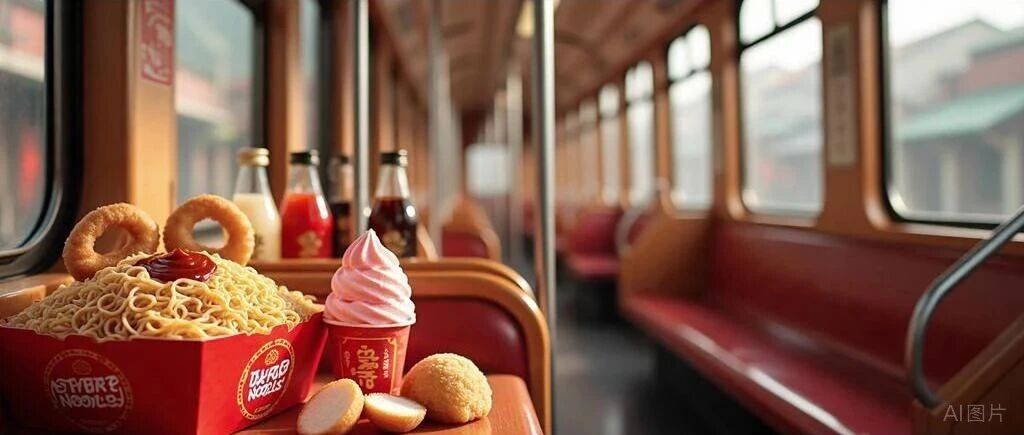
从泡面到文创雪糕,一节车厢,浓缩二十年食品饮料消费变迁
新消费智库· 2025-10-13 13:04
Core Viewpoint - The article discusses the evolution of food and beverage consumption in train carriages in China over the past 26 years, highlighting a shift from basic functional needs to experience-oriented consumption, particularly during travel periods like the National Day holiday [8][12]. Group 1: Historical Context - In 1999, the introduction of the "Golden Week" holiday led to a significant increase in domestic travel, with 28 million trips and a total tourism revenue of 14.1 billion yuan [8]. - By 2024, domestic travel reached 765 million trips, with total spending hitting 700.817 billion yuan, indicating a substantial growth in travel culture and consumer spending [8][12]. Group 2: Changes in Food Consumption - The food and beverage consumption on trains has transitioned from simple snacks like peanuts and instant noodles to more diverse and experience-driven options, reflecting changing consumer preferences [9][10]. - Consumers now seek visually appealing, emotionally satisfying products during travel, such as specialty teas and creative snacks, rather than just functional food [10][12]. Group 3: Iconic Products - Instant noodles, particularly the Kang Shifu brand's beef noodles, became iconic in train carriages due to their convenience and affordability, with initial pricing at 1.98 yuan compared to higher-priced train meals [17][18]. - The introduction of various flavors and local specialties in instant noodles has further solidified their popularity among travelers [19]. Group 4: Innovations in Packaging and Offerings - The development of new packaging technologies, such as the "modified atmosphere packaging" by Zhou Hei Ya, has improved the freshness and convenience of ready-to-eat foods like marinated meats, making them popular in train settings [36][37]. - The rise of instant coffee and fruit teas in convenient packaging reflects the growing demand for portable and easy-to-prepare beverages among travelers [41][42]. Group 5: Cultural and Regional Influences - The emergence of culturally themed snacks, such as creative ice creams representing local train stations, showcases a trend towards localized and experiential food offerings in train travel [50][55]. - Regional specialties are increasingly featured in train menus, allowing travelers to experience local flavors, enhancing the overall travel experience [56][64].