极氪

Search documents
理想累计交付量破154万辆,小米汽车单月销量首超5万辆,新能源车企2025年交付集体爆发,2026年车市“开门红”稳了?
Mei Ri Jing Ji Xin Wen· 2026-01-01 11:29
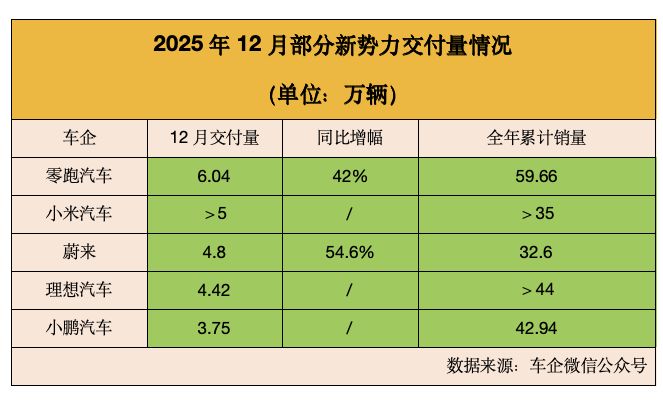
Core Insights - In 2025, several new energy vehicle companies reported significant growth in their delivery numbers, with many achieving record monthly deliveries in December [1][9]. Group 1: Company Performance - Leap Motor delivered approximately 59.66 million vehicles in 2025, marking a year-on-year increase of 103%. In December alone, the company delivered about 6.04 million vehicles, a 42% increase year-on-year [1][2]. - Xiaomi Auto surpassed 50,000 vehicles in December 2025 for the first time, with total deliveries exceeding 350,000 for the year, achieving a significant milestone [2]. - NIO reported a December delivery of over 48,000 vehicles, a 54.6% increase year-on-year, contributing to a total of approximately 326,000 vehicles delivered in 2025, a 46.9% increase [3][5]. - Li Auto delivered about 44,000 vehicles in 2025, with December deliveries reaching approximately 44,300 vehicles [5]. - Xpeng Motors achieved a total of approximately 429,400 vehicles delivered in 2025, reflecting a 126% year-on-year growth [5]. Group 2: Market Trends - The overall passenger vehicle market in China saw a decline in December 2025, with retail sales dropping by 17% year-on-year to approximately 1.928 million vehicles [9]. - Despite the decline in the overall market, the new energy vehicle sector showed resilience, with many brands reporting record monthly deliveries [9]. - The absence of the typical year-end "tail effect" in the market is expected to lead to a positive start for 2026, with forecasts indicating growth in the first quarter [9].


蔚来12月交付超4.8万台!小鹏交付超3.7万台,零跑同比增长42%!雷军宣布:小米YU7全系推出3年0息购车活动
Mei Ri Jing Ji Xin Wen· 2026-01-01 10:33
Group 1: NIO Performance - In December 2025, NIO delivered 48,135 vehicles, marking a historical high with a year-on-year increase of 54.6% [1] - For the entire year of 2025, NIO delivered a total of 326,028 vehicles, also a historical high, with a year-on-year growth of 46.9% [1] Group 2: XPeng Performance - XPeng reported cumulative deliveries of 429,445 vehicles for the year 2025, achieving a year-on-year growth of 126% [3] - In December 2025, XPeng delivered 37,508 vehicles, showing both month-on-month and year-on-year growth [3] Group 3: Li Auto Performance - Li Auto delivered 44,246 vehicles in December 2025, bringing the cumulative total to 1,540,215 vehicles by the end of the year [4] Group 4: Xiaomi Auto Performance - Xiaomi Auto exceeded 50,000 vehicle deliveries in December 2025 [5] - Xiaomi's CEO announced a promotional financing plan for the YU7 model, which has already surpassed 150,000 deliveries in six months, 2.3 times the deliveries of the SU7 during the same period [7] Group 5: Leap Motor Performance - Leap Motor delivered 60,423 vehicles in December 2025, reflecting a year-on-year increase of 42% [7] - The total deliveries for Leap Motor in 2025 reached 596,555 vehicles, with a year-on-year growth of 103% [7] Group 6: Hongmeng Zhixing Performance - Hongmeng Zhixing reported total deliveries of 589,107 vehicles for the year 2025, with a year-on-year growth of 32% [8] - In December 2025, the company delivered 89,611 vehicles, achieving a historical monthly delivery high for three consecutive months [8] Group 7: Zeekr Performance - Zeekr announced December 2025 deliveries of 30,267 vehicles, with a year-on-year increase of 11.3% and a month-on-month increase of 4.9% [11] - The cumulative sales for Zeekr exceeded 224,000 vehicles [11]

问界/极氪/岚图/智己2025年交付率出炉,多家创新高
Ju Chao Zi Xun· 2026-01-01 10:19
Group 1 - Multiple automotive brands reported strong market performance for December 2025, with several brands achieving significant sales growth and milestones [2] - Zeekr delivered 30,267 vehicles in December 2025, marking the first time monthly deliveries exceeded 30,000, with total sales surpassing 224,000 units for the year [2] - Lantu Automotive delivered 150,169 new vehicles in 2025, a year-on-year increase of 87%, and expanded its distribution network by adding 11 new stores and 4 user centers in December [2] - Aion BU achieved a record monthly sales of 40,066 vehicles in December 2025, with the i60 model selling over 10,000 units in its first month [2] - SAIC Passenger Cars reported total retail sales of 919,000 vehicles in 2025, a year-on-year growth of over 12%, with a 22% increase in new energy vehicle sales [2] - Aito announced cumulative deliveries of over 970,000 vehicles, with more than 420,000 units delivered in 2025, including significant contributions from models M9, M8, M7, and M5 [2] Group 2 - Zhiji Auto achieved total sales of 81,017 units in 2025, marking a historical high for the brand with four consecutive months of sales exceeding 10,000 units [3]
小米回应YU7配置调整:下架不影响维修;上汽大众今年将投放7款全新车型丨汽车交通日报
创业邦· 2026-01-01 10:18
Group 1 - SAIC Volkswagen plans to launch 7 new energy models by 2026, covering pure electric, hybrid, and range-extended power forms, with a target of over 1 million annual sales in 2025 [2] - Several new energy vehicle manufacturers have reported their delivery data for December 2025 and the entire year, with Li Auto delivering 44,246 vehicles in December and a total of 1,540,215 vehicles cumulatively [2] - NIO achieved a record high of 326,028 vehicle deliveries in 2025, marking a year-on-year growth of 46.9% [2] Group 2 - Xiaomi responded to configuration adjustments for the YU7 model, stating that the changes are aimed at optimizing production processes and improving delivery efficiency, ensuring that after-sales service will not be affected [3] - Kia China announced a nationwide fixed price for the K3 and 2026 model of the Yipao, with the Yipao priced at 55,900 yuan and the K3 at 69,900 yuan [4]

极氪12月交付30267辆,同比增长11.3%
Feng Huang Wang· 2026-01-01 08:29
据官方介绍,2025年极氪累计销量已超22.4万辆。 凤凰网科技讯1月1日,极氪官方宣布2025年12月极氪交付30267台,同比增长11.3%,环比增长4.9%, 单月交付首破3万大关,创历史新高。其中,极氪9X月交付突破1万辆。 ...

造车新势力2025年12月及全年交付“成绩单”一览
Xin Lang Cai Jing· 2026-01-01 08:29
Summary of Key Points Group 1: Delivery Data - Li Auto delivered 44,246 vehicles in December, with a total of 109,194 vehicles delivered in Q4 2025, bringing cumulative deliveries to 1,540,215 vehicles by December 31, 2025 [1] - NIO delivered 48,135 vehicles in December, a year-on-year increase of 54.6%, with Q4 deliveries totaling 124,807 vehicles, up 71.7%. The total annual deliveries reached 326,028 vehicles, marking a historical high with a 46.9% increase [1] - Xpeng Motors delivered 37,508 vehicles in December, a 2% year-on-year increase, and a total of 429,445 vehicles for the year, reflecting a 126% growth [1] - Xiaomi Auto exceeded 50,000 vehicle deliveries in December [1] - Leap Motor delivered 60,423 vehicles in December, a 42% increase, with total annual deliveries of 596,555 vehicles, up 103% [1] - Zeekr delivered 30,267 vehicles in December, a historical high with an 11.3% year-on-year increase, totaling 224,133 vehicles for the year [1] - Lantu Auto achieved total deliveries of 150,169 vehicles for the year, marking a 87% year-on-year increase [1] - Hongmeng Zhixing delivered 589,107 vehicles for the year, a 32% increase, with December deliveries reaching 89,611 vehicles, setting a new monthly record for three consecutive months [1] - Seres delivered over 57,000 vehicles in December, setting a new monthly record, with total annual deliveries exceeding 420,000 vehicles [1] - IM Motors achieved annual sales of 81,017 vehicles, marking a new historical high [1] - GAC Aion's Haobo Aion BU reached 40,066 vehicle sales in December, a new high, with the i60 model exceeding 10,000 sales in its first month [1]


2025年12月极氪交付30267台
Zheng Quan Shi Bao Wang· 2026-01-01 07:50
人民财讯1月1日电,2025年12月极氪品牌交付30267台,创历史新高,同比增长11.3%,环比增长 4.9%,极氪9X月交付突破10000台。2025年极氪累计销量超22.4万台。 ...
车市寒冬迎新政“强心针”,2026年前景如何?
Guo Ji Jin Rong Bao· 2025-12-31 16:09
Core Viewpoint - The Chinese automotive market is experiencing a downturn as the year ends, with many companies facing challenges in sales and inventory management due to policy changes and consumer hesitation [1][6][15]. Group 1: Market Conditions - The automotive market is described as facing a "cold winter," with sales personnel frequently using the term to describe current conditions [1][5]. - Sales data indicates a significant decline in orders, with some brands reporting a drop from approximately 20 orders to around 10 in a month [9]. - The overall market sentiment is cautious, with many consumers waiting for clearer policy guidelines for 2026 before making purchasing decisions [6][7]. Group 2: Policy Impact - The Ministry of Finance and other departments released the implementation details for the 2026 vehicle trade-in subsidy, which is expected to provide a boost to the market [2][16]. - The new subsidy structure includes up to 20,000 yuan for electric vehicles and 15,000 yuan for fuel vehicles, aimed at encouraging consumer purchases [16]. - The discontinuation of previous trade-in subsidies has led to a decline in consumer demand, contributing to the current market slowdown [15]. Group 3: Sales Trends - Retail sales in the first three weeks of December showed a decline of approximately 19% year-on-year, with wholesale sales down by about 23% [14]. - The new energy vehicle segment also faced challenges, with retail sales only increasing by 1% year-on-year, while wholesale sales decreased by 10% [14]. - The disappearance of the "tail effect" typically seen at year-end is attributed to policy changes and consumer uncertainty regarding future incentives [15]. Group 4: Future Outlook - Industry experts predict that the overall growth rate for the automotive market in 2026 will exceed zero growth, with expectations for a strong start in January [16]. - Companies are focusing on inventory clearance and promotional strategies to stabilize sales channels as they await further policy developments [12].
2025年即将结束,在新能源品牌的你过得还好吗?
车fans· 2025-12-31 00:30
Core Viewpoint - The market share of new energy vehicles (NEVs) is expected to increase further in 2025, with intensified competition driven by price wars, flagship product launches, and the introduction of L3 autonomous driving testing by the end of the year [1] Group 1: Sales Performance - Monthly average sales are around 40-50 units, totaling approximately 550 units for the year, with the best-selling model being the AITO M8, which accounted for about 25% of total sales [2] - The YU7 model has seen explosive sales, maintaining its price without discounts, while the YU7 Max is recognized for its comfort and driving experience [5][6] - The M03 model continues to be the best seller, with promotional activities boosting sales, and the P7+ is highlighted for its technological advancements and spacious design [10][11] Group 2: Market Outlook - There is optimism for the NEV market in 2025, with expectations of increased market share and regulatory support for luxury brands [3] - Despite a decline in sales compared to the previous year, brands like L6 and i6 have accumulated significant orders, indicating a potential rebound [8] - Concerns about the NEV market's sustainability are emerging, with some sales personnel expressing skepticism about future growth due to subsidy reductions and increased competition [13][17] Group 3: Product Development - The introduction of new models such as the AITO M7 and the upcoming MPV products is anticipated to enhance product competitiveness [3] - The i6 model has gained traction with a significant number of pre-orders, reflecting consumer interest despite overall sales challenges [8] - The focus on product strength and technological improvements, particularly in intelligent driving capabilities, is seen as crucial for attracting customers [11]
2025汽车行业年鉴 | 新技术篇:故事是开局,商业化才是终点
Jing Ji Guan Cha Wang· 2025-12-30 11:01
Group 1: Industry Overview - The Chinese automotive industry is at a pivotal moment, with significant advancements in technology expected by 2025, including solid-state batteries and new charging methods [2] - The competition among companies is shifting from storytelling to the robustness of their technological systems, with a focus on market scale, cost control, and user reputation [2] Group 2: Battery Technology - By 2025, solid-state batteries are on the verge of mass production, while semi-solid batteries are already being used in high-end models, with brands like NIO and Zhiji promoting these technologies [3] - Traditional liquid battery manufacturers are adopting a dual strategy, investing heavily in solid-state battery research while maintaining their market position with innovative liquid battery designs [3] - Startups in the solid-state battery space are leveraging venture capital to bypass traditional patents and seek partnerships with second-tier automakers [3] Group 3: Charging Solutions - The competition between fast charging and battery swapping is intensifying, with new models featuring 800V high-voltage platforms enhancing fast charging capabilities [4] - Companies are focusing on user experience and profitability in their charging networks, with Tesla and NIO expanding their proprietary networks while third-party operators form alliances [4] - The battery swapping model is gaining traction through partnerships with major automakers, although it faces challenges related to high fixed asset investments and operational complexities [5] Group 4: Driving Technologies - Range-extended electric vehicles are experiencing rapid growth, appealing to family buyers and mid-to-high-end SUV consumers [6] - There are concerns about the long-term impact of range-extended vehicles on the industry, particularly regarding resource allocation for pure electric vehicle development [7] - The introduction of steer-by-wire systems is set to revolutionize vehicle control, enhancing the potential for advanced driver-assistance systems and future autonomous driving [7] Group 5: Future Trends - The industry is expected to move towards a more integrated approach, balancing various technologies rather than focusing on a single solution [8] - By 2026, solid-state batteries may begin to see limited commercial deployment, primarily in high-end models, serving as a proof of concept rather than a mass-market solution [8] - Companies are likely to adopt mixed charging and swapping strategies based on user needs, optimizing their offerings for different market segments [8] - The distinction between high-end range-extended and plug-in hybrid vehicles is blurring, with market success determined by the ability to provide a seamless user experience [9]